July 6, 2026
24/7 Dental Receptionist Benefits for Practice Owners

A 24/7 dental receptionist is defined as a continuous patient communication and scheduling service that keeps your practice reachable every hour of every day, including nights, weekends, and holidays. The 24/7 dental receptionist benefits go well beyond simple call answering. They include after-hours booking, automated follow-ups, emergency call routing, and real-time scheduling integration. Dental front desk salaries average $37,000–$46,000 annually in 2026, and that figure climbs significantly once you add taxes, benefits, and paid time off. For practice owners managing tight margins and high patient expectations, round-the-clock receptionist support is no longer a luxury. It is a measurable operational advantage.
1. How 24/7 dental receptionist benefits improve patient experience
Patients do not schedule dental appointments only between 9:00 AM and 5:00 PM. A large share of booking decisions happen in the evening, on weekends, or immediately after a patient experiences tooth pain. A practice that cannot answer those moments loses the appointment entirely.
24/7 virtual dental receptionists provide instant responses, after-hours booking, emergency call routing, and automatic scheduling integration. Each of these features addresses a specific failure point in the traditional front desk model. A patient who calls at 9:00 PM with a toothache and reaches a live or AI-powered voice is far more likely to book than one who reaches voicemail.

Automated appointment confirmations and reminders also reduce no-shows directly. Practices with 24/7 receptionist services benefit from reduced no-shows and follow-up lapses, which directly increase patient retention and revenue. That is not a soft benefit. Fewer empty chairs mean more predictable monthly income.
The patient experience improvement also shows up in reviews. When patients feel heard and responded to quickly, they leave better feedback. Better reviews attract new patients, which compounds the growth effect over time.
2. What the real cost of an in-house receptionist looks like
Most practice owners underestimate what a full-time front desk employee actually costs. The base salary is only the starting point.
In-house dental receptionist salaries range from $38,000 to $50,000 annually. On top of that, the burden rate, which includes payroll taxes, health insurance, PTO, and training, adds 20–35% to the total. That means a $42,000 salary can realistically cost the practice $54,000 or more per year. And that figure covers only standard business hours.
By contrast, 24/7 virtual or AI receptionist services cost between $200 and $800 per month. That is a fixed, predictable expense with no sick days, no turnover costs, and no training cycles. For a solo practice or a small group, the math is difficult to ignore.
Pro Tip: Calculate your true in-house receptionist cost by multiplying the base salary by 1.30. That number is your real annual expense before you account for overtime or temporary coverage during vacations.
The financial case for virtual reception is strongest for practices that currently pay overtime to cover phones or rely on a single front desk employee. One absence can create a cascade of missed calls and scheduling gaps that costs far more than a monthly service fee.
3. How 24/7 support reduces staff burnout and improves retention
Front desk employees in dental offices face a specific and underappreciated pressure. They handle phones, greet patients, process insurance, and manage scheduling simultaneously. When the practice closes on Friday, the calls do not stop. Monday morning often begins with a backlog of weekend voicemails, missed texts, and unanswered online inquiries.
“Practices lacking 24/7 communication channels risk higher staff turnover and weekend backlog burnout. The front desk team arrives Monday already behind, and that stress compounds throughout the week.” Insight from HR for Health on dental front desk staffing
That backlog is not just an inconvenience. It is a documented driver of burnout. Failure to offer 24/7 communication channels leads to staff burnout as employees try to process weekend missed messages during already-busy Monday hours.
The solution is not to hire more staff. It is to remove the after-hours burden entirely. When a 24/7 service handles weekend calls, Monday morning starts clean. The human receptionist can focus on the patients in front of them rather than triaging a pile of missed messages.
Flexible work arrangements and comprehensive benefits improve retention for dental front desk staff, and 24/7 services help meet these demands by sharing the workload. A receptionist who does not feel overwhelmed is more engaged, more accurate, and more likely to stay.
4. The operational advantages of virtual receptionist services
Beyond cost and burnout, virtual receptionists change how a practice runs day to day. The operational advantages are concrete and measurable.
Dental receptionists perform multifaceted roles including scheduling, billing, insurance verification, and patient communication. A virtual service can handle the transactional layer of these tasks, freeing your in-office team for the relational work that actually requires a human presence.
Real-time scheduling integration is the most immediate operational win. When a patient books at 11:00 PM, the appointment appears in your practice management software immediately. No double-booking. No manual entry the next morning. The schedule is accurate before the office opens.
Multi-channel communication support, covering calls, SMS, and chat, also matters. Patients communicate differently. Older patients may prefer a phone call. Younger patients often prefer text or chat. A 24/7 service that handles all three channels captures more bookings than one that handles only calls.
Insurance verification and billing assistance add another layer of efficiency. When a virtual receptionist collects insurance information during the booking call, your clinical team spends less time on administrative prep before each appointment.
5. Key features that drive practice growth and patient retention
Not all 24/7 receptionist services deliver the same results. The features that most directly drive growth are specific, and practice owners should evaluate services against this list.
Key features driving practice growth include real-time scheduling integration, multi-channel patient communication, automated follow-ups, and review management automation. Each feature addresses a different stage of the patient relationship.
- Automated appointment reminders. Reminders sent via text or email 48 hours and 24 hours before an appointment reduce no-shows without requiring staff time.
- After-hours booking. Patients who call outside office hours can book immediately rather than waiting until the next business day, which reduces the chance they call another practice.
- Emergency call routing. Urgent calls reach the on-call provider directly. Non-urgent calls are logged and scheduled. This protects provider time while ensuring patient safety.
- Review request automation. After a completed appointment, an automated message asks the patient to leave a review. This builds your online reputation without any manual effort from staff.
- Bilingual support. For practices serving Spanish-speaking patients, a receptionist fluent in both English and Spanish captures appointments that would otherwise be lost to a language barrier.
Pro Tip: Ask any 24/7 receptionist service whether their scheduling integration is bidirectional. One-way sync creates gaps. Bidirectional sync means cancellations and reschedules update in real time on both ends.
6. In-house vs. virtual reception: what each model covers
The decision between in-house and virtual reception is not binary. Many practices use both. The question is which tasks belong to each model.
| Feature category | In-house receptionist | 24/7 virtual or AI receptionist |
|---|---|---|
| Hours of coverage | Business hours only | 24 hours a day, 7 days a week |
| Annual cost range | $46,000–$68,000 (with burden rate) | $2,400–$9,600 per year |
| After-hours booking | Not available | Available |
| Multilingual support | Depends on individual hire | Available with bilingual services |
| Scheduling integration | Manual entry | Real-time, automated |
| Scalability | Requires additional hires | Scales without added cost |
| Sick day coverage | Requires backup plan | Uninterrupted |
The table above shows why practices with growth goals increasingly treat virtual reception as the foundation and in-house staff as the relationship layer. Successful integration of 24/7 AI receptionist service requires well-defined workflows so human staff focus on high-value patient interactions while automation handles transactional efficiency.
Key takeaways
A 24/7 dental receptionist service reduces costs, prevents missed bookings, and protects staff well-being simultaneously, making it the most efficient front desk investment available to practice owners today.
| Point | Details |
|---|---|
| Real cost of in-house staff | Base salary plus a 20–35% burden rate means a $42,000 hire costs over $54,000 annually. |
| Virtual service pricing | 24/7 AI or virtual receptionist services run $200–$800 per month with no variable costs. |
| Burnout prevention | Removing the weekend call backlog lets in-office staff start Monday focused, not behind. |
| Growth features that matter | Real-time scheduling, automated reminders, and bilingual support drive measurable retention gains. |
| Best integration model | Use virtual reception for transactional tasks and in-house staff for high-value patient relationships. |
What I’ve learned about 24/7 automation in dental offices
The practices that get the most from 24/7 receptionist services are not the ones that use it to cut staff. They are the ones that use it to protect their staff.
I have seen offices where the front desk team was talented and committed but completely buried. They were answering phones while checking patients in, processing insurance while managing a full waiting room. The quality of every task suffered because the volume was too high for the hours available. Adding a 24/7 service did not eliminate those jobs. It removed the after-hours pressure that was quietly draining the team’s energy every week.
The technology works best when the workflows are defined clearly before launch. Decide which calls the AI handles, which go to voicemail for human follow-up, and which route directly to the on-call provider. Without that structure, the service creates confusion rather than clarity.
The future of dental reception is not fully automated. It is a division of labor where machines handle speed and availability, and humans handle empathy and complexity. Practices that understand that distinction will build stronger teams and more loyal patient bases than those chasing full automation.
— Francisco
Diazluna’s bilingual front desk for dental practices
Dental practices serving Hispanic patients face a specific gap that standard 24/7 services do not fill. A patient who speaks Spanish as their primary language and reaches an English-only receptionist often hangs up and calls elsewhere.
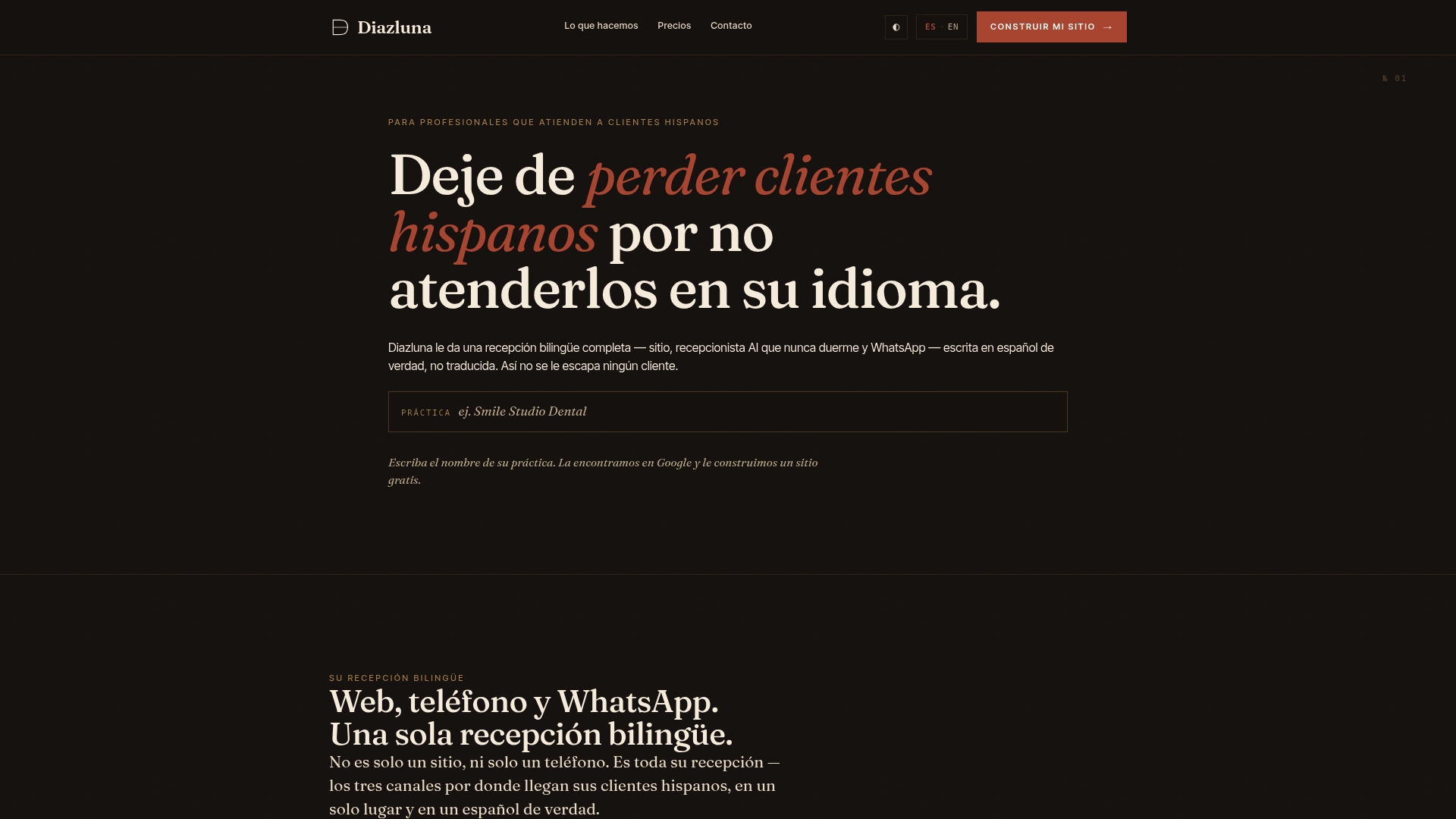
Diazluna solves this with a bilingual front desk service built specifically for dental practices. The platform combines a 24/7 AI receptionist fluent in both English and Spanish, WhatsApp integration for patients who prefer messaging, and a fully optimized bilingual website. All three components work together so no Spanish-speaking patient is lost to a language barrier. Diazluna delivers this at a fraction of the cost of traditional agency services, with Google indexing reported within 24 hours of launch. For practices ready to stop losing Hispanic patients to communication gaps, Diazluna’s dental solution is the direct answer.
FAQ
What are the main 24/7 dental receptionist benefits?
The core benefits include after-hours booking, reduced no-shows through automated reminders, emergency call routing, and lower staffing costs compared to full-time in-house employees.
How much does a 24/7 virtual dental receptionist cost?
Virtual and AI receptionist services typically cost between $200 and $800 per month, compared to $46,000 or more annually for an in-house receptionist when you include taxes and benefits.
Does a 24/7 receptionist service replace in-office staff?
No. The most effective model uses virtual reception for transactional tasks like after-hours booking and reminders, while in-office staff focus on patient relationships and clinical support.
How does 24/7 dental support reduce staff burnout?
By handling weekend and after-hours calls automatically, a 24/7 service eliminates the Monday morning backlog that drives front desk burnout and contributes to high turnover in dental offices.
What should I look for in a 24/7 dental receptionist service?
Prioritize real-time scheduling integration, multilingual support, multi-channel communication (calls, SMS, chat), and bidirectional sync with your practice management software.