July 2, 2026
What a Bilingual Business Website Means for Growth

A bilingual business website is a digital platform that delivers all content, navigation, calls to action, and legal notices in two languages at native quality. This is not a translation widget bolted onto an existing site. The industry term is “multilingual localization,” and understanding what bilingual business website means is the difference between reaching a new market and losing it entirely. Businesses with multilingual sites see a 2.3x increase in overseas user dwell time and a 41% drop in bounce rates compared to single-language sites. For professionals serving Hispanic clients in dentistry, law, or healthcare, that gap is not a statistic. It is a waiting room that is either full or empty.
What does a bilingual business website actually include?
A true bilingual site goes far beyond swapping words from one language to another. Every element a visitor touches must exist in both languages at the same quality level. That means navigation menus, meta titles, meta descriptions, image alt text, footer disclaimers, and every call to action, but if your “Schedule a Consultation” button is in English but your Spanish-speaking client never sees it translated, you have not built a bilingual site. You have built half of one.

Localization involves adapting currencies, date formats, images, legal disclaimers, and tone for the target market. A dental practice serving a Spanish-speaking community in Miami needs different imagery and phrasing than one serving clients in Chicago. The cultural context changes the message even when the words are technically correct.
The most common pitfalls professionals encounter include:
- Partial translation: Only the homepage or service pages are translated, leaving contact forms, blog posts, and legal pages in English only.
- Tone mismatch: A direct English call to action translated word for word often sounds cold or confusing in Spanish. Market-specific messaging outperforms direct translation consistently.
- Broken language switchers: A switcher that resets to the homepage instead of the equivalent page in the other language destroys the user experience immediately.
- Auto-translation widgets: Automated translation plugins negatively affect SEO and user experience. They produce errors that undermine professional credibility.
Pro Tip: Test your language switcher on mobile. Most switcher failures happen on small screens, and mobile is where the majority of Spanish-speaking users first encounter your site.
What are the technical SEO requirements for bilingual sites?
The technical foundation of a bilingual site determines whether search engines find it and whether users trust it. Getting this wrong means Google may index only one language version or penalize the site for duplicate content.
The four technical priorities are:
- Subdirectory URL structure. Use
yoursite.com/es/for Spanish andyoursite.com/en/for English. Subdirectories consolidate domain authority better than subdomains (es.yoursite.com) or separate domains (yoursite.es). SEO guidelines for multilingual sites consistently recommend subdirectories as the most reliable structure for small and mid-size businesses. - Hreflang tags. These HTML tags tell search engines which language version to serve to which user. A Spanish-speaking user in Texas should see the Spanish version in search results. Without hreflang, Google guesses, and it often guesses wrong.
- Multilingual XML sitemaps. Your sitemap must list every URL in every language. This accelerates indexing and confirms to search engines that both versions are intentional and complete.
- Professionally reviewed content. Automated translation creates duplicate content signals that can suppress rankings. Human-reviewed localization avoids this entirely.
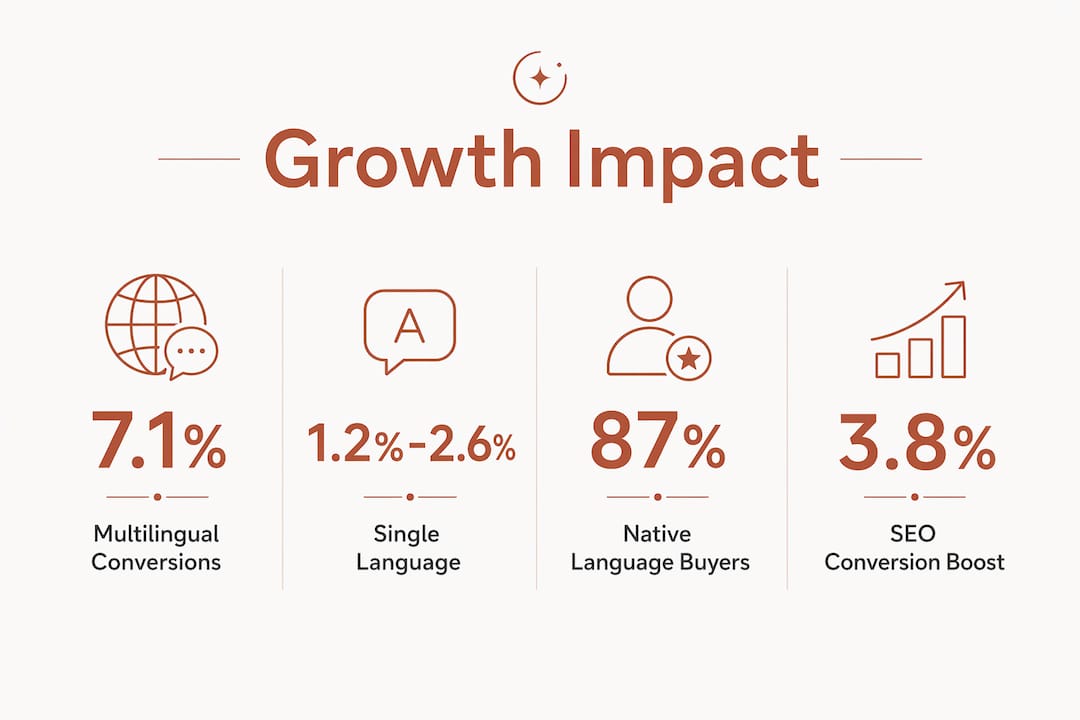
The conversion data makes the technical investment obvious. Multilingual websites achieve conversion rates between 3.8% and 7.1%, while single-language sites typically convert at 1.2%–2.6%. That gap reflects the direct revenue impact of speaking your client’s language correctly.
| Technical Element | Purpose | Risk if Skipped |
|---|---|---|
| Subdirectory URL structure | Consolidates SEO authority | Split authority, weaker rankings |
| Hreflang tags | Directs correct language to correct user | Wrong version shown in search results |
| Multilingual XML sitemap | Ensures full indexing of both versions | Pages missed or slow to index |
| Human-reviewed translation | Protects quality and credibility | Duplicate content penalties, lost trust |
How does a bilingual website build professional trust?
Language familiarity is one of the fastest trust signals a professional can send. A client who finds your law firm’s website in Spanish does not just feel welcomed. They conclude that your practice understands their community and is prepared to serve them properly.
“A bilingual website signals professionalism especially in B2B and professional services markets, showing intent for long-term partnerships and increasing client confidence early in the sales funnel.”
This effect is measurable. Bilingual sites build trust and partnership signals that single-language sites cannot replicate. For a dentist or attorney, the first impression happens online before any phone call. A Spanish-speaking client who lands on a fully localized site stays longer, reads more, and is far more likely to book an appointment.
The trust benefits extend beyond the homepage:
- Localized calls to action perform better because they match the client’s expectations and communication style.
- Longer session times result from content that feels native rather than translated. Clients read more when they are not working to decode awkward phrasing.
- Lower abandonment rates on contact forms occur when every field label and instruction is in the client’s language.
87% of overseas consumers refuse to purchase on sites not in their native language. That figure applies directly to professional services. A Spanish-speaking client who cannot navigate your site in Spanish will call the next practice on the list.
How do you plan and launch a bilingual business website?
A phased approach produces better results than trying to translate everything at once. Start with your highest-traffic pages and build from there.
- Audit your analytics first. Identify where Spanish-speaking visitors currently land and where they exit. Data-driven language selection based on actual search demand prevents wasted effort on pages nobody visits.
- Choose localization over translation. Hire a professional who understands both languages and the cultural context of your specific client base. A bilingual professional website for a law firm in Texas requires different phrasing than one for a healthcare practice in California.
- Set up the technical structure before publishing. Configure subdirectories, hreflang tags, and your sitemap before the Spanish version goes live. Fixing these after launch is significantly harder and can cause ranking drops.
- Launch the highest-priority pages first. Your homepage, services pages, and contact page should go live in both languages simultaneously. Blog posts and secondary pages can follow in phases.
- Monitor and update continuously. Localization is a continuous process. Companies that treat their bilingual site as a one-time project lose ground to those who update both language versions on the same schedule.
Pro Tip: Set a calendar reminder to audit both language versions every 90 days. Check for pages that exist in English but have no Spanish equivalent. These gaps are where potential clients fall through.
Diazluna’s approach to bilingual website solutions for professional practices includes Google indexing within 24 hours of launch, which means the Spanish-language version of your site starts working immediately rather than waiting weeks for search engines to discover it.
Key Takeaways
A bilingual business website requires full localization in both languages, proper technical SEO structure, and continuous updates to deliver real business results.
| Point | Details |
|---|---|
| Full localization, not translation | Every page element, including metadata and legal notices, must exist in both languages at native quality. |
| Technical SEO is non-negotiable | Subdirectory URLs, hreflang tags, and multilingual sitemaps prevent duplicate content penalties and indexing failures. |
| Trust drives conversion | Clients served in their native language stay longer, convert at higher rates, and are more likely to return. |
| Data guides language selection | Use analytics to identify which language your actual visitors speak before committing resources to localization. |
| Localization never stops | Treat both language versions as living assets that require the same update schedule and quality review. |
What I have learned about bilingual sites that most guides miss
Most articles about bilingual websites treat the project as a technical checklist. Build the subdirectories, add the hreflang tags, hire a translator, and you are done. That framing misses the most important part.
The professionals I have seen succeed with bilingual sites treat them as a client relationship tool, not a web development task. A Spanish-speaking client who lands on a fully localized dental or legal website does not just find information. They feel recognized. That feeling converts to booked appointments faster than any advertising campaign.
The mistake I see most often is launching a bilingual site and then ignoring the Spanish version for six months while the English version gets updated. Both versions drift apart. The Spanish pages become stale. Clients notice. The trust signal disappears.
The future of bilingual professional websites is not just text in two languages. It is integrated communication, where the website, the phone system, and messaging platforms like WhatsApp all speak the client’s language from the first contact to the final appointment. Professionals who build that full experience now will be significantly harder to compete with in three years. The ones who treat bilingual as a checkbox will keep losing clients to those who do not.
— Francisco
How Diazluna handles bilingual websites for professional practices
Professionals in dentistry, law, and healthcare face a specific problem. They need a bilingual website, a phone system that handles Spanish-speaking callers, and a WhatsApp channel, all working together. Building each piece separately is expensive and creates gaps where clients fall through.
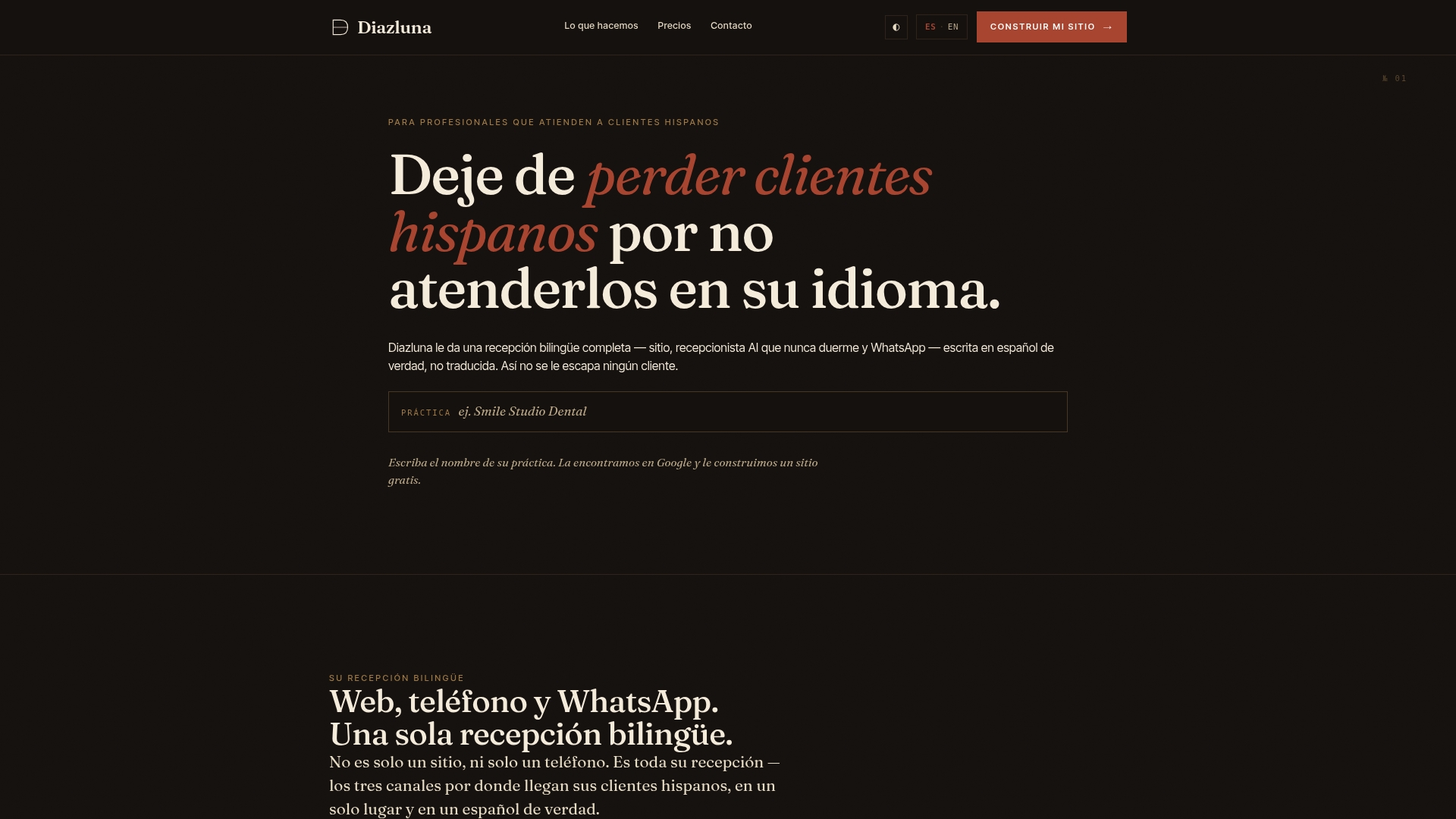
Diazluna delivers all three as a single package: a fully optimized bilingual front desk that includes a professionally built bilingual website, a 24/7 AI receptionist fluent in both English and Spanish, and WhatsApp integration. The website indexes on Google within 24 hours of launch. Attorneys can review the bilingual solution for law firms built specifically for practices with Spanish-speaking clients. No client is lost because of a language barrier at any point in the contact process.
FAQ
What does a bilingual business website mean?
A bilingual business website is a site that provides all content, navigation, and interactions in two languages at native quality. It goes beyond translation to include cultural adaptation of tone, imagery, and calls to action.
How is localization different from translation?
Translation converts words from one language to another. Localization adapts the full user experience, including tone, date formats, legal disclaimers, and imagery, to match the expectations of the target audience.
What URL structure works best for bilingual SEO?
Subdirectory structures such as yoursite.com/es/ are the most recommended approach for small and mid-size businesses. They consolidate domain authority and are easier for search engines to crawl and index correctly.
Do bilingual websites actually improve conversion rates?
Multilingual websites convert at 3.8%–7.1%, compared to 1.2%–2.6% for single-language sites. The difference comes from localized copy and a user experience that matches the client’s language and cultural expectations.
How often should a bilingual website be updated?
Both language versions require updates on the same schedule. Localization is a continuous process, and letting one version fall behind creates trust gaps that reduce engagement and search performance over time.