July 12, 2026
AI Receptionist for Medical Spanish Patients: 2026 Guide

A bilingual AI medical receptionist is defined as an automated voice and text system that detects a caller’s preferred language within seconds and responds in that language without menus or transfers. For medical practices serving Spanish-speaking patients, this technology closes the single largest gap in patient retention: the language barrier at the front desk. AI medical receptionists cost about $0.75 per call versus $3.50 for a human receptionist, while achieving 95% accuracy on medical queries and earning an empathy score of 4.5 out of 5 from clinical evaluators. That cost gap alone makes the business case clear, but the real value is the patient who does not hang up because no one spoke Spanish.
What does an AI receptionist for medical Spanish patients actually do?
The industry term for this technology is “agentic AI receptionist,” and it matters that you use that phrase rather than “chatbot.” A basic chatbot follows a script. An agentic AI system performs complex, multi-step workflows: it verifies patient identity, books appointments, updates electronic health records, and routes urgent calls to clinical staff, all within a single interaction. The distinction is critical because Spanish-speaking patients often have layered needs. They may need to confirm insurance, reschedule a family member, and ask a triage question in the same call.
Bilingual AI receptionists auto-detect caller language within seconds and switch between English and Spanish mid-call without asking the patient to press a number. That frictionless experience matters enormously in healthcare, where a confused or frustrated patient simply hangs up and does not reschedule. The system also handles text channels, including WhatsApp, which is the dominant messaging platform for many Hispanic communities in the United States.

What do you need before implementing a bilingual AI receptionist?
Getting the infrastructure right before launch prevents the most common failure points. Here is what your practice needs in place:
- Phone system compatibility. Agentic AI receptionists integrate with existing phone systems for call routing, so your legacy patient numbers stay intact. No new numbers, no patient confusion.
- EHR integration. The AI must connect to your electronic health record system to read and write appointment data. Confirm your EHR vendor supports API access before selecting a platform.
- HIPAA compliance documentation. HIPAA compliance for AI receptionists requires a signed Business Associate Agreement, identity verification protocols, role-based access control, and continuous audit logging for every interaction involving protected health information.
- Language and empathy design review. The AI’s voice, pacing, and phrasing must be reviewed by a native Spanish speaker with healthcare experience. Generic Spanish translations often miss regional vocabulary that patients from Mexico, Puerto Rico, or Central America use for symptoms.
- Staff workflow adjustment. Your clinical team needs a clear escalation protocol. When the AI flags an urgent call, a human must be reachable within a defined time window.
Pro Tip: Before signing any vendor contract, ask specifically whether their Business Associate Agreement covers AI-generated transcripts and audio logs. Many standard BAAs do not, and that gap creates HIPAA exposure.
How to implement a bilingual AI receptionist step by step
A structured rollout prevents the two most common failures: poor language performance and patient distrust of the technology.
- Select an agentic system, not a single-task bot. Confirm the platform handles identity verification, scheduling, EHR writes, and call escalation in one workflow. Single-task bots require patients to call back for each need, which destroys the experience.
- Map your call routing logic. Define which call types the AI handles fully (scheduling, reminders, directions) and which it escalates immediately (chest pain, pediatric fever, medication emergencies). Build that logic into the system before testing.
- Customize language and voice settings. Set the default to auto-detect, not English-first. Configure the voice for warm tonality and natural conversational pacing. Affective design elements like warm voice tonality significantly increase patient trust and willingness to share health information.
- Run bilingual scenario testing. Test every call type in both languages, including mid-call language switches. A patient who starts in English and shifts to Spanish when describing symptoms must receive a fluid response, not a system reset.
- Pilot with a subset of call volume. Launch with after-hours calls first. That window carries lower clinical risk and gives your team time to review transcripts and catch errors before full deployment.
- Collect patient feedback in both languages. Send a two-question SMS survey after each AI-handled call. Ask whether the patient felt understood and whether their need was resolved. Adjust voice and phrasing settings based on responses.
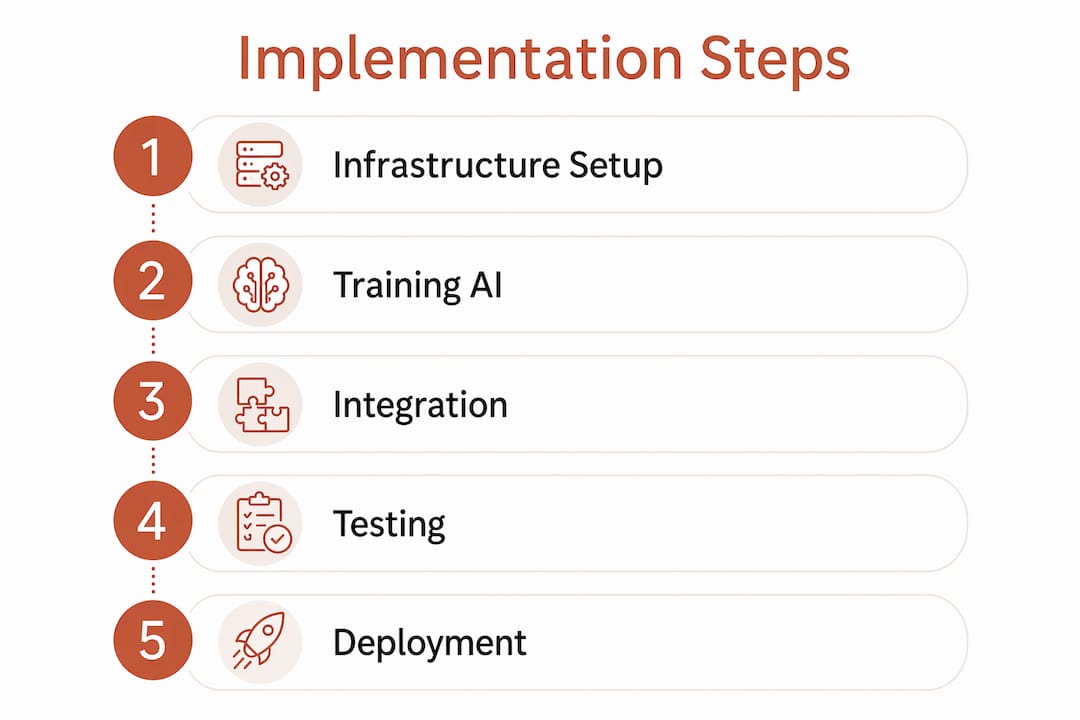
The table below shows the core implementation phases and their primary success metrics.
| Phase | Primary action | Success metric |
|---|---|---|
| Infrastructure setup | EHR and phone integration | Zero dropped data on test calls |
| Language configuration | Auto-detect and voice tuning | Correct language detection on first response |
| Compliance verification | BAA signed, audit logging active | HIPAA checklist complete |
| Pilot launch | After-hours call handling | Patient satisfaction score above 4/5 |
| Full deployment | All call types active | No-show rate and call abandonment rate |
Pro Tip: Record 20 real patient calls in Spanish before configuring the AI. Use those recordings to identify the specific symptom vocabulary and regional expressions your patient population actually uses, then build those phrases into the system’s recognition library.
How does a bilingual AI receptionist build trust with Spanish-speaking patients?
Patient trust is the variable that determines whether an AI receptionist improves outcomes or damages them. Patients provide lower-quality symptom reports to AI unless the system incorporates empathetic, human-like communication to build rapport first. That finding has a direct clinical implication: an AI that sounds cold or robotic will receive incomplete symptom information, which increases triage errors.
The mechanism behind this is called affection expression in the research literature. It refers to the combination of language warmth, voice tone, and conversational pacing that signals to a patient that they are being heard. For Spanish-speaking patients specifically, this includes using culturally familiar terms of address, acknowledging the patient’s concern before asking the next question, and never rushing through a symptom description.
“An AI system outperformed human clinicians on 29 of 32 evaluation axes, including empathy and conversational quality, in telehealth simulations. That result does not mean AI replaces clinical judgment. It means a well-designed AI front desk can match or exceed the communication quality patients receive from human staff.” Advancing conversational diagnostic AI
Three specific features drive engagement quality for Spanish-speaking patients:
- Auto language detection. The system identifies Spanish from the first spoken phrase and responds in kind, with no menu prompts. Patients who hear Spanish immediately are far more likely to complete the interaction.
- Automated bilingual reminders. AI receptionists reduce no-shows by up to 40% through automated appointment confirmations and reminders sent in the patient’s preferred language. That figure represents a measurable revenue and health outcome improvement.
- Urgency triage in Spanish. The system must recognize Spanish-language descriptions of urgent symptoms and escalate correctly. “Me duele el pecho” must trigger the same clinical escalation as “I have chest pain.” Test this scenario explicitly before going live.
Learn more about how AI medical receptionists work in practice, including the technical architecture behind language detection and EHR integration.
What are the most common problems when deploying AI for Spanish patients?
The perception gap is the most underestimated challenge. Patients often assume AI is less empathetic than a human receptionist, and that assumption leads them to withhold symptoms or end the call early. Emphasizing affectionate design in AI can close this gap, but it requires intentional configuration, not default settings.
Other common problems and their fixes:
- Language misdetection on accented English. Some Spanish-speaking patients open in accented English and switch to Spanish mid-call. Configure the system to monitor language throughout the call, not just at the opening phrase.
- Call routing failures during peak hours. Agentic AI integrates with your phone system for overflow routing, but routing rules must be tested under simulated peak load before launch. A routing failure that sends a Spanish-speaking patient to an English-only voicemail is a lost patient.
- HIPAA gaps in transcript storage. HIPAA compliance requires continuous audit logging during all AI interactions involving protected health information. Confirm your vendor stores transcripts in encrypted, access-controlled storage and that your BAA explicitly covers that data.
- No human fallback defined. Every AI-handled call must have a clear path to a human when the patient requests one or when the system detects distress. Build that escalation into the call flow from day one.
Pro Tip: Run a quarterly audit of AI call transcripts in Spanish. Look for calls where patients repeated themselves, asked to speak to a person, or ended the call without completing their request. Those transcripts reveal exactly where the system needs retraining.
Key Takeaways
A bilingual agentic AI receptionist reduces call costs, cuts no-shows, and improves Spanish-speaking patient engagement when configured with empathetic design and full HIPAA compliance from the start.
| Point | Details |
|---|---|
| Cost and accuracy advantage | AI handles calls at $0.75 versus $3.50 for humans, with 95% medical query accuracy. |
| Agentic systems over basic bots | Choose platforms that handle scheduling, identity verification, and EHR integration in one workflow. |
| Empathy design is non-negotiable | Warm voice tone and natural pacing increase patient trust and symptom disclosure quality. |
| HIPAA compliance goes beyond encryption | Require a BAA, audit logging, and identity verification protocols before deployment. |
| Bilingual reminders cut no-shows | Automated Spanish-language appointment reminders reduce no-shows by up to 40%. |
What I have learned from watching clinics get this wrong
I have watched medical practices buy AI receptionist platforms and then spend six months wondering why Spanish-speaking patients still call back to reschedule. The problem is almost never the technology. It is the configuration. Practices set the system to English-first because that is the default, and they never test a single Spanish-language call scenario before going live.
The second mistake is treating HIPAA compliance as a checkbox. Signing a BAA is the beginning, not the end. HIPAA requires identity verification and audit logging throughout every AI interaction involving patient data. I have seen practices pass their initial compliance review and then fail an audit because their AI vendor updated the platform and the logging configuration reset to default.
The insight that most articles skip is this: properly designed AI receptionists reduce administrative burnout by about 60%. That number matters not just for staff retention but for clinical quality. A burned-out front desk team makes scheduling errors and misses urgency cues. An AI that handles routine calls correctly frees your staff to focus on the interactions that actually require human judgment.
My honest advice is to start with after-hours calls in Spanish only. That single use case will teach you more about your patient population’s language patterns and needs than any vendor demo. Use what you learn to configure the full system before you expand. Iterate based on real transcript data, not assumptions.
— Francisco
Diazluna’s bilingual front desk for medical practices
Medical practices serving Spanish-speaking patients need more than a translated phone tree. They need a front desk that speaks Spanish fluently, handles scheduling at 2:00 AM, and never loses a patient to a language barrier.
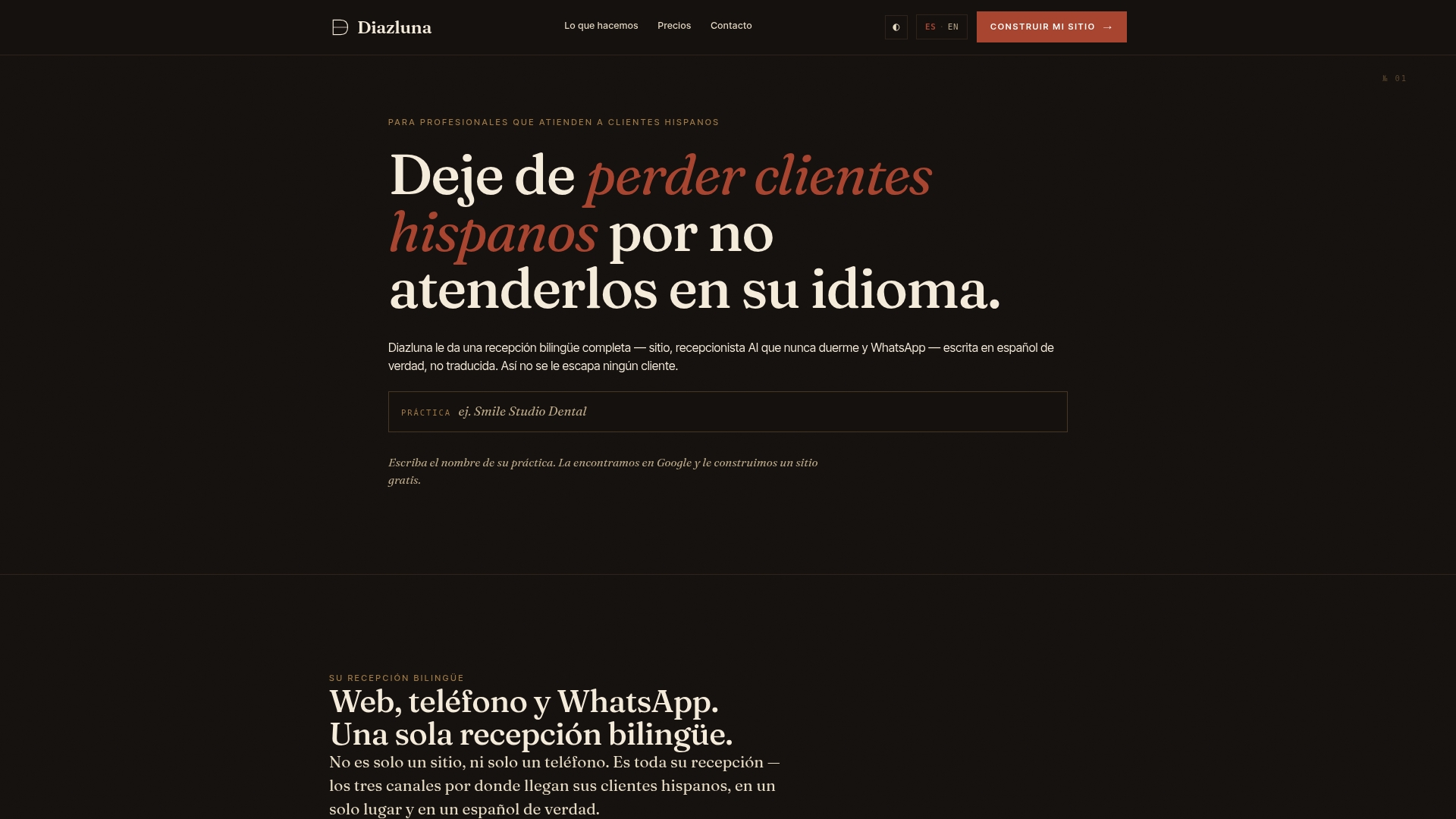
Diazluna delivers a 24/7 bilingual AI receptionist built specifically for healthcare providers, combined with a fully optimized bilingual website and WhatsApp integration. The system integrates with your existing phone number and EHR, so your patients experience no disruption. Diazluna clients report a significant reduction in patient loss due to language barriers, and the platform indexes with Google within 24 hours of launch. If your practice serves Hispanic patients and your front desk is not bilingual around the clock, that gap is costing you patients every day.
FAQ
What is a bilingual AI medical receptionist?
A bilingual AI medical receptionist is an automated system that detects whether a caller speaks English or Spanish and responds in that language without menus or transfers. It handles scheduling, reminders, and triage routing in both languages.
How accurate are AI receptionists for medical queries in Spanish?
AI medical receptionists achieve 95% accuracy on medical queries and have outperformed human clinicians on 29 of 32 communication metrics in telehealth simulations, including empathy and conversational quality.
What HIPAA requirements apply to AI receptionists?
HIPAA requires a signed Business Associate Agreement, identity verification protocols, role-based access control, and continuous audit logging for every AI interaction involving protected health information.
How do bilingual AI receptionists reduce no-shows?
They send automated appointment confirmations and reminders in the patient’s preferred language. This approach reduces no-shows by up to 40% compared to practices without automated bilingual reminders.
How does an AI receptionist detect Spanish without a menu prompt?
The system analyzes the caller’s first spoken phrase and identifies the language within seconds. It then responds in that language for the entire call and adjusts if the patient switches languages mid-conversation.