July 7, 2026
Authentic Bilingual Service Explained for Professionals

Authentic bilingual service is defined as the consistent delivery of high-quality client engagement in both English and Spanish, across every communication channel, with no reduction in quality, tone, or accuracy based on language. This is the industry standard term for what many professionals loosely call “bilingual support,” and the distinction matters. The United States has 42 million Spanish speakers at home, with 4 in 10 having limited English proficiency. That scale means language access is not a courtesy. It is an operational requirement. Professionals in dentistry, law, and healthcare who understand what is authentic bilingual service explained correctly will retain more clients, build stronger trust, and avoid the costly errors that come from treating bilingual communication as an afterthought.
How does authentic bilingual service differ from basic translation?
Authentic bilingual service is not translation. Translation converts words from one language to another. Authentic bilingual service goes beyond word-for-word conversion to deliver an identical client experience in both languages, including tone, empathy, procedural accuracy, and brand consistency.
The most common failure professionals make is treating bilingual support as a language task rather than an operational one. A front desk coordinator who speaks conversational Spanish but does not know dental billing codes, legal intake procedures, or healthcare consent terminology cannot deliver authentic service. The words may be Spanish, but the experience breaks down the moment complexity enters the conversation.
Machine translation tools compound this problem. Automated word substitution misses cultural nuance, urgency, and the domain-specific phrasing that clients in professional settings expect. A Spanish-speaking patient asking about a root canal procedure or a client asking about a retainer agreement needs more than a translated sentence. They need a response that reflects cultural context and procedural knowledge specific to the field.
The bilingual service definition that holds up in practice has three layers:
- Linguistic accuracy: Fluent, natural-sounding communication in the client’s preferred language, not translated English.
- Cultural competence: Understanding of norms, expectations, and communication styles within Hispanic communities.
- Operational integration: Language capability embedded into scheduling, billing, intake, and follow-up workflows, not bolted on as a separate step.
Pro Tip: Test your current bilingual setup by having a fluent Spanish speaker call your office with a complex question, such as a billing dispute or a procedural inquiry. The quality of that interaction reveals whether you have authentic service or just a language workaround.
What are the key components of authentic bilingual service?
Authentic bilingual service in professional sectors rests on four operational pillars. Each one must function consistently for the service to hold up under real client pressure.
1. Immediate language detection
The first seconds of an interaction determine whether a Spanish-speaking client stays or hangs up. Modern bilingual solutions use AI to detect the caller’s language immediately and route them to a fluent agent or system without delay. A client who has to press a number, wait on hold, or repeat themselves in English has already experienced a failure of authentic service.
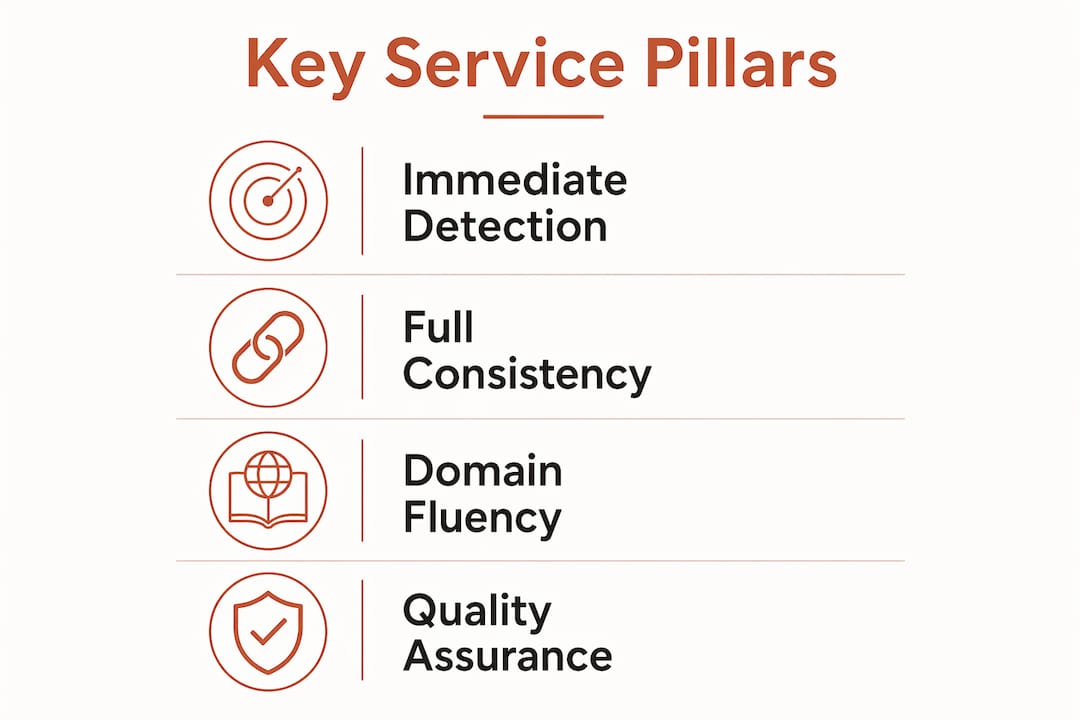
2. Full-channel consistency
Authentic bilingual support covers every channel your clients use: phone, text, email, chat, and WhatsApp. A client who receives fluent Spanish support by phone but gets an English-only email confirmation has not received consistent service. Maintaining brand tone and client experience equivalently across languages and channels is a non-negotiable standard.

3. Domain-specific fluency
Agents and AI systems must know the terminology of your field. In dentistry, that means procedure names, insurance terms, and appointment protocols. In law, it means intake language, case status updates, and confidentiality standards. In healthcare, it means symptom descriptions, referral processes, and consent procedures. Bilingual agents must understand domain-specific nuances to prevent misunderstandings that cost you clients.
4. Quality assurance and continuous improvement
Authentic service requires ongoing measurement. Call recordings, client satisfaction scores, and regular audits of bilingual interactions identify gaps before they become patterns. Training must cover tone and empathy, not just vocabulary.
Pro Tip: Build a short bilingual quality checklist for your front desk. Include items like: Did the agent respond in the client’s preferred language without prompting? Did they use correct terminology? Did the interaction resolve in one contact?
What types of bilingual services exist, and how do you choose?
Three primary models deliver bilingual service in professional sectors. Each has a different cost profile, capability ceiling, and integration depth.
| Model | Best for | Key limitation |
|---|---|---|
| Human bilingual agents (in-house) | High-volume, complex interactions | Expensive, limited to business hours |
| Outsourced bilingual call centers | Mid-volume practices needing 24/7 coverage | Variable quality, less brand alignment |
| AI-driven bilingual receptionists | 24/7 coverage with consistent quality | Requires strong AI training on domain knowledge |
| Hybrid (AI + human escalation) | Best balance of cost and quality | Requires careful workflow design |
Human in-house agents offer the deepest brand alignment but come with the highest cost and the hardest coverage gaps to fill. After hours, weekends, and high-call-volume periods expose the limits of a purely human model. A Spanish-speaking client who calls a dental office at 7:00 PM and reaches voicemail has effectively been turned away.
Outsourced bilingual call centers solve the coverage problem but introduce quality variability. Choosing integrated partners over freelancers or ad-hoc arrangements is the standard recommendation for high-volume, ongoing bilingual interactions. Freelance or on-call bilingual staff cannot deliver the terminology consistency or quality assurance that professional sectors require.
AI-driven bilingual receptionists represent the fastest-growing model in 2026. When trained on domain-specific knowledge and integrated directly into scheduling and intake workflows, AI detects caller language immediately and handles the most common client interactions without friction. The hybrid model, where AI handles routine contacts and escalates complex cases to a fluent human agent, delivers the strongest combination of coverage and quality for most professional practices.
The right choice depends on your call volume, the complexity of your client interactions, and your budget. A solo dental practice and a multi-attorney law firm have different needs. What does not change across either is the requirement for operational integration rather than siloed language handling.
Why does authentic bilingual service determine client trust?
Trust is built or lost in the first few seconds of a client interaction. Live fluency, whether from a human agent or a well-trained AI, captures the cultural nuance and urgency that machine translation cannot replicate. A Spanish-speaking client calling a law firm about an immigration matter or a healthcare patient describing symptoms needs to feel heard, not processed.
The risks of poor bilingual handling are concrete:
- A client forced to switch to English mid-call to resolve a billing issue loses confidence in your practice.
- A patient who cannot schedule an appointment in Spanish calls the next provider on the list.
- A legal client who cannot understand intake questions in their preferred language may not return your call.
“For high-stakes sectors like dentistry, law, or healthcare, tone and empathy are as important as linguistic accuracy. Clients feel alienated if forced to switch languages mid-interaction. Authentic bilingual service ensures the entire engagement remains in the client’s preferred language.”
The benefits of authentic bilingual service go beyond avoiding client loss. Practices that deliver consistent Spanish-language engagement build referral networks within Hispanic communities. Word of mouth in tight-knit communities is a powerful growth channel, and it flows toward practices that treat Spanish-speaking clients with the same care as English-speaking ones. Bilingual service is not just a retention tool. It is a growth strategy grounded in respect.
Key Takeaways
Authentic bilingual service requires operational integration across all channels, not just language translation, to deliver equal client experiences in English and Spanish.
| Point | Details |
|---|---|
| Definition is operational, not linguistic | Authentic bilingual service embeds language capability into workflows, not just conversations. |
| Immediate language detection matters | Clients form trust judgments in the first seconds; AI routing prevents early drop-offs. |
| Domain knowledge is non-negotiable | Agents must know field-specific terminology in both languages to avoid client loss. |
| Consistency across channels | Phone, text, email, and WhatsApp must all deliver equivalent Spanish-language quality. |
| Integrated partners outperform freelancers | Ongoing quality assurance requires structured partners, not ad-hoc bilingual help. |
What I’ve learned from watching practices get bilingual service wrong
The most common mistake I see professionals make is treating bilingual service as a checkbox. They hire one Spanish-speaking staff member, add “Se habla español” to their website, and call it done. That approach fails the moment that one person is out sick, on another call, or simply does not know the answer to a complex question.
The second mistake is over-relying on machine translation for written communications. A translated intake form that uses the wrong register, or a billing notice that reads like it was run through a basic translation engine, signals to Spanish-speaking clients that they are an afterthought. That signal is hard to undo.
What actually works is treating bilingual service the same way you treat any other core operational system. You build it into your scheduling software, your intake process, your follow-up workflows, and your quality review cycle. You train for tone, not just vocabulary. You test it regularly with real Spanish-speaking callers, not just internal checks.
The practices I have seen grow their Hispanic client base consistently are the ones that made bilingual communication a front-desk priority, not a back-office accommodation. They invested in systems that work at 8:00 PM on a Friday, not just during business hours. And they measured outcomes, tracking whether Spanish-speaking clients converted, returned, and referred others.
If you are evaluating your current setup, start with the hardest test: call your own office in Spanish at 6:00 PM and see what happens. The answer will tell you everything you need to know about where you actually stand. You can find more context on what a full bilingual service package covers in 2026 if you want a structured benchmark.
— Francisco
How Diazluna delivers authentic bilingual service for your practice
Professionals in dentistry, law, and healthcare need bilingual service that works around the clock, not just when a Spanish-speaking staff member happens to be available.
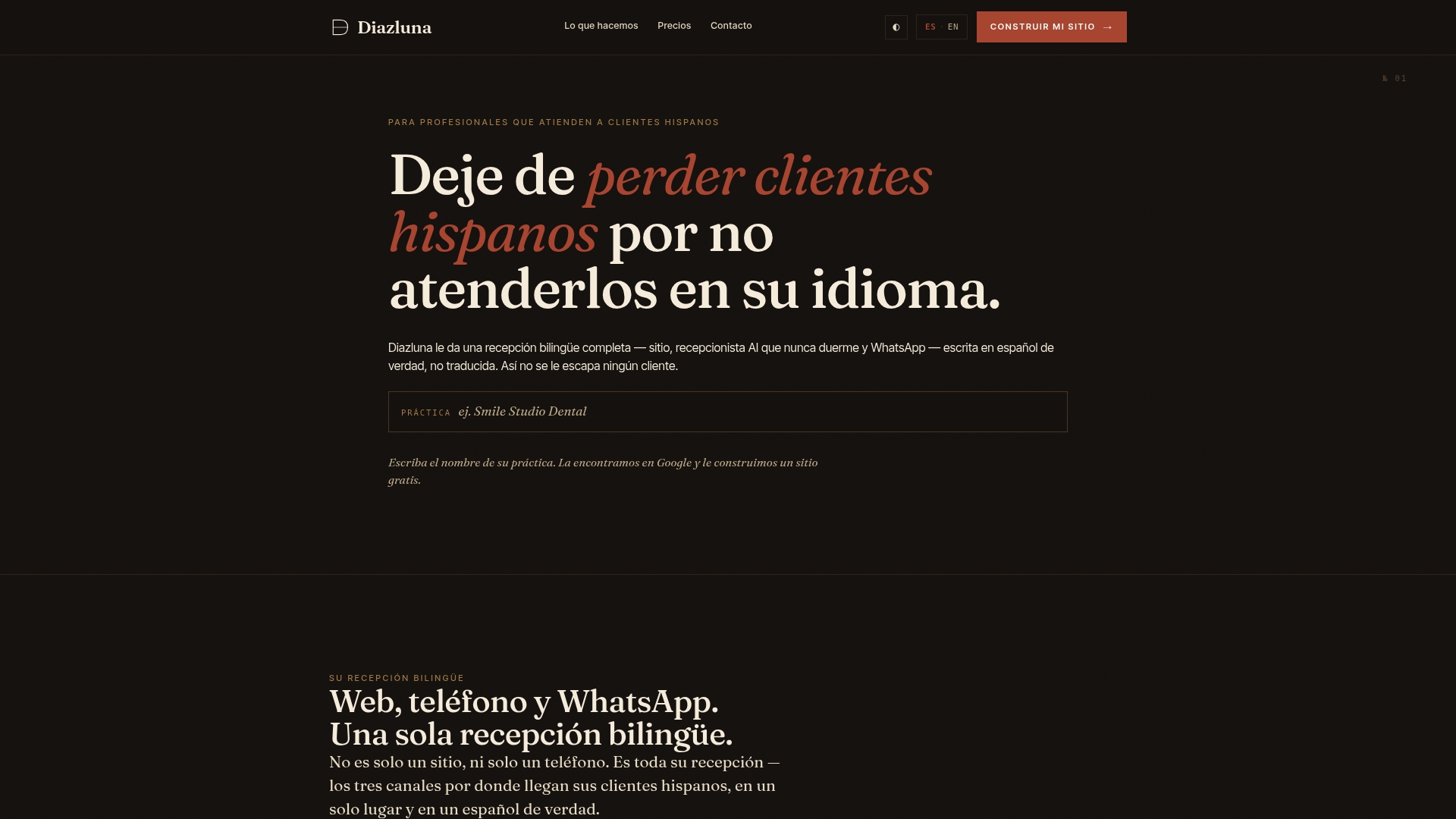
Diazluna combines a fully bilingual website, a 24/7 AI receptionist fluent in both English and Spanish, and WhatsApp integration into a single front-desk solution built for professional practices. The AI receptionist detects language immediately, handles scheduling and intake in the client’s preferred language, and escalates when needed. Diazluna’s bilingual front desk is designed for dental practices, law firms, and healthcare providers who cannot afford to lose a Spanish-speaking client to a language gap. Sector-specific solutions for legal firms and dental practices are available with tailored terminology and workflows built in.
FAQ
What is the bilingual service definition used in professional sectors?
Authentic bilingual service is the consistent delivery of client engagement in both English and Spanish across all channels, with equal quality, tone, and accuracy in each language. It goes beyond translation to include cultural competence and operational integration into core business workflows.
What types of bilingual services are available for professional practices?
The main types are in-house human agents, outsourced bilingual call centers, AI-driven bilingual receptionists, and hybrid models that combine AI with human escalation. Hybrid and AI-driven models are the most practical for 24/7 coverage in professional sectors.
Why does machine translation fall short for authentic bilingual support?
Machine translation cannot replicate cultural nuance, empathy, or domain-specific terminology. In high-stakes fields like law, dentistry, and healthcare, clients need responses that reflect procedural knowledge and professional tone, not just converted words.
How does bilingual service affect client retention in Hispanic communities?
Clients who experience a forced language switch or poor Spanish-language handling during a sensitive interaction are likely to seek another provider. Practices that deliver consistent, fluent Spanish engagement build trust and referral networks within Hispanic communities.
What is the first step to improve bilingual service in my practice?
Audit your current setup by calling your own office in Spanish during off-hours. That single test reveals whether your bilingual capability is operational or just a label, and it identifies the most urgent gaps to address first.