June 30, 2026
Bilingual AI Receptionist Advantages for Service Firms
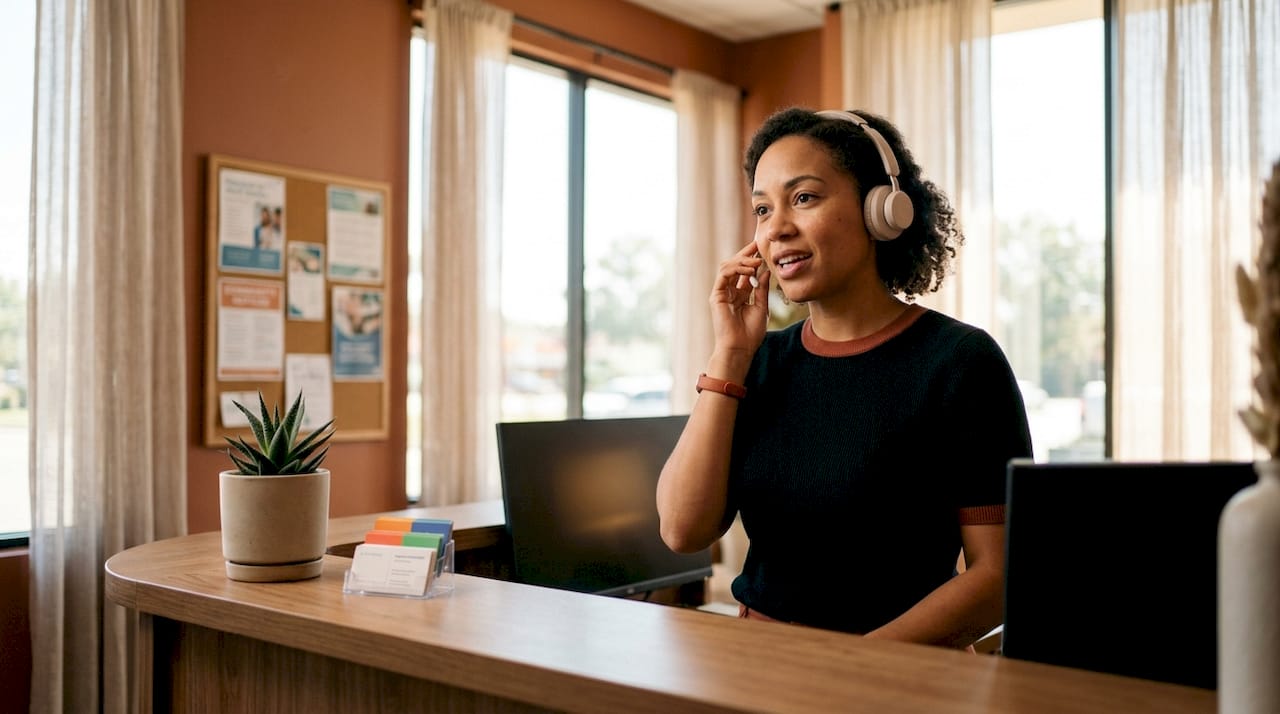
A bilingual AI receptionist is an automated phone system that instantly recognizes and converses in multiple languages, delivering native-level communication without added surcharges or delays. The industry term for this capability is “multilingual virtual receptionist,” though “bilingual AI receptionist” has become the standard shorthand for English-Spanish systems serving the US market. With 41 million Spanish speakers living in the United States, firms that cannot answer a call in Spanish are leaving real revenue on the table. Service businesses in high-density Spanish-speaking regions can recover $30,000–$120,000 annually by switching to bilingual AI coverage. The bilingual AI receptionist advantages covered here apply directly to law firms, dental practices, and healthcare providers serving Hispanic clients.
1. How do bilingual AI receptionists cut costs compared to human services?
Bilingual AI receptionists cost $25–$160 per month, while traditional human bilingual answering services run $300–$1,500 per month. That gap alone justifies the switch for most small and mid-size firms. Traditional services also impose a 20–40% surcharge on Spanish-language calls, treating bilingual coverage as a premium add-on rather than a baseline feature. AI receptionists charge a flat monthly rate that covers every language the system supports.
The cost difference compounds over a full year. A firm paying $800 per month for a human bilingual answering service spends $9,600 annually before surcharges. The same firm on a $99 AI plan spends $1,188. That is an $8,400 annual difference that goes directly back into the business. For firms in Texas, California, Florida, or New York, where Spanish-preferring callers account for 25–40% of total inbound volume, the math is even more favorable.

Pro Tip: When budgeting for an AI receptionist, calculate your current monthly answering cost plus any language surcharges. That combined figure is your baseline. Most firms see full ROI within the first 60 days of switching.
2. What is a culturally fluent AI receptionist?
A culturally fluent AI receptionist goes beyond word-for-word translation. It adapts formality, honorifics, and communication style to match the caller’s cultural expectations. Cultural fluency improves caller satisfaction more than simple language translation, because callers respond to tone and register, not just vocabulary.
The distinction matters most in professional settings. A Spanish-speaking caller contacting a law firm expects formal address and precise legal terminology. A caller booking a dental appointment may expect a warmer, more conversational tone. Native-trained AI models handle these shifts automatically because they are built on native grammar and vocabulary, not real-time translation engines running on top of an English base.
Translation-overlay models produce technically correct sentences that still feel foreign to native speakers. They miss regional idioms, misapply formality levels, and occasionally produce phrasing that sounds awkward or untrustworthy. Native-trained systems avoid these problems because the language model itself was trained in Spanish, not translated into it.
The practical result is higher call completion rates and stronger first impressions. Callers who feel understood stay on the line. Callers who feel processed hang up.
3. How does instant language detection improve caller experience?
Bilingual AI receptionists detect caller language in 0.4–3 seconds, eliminating the language selection menus that frustrate callers on traditional phone trees. The caller speaks, the system responds in kind, and the conversation proceeds without interruption. No “press 2 for Spanish” prompt. No hold queue while a bilingual agent becomes available.
Human answering services route non-English callers to a smaller pool of bilingual agents. That routing creates delays, and during peak hours it creates hold times. AI systems face no such constraint. Every call receives the same immediate response regardless of language, time of day, or call volume.
Mid-call language switching is another practical benefit. A caller who starts in English and shifts to Spanish mid-sentence does not need to restart the call. The AI detects the shift and continues in the new language. This matters in households where one family member may speak English while another handles the details in Spanish.
4. How do AI receptionists handle appointments and workflow integration?
AI receptionists integrate with scheduling and CRM systems, enabling real-time appointment booking and automated follow-ups in the caller’s language. A Spanish-speaking patient calling a dental office can book, reschedule, or confirm an appointment entirely in Spanish without involving a staff member. The confirmation SMS arrives in Spanish as well.
This integration removes a common failure point in bilingual practices. When a front desk staff member does not speak Spanish, the caller either waits for a bilingual colleague or hangs up. AI eliminates that dependency entirely. The system handles the full intake workflow, from language detection through appointment confirmation, without human involvement.
Pro Tip: When evaluating AI receptionist platforms, ask specifically whether the CRM integration sends follow-up messages in the caller’s detected language. Some platforms book the appointment correctly but default all outbound messages to English.
Key workflow features to look for in a bilingual AI receptionist:
- Automatic language detection without menu navigation
- Real-time appointment booking in the caller’s language
- SMS and email confirmations sent in the detected language
- Integration with scheduling platforms and billing systems
- Consistent voice quality across both languages
5. Which industries benefit most from bilingual AI receptionists?
Healthcare, immigration law, home services, and property management see the highest return from bilingual AI receptionists because these sectors have the largest share of Spanish-preferring callers. In healthcare, a missed call from a Spanish-speaking patient often means a missed appointment and a lost relationship. In immigration law, a caller who cannot communicate clearly with the intake system may never call back.
The bilingual legal receptionist advantages are particularly concrete. Immigration attorneys, family law firms, and criminal defense practices in Texas, California, Florida, and New York regularly report that Spanish-speaking callers represent a significant share of their inbound leads. A firm that cannot capture those leads in real time loses them to competitors who can.
Domain-specific AI configuration increases accuracy further. An AI receptionist trained on legal terminology handles intake questions about case types, consultation fees, and document requirements with precision. One trained on dental vocabulary handles questions about procedures, insurance, and appointment availability without confusion. Generic AI receptionists without this configuration produce more errors and lower caller trust.
Regional concentration amplifies the advantage. Spanish-speaking populations are densest in metro areas across Texas, California, Florida, and New York. Firms in these markets that deploy bilingual AI coverage capture a caller segment that competitors with English-only systems consistently miss.
6. What does 24/7 availability mean for a bilingual practice?
A bilingual AI receptionist answers calls at 11 PM on a Sunday with the same quality as a Monday morning call. Human answering services charge overtime rates for after-hours coverage, and bilingual staff availability drops sharply outside business hours. AI systems have no off-hours. The flat monthly rate covers every hour of every day.
For dental practices and law firms, after-hours calls are often the highest-value leads. A person searching for a dentist at 9 PM and calling immediately is a motivated client. If that call goes to voicemail or an English-only recording, the lead is gone. If it reaches a bilingual AI that books the appointment on the spot, the lead converts.
AI receptionists supporting multiple languages offer a 90–97% cost reduction compared to hiring bilingual staff, with consistent quality across all hours. That figure reflects the combined savings from eliminating salary, benefits, training, and turnover costs. For small practices, it also removes the operational risk of a single bilingual employee calling in sick.
7. How does AI receptionist quality compare to translation-based alternatives?
The most common mistake when selecting a bilingual AI receptionist is choosing a real-time translation-based system. Translation-based AI is slower and less accurate than native-trained models, and callers notice. The slight delay, the occasional awkward phrasing, and the generic tone all signal to the caller that they are not being fully understood.
Native-trained AI processes Spanish as a first language, not as a translation target. The response time is faster, the phrasing is natural, and the system handles regional vocabulary without errors. For a law firm in Miami serving Cuban-American clients, or a dental practice in Los Angeles serving Mexican-American families, that regional accuracy is a meaningful differentiator.
Training AI with domain-specific jargon and cultural nuances increases conversion and reduces errors compared to generic translation. The setup investment is small. The payoff in caller trust and completed bookings is significant.
Key Takeaways
Bilingual AI receptionists deliver the strongest ROI when they combine native-trained language models, domain-specific configuration, and 24/7 availability at a flat monthly rate.
| Point | Details |
|---|---|
| Cost advantage is immediate | AI bilingual coverage costs $25–$160/month versus $300–$1,500 for human services with surcharges. |
| Cultural fluency drives conversions | Native-trained AI outperforms translation overlays by matching tone, formality, and regional vocabulary. |
| Language detection is instant | AI detects caller language in 0.4–3 seconds, removing hold queues and language menus entirely. |
| Industry configuration matters | AI trained on legal or dental terminology produces fewer errors and higher caller trust. |
| 24/7 coverage captures high-value leads | After-hours bilingual availability converts motivated callers that English-only voicemail systems lose. |
Why I stopped recommending translation-layer AI to my clients
The first time I watched a Spanish-speaking caller hang up mid-sentence because the AI gave a stilted, clearly translated response, I understood the problem clearly. Translation-overlay systems are not bilingual receptionists. They are English receptionists wearing a Spanish costume. The phrasing is technically correct and emotionally wrong, and callers feel it immediately.
My recommendation has been consistent since then: only deploy AI that was trained natively in Spanish, not translated into it. The difference in caller response is not subtle. Clients who switched from translation-based systems to native-trained AI reported fewer hang-ups and more completed bookings within the first month.
The second mistake I see regularly is treating bilingual AI as a cost-cutting tool rather than a revenue-capture tool. The framing matters. A firm that deploys bilingual AI to save $500 a month on answering services is thinking too small. The real question is how many Spanish-speaking leads were lost last month because no one answered in their language. In high-density markets, that number is often worth more than the entire annual cost of the AI system.
The emerging trend worth watching is expanded language support beyond English and Spanish. Portuguese, Vietnamese, and Mandarin are already appearing in AI receptionist configurations for firms in specific metro markets. The firms that build multilingual intake infrastructure now will have a structural advantage when those caller populations grow. Early adoption in a competitive market is not a luxury. It is a positioning decision.
— Francisco
Diazluna’s bilingual front desk for professional firms
Firms serving Hispanic clients in dentistry, law, and healthcare face a specific problem: every missed Spanish-language call is a missed client. Diazluna addresses that directly with a bilingual AI receptionist included in every plan, paired with a fully optimized bilingual website and WhatsApp integration.
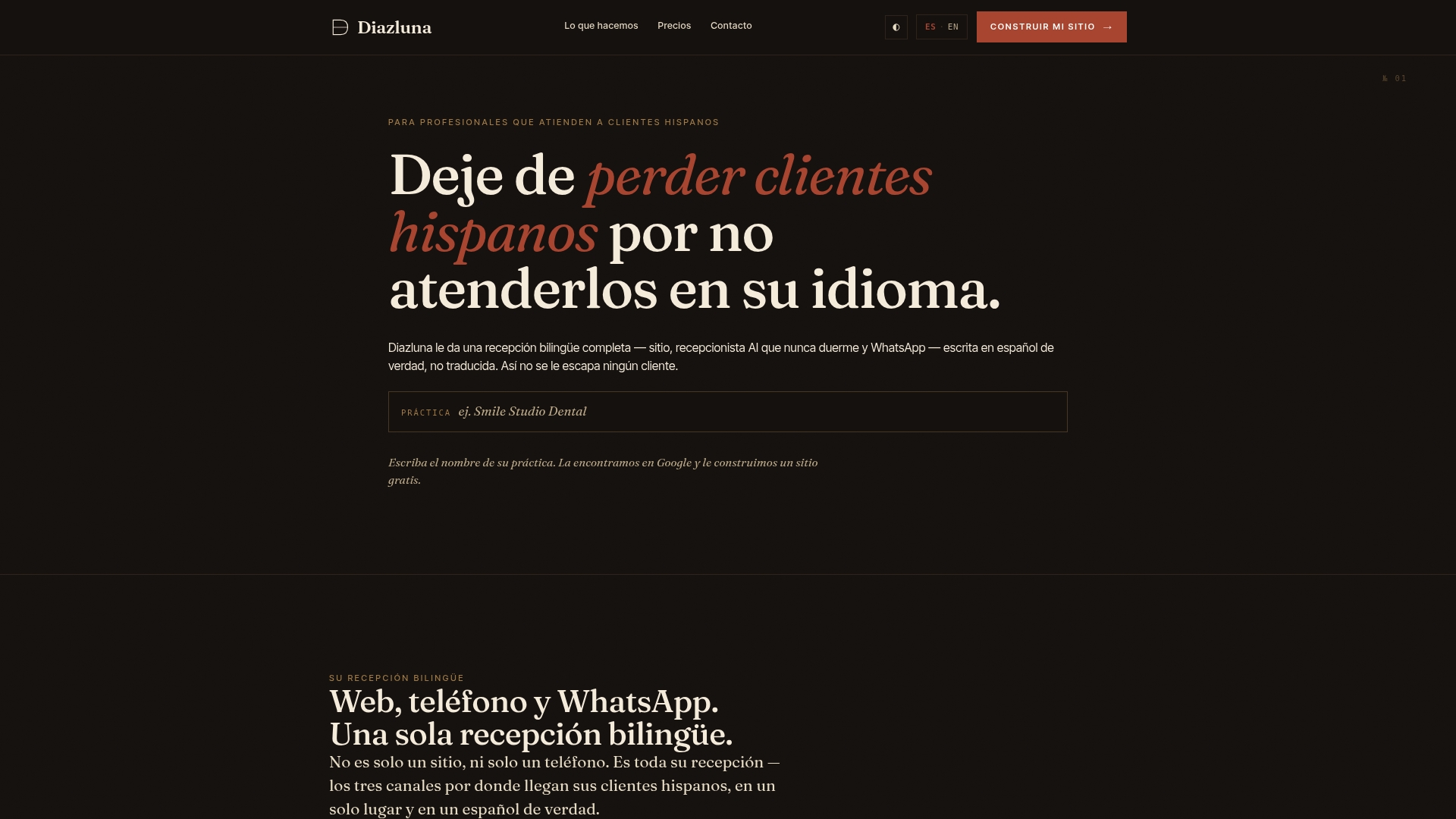
Diazluna’s system covers phone, web, and WhatsApp in both English and Spanish, so no lead falls through because of a language gap. Dental practices can explore the bilingual dental front desk built specifically for Spanish-speaking patient intake. Law firms serving Hispanic clients can review the attorney-focused bilingual solution designed for legal intake workflows. All three channels are included at a fraction of the cost of managing them separately.
FAQ
What is a bilingual AI receptionist?
A bilingual AI receptionist is an automated phone system that detects and responds in multiple languages, typically English and Spanish, without menus or hold queues. It handles calls, books appointments, and sends confirmations in the caller’s language.
How much does a bilingual AI receptionist cost?
Bilingual AI receptionists typically cost $25–$160 per month on flat-rate plans, compared to $300–$1,500 per month for human bilingual answering services that also charge language surcharges.
What are the bilingual legal receptionist advantages?
Law firms using bilingual AI receptionists capture Spanish-speaking leads in real time, reduce missed intake calls, and handle after-hours inquiries without overtime costs. Firms in Texas, California, Florida, and New York see the highest return given local Spanish-speaking caller volume.
What is the difference between a native-trained AI and a translation-overlay AI?
A native-trained AI was built on Spanish grammar and vocabulary from the ground up, producing natural phrasing and accurate regional terminology. A translation-overlay AI translates English responses in real time, resulting in slower, less natural output that reduces caller trust.
Can a bilingual AI receptionist integrate with my scheduling system?
Yes. Most bilingual AI receptionists integrate with scheduling and CRM platforms to book appointments, send confirmations, and trigger follow-ups, all in the caller’s detected language.