July 9, 2026
Bilingual Business Communication: What It Covers

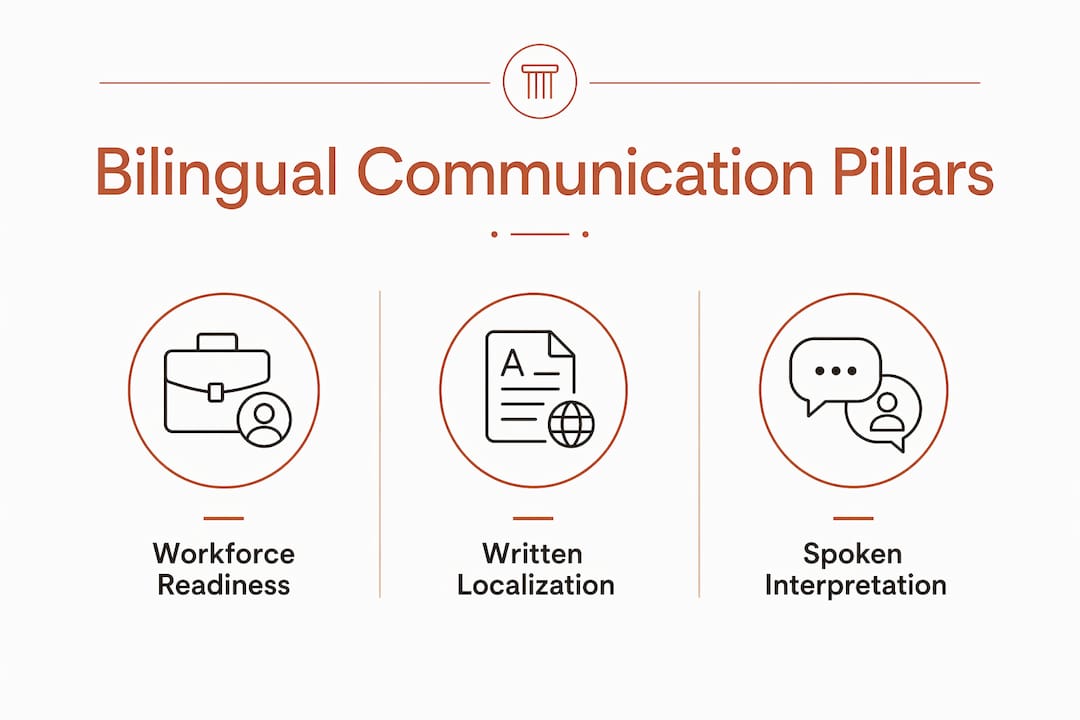
Bilingual business communication is defined as a holistic language access framework built on three pillars: spoken interpretation, written translation and localization, and workforce readiness. The industry term for this practice is “language access strategy,” and professionals who treat it as such gain a measurable edge over those who rely on ad hoc translation. What bilingual business communication covers goes far beyond swapping words between languages. It includes cultural adaptation, staff training, and technology integration, all working together to keep every client interaction clear and trustworthy.
What are the main components of bilingual business communication?
Bilingual professional communication breaks into three core components. Each one addresses a different point of failure in cross-language engagement.

Spoken interpretation
Interpretation covers real-time spoken communication across three formats:
- In-person interpretation: A trained interpreter is physically present. This works best for high-stakes settings like legal consultations, medical appointments, or contract negotiations where tone and body language matter.
- Video remote interpreting (VRI): An interpreter joins via video call. VRI reduces scheduling delays and works well for mid-complexity conversations.
- Over-the-phone interpreting (OPI): The fastest and most accessible option. OPI suits routine calls and situations where visual context is not needed.
Each format carries a different cost and response time. Choosing the wrong one for the situation creates friction, not clarity.
Written translation and localization
Translation converts text from one language to another. Localization goes further by adapting the content to fit the target audience’s region, culture, and expectations. A legal disclaimer translated word-for-word from English to Spanish may be grammatically correct but legally confusing to a client in Miami versus one in Mexico City. Localization closes that gap.
Workforce readiness
Workforce readiness means validating and training bilingual staff so their language skills meet professional standards. A receptionist who speaks conversational Spanish is not automatically prepared to handle a patient’s medical history or a client’s legal question. Structured training and terminology validation are what separate functional bilingual staff from genuinely effective ones.
Pro Tip: Build a glossary of industry-specific terms in both languages before training bilingual staff. Consistent terminology from day one prevents costly miscommunications later.
How do localization and transcreation enhance bilingual communication?
Localization and transcreation are not the same thing, and confusing them is one of the most common mistakes professionals make when expanding into new language markets.
Localization adapts functional elements such as date formats, currencies, measurement units, and cultural references so that content reads naturally in the target market. A website built for a U.S. audience that lists prices in dollars and uses American date formats needs localization before it serves a Spanish-speaking client base effectively. This is a technical and editorial process, not a creative one.
Transcreation is different. It applies to marketing copy, slogans, brand messaging, and any content where emotional resonance matters as much as accuracy. A tagline that works in English may fall flat or carry unintended meaning in Spanish. Transcreation rebuilds the message from the ground up in the target language, preserving the intent and emotional impact rather than the literal words.
| Modality | Best use case | Primary goal |
|---|---|---|
| Translation | Legal documents, contracts, reports | Accuracy |
| Localization | Websites, apps, product listings | Cultural fit |
| Transcreation | Slogans, ads, brand campaigns | Emotional resonance |
The practical rule is straightforward. Use translation for documents where accuracy is the only requirement. Use localization for any digital asset a client will interact with. Use transcreation when your brand voice must survive the language switch intact.
Pro Tip: Test transcreated content with native speakers from the specific region you are targeting, not just any speaker of the language. Spanish in Colombia sounds and feels different from Spanish in Texas.
Why is bilingual workforce readiness critical in business communication?
Workforce readiness is the component most organizations underinvest in, and it is the one that causes the most visible failures.
Intensive language training for executives often involves 15–30 hours per week of immersive instruction designed to simulate real business scenarios. That level of investment reflects how much is at stake when a manager misreads a contract clause or misses a negotiation signal because of a language gap.
Building a workforce that communicates effectively across languages requires a structured approach:
- Assess current proficiency levels. Do not assume that a bilingual hire meets professional standards. Use standardized assessments to establish a baseline before assigning client-facing roles.
- Prioritize functional proficiency over perfect fluency. Functional proficiency means a professional can conduct meetings and read reports accurately, even if their accent or grammar is imperfect. This is the realistic and effective standard for most operational roles.
- Standardize terminology across the organization. Inconsistent terminology across languages increases compliance risk and damages client trust. A centralized glossary enforced across all departments prevents this.
- Implement sector-specific language coaching. General Spanish classes do not prepare a dental receptionist for patient intake conversations. Training must match the professional context.
- Refresh training regularly. Language skills decay without practice. Quarterly refreshers and updated terminology reviews keep bilingual staff sharp.
Centralized Translation Management Systems convert fragmented translation workflows into consistent, auditable processes. They reduce compliance risk and give organizations a single source of truth for terminology across every language they operate in.
What strategic advantages does bilingual business communication offer?
Language proficiency is a competitive asset, not just an operational convenience.
“Acquired language proficiency and linguistic proximity have become strategic assets in international trade, facilitating negotiation, adaptation, and information flow. Native language ties are declining in influence, while functional communication skills gain prominence, especially in emerging markets.”
That shift matters for any professional serving a multilingual client base. A law firm that communicates fluently in Spanish does not just serve more clients. It builds deeper trust, reduces misunderstandings in sensitive conversations, and retains clients who would otherwise leave for a practice that speaks their language.
Operating bilingually in both a primary language and English is now standard in most international enterprises. Professionals who operate only in English miss market intelligence, referral networks, and advancement opportunities that exist in other language communities.
The strategic advantages of effective bilingual communication include:
- Expanded client reach: Serving Spanish-speaking clients in the U.S. opens access to one of the fastest-growing consumer segments in the country.
- Stronger negotiation outcomes: Professionals who communicate in a client’s language build rapport faster and close deals with fewer misunderstandings.
- Reduced attrition: Clients who feel understood stay longer and refer more.
- Regulatory compliance: In healthcare and legal services, language access is not optional. It is a legal requirement in many jurisdictions.
How can professionals implement effective bilingual communication strategies?
Effective bilingual communication strategies combine technology, training, and cultural awareness. None of the three works well without the other two.
Visual aids and AI-powered translation tools improve day-to-day multilingual communication, especially in operational contexts where staff literacy levels vary. Picture-based task management and photo confirmations reduce errors when written instructions are not enough. This is not a workaround. It is a recognized best practice in multilingual workplace communication.
Practical steps for professionals who want to raise their bilingual communication standard:
- Adopt a translation management system. Centralized platforms maintain consistent terminology and flag outdated translations before they reach clients.
- Invest in immersion-based language training. Classroom instruction alone does not build the reflexes needed for real-time professional conversations. Simulated scenarios and role-play exercises close the gap.
- Tune communication to local cultural rhythms. Vocabulary, formality level, and even humor differ across Spanish-speaking communities. A bilingual business website built for a Miami audience reads differently from one built for a Los Angeles audience.
- Simplify written content for diverse literacy levels. Short sentences, plain vocabulary, and clear formatting serve both native speakers and those reading in a second language.
- Integrate WhatsApp and other preferred communication channels. Hispanic clients in the U.S. use WhatsApp at high rates. Meeting clients on their preferred platform removes a friction point before the conversation even starts.
A bilingual service package that combines a trained front desk, a localized website, and preferred messaging channels covers the full communication cycle from first contact to follow-up.
Key Takeaways
Effective bilingual business communication requires spoken interpretation, written localization, and trained bilingual staff working together as a single, consistent system.
| Point | Details |
|---|---|
| Three-pillar framework | Bilingual communication covers interpretation, translation and localization, and workforce readiness. |
| Localization vs. transcreation | Use localization for digital assets and transcreation for brand messaging that must carry emotional weight. |
| Functional proficiency standard | Prioritize staff who can conduct meetings and read reports accurately over those chasing perfect fluency. |
| Terminology consistency | Centralized glossaries and translation management systems prevent compliance risk across languages. |
| Strategic business asset | Language proficiency expands client reach, strengthens negotiations, and reduces client attrition. |
What I have learned about bilingual communication after years in professional services
Most professionals think bilingual communication is a translation problem. It is not. It is a trust problem. When a client cannot fully understand what you are saying, or feels that you are not fully understanding them, they do not complain. They leave.
The biggest mistake I see is overreliance on literal translation. A word-for-word Spanish version of an English intake form does not make a Hispanic client feel welcome. It makes them feel like an afterthought. The language is technically correct, but the experience is wrong. Cultural tuning is what converts a translated document into a genuine connection.
I have also seen organizations invest heavily in bilingual hiring and then do nothing to validate or develop those skills. A staff member who speaks Spanish at home is not automatically prepared to handle a patient’s insurance question or a client’s legal concern in Spanish. Structured training and regular terminology reviews are what make the difference between a bilingual practice and a practice that thinks it is bilingual.
The professionals who get this right treat language access as a continuous investment, not a one-time setup. They update their glossaries, refresh their staff training, and pay attention to how their Spanish-speaking clients actually communicate, not just how they assume they do.
— Francisco
How Diazluna helps professionals close the language gap
Professionals serving Hispanic clients in dentistry, law, and healthcare face a specific version of this challenge. Every missed call from a Spanish-speaking patient or client is a lost relationship, not just a missed appointment.
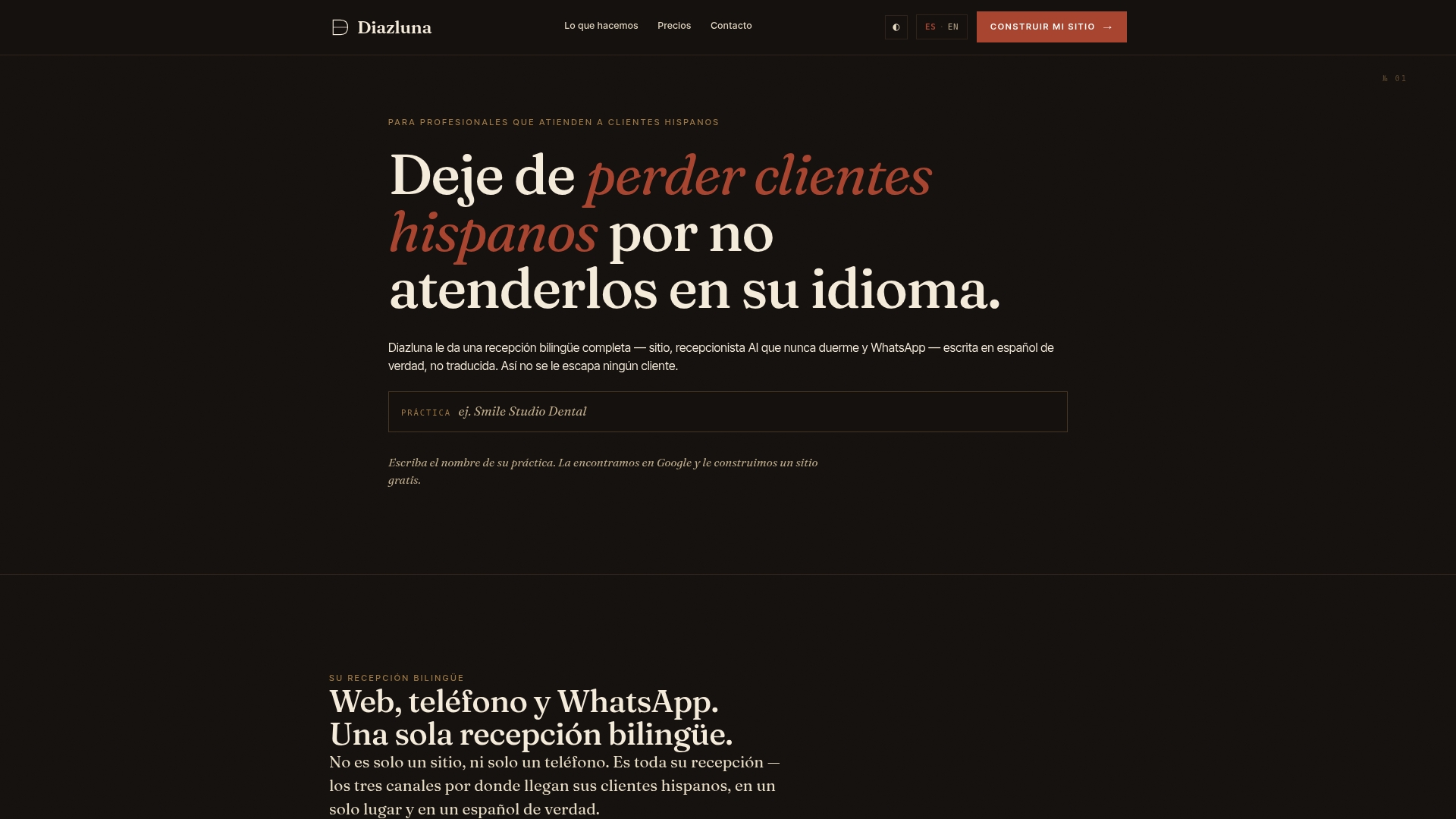
Diazluna delivers a bilingual front desk solution that combines a fully localized bilingual website, a 24/7 AI receptionist fluent in both Spanish and English, and WhatsApp integration. All three work together so no Hispanic client falls through the gap because of a language barrier. Diazluna indexes new sites on Google within 24 hours and is built specifically for practices that cannot afford to lose clients to communication failures. For dental practices, the bilingual communication tools for dentists page shows exactly how the system fits a clinical environment.
FAQ
What does bilingual business communication cover?
Bilingual business communication covers spoken interpretation, written translation and localization, and bilingual workforce readiness. These three components work together to support clear, culturally appropriate communication across languages in professional settings.
What is the difference between localization and transcreation?
Localization adapts functional content like dates, currencies, and cultural references for a target market. Transcreation rebuilds creative content such as slogans and brand messaging from the ground up to preserve emotional impact in the target language.
Why is functional proficiency enough for most business roles?
Functional proficiency means a professional can conduct meetings and read reports accurately, even without perfect grammar or accent. Research shows this standard is prioritized over native-level fluency in most operational business roles because it delivers results without requiring years of advanced study.
How does inconsistent terminology hurt bilingual communication?
Inconsistent terminology across languages increases compliance risk and erodes client trust. Centralized translation management systems and standardized glossaries prevent this by giving every team member a single, verified reference for professional terms in both languages.
How can AI tools support bilingual workplace communication?
AI translation tools and visual aids like picture-based instructions reduce errors in multilingual operational environments. Combined with trained bilingual staff, these tools cover the communication gaps that arise when written literacy levels vary across a team or client base.