July 24, 2026
Bilingual Dental Patient Intake Benefits for Your Practice
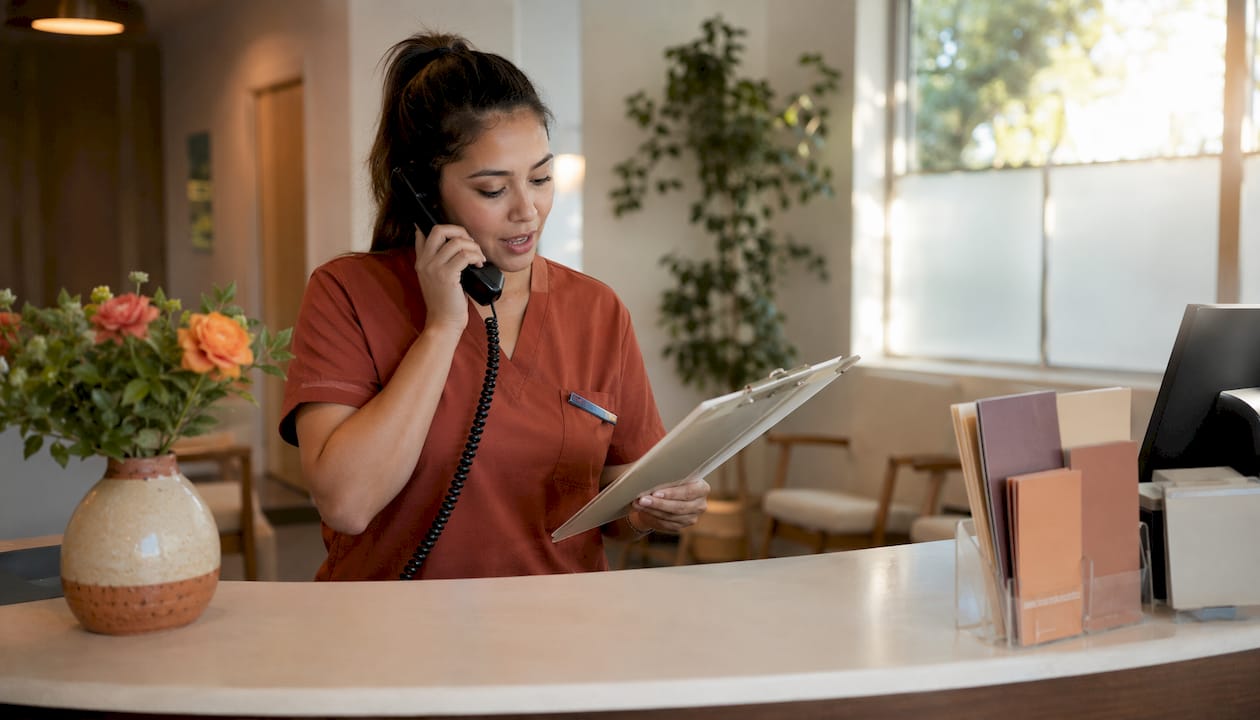
Why bilingual dental patient intake benefits every practice serving Hispanic patients
Practices that greet Hispanic patients in Spanish from the first touchpoint book more appointments, collect more accurate intake data, and see fewer no-shows. That is not a theory. Research on bilingual clinical forms in dental school settings found that 80% of LEP patients reported their comfort level with dental care was much better after receiving a translated form. The operational and clinical case for bilingual intake is already made.
Here is what bilingual dental patient intake actually delivers:
- Higher patient satisfaction. Patients who receive forms and explanations in their preferred language rate their care experience significantly better.
- Cleaner intake data. When patients understand every field, they fill forms accurately the first time, reducing callbacks and corrections.
- Fewer cancellations and no-shows. Patients who clearly understand their appointment details and next steps are far more likely to follow through.
- Stronger trust at first contact. Language clarity tells a patient the practice is organized and prepared to help them, before they ever sit in the chair.
- Legal compliance. Section 1557 of the Affordable Care Act requires healthcare providers receiving federal funding to offer translated materials in the top languages spoken by LEP patients in their state. For most US states, Spanish is first or second on that list.
- Cultural competence beyond translation. Effective bilingual intake accounts for name structures, date formats, and culturally specific questions, not just word-for-word conversion.
Table of Contents
- How language barriers hurt LEP dental patients in real terms
- Best practices for setting up a bilingual dental intake workflow
- How digital bilingual front desk tools change the patient experience
- Key Takeaways
- The part most practices get wrong about bilingual intake
- Your practice’s bilingual front desk, without building it from scratch
How language barriers hurt LEP dental patients in real terms
LEP patients are nine times more likely to misunderstand medical scenarios and four times more likely to misread medication labels than English-proficient patients. Those numbers show up in your practice as missed doses, incorrect health histories, and patients who leave without understanding their treatment plan.
The consent form problem is particularly sharp. A patient who cannot read the form they are signing has not actually given informed consent, which creates both an ethical gap and a legal exposure. Machine-translated forms compound the risk because automated tools routinely mistranslate clinical and legal terminology.
Cultural factors add another layer. Many Hispanic patients come from healthcare systems where the provider-patient relationship is more formal, and direct questioning about symptoms or medications can feel uncomfortable. A bilingual intake process that accounts for this dynamic, not just the language, produces more complete and honest health histories.
Key stat: LEP patients are 9x more likely to misunderstand medical scenarios than English-proficient patients, directly affecting treatment adherence and safety.
Federal law reinforces the obligation. Title VI of the Civil Rights Act covers any program receiving federal financial assistance. Section 1557 of the ACA extends that to providers receiving Medicare or Medicaid reimbursement. State laws like California’s Dymally-Alatorre Bilingual Services Act add further requirements for practices in high-LEP-population areas.
Best practices for setting up a bilingual dental intake workflow
Getting bilingual intake right takes more than dropping a Spanish PDF on your front desk. These are the practices that actually hold up under clinical and legal scrutiny.
- Use certified translation, not machine-only output. Certified translation by a qualified translator, followed by review from a bilingual subject-matter expert, is the standard for intake, consent, and waiver forms. Machine translation handles conversational Spanish adequately but fails on medical and legal terminology.
- Localize culturally, not just linguistically. Date formats, name structures, and address fields differ across Spanish-speaking countries. A form that asks for “apellido” without accounting for the maternal surname convention will produce incomplete records.
- Offer language selection at the very start. A simple two-button selector at the top of a digital form, before any substantive questions, sets the language for every subsequent page and records the choice in the audit trail.
- Train staff to use short, clear, first-person sentences. Staff should avoid jargon and slang entirely when working with LEP patients. “I will take an X-ray of your back teeth” works. “We’ll be performing posterior radiographic imaging” does not.
- Maintain a complete audit trail. Best practice requires capturing the language selected, the exact form version rendered, the signature, and a timestamp. Without that record, a bilingual signature is legally indefensible.
- Avoid metaphors and idioms. Universal, straightforward language minimizes cultural misunderstanding. Expressions that feel natural in English often carry no equivalent meaning in Spanish.
- Update both language versions simultaneously. Practice management platforms do not automatically sync translated forms when you edit the English version. Manual updates to both versions are required to keep them consistent.
Pro Tip: Assign one staff member as the bilingual forms owner. That person reviews both language versions every time a form changes, signs off on the audit log, and flags any terminology that needs certified review. One owner beats a shared responsibility that nobody actually owns.

How digital bilingual front desk tools change the patient experience
The first call or message is where most practices quietly lose Hispanic patients. When a patient reaches out in Spanish and hits a phone tree, a hold, or a staff member who cannot respond confidently, abandonment happens fast. The inquiry disappears before the office even knows it had one.
Digital bilingual front desk solutions address this at the point of first contact, which is where conversion is most vulnerable. Key capabilities to look for:
- 24/7 availability in both languages. A patient searching for a dentist at 9 PM on a Sunday should reach a response in Spanish, not a voicemail in English.
- WhatsApp integration. A large share of Hispanic patients in the US use WhatsApp as their primary communication channel. A practice that meets patients there removes a significant friction point.
- Native multi-language support. Platforms that bolt translation on as a plugin produce inconsistent results. Native bilingual architecture handles field labels, consent language, and confirmation emails correctly from the start.
- Audit-trail capture. The platform must record language selection, form version, and timestamp automatically, not as a manual step.
- Reduced staff workload. Bilingual intake workflows cut the rework that comes from incomplete intake records, repeated explanations, and callbacks caused by misunderstood next steps.
Key stat: Practices that greet patients in their language without phone trees or transfers see fewer abandoned inquiries and more completed bookings from first contact.
Bilingual patient onboarding done well also improves your online visibility. A bilingual website with properly indexed Spanish content reaches Hispanic patients who search in Spanish, a segment that English-only sites miss entirely. For practices managing patient feedback across languages, clear bilingual communication also reduces the friction that leads to negative patient reviews.
Key Takeaways
Bilingual dental patient intake directly improves patient trust, intake accuracy, legal compliance, and booking conversion for practices serving Hispanic communities.
| Point | Details |
|---|---|
| Patient comfort increases sharply | 80% of LEP patients reported better dental care comfort after receiving a translated form. |
| LEP comprehension gaps are severe | LEP patients are 9x more likely to misunderstand medical scenarios without language support. |
| Certified translation is the legal standard | Title VI and ACA Section 1557 require translated materials; machine-only translation does not meet the compliance bar. |
| Audit trails are non-negotiable | Capture language selection, form version, and timestamp on every signed document to maintain legal defensibility. |
| Diazluna covers the full workflow | Diazluna combines a bilingual website, 24/7 AI receptionist, and WhatsApp integration to handle first contact through intake for Hispanic-serving dental practices. |
The part most practices get wrong about bilingual intake
Most dental practices treat bilingual intake as a translation project. Print the form in Spanish, check the box, move on. That framing misses the actual problem.
The real gap is not the form. It is the entire first-contact experience: the phone call that goes to a monolingual voicemail, the website that exists only in English, the front desk staff who apologize and put the patient on hold while they find someone who speaks Spanish. By the time the translated form appears, the patient has already decided whether to trust the practice.
Language access is a trust signal, and trust signals work at the moment of first contact, not after the patient is already in the waiting room. Practices that understand this build bilingual workflows from the outside in: the website, the phone system, the first message, and then the intake form. That sequence is what actually converts inquiries into appointments.
Cultural competence matters here too. A bilingual staff member who speaks Spanish but communicates with the same rushed, clinical detachment as an English-only interaction has not solved the problem. The goal is a patient who feels genuinely understood, not just linguistically processed. That distinction shows up in treatment adherence, recall rates, and referrals from within the Hispanic community.
For practices ready to build this from the ground up, bilingual customer service is the foundation everything else sits on.
Your practice’s bilingual front desk, without building it from scratch
Hispanic patients represent one of the fastest-growing patient populations in the US, and most dental practices are still losing them at first contact because the front desk experience is English-only. Diazluna solves that with one integrated service: a fully bilingual website, a 24/7 AI receptionist fluent in both Spanish and English, and WhatsApp integration, all for a fraction of what a traditional agency charges for any one of those pieces separately.
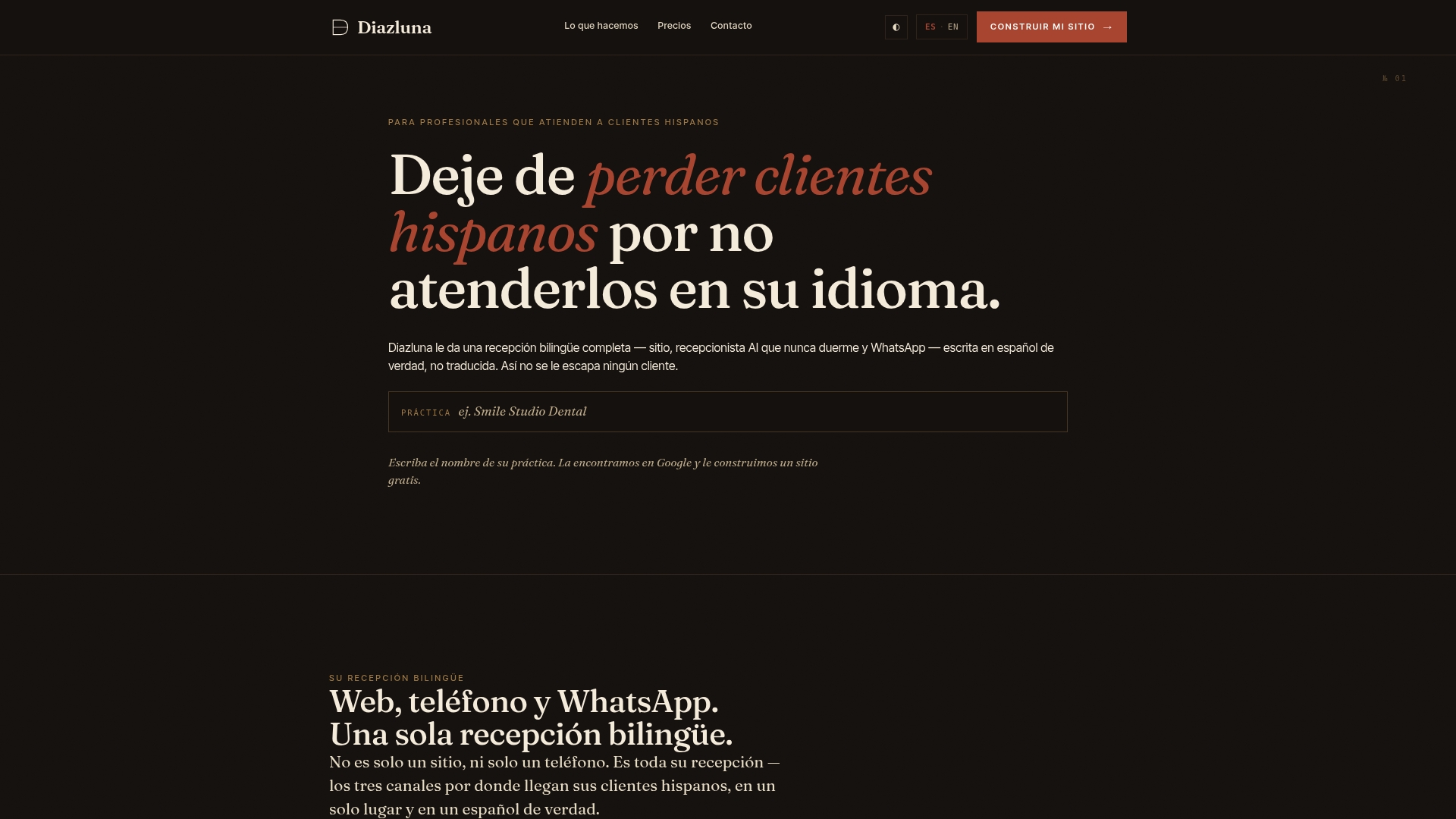
The result is a practice that never misses a Spanish-speaking inquiry, indexes on Google within 24 hours in both languages, and stops losing patients to the competitor down the street who happens to answer in Spanish. If your practice serves Hispanic patients and your front desk does not, that gap is costing you appointments every week. See exactly what Diazluna offers for bilingual dental reception and get started today.