July 11, 2026
Bilingual Patient Onboarding: What It Means for Providers

Bilingual patient onboarding is defined as the structured process of communicating, documenting, and scheduling healthcare visits in a patient’s preferred language from the very first contact through a completed appointment. Understanding what bilingual patient onboarding means is the starting point for any practice that serves Spanish-speaking or other limited English proficiency patients. The process goes well beyond translation. It requires capturing language preference at intake, routing that preference through every system, and delivering consistent communication at each touchpoint. Practices that treat this as infrastructure rather than a courtesy see measurable gains in scheduling completion, patient trust, and staff efficiency.
What bilingual patient onboarding means for your practice
Bilingual patient onboarding is the industry’s term for a fully language-consistent intake process. It covers the moment a patient first calls or visits your website through the point they arrive for their appointment, with every step conducted in their preferred language. The goal is zero friction caused by language barriers.
The core mechanism is straightforward. A patient calls your office, selects Spanish, and the entire experience from that point forward, including intake forms, appointment confirmations, and follow-up reminders, runs in Spanish. Bilingual first-contact workflows reduce friction from first contact through completion, increasing appointment conversion by addressing language barriers and minimizing booking gaps. That means fewer abandoned calls, fewer no-shows, and fewer patients who simply never book.

Language clarity at first contact also builds credibility. When a patient hears their own language spoken fluently and sees their own language on intake forms, the practice signals competence and respect. Language clarity at first contact significantly increases patient trust, practice credibility, and reduces workload caused by repeated explanations and errors. That trust is not a soft benefit. It directly reduces the staff time spent re-explaining instructions or correcting misunderstandings.
What authentic bilingual onboarding means, in practice, is that no single step in the patient journey defaults back to English without the patient’s choice. That consistency is what separates a true bilingual process from a practice that simply has one Spanish-speaking receptionist.
How bilingual onboarding reduces booking friction
The “booking gap” is the space between a patient’s first contact and a confirmed appointment. Language friction is one of the most common causes of that gap. A patient who cannot fully understand the intake process is far more likely to hang up, fail to complete a form, or miss a confirmation step.
Comprehensive bilingual first-contact workflows with language-consistent confirmation reduce no-shows and abandoned leads. The mechanism is not complicated. When a patient understands every instruction clearly, they follow through. When they are confused, they disengage.
Strong bilingual workflows also close the loop before the call ends. Capturing and confirming patient understanding before ending the call ensures clear next steps and reduces lost momentum in follow-up care. That single practice, confirming comprehension before hanging up, eliminates a significant share of no-shows.
The operational benefits extend beyond scheduling:
- Reduced repeat calls. Patients who understand their instructions the first time do not call back to clarify.
- Faster form completion. Language-specific digital intake forms have higher completion rates than English-only forms sent to Spanish-speaking patients.
- Lower staff burden. Staff spend less time interpreting or re-explaining when the system handles language consistency automatically.
- Higher conversion from inquiry to booked visit. Language-matched outreach at every stage keeps patients moving forward.
Pro Tip: Set your intake system to capture language preference as the very first field, before name or date of birth. Every downstream communication, from appointment reminders to consent forms, should pull from that field automatically.
What infrastructure does effective bilingual onboarding require?
Effective bilingual onboarding is not a staffing decision. It is a systems decision. The infrastructure must handle language consistency automatically, so the process does not break down when your one bilingual staff member is unavailable.
The four non-negotiable components are:
- Language preference capture. Language preference must be recorded at intake as a primary field in your EHR or CRM, not as a note in the comments section. Every automated workflow, including reminders, recalls, and follow-ups, must pull from that field.
- Language-specific digital intake forms. Mature bilingual onboarding systems include language-specific digital intake forms integrated with EHRs to automate language consistency across patient communications. Sending an English PDF to a Spanish-speaking patient breaks the process immediately.
- Voice AI and SMS outreach in the patient’s language. Outreach in the patient’s preferred language via SMS, voice AI, and localized forms is critical to serving limited English proficiency patients and adhering to language access obligations. A voice AI that handles scheduling in Spanish removes the dependency on bilingual staff for routine calls.
- Standardized multilingual documentation. Consent forms, privacy notices, and new patient packets must exist in the patient’s language before the first appointment. Failing to translate key first-contact documents such as consent forms and privacy notices increases patient retention risks and liability.
The table below shows how each infrastructure layer maps to a specific operational outcome.
| Infrastructure layer | Operational outcome |
|---|---|
| Language preference field in EHR/CRM | Automated, consistent language routing across all communications |
| Language-specific digital intake forms | Higher form completion rates and fewer data errors |
| Voice AI and SMS in patient’s language | 24/7 scheduling coverage without bilingual staff dependency |
| Translated consent and privacy documents | Reduced liability and stronger informed consent |
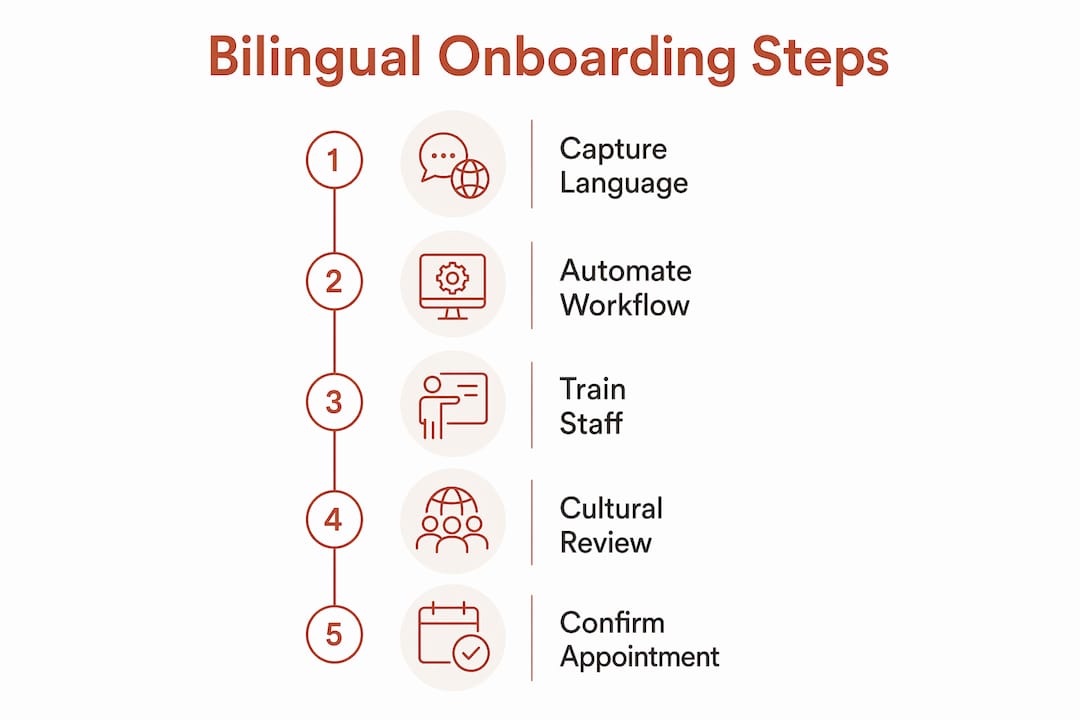
True bilingual onboarding is an infrastructure upgrade, not just a translation task. Capturing language preference as a primary system field enables automated, language-consistent workflows that scale across your entire patient population.
Cultural nuances that shape bilingual patient communication
Translation accuracy is necessary but not sufficient. A word-for-word translation of an English intake form into Spanish can still confuse or alienate a Spanish-speaking patient if it ignores cultural context. The bilingual healthcare onboarding process must account for how patients from different cultural backgrounds understand medical authority, consent, and privacy.
Several cultural factors directly affect patient comfort during onboarding:
- Formality in address. Many Spanish-speaking patients expect formal address (“usted” rather than “tú”) in medical settings. Informal language can feel disrespectful and reduce trust.
- Family involvement in decisions. Hispanic patients frequently involve family members in healthcare decisions. Intake processes that assume individual decision-making can create confusion or delay.
- Attitudes toward written consent. In some cultural contexts, signing a document carries significant weight and can feel alarming without a clear verbal explanation first. A bilingual staff member or voice AI that walks the patient through the consent form verbally before asking for a signature dramatically improves completion rates.
- Privacy concerns. Patients from communities with limited trust in institutions may hesitate to share information. Explaining how data is used, in their language, reduces that hesitation.
Pro Tip: Review your Spanish-language intake forms with a native speaker from the specific regional background your patient population represents. Mexican Spanish, Puerto Rican Spanish, and Cuban Spanish carry different colloquialisms. A form that reads naturally to one group may feel awkward to another.
Consistent bilingual communication also reduces misunderstandings that generate liability. When a patient misunderstands a post-procedure instruction because it was given only in English, the clinical and legal risk falls on the practice. Culturally appropriate translation, delivered at every touchpoint, is a risk management tool as much as a patient experience tool. For a deeper look at how authentic bilingual service differs from basic translation, the distinction matters in every patient-facing interaction.
Common pitfalls in bilingual onboarding and how to avoid them
Most practices that struggle with bilingual onboarding share the same root problem. They treat language access as a staffing solution rather than a systems solution. That approach creates three predictable failure points.
- Over-reliance on individual bilingual staff. Overreliance on bilingual individual staff creates inconsistency. When that person is out sick, on vacation, or simply busy, the bilingual process collapses. Standardized bilingual templates and documented workflows maintain quality regardless of who is working.
- Inconsistent language across touchpoints. A patient who receives a Spanish intake call but an English appointment reminder experiences a broken process. That inconsistency signals disorganization and erodes the trust built during the first contact.
- Ad hoc interpretation instead of structured workflows. Asking a bilingual colleague to “help out” with a patient call is not a workflow. It is an improvisation. Improvised interpretation introduces errors, delays, and liability. Structured workflows with documented scripts and language-specific templates eliminate those risks.
- Untranslated documentation. Sending English consent forms to Spanish-speaking patients is both a compliance risk and a trust failure. Standardized multilingual documentation must be part of the onboarding infrastructure from day one.
Systematized bilingual onboarding ensures professional, consistent communication that does not depend on which staff member happens to be available. The fix is not hiring more bilingual staff. The fix is building systems that deliver language consistency automatically. A bilingual service package for healthcare providers typically includes the website, intake forms, voice AI, and SMS outreach as a single integrated layer.
Key Takeaways
Bilingual patient onboarding is a systems-level infrastructure requirement, not a staffing workaround, and practices that build it correctly see measurable gains in scheduling, trust, and operational efficiency.
| Point | Details |
|---|---|
| Core definition | Bilingual onboarding delivers language-consistent communication from first contact through completed visit. |
| Infrastructure first | Language preference must be captured in EHR/CRM and drive all automated workflows automatically. |
| Cultural accuracy matters | Culturally appropriate translation outperforms word-for-word translation in patient trust and form completion. |
| Avoid staff dependency | Systematized workflows, not individual bilingual staff, create consistent and scalable language access. |
| Documentation is non-negotiable | Translated consent forms and privacy notices reduce liability and strengthen informed consent. |
Why I stopped thinking of bilingual onboarding as a language problem
The practices I have seen struggle most with bilingual onboarding share one assumption: that language access is a communication problem solved by finding the right person. Hire a bilingual receptionist, problem solved. That thinking is the trap.
What I have observed is that the moment you treat bilingual onboarding as infrastructure, the entire operation changes. Language preference becomes a data field, not a conversation. Reminders go out in the right language automatically. Consent forms arrive pre-translated. Staff stop being translators and start being clinicians and coordinators again.
The first contact is where trust is either established or lost. A patient who reaches your practice and immediately hears their own language, receives forms in their own language, and gets a confirmation in their own language does not just book an appointment. They become a loyal patient. That loyalty shows up in retention, referrals, and reviews.
The practices that get this right do not have larger budgets. They have better systems. Bilingual onboarding built into the infrastructure of a practice is not an expense. It is the mechanism that converts inquiries into appointments and appointments into long-term relationships. The role of bilingual content in client loyalty extends well beyond the first visit. Every touchpoint after onboarding either reinforces or undermines the trust you built at first contact.
— Francisco
How Diazluna supports bilingual patient onboarding
Healthcare practices serving Hispanic patients need more than a translated website. They need a complete front desk that operates in Spanish and English without gaps.
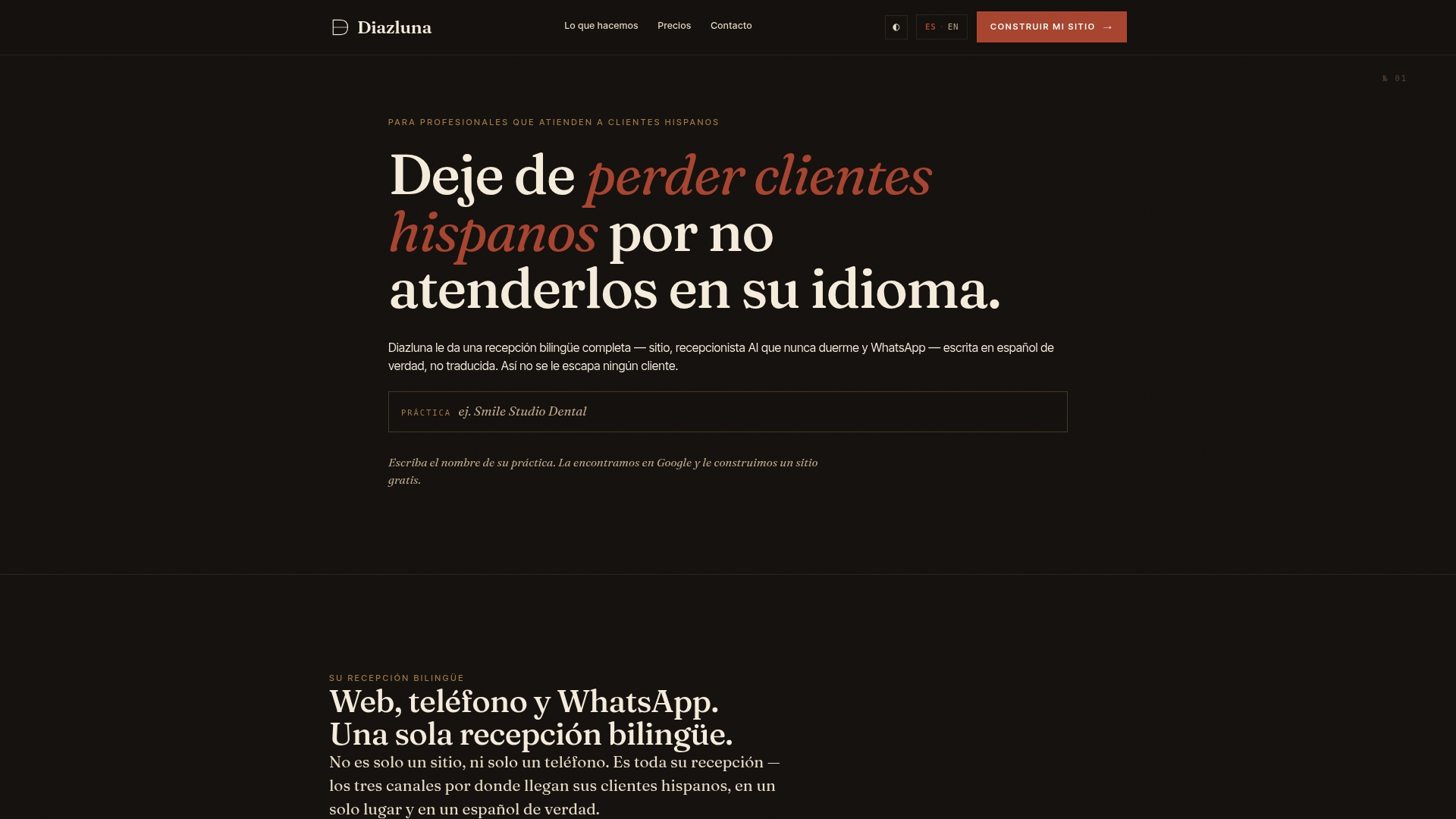
Diazluna delivers a bilingual front desk that combines a fully optimized bilingual website, a 24/7 AI receptionist fluent in Spanish and English, and WhatsApp integration. The system captures language preference at first contact and routes every follow-up, reminder, and intake form in the patient’s language automatically. Practices using Diazluna report a significant decrease in lost patients due to language barriers, and the website indexes on Google within 24 hours of launch. For dental practices specifically, Diazluna offers a dedicated bilingual solution built for Hispanic-serving offices. The result is a practice that never loses a patient because of a language gap.
FAQ
What does bilingual patient onboarding mean?
Bilingual patient onboarding is the process of delivering every step of patient intake, from the first call through a completed appointment, in the patient’s preferred language. It includes language-specific forms, voice communication, appointment reminders, and translated documentation.
How does the bilingual onboarding process work?
The process starts by capturing language preference at first contact and storing it as a primary field in the EHR or CRM. Every automated workflow, including scheduling, reminders, and intake forms, then runs in that language without requiring staff intervention.
What is bilingual dental onboarding?
Bilingual dental onboarding applies the same language-consistent intake process to dental practices, covering the initial call, new patient forms, consent documents, and appointment confirmations in the patient’s preferred language, most commonly Spanish for Hispanic-serving practices.
Why does authentic bilingual onboarding matter more than basic translation?
Authentic bilingual onboarding accounts for cultural context, regional language differences, and communication norms, not just word-for-word translation. Culturally appropriate communication builds stronger patient trust and produces higher form completion and appointment conversion rates.
What are the biggest risks of poor bilingual onboarding?
The primary risks are lost appointments from booking gaps, liability from untranslated consent forms, and patient attrition caused by inconsistent language across touchpoints. Practices that rely on individual bilingual staff instead of documented workflows face the highest exposure.