July 14, 2026
Bilingual Customer Service Benefits for Hispanic Clients

Bilingual customer service is defined as the delivery of support in both English and Spanish to meet clients in their preferred language at every touchpoint. Businesses that adopt this practice see CSAT scores rise by up to 25% and sales conversion rates climb 15–20% among Spanish-speaking clients. Those numbers are not marginal gains. They represent the difference between a practice that grows its Hispanic client base and one that quietly loses it to competitors who communicate more naturally. The bilingual customer service benefits covered here apply directly to dentists, attorneys, and healthcare providers who serve Spanish-speaking communities.
1. What are the core bilingual customer service benefits?
The most direct benefit is trust. When a Spanish-speaking client calls your office and hears a response in their own language, the interaction shifts from transactional to relational. That shift drives measurable outcomes across satisfaction, loyalty, and revenue.
- Nearly 70% of clients are more likely to stay loyal to or switch toward a brand that supports them in their native language. Loyalty at that scale translates directly into repeat appointments and referrals.
- Sales conversion rates among Spanish-speaking clients rise 15–20% when service is delivered in Spanish. That uplift comes from reduced friction, not from discounting or promotions.
- Brand reputation inside Hispanic communities grows faster through word of mouth than through paid advertising. A single satisfied Spanish-speaking client often refers family members, coworkers, and neighbors.
The multilingual customer service impact goes beyond individual interactions. It positions your practice as one that genuinely serves the community, not one that tolerates it.
2. How bilingual support increases customer loyalty

Approximately 70% of clients prefer brands that communicate in their native language. Preference at that level is not a soft metric. It predicts churn, referral behavior, and lifetime value.
Hispanic clients who feel understood are far less likely to shop around after a single appointment. They return, they refer, and they leave reviews in Spanish that attract more Spanish-speaking clients organically. The referral network inside Hispanic communities is one of the most underestimated growth channels in professional services. Bilingual support generates referral networks that monolingual competitors simply cannot access.
Pro Tip: Ask satisfied Spanish-speaking clients to leave a Google review in Spanish. Those reviews rank for Spanish-language searches and attract new clients who are actively looking for a provider who speaks their language.
3. How bilingual customer service reduces costs and improves efficiency
The cost argument for bilingual support is stronger than most professionals expect. Nearshore bilingual support in Latin America cuts staffing costs by 30–50% compared to onshore U.S. hiring, while maintaining cultural rapport and time-zone alignment with U.S. clients. That cost reduction does not come with a quality penalty. It comes with a quality improvement, because agents share cultural context with the clients they serve.
In-house bilingual staffing carries a hidden cost that rarely appears in budget discussions. Annual turnover for in-house bilingual staff runs between 30–45%. Recruiting, onboarding, and retraining at that rate consumes time and money that most small practices cannot afford. Outsourced or AI-assisted models deliver more consistent coverage without the churn risk.
The 24/7 bilingual support cost benefits become clearest when you calculate the revenue lost from after-hours calls that go unanswered. A Spanish-speaking client who calls at 8:00 PM and reaches voicemail will call the next practice on the list. That lost appointment is a real cost, even if it never appears on a balance sheet.
4. What bilingual customer intake actually covers
Bilingual customer intake is the structured process of capturing a new client’s information, qualifying their need, and routing them to the right service, all in their preferred language. Effective bilingual intake requires automatic language detection, native cultural phrasing, omnichannel coverage, and CRM integration.
What that looks like in practice:
- Automatic language detection: The system identifies the caller’s or visitor’s preferred language without asking them to press 1 for English. Menus that force a language choice signal that Spanish is secondary.
- Cultural phrasing: A bilingual agent or AI receptionist uses regional expressions naturally. A client from Mexico and a client from Puerto Rico do not speak identical Spanish. Quality services account for that.
- Omnichannel coverage: Intake happens across phone calls, text messages, web chat, and WhatsApp. Spanish-speaking clients use WhatsApp at significantly higher rates than the general U.S. population.
- CRM integration with language tagging: Every intake record is tagged with the client’s preferred language. Follow-up calls, appointment reminders, and post-visit surveys all arrive in that language.
Automated bilingual lead qualification integrated with CRM eliminates handoff errors and ensures no client falls through the gap between intake and follow-up.
Pro Tip: Tag every Spanish-language intake record in your CRM immediately. If your follow-up team does not know a client prefers Spanish, the relationship resets to zero at the next touchpoint.
5. Which bilingual service model fits your practice in 2026?
Choosing the right model depends on three variables: call volume, case complexity, and budget. Human bilingual agents suit complex or sensitive calls but operate within limited hours and at higher cost. AI bilingual receptionists provide 24/7 coverage at scale. Hybrid models combine both.
| Model | Best for | Key limitation |
|---|---|---|
| Human bilingual agents | Complex intake, empathy-driven cases | Limited hours, higher turnover |
| AI bilingual receptionist | High-volume, 24/7 booking and triage | Less nuanced for sensitive conversations |
| Hybrid AI and human | Scale with quality control | Requires coordination between systems |
| In-house bilingual staff | Full control, deep brand alignment | High cost, 30–45% annual turnover |
For most small and mid-size professional practices, the hybrid model delivers the best return. The AI receptionist handles after-hours calls, appointment booking, and initial intake. Human agents step in for complex consultations or sensitive legal and medical conversations. Diazluna is built on exactly this structure, combining a 24/7 AI receptionist with WhatsApp integration and a bilingual website so that no Spanish-speaking client ever hits a dead end.
6. What makes bilingual service quality genuinely high?
Language ability is the floor, not the ceiling. The quality of a bilingual experience depends more on cultural and operational factors than on language skill alone. A Spanish-speaking agent who uses formal Castilian phrasing with a client from Central America creates friction, not connection.
High-quality bilingual service meets four standards. First, it never makes Spanish-speaking clients feel like second-class users. The Spanish experience must match the English experience in speed, accuracy, and warmth. Second, it handles code-switching naturally. Many bilingual clients move between English and Spanish mid-sentence. A quality service follows without breaking stride. Third, it maintains standardized workflows so that intake data is captured consistently regardless of the language used. Fourth, it routes clients to the right provider or appointment type based on what they say, not just what language they say it in.
Native-level cultural nuance and standardized workflows are the two factors that separate adequate bilingual service from one that actually builds client relationships.
7. How bilingual support opens markets competitors cannot reach
Bilingual customer service acts as a market access tool that monolingual competitors cannot replicate without significant investment. A dental practice or law firm that serves Spanish-speaking clients fluently occupies a position in the local Hispanic market that English-only competitors simply cannot enter.
This is not a niche advantage. The Hispanic population in the United States is the fastest-growing demographic segment, and a large share of that population actively seeks providers who communicate in Spanish. Practices that establish bilingual service early build brand recognition and referral networks that compound over time. The advantages of bilingual support grow with the community, not just with the practice’s marketing budget.
For small businesses, Spanish-language support in 2026 is no longer optional if the local Hispanic population represents a meaningful share of potential clients. It is a baseline requirement for competitive relevance.
Key Takeaways
Bilingual customer service delivers measurable gains in satisfaction, loyalty, and revenue for practices serving Hispanic clients, and the cost of not offering it is client loss to competitors who do.
| Point | Details |
|---|---|
| CSAT and conversion gains | Native-language service lifts satisfaction scores by up to 25% and conversion rates by 15–20%. |
| Loyalty at scale | Nearly 70% of clients favor brands that support them in their native language. |
| Cost efficiency | Nearshore and AI-assisted bilingual models cut staffing costs by 30–50% versus in-house U.S. hiring. |
| Intake quality | CRM-integrated bilingual intake with language tagging prevents follow-up errors and client drop-off. |
| Market access | Bilingual service opens referral networks inside Hispanic communities that monolingual competitors cannot reach. |
Why I think most practices underestimate this advantage
I have watched practices spend thousands of dollars on paid search ads targeting Spanish-speaking clients, then lose those clients the moment they call and reach an English-only receptionist. The ad spend is wasted. The client is gone. And the practice never connects the two events.
The uncomfortable truth about bilingual support as a competitive edge is that most professionals think of it as a cost center. They budget for it the way they budget for office supplies. That framing is wrong. Bilingual service is a revenue channel. It determines whether a Spanish-speaking client books an appointment or hangs up and calls someone else.
The referral dynamic inside Hispanic communities makes this even more consequential. One satisfied client does not just return. They tell their family. Their family tells their coworkers. A single well-handled intake call in Spanish can generate five or six new clients over the following year. No paid ad delivers that return.
My practical advice: start with the after-hours gap. Most practices lose more Spanish-speaking clients between 6:00 PM and 9:00 AM than during business hours, because that is when people have time to call. An AI bilingual receptionist that answers in Spanish at 8:30 PM captures clients that a human-staffed office never could. Test that single change before investing in anything else. The results will tell you everything you need to know about the size of the opportunity you have been leaving on the table.
— Francisco
Diazluna’s bilingual front desk for Hispanic-serving practices
Practices that serve Spanish-speaking clients need more than a translated website. They need a complete communication system that works in Spanish at every touchpoint, around the clock.
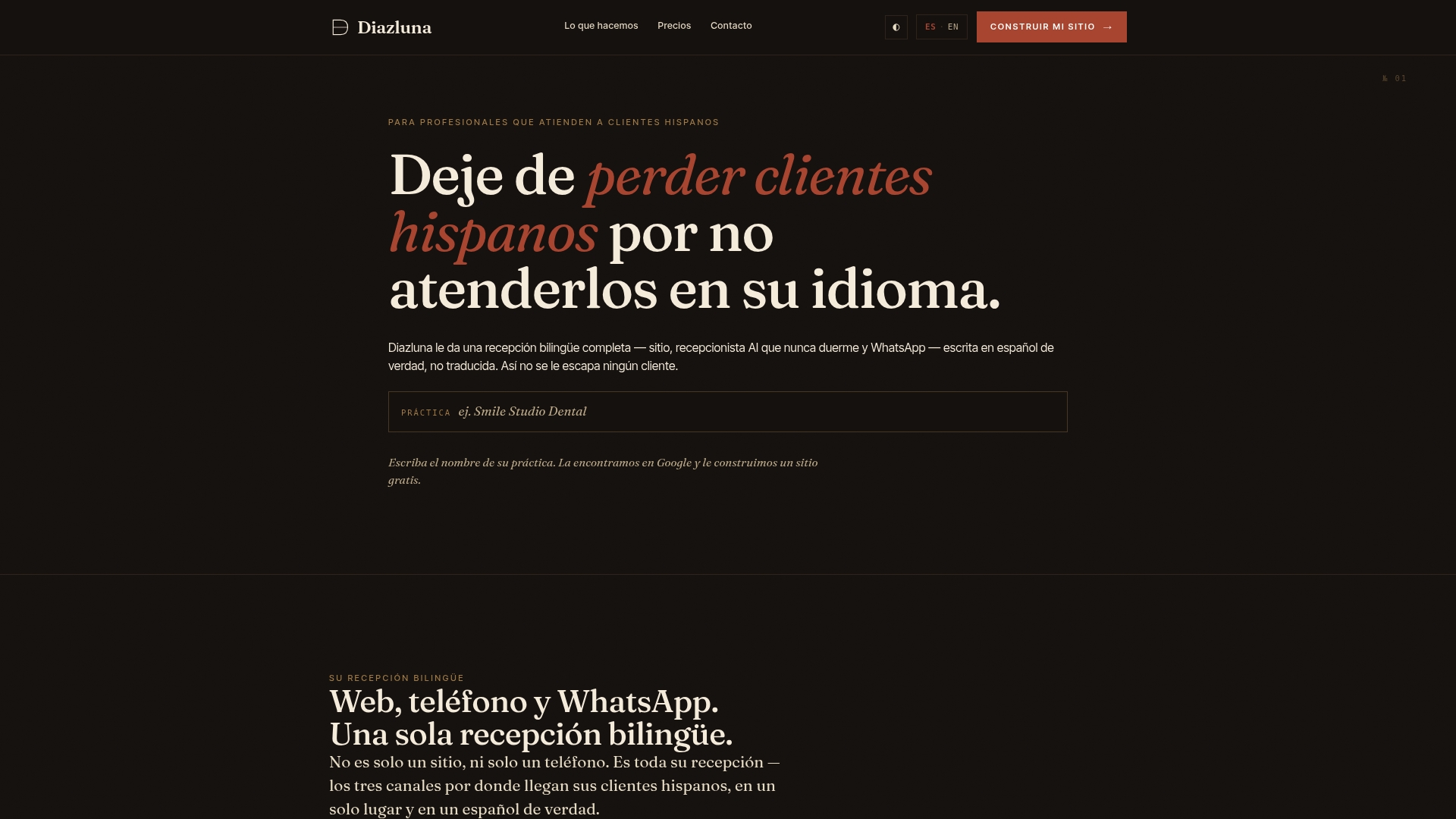
Diazluna delivers a bilingual front desk solution that combines a fully optimized bilingual website, a 24/7 AI receptionist fluent in both English and Spanish, and WhatsApp integration. Dentists, attorneys, and healthcare providers use Diazluna to capture Spanish-speaking clients after hours, qualify leads automatically, and follow up in the client’s preferred language. For dental practices specifically, Diazluna’s bilingual tools for dentists are built to reduce client loss and get practices indexed by Google within 24 hours. No client is lost because of a language barrier.
FAQ
What are the main bilingual customer service benefits?
Bilingual customer service increases client satisfaction by up to 25%, raises sales conversion rates by 15–20% among Spanish-speaking clients, and builds loyalty in Hispanic communities through native-language communication.
How does bilingual customer intake work?
Bilingual intake uses automatic language detection, cultural phrasing, and CRM integration to capture client information in Spanish or English, then routes and tags records for follow-up in the client’s preferred language.
What is the cost benefit of 24/7 bilingual support?
Nearshore and AI-assisted bilingual models reduce staffing costs by 30–50% compared to in-house U.S. hiring, while eliminating the revenue loss from after-hours calls that go unanswered.
When should a practice use an AI bilingual receptionist versus a human agent?
AI bilingual receptionists are best for high-volume, after-hours, and routine booking tasks. Human agents are better suited for complex or sensitive intake conversations that require empathy and judgment.
How does bilingual service affect referrals in Hispanic communities?
Bilingual support generates referral networks inside Hispanic communities that monolingual competitors cannot access. Satisfied Spanish-speaking clients refer family and community members at high rates, compounding client growth over time.