August 21, 2026
Spanish Readability Healthcare: A Clinic Audit Checklist

Run a validated readability check on your top ten Spanish patient education materials this week. Nearly 85.2% of online Spanish-language health information sits above the recommended 8th-grade reading level, and 60% of patients in secondary care report inadequate or problematic health literacy. That gap between what clinics hand out and what patients can actually use is measurable and fixable inside a single workweek.
Start with this micro-audit before lunch:
- Pull your five most-distributed Spanish PEMs (consent forms, discharge instructions, medication guides).
- Run each through an INFLESZ or Fernández-Huerta calculation, not an English formula.
- Flag anything scoring below “somewhat difficult” on the INFLESZ scale for rewrite.
- Ask one bilingual staff member to read a sample aloud to a patient and note where they stumble.
- Log results in a shared sheet so the rewrite queue is visible to your whole team.
The full audit workflow, sampling strategy, and remediation steps follow below.
Key Takeaways
Closing the Spanish readability gap in healthcare requires a validated audit this week, clinician-reviewed rewrites, and interim bilingual access while the work is underway.
| Point | Details |
|---|---|
| Audit before you rewrite | Score your top ten Spanish PEMs with INFLESZ or Fernández-Huerta before assuming which ones need work. |
| Trust patient-calibrated tools | English readability formulas misjudge Spanish text; use SAHL-S&E for patient-level screening instead. |
| Never skip clinical review | AI-simplified text hit target readability in about 53% of cases but only half were rated clinically accurate. |
| Reuse authoritative content | MedlinePlus en español and Health Information Translations save you from drafting from scratch. |
| Cover access gaps immediately | A bilingual front desk like Diazluna keeps patients connected by phone and WhatsApp while materials get rewritten. |
Table of Contents
- What the research says about Spanish readability in healthcare
- Why Spanish readability affects patient outcomes and compliance
- Which readability tools work for Spanish medical text?
- How do you run a Spanish readability audit in a week?
- How do you rewrite Spanish patient materials for lower reading levels?
- Building a quality assurance workflow that sticks
- Which tools and resources should you use first?
- What can you do about access while materials are being rewritten?
- Are your Spanish materials readable on the devices patients actually use?
- What one clinic learned from running its first Spanish readability audit
- Keep patients connected while you rewrite your materials
- Frequently Asked Questions
- Sources
What the research says about Spanish readability in healthcare
The numbers are consistent across studies, and they are not flattering. A 2025 systematic review of online Spanish health content found that the overwhelming majority of materials exceed the recommended 8th-grade reading level, which health literacy experts recommend for general patient audiences. That is not a marginal miss. It means the overwhelming majority of what patients read is written for an audience with more education and more medical vocabulary than most patients bring to the exam room.
Pair that with patient-side data: 60% of participants in a secondary-care setting scored their own health literacy as inadequate or problematic, measured with the Spanish version of the HLS19-Q12 survey. Two numbers, two different angles, same conclusion. The materials are too hard, and the patients know it.
A few patterns show up repeatedly in the literature:
- Studies most often use INFLESZ or Fernández-Huerta scores, both calibrated for Spanish syllable and sentence structure rather than English word counts.
- Many audits, including the orthopaedic-focused review published in PMC on Spanish translations for slipped capital femoral epiphysis materials, document exactly which formulas were applied and why, which makes their numbers easy to cite in an internal report.
- A recurring weakness across the field: some audits still run English-only formulas like Flesch-Kincaid on translated Spanish text, which produces numbers that do not map cleanly onto Spanish syllabic structure.
- Sample sizes vary widely, and a handful of frequently cited audits pull from fewer than 50 documents, so treat any single study’s percentage as a signal, not gospel.
The takeaway for a clinic administrator: your materials are probably not the exception. Assume they score high on difficulty until an INFLESZ run proves otherwise.
Why Spanish readability affects patient outcomes and compliance
Poor readability is not a cosmetic problem. When a discharge instruction sheet reads at a college level, patients misdose medication, miss follow-up appointments, and manage chronic conditions worse. Health literacy shapes whether a diabetic patient reads a glucose log correctly or whether a post-surgical patient recognizes a warning sign in time to call.
MedlinePlus frames health literacy as an organizational responsibility, not just an individual patient skill. That framing matters. It shifts the burden from “the patient should have asked” to “the clinic should have written it clearly.” Operationally, this connects to access obligations that many healthcare organizations already navigate under Title VI-style language-access requirements, which is one more reason readability work belongs on a compliance checklist, not just a communications wish list.
Three quick wins reduce risk while a full rewrite is still in progress:
- Add a one-line phone number for a bilingual nurse line to every existing Spanish handout.
- Highlight dosage numbers and frequency in bold on medication sheets, even before the prose gets rewritten.
- Attach a simple pictogram for “call your doctor if” symptoms to any document scoring poorly.
Pro Tip: Bold the three numbers that matter most on any medication sheet (dose, frequency, and the phone number to call with questions) before you touch the prose. It buys you weeks while the full rewrite works through review.
Which readability tools work for Spanish medical text?
Not every tool that claims to measure “readability” understands Spanish. English formulas like Flesch-Kincaid count syllables and sentence length using rules built for English phonetics, and Spanish has a different syllabic rhythm, more polysyllabic words, and different sentence conventions. Running an English formula on Spanish text produces a number that looks precise and means very little.
Two formulas dominate the Spanish-language literature:
- INFLESZ, an index built specifically for Spanish health text, with interpretation bands running from “very difficult” through “very easy,” and a target zone most patient materials should hit.
- Fernández-Huerta, an older adaptation of the Flesch formula recalibrated for Spanish vocabulary and sentence patterns, still cited in PMC’s review of Spanish translation readability for orthopaedic patient materials.
Some audits also use Flesch-Szigriszt variants, which follow a similar recalibration logic. All three outperform raw English formulas applied to translated text, but none of them catch clinical inaccuracy. A document can score “easy” on INFLESZ and still tell a patient the wrong dose.
Here is the workflow that keeps you from over-trusting a single number:
- Pull the document’s full text into a Spanish-calibrated readability calculator (INFLESZ or Fernández-Huerta).
- Record the raw score and its interpretation band, not just a pass/fail label.
- Cross-check any document scoring “difficult” or worse against a plain-language checklist: sentence length, passive voice, technical jargon.
- Route the document to a bilingual clinician for a fifteen-minute accuracy read before publishing any rewrite.
- Log the before-and-after scores so you can show measurable progress in a quarterly report.
That fourth step is the one teams skip, and it is the one that matters most. Recent research on AI-simplified orthopaedic materials found that readability improved to target levels in about 53% of AI-adapted cases, but only roughly half of those were rated clinically accurate by subject-matter experts. A tool can make text easier to read while quietly breaking the clinical content. Automated simplification, whether from an AI tool or a fast human rewrite, needs a second set of eyes trained in the subject matter.
Pro Tip: Pair every automated readability score with one plain question asked directly to a patient: “What would you do after reading this?” If they can’t answer correctly, the score doesn’t matter.
How do you run a Spanish readability audit in a week?
A full-scale rewrite of every document in your practice is not realistic on a normal schedule. A focused audit is. The trick is sampling the right documents first, not all of them.
Prioritize by clinical stakes and traffic: consent forms, medication instructions, and pre/post-op instructions carry the highest risk if misunderstood, so audit those before generic wellness handouts. High-traffic website pages, the ones patients actually land on before an appointment, come next.
For a one-day audit, sample eight to twelve documents across three strata: clinic-issued forms, website pages, and printed handouts. A one-week audit can expand that to twenty-five or thirty documents and add a small patient-feedback round.
| Field to capture | What it tells you |
|---|---|
| Document ID and title | Tracks which version was scored and when |
| Audience and clinical context | Flags whether stakes are high (surgical) or low (general wellness) |
| Original language of drafting | Shows whether the Spanish is a translation or a native draft |
| INFLESZ or Fernández-Huerta score | The core difficulty measurement |
| Clinical-review flag | Marks whether a bilingual clinician has verified accuracy |
Interpretation is straightforward once the data is in front of you. Anything landing in “very difficult” or “difficult” on INFLESZ goes into an immediate rewrite queue. Documents in the “normal” band get a fast edit pass, mostly sentence-length trims and jargon swaps. Anything already in “easy” or “very easy” gets monitored on your normal review cycle rather than rewritten from scratch.
How do you rewrite Spanish patient materials for lower reading levels?
Lowering a reading-grade score without damaging clinical meaning takes a specific set of habits, not a generic “simplify” instruction. Short sentences, active voice, and familiar vocabulary do most of the work. Avoid calques (literal word-for-word translations that sound off in Spanish) and false friends like “embarazada” traps, where a translator assumes a cognate means what it does in English.
Translation and transcreation are not the same job. Straight translation works for a nutrition label or a clinic hours sheet, where the content is factual and culturally neutral. Transcreation, rebuilding the message around the target culture’s assumptions rather than translating word for word, matters more for anything touching pain management, mental health, or end-of-life decisions, where direct translation can carry the wrong emotional register or miss a cultural nuance entirely. Getting the tone and cultural nuance right in these higher-stakes documents is worth the extra review cycle.
Visuals carry weight that text alone cannot. Numeracy guidance benefits enormously from labeled units and simple frequency charts (once a day, twice a day, shown as icons rather than just written out). For audiences with limited literacy in either language, fotonovelas and community health workers known as promotores often outperform text-only pamphlets, because they carry information through narrative and social trust rather than through reading comprehension alone.
None of this replaces a second read from someone with clinical training. Patient-centered translation research shows that patient review panels catch confusing phrasing that readability formulas miss entirely, because a formula measures sentence structure, not whether a patient actually understands the instruction the way you intended.
Pro Tip: Route every simplified document through a bilingual clinician before publishing, especially after an AI tool has touched it. Readability tools improve syllable counts; only a clinician catches a dropped contraindication.
Building a quality assurance workflow that sticks
An audit that happens once and never repeats is not an audit, it is a snapshot. Durable improvement needs assigned roles: a content owner who tracks the document inventory, a bilingual clinical reviewer who signs off on accuracy, a patient reviewer panel (ideally including promotores) who checks real-world comprehension, and a QA data steward who logs scores over time.
A lightweight sign-off checklist before anything gets published should confirm four things: the INFLESZ score meets your target band, a clinician has verified accuracy, a patient or promotor has confirmed cultural fit, and the document meets basic accessibility standards for font and format.
Track a small set of KPIs quarterly: percent of PEMs meeting your target readability score, average time from flagging a document to publishing its fix, and results from periodic patient comprehension spot-checks.
Pro Tip: Embed the readability score and review date directly into your document management system’s metadata. When a document drifts out of date or a clinical guideline changes, you’ll know instantly which Spanish materials need a re-audit instead of guessing.
Which tools and resources should you use first?
You do not need to build readability tools from scratch. Use INFLESZ and Fernández-Huerta calculators for scoring, and treat any score below the “normal” band as your rewrite trigger. For patient-level screening, the SAHL-S&E instrument is validated across Spanish and English speakers with strong reliability, making it a solid choice when you want to measure actual patient health literacy rather than just document difficulty.
For content you can adapt rather than write from scratch, MedlinePlus en español and the Health Information Translations project both offer authoritative, pre-translated patient materials covering common conditions. Store adapted versions in a version-controlled folder so edits do not overwrite prior clinician sign-offs.
What can you do about access while materials are being rewritten?
A full rewrite queue can take months. Patients still walk through your door tomorrow. Interim tactics close the gap: bilingual front-desk support, a WhatsApp concierge line, and templated clinician scripts in Spanish for the most common instructions (medication timing, follow-up scheduling, when to seek emergency care).
Document these interim measures in your access logs. If a patient was walked through discharge instructions verbally by bilingual staff rather than handed an English-only sheet, note it. That record matters for both continuity of care and language-access auditability.
- Train front-desk and triage staff to scan for key clinical data points rather than attempt literal translation on the fly.
- Log every interim bilingual interaction the same way you’d log a document handout.
- Keep a short list of pre-approved phrases for common scenarios so staff aren’t improvising translations under pressure.
Pro Tip: Administrative Spanish and conversational Spanish are different registers. Train staff to recognize and scan for the data point (a dosage, a date, a diagnosis code) rather than trying to translate a form word for word in real time.
Are your Spanish materials readable on the devices patients actually use?
Readability is not just about grade level. A document scoring “easy” on INFLESZ can still fail patients if the font drops accents and tildes, or if the layout breaks on a phone screen. Spanish requires consistent rendering of characters like ñ, á, é, í, ó, ú, and ü. Some older PDF templates and legacy web fonts substitute a placeholder box or drop the diacritic entirely, which changes word meaning (“año” without the tilde reads as an entirely different, vulgar word) and undermines trust instantly.
Test every Spanish PEM on the actual device most patients use to view it. For many clinics, that is a smartphone browser, not a desktop PDF viewer. Check that:
- Accented characters render correctly across your website, your patient portal, and any printed handout template.
- Text reflows properly on small screens instead of requiring horizontal scrolling.
- PDF forms remain fillable and legible when opened directly on a phone rather than downloaded first.
- Color contrast and font size meet basic accessibility standards for older patients, who make up a large share of chronic-disease PEM readers.
A clinic website built with proper bilingual architecture from the start avoids most of these problems, since accent and layout handling gets addressed at the template level rather than patched document by document. Some medical website design resources specifically address font and rendering choices for practices serving multilingual patient bases, which is worth a look if your current site was built without Spanish in mind from day one.
What one clinic learned from running its first Spanish readability audit
A community clinic content owner spent roughly six hours over two days auditing eighteen Spanish PEMs. The top three wins: two consent forms dropped from “difficult” to “normal” on INFLESZ after cutting passive voice, a medication handout gained a bolded dosage table that patients immediately understood better in informal feedback, and a discharge sheet got flagged for a mistranslation a bilingual nurse caught during clinical review, something no formula would have caught.

The failure: the team initially trusted an AI-generated Spanish draft without clinical review, and it slipped through for two weeks before a nurse spotted an error in wound-care frequency.
The advice that stuck: audit small, verify with a clinician every time, and don’t publish anything AI-touched without a human check first.
Keep patients connected while you rewrite your materials
While your team works through the audit queue, patients are still calling, texting, and walking in with questions your rewritten materials haven’t reached yet. A bilingual front desk that never sleeps closes that gap without waiting for the full remediation project to finish.
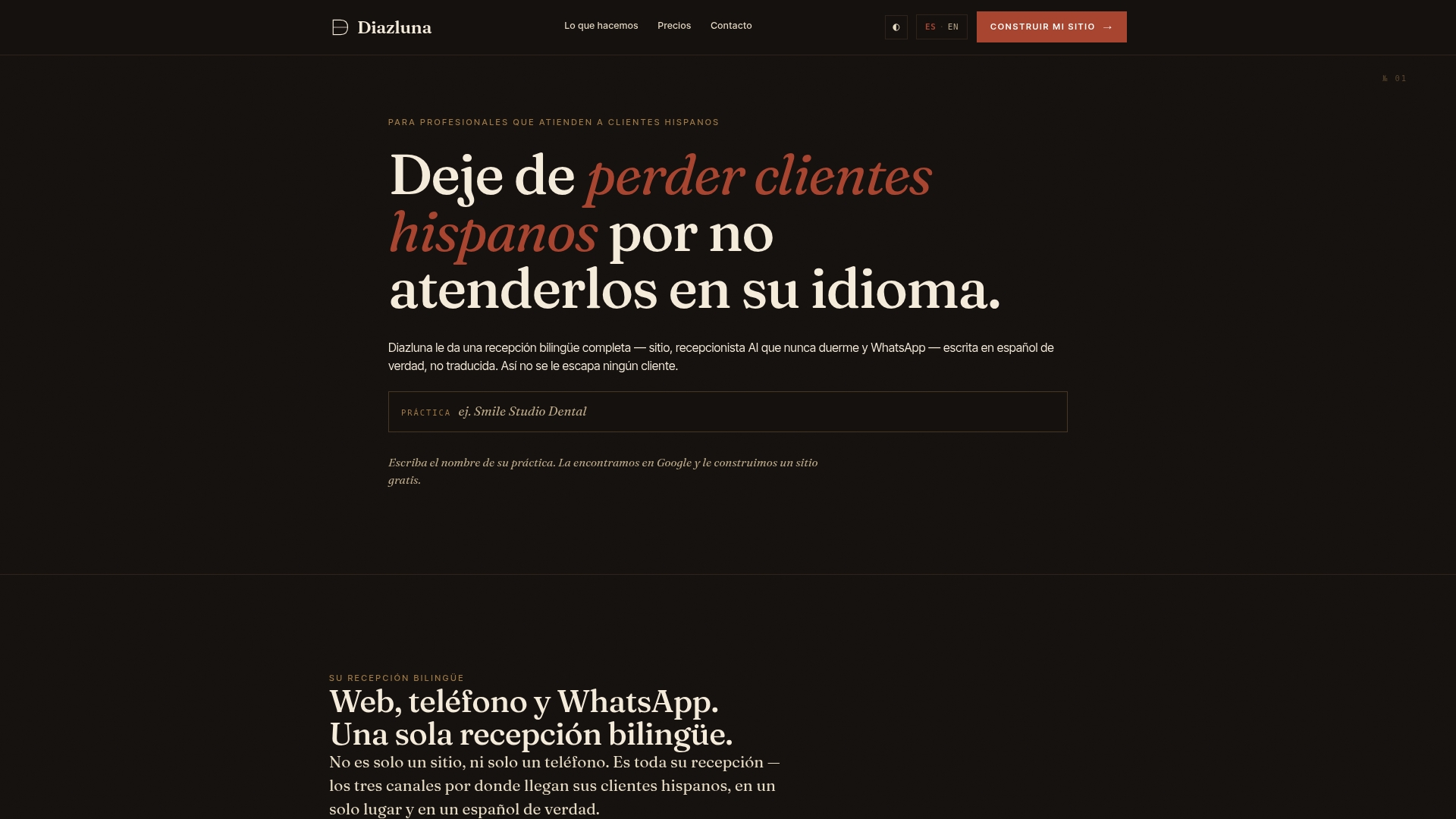
Diazluna gives practices a bilingual website, a 24/7 AI receptionist fluent in Spanish and English, and WhatsApp integration built for exactly this interim period, when your printed materials are still catching up but your patients need answers now. Instead of hiring a translator, a separate answering service, and a web developer, one platform handles all three at a fraction of what those services would cost separately. For dental practices specifically, the bilingual site, phone, and WhatsApp package for Hispanic-serving dentists is built around exactly this kind of patient-access gap.
If your clinic serves Hispanic patients and your Spanish PEMs are mid-rewrite, start with Diazluna’s bilingual front-desk platform and get a same-week setup instead of leaving patients to navigate English-only phone trees while your content team finishes the audit.
Frequently Asked Questions
What is a good INFLESZ score for a Spanish patient handout? Aim for the “normal” or “easy” bands. Anything landing in “difficult” or “very difficult” should go straight into your rewrite queue, since patients with limited health literacy are unlikely to fully understand it.
Can I just run my Spanish PEMs through Flesch-Kincaid? No. Flesch-Kincaid is calibrated for English syllable and sentence patterns, and applying it to Spanish text produces a misleading score. Use INFLESZ or Fernández-Huerta instead.
Is AI translation safe to use for medical instructions? AI tools can improve readability quickly, but a recent study found only about half of AI-simplified adaptations were rated clinically accurate by experts. Always route AI-generated Spanish text through a bilingual clinician before publishing.
How often should we re-audit our Spanish materials? Quarterly spot-checks work for most clinics, with an immediate re-audit any time a clinical guideline or medication protocol changes.
Do we need a native Spanish speaker to write these materials, or is professional translation enough? Professional translation handles factual content well, but higher-stakes materials, especially around pain, mental health, or end-of-life care, benefit from transcreation by someone who understands the target community’s cultural context, not just the language.
This article is general information, not a substitute for advice from a qualified doctor. Consult a qualified healthcare professional about your own circumstances before acting on anything here.
Sources
- Readability Level of Spanish Language Online Health Information: A Systematic Review
- Validation of the Spanish version of the Health Literacy Survey (HLS19-Q12) in secondary care specialty consultations
- Health literacy - MedlinePlus
- Short Assessment of Health Literacy-Spanish and English: A Comparable Test of Health Literacy for Spanish and English Speakers
- AI adaptation study (2025) showing trade-offs between readability gains and accuracy