July 29, 2026
Why Spanish Tone Matters for Client Retention

Spanish tone directly determines whether a Hispanic client feels understood or dismissed, and that perception drives whether they stay, refer others, or quietly leave. Run a tone audit on your three highest-stakes touchpoints this week: phone intake, appointment confirmations, and consent documents.
Bilingual support done right costs less than the clients you lose without it. Diazluna’s bilingual front-desk system is built around exactly this principle.
Table of Contents
- Why Spanish tone matters for client retention: the real business case
- How Spanish tone differs from literal translation
- Where Spanish tone must be implemented across the client journey
- A practical implementation roadmap for your practice
- Building a Spanish tone guide and QA process
- How to measure the impact of Spanish-tone improvements
- U.S. legal and ethical considerations for Spanish-language communications
- How Diazluna’s bilingual front desk reduces invisible losses
- Key Takeaways
- The part most practices get wrong
- Diazluna’s bilingual front desk: built for this exact problem
- Authoritative sources and further reading
Why Spanish tone matters for client retention: the real business case
Poor Spanish-language tone creates losses that never show up on a cancellation report. A prospective patient who hears a robotic automated greeting in Spanish and hangs up is not logged as a lost lead. A legal client who felt talked down to during intake and chose another firm never files a complaint. These are invisible losses, and they compound.
Bilingual support gaps typically cost more in lost acquisitions, churn, and foregone referrals than the full cost of implementing Spanish-language support. For a small practice with 20 new Hispanic inquiries per month, even a notable drop-off at intake represents meaningful annual revenue gone without a trace.
The referral angle is just as significant. Hispanic communities are relationship-driven. One client who feels genuinely respected in Spanish can generate three or four referrals. One who felt like a transaction tells the same number of people to go elsewhere.
Key invisible loss categories:
- Abandoned calls from Spanish IVR nodes that never connect to a live or bilingual AI agent
- Intake forms available only in English that reduce conversion among Spanish-dominant prospects
- Consent and fee agreements that clients sign without fully understanding, leading to disputes and early churn
- Billing communications that feel cold or confusing, triggering unnecessary escalations
Bilingual customer care increases repurchase likelihood and reduces churn, with some case studies documenting meaningful churn improvements after dedicated Spanish-language support was introduced.
How Spanish tone differs from literal translation
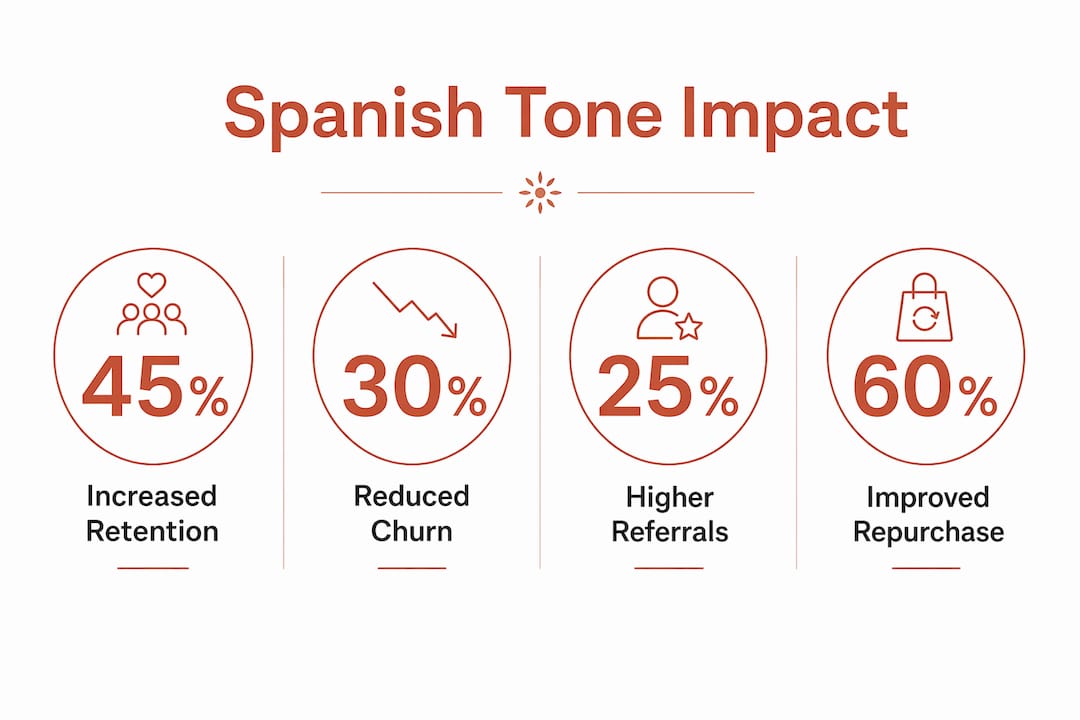
Literal translation is not the same as culturally appropriate Spanish. A phrase that reads as warm and professional in English can land as blunt, dismissive, or even rude once translated word-for-word into Spanish.

The technical term for this is pragmatic transfer: the speaker’s native-language politeness norms carry over into the second language, producing communication that is grammatically correct but culturally off. In Spanish, warmth is not optional. It is structural.
Three paired examples that show the gap:
| English original | Literal Spanish translation | Spanish-tone alternative |
|---|---|---|
| ”We’ll get back to you." | "Le contactaremos." | "Con mucho gusto le llamamos en breve, señora García." |
| "Please fill out this form." | "Por favor llene este formulario." | "Le pedimos amablemente que complete este formulario para poder atenderle mejor." |
| "Your appointment is confirmed." | "Su cita está confirmada." | "Confirmamos su cita con el doctor Ruiz el martes a las 10 AM. Estamos para servirle.” |
The tú/usted choice matters more than most English-speaking professionals realize. In healthcare and legal settings, defaulting to usted signals respect. Switching to tú prematurely reads as overfamiliar, especially with older clients or those from more formal regional backgrounds. Brand voice in Spanish requires calibrated tone decisions, not just vocabulary swaps.
Spanish-speaking clients often prefer detailed, formal interactions. A casual English register that feels friendly can read as dismissive once rendered in Spanish.
Pro Tip: Avoid the two most common tone errors: robotic over-formality (“Estimado cliente, su solicitud ha sido procesada”) and accidental bluntness from direct translation. Neither builds trust. Aim for measured warmth: formal enough to show respect, personal enough to show care.
Where Spanish tone must be implemented across the client journey
Every touchpoint in the client lifecycle carries a tone risk. The ones below are where tone failures most often trigger churn or block acquisition.
- Phone greeting and IVR: The first 10 seconds set the relationship. A Spanish option that sounds like a machine translation signals that Spanish speakers are an afterthought. Use natural phrasing: “Gracias por llamar. ¿En qué le podemos ayudar hoy?”
- Intake forms: Translated forms should use plain, respectful language. Avoid legal jargon in Spanish that even educated native speakers find opaque.
- WhatsApp: Many Hispanic clients prefer WhatsApp over email or phone. Tone here should be warm but professional. “Buenos días, señora López. Le confirmamos su cita para mañana a las 9 AM. Cualquier pregunta, con gusto le ayudamos.”
- Appointment confirmations: Include the provider’s name and a warm closing. Impersonal confirmations feel like spam.
- Consent and fee agreements: Multilingual communication breakdowns often occur before legal work formally begins. Translated consent documents must be accurate and reviewed by a native speaker, not auto-translated.
- Billing communications: Cold billing language in Spanish is a top driver of disputes. Use respectful phrasing and offer a contact name.
- After-hours support: A missed Spanish call after hours is often a permanently lost client. After-hours Spanish support is one of the highest-ROI investments a small practice can make.
On regional variation: Mexican Spanish dominates in many U.S. markets, but Puerto Rican, Cuban, Central American, and Colombian Spanish carry different registers and vocabulary. When in doubt, use neutral Latin American Spanish for written materials and train staff to follow the client’s lead in conversation.
A practical implementation roadmap for your practice
| Timeline | Priority actions |
|---|---|
| 0–30 days | Bilingual phone greeting, Spanish IVR option, WhatsApp availability, translated intake form |
| 1–3 months | Hire or train bilingual staff, build a one-page Spanish tone guide, translate consent and fee documents |
| 3 months | Embed AI receptionist with Spanish capability, instrument KPIs by language cohort, run quarterly tone QA |
Quick wins that reduce churn fast:
- Add a Spanish greeting to your phone system today. It costs nothing and signals inclusion immediately.
- Enable WhatsApp as a contact channel and assign a bilingual team member to manage it.
- Bilingual support reduces friction at critical moments, improving first-contact resolution and trust.
Medium-term, the goal is consistency. A bilingual staff member who improvises tone differently every call creates brand confusion. A one-page tone guide solves this. Long-term, embedding a 24/7 AI receptionist with genuine Spanish fluency removes the dependency on individual staff availability entirely.
Building a Spanish tone guide and QA process
A tone guide does not need to be a 40-page manual. One page, used consistently, beats a binder no one reads.
Core components of a compact Spanish tone guide:
- Brand personality in Spanish: Two or three adjectives that describe how your practice sounds (e.g., warm, respectful, clear).
- Tú/usted policy: Default to usted for all new clients unless they explicitly invite informality.
- Phrase lists: Five phrases to use, five to avoid. Example to avoid: “No podemos hacer eso.” Replace with: “Lo que sí podemos hacer es…”
- Register examples by touchpoint: One model sentence for phone, WhatsApp, billing, and follow-up.
QA checklist:
- Review a random sample of 10 Spanish interactions per month (calls, WhatsApp, emails).
- Have a native Spanish speaker score each on warmth, clarity, and formality appropriateness.
- Flag any interaction where a client repeated themselves or escalated, and trace whether tone contributed.
- Tone mistakes show up as escalations and longer resolution times, not grammar errors. Targeted coaching moves those metrics.
Micro-training exercises: Role-play a billing dispute in Spanish. Role-play a client who speaks Caribbean Spanish when your staff trained on Mexican Spanish. These scenarios surface gaps faster than any written test.
How to measure the impact of Spanish-tone improvements
You cannot manage what you cannot see. Most practices track overall retention but never segment it by language.
KPIs to add to your dashboard:
- Retention rate by language cohort (Spanish-dominant vs. English-dominant clients)
- First-contact resolution rate by language
- Cancellation and no-show rates by language
- Referral source tracking: what percentage of new Hispanic clients came from a referral?
- CSAT scores by language, collected via WhatsApp or post-visit SMS
| Metric | How to surface it | Directional target |
|---|---|---|
| Spanish call abandonment rate | IVR analytics by language node | — |
| Spanish-cohort retention | CRM filter by preferred language | At or above overall practice average |
| First-contact resolution (Spanish) | Support ticket or call log tagging | — |
| Referral rate (Hispanic clients) | Intake form: “How did you hear about us?” | Rising quarter over quarter |
Hidden losses surface when you add language as a filter. If your Spanish-cohort no-show rate is notably higher than your English-cohort rate, that is a tone and communication problem, not a scheduling problem.
U.S. legal and ethical considerations for Spanish-language communications
Language access in healthcare and consumer-facing professional services carries real regulatory weight. The HHS Office for Civil Rights enforces limited English proficiency requirements under Title VI for federally funded programs, which includes most healthcare providers.
Risk checklist:
- Translated consent documents must be accurate. Auto-translated forms that contain errors can invalidate informed consent.
- WhatsApp and SMS messaging of protected health information (PHI) requires a Business Associate Agreement (BAA) and HIPAA-compliant configuration. Standard WhatsApp does not meet this standard without additional controls.
- Retain copies of translated communications as part of the client record.
- Fee agreements in Spanish must be reviewed by a qualified bilingual professional, not just run through a translation tool.
This article is general information, not legal or compliance advice. Confirm current requirements with HHS guidance or a qualified attorney for your specific situation.
How Diazluna’s bilingual front desk reduces invisible losses
Diazluna’s service addresses the exact touchpoints where tone failures most often occur: the first phone call, the after-hours inquiry, the WhatsApp message that goes unanswered, and the website that greets a Spanish-speaking visitor in English.
The core offering combines three components:
- A fully optimized bilingual website indexed by Google within 24 hours of launch, so Spanish-speaking prospects find you before they find a competitor.
- A 24/7 AI receptionist fluent in both Spanish and English, trained to handle intake, appointment scheduling, and follow-up with culturally appropriate tone, not machine translation.
- WhatsApp integration that meets Hispanic clients on the channel they already use, with consistent tone across every message.
Diazluna clients report a significant decrease in client loss attributed to language barriers after implementation. Specific case metrics are available directly from Diazluna upon request.
Three in four clients change advisers due to service dissatisfaction. Tone is a service quality issue, not a translation issue.
Key Takeaways
Spanish tone is the single most underinvested retention lever for U.S. practices serving Hispanic clients, and fixing it at three touchpoints produces measurable churn reduction within 90 days.
| Point | Details |
|---|---|
| Tone audit first | Run a native-speaker review of phone, WhatsApp, and consent documents before any other change. |
| Default to usted | Use formal address for all new Spanish-speaking clients unless they invite informality. |
| Segment your KPIs | Add language cohort as a filter to retention, no-show, and referral metrics to surface hidden losses. |
| Build a one-page tone guide | Document five phrases to use and five to avoid; assign a native reviewer for monthly QA sampling. |
| Diazluna accelerates the roadmap | Diazluna’s bilingual website, AI receptionist, and WhatsApp integration cover the highest-risk touchpoints from day one. |
The part most practices get wrong
Most healthcare and legal practices treat Spanish-language support as a translation problem. They hire one bilingual staff member, translate their intake form, and consider the job done. What they miss is that tone is not a language feature. It is a relationship signal.
A client who hears usted used correctly, who receives a WhatsApp confirmation with their doctor’s name and a warm closing, who gets a billing question answered without feeling rushed, does not consciously think “that practice respects my culture.” They just feel comfortable. And comfortable clients refer people.
The practices that get this right do not necessarily have larger budgets. They have made a deliberate decision to treat Spanish communication as a system, not a workaround. That means a tone guide, a QA process, and technology that holds the standard when staff turns over. The operational investment is modest. The retention difference is not.
Diazluna’s bilingual front desk: built for this exact problem
If the roadmap above describes where you want to go, Diazluna gets you there without building it from scratch. Instead of hiring, training, and managing bilingual staff across every shift, you get a done-for-you bilingual front desk: a Spanish-English website live within 24 hours, a 24/7 AI receptionist that handles intake and scheduling in both languages with genuine cultural tone, and WhatsApp integration your Hispanic clients will actually use.
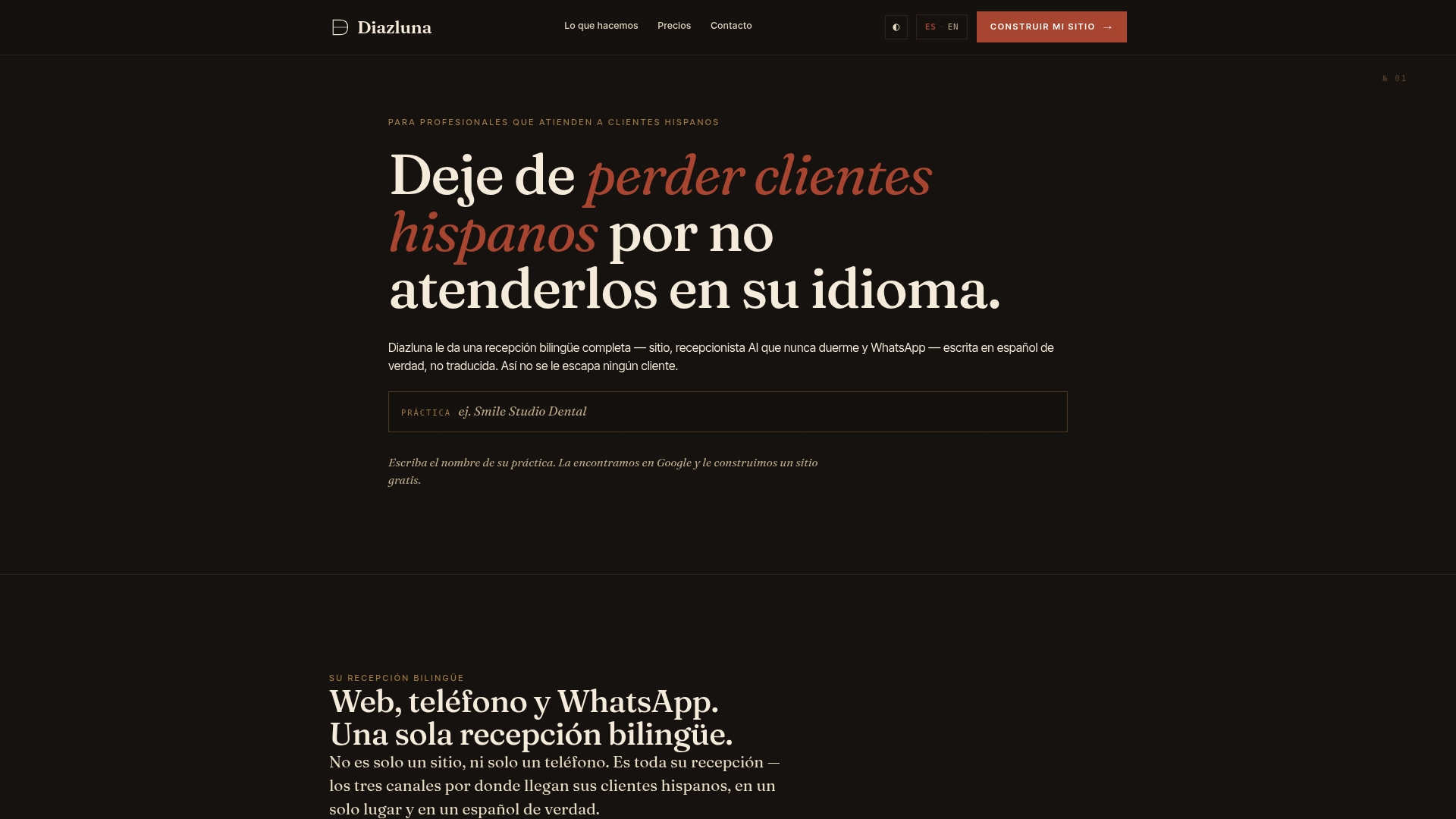
For dental practices, law firms, and healthcare providers, this covers the 0–30 day quick wins and the long-term systems integration in a single package, at a fraction of what a traditional agency charges for each piece separately. Visit Diazluna’s bilingual front-desk service to see how it maps to your practice’s specific gaps, or go directly to the dental practice page if you serve a Hispanic patient base and want a demo.
Authoritative sources and further reading
The claims in this article draw from the following sources, each relevant to a specific layer of the Spanish-tone retention argument:
- Spanish-speaking customer support — enhanced CX: Business case for bilingual support ROI and invisible-loss framing in U.S. markets.
- Three in four clients change legal adviser due to service dissatisfaction: Professional-services switching study; foundational for the retention argument in law and healthcare.
- How bilingual support improves retention | CallZent: Operational findings on first-contact resolution and trust in bilingual service settings.
- Customer service language: how tone makes the difference | Talaera: Tone-coaching framework with measurable outcomes (escalation rate, handle time).
- Brand voice in two languages | Copybara: Practical guidance on tú/usted decisions and voice adaptation for bilingual markets.
- Spanish language guide | Unbabel: Cultural-pragmatic guidance on formality expectations in Spanish-language client interactions.
- 2026 Spanish bilingual customer service study | PCNAnswers: Aggregate findings on churn reduction and repurchase likelihood from dedicated Spanish-language support.
- Multilingual client communication and law firm retention | Legal Marketing Blog: Strategic framing of language access as a retention and marketing advantage for law firms.
- HHS Limited English Proficiency guidance: Primary U.S. regulatory source for language access obligations in healthcare.