July 22, 2026
What Is a 24/7 Legal AI Receptionist? 2026 Guide

A 24/7 legal AI receptionist is an AI-powered virtual assistant that answers client calls, runs intake conversations, schedules consultations, and routes urgent matters around the clock, with no hold times and no missed calls. Unlike a standard phone menu, it holds a real conversation. A caller describes their situation in plain language, and the system responds with relevant questions, captures intake data, and either books an appointment or escalates to a live attorney when the matter is urgent. For law firms, that means every inbound call at 2 AM on a Saturday gets the same professional response as one at 10 AM on a Monday.
The core functions at a glance:
- 24/7 call answering with natural language conversation, no phone trees
- Client intake scripting that captures case type, contact details, and urgency level
- Consultation scheduling synced directly to attorney calendars
- Urgent call routing to on-call staff when the situation demands it
- Message handling for existing clients, with call screening to block spam
What is a 24/7 legal AI receptionist built to do for your firm?
The technology behind these systems goes well beyond a simple chatbot. Leading AI receptionists use natural language processing so callers describe their needs without navigating complex menus, which removes friction at the first point of contact. The result is a front desk that feels attentive rather than automated.
Modern platforms use a layered, multi-agent architecture where specialized roles handle different parts of a call. One agent triages the call type, another retrieves firm-specific knowledge, and a third coaches the system toward lead conversion. This prevents the generic, one-size-fits-all responses that frustrate callers and erode trust.
The business case is direct. Firms gain 24/7 availability without adding headcount, which cuts front desk labor costs while keeping every inquiry covered. Client intake data flows automatically into case management platforms, so attorneys start their day with organized leads rather than a stack of voicemails.
Primary benefits law firms report:
- Higher lead capture by answering calls that would otherwise go to voicemail
- Lower overhead compared to hiring additional reception staff
- Faster intake, since the AI collects structured data during the call
- Consistent, professional tone on every call regardless of time or call volume
- Reduced staff interruptions from routine inquiries and spam calls
Stat to know: 33% of law firms reported gaining 1–2 new leads per week after adopting a virtual receptionist service to handle routine communications.
Some platforms, including those with call screening capabilities, also block unwanted calls and handle existing clients through a separate queue, which keeps the intake pipeline clean and the staff focused on billable work.
How do you integrate a legal AI receptionist into your existing workflow?
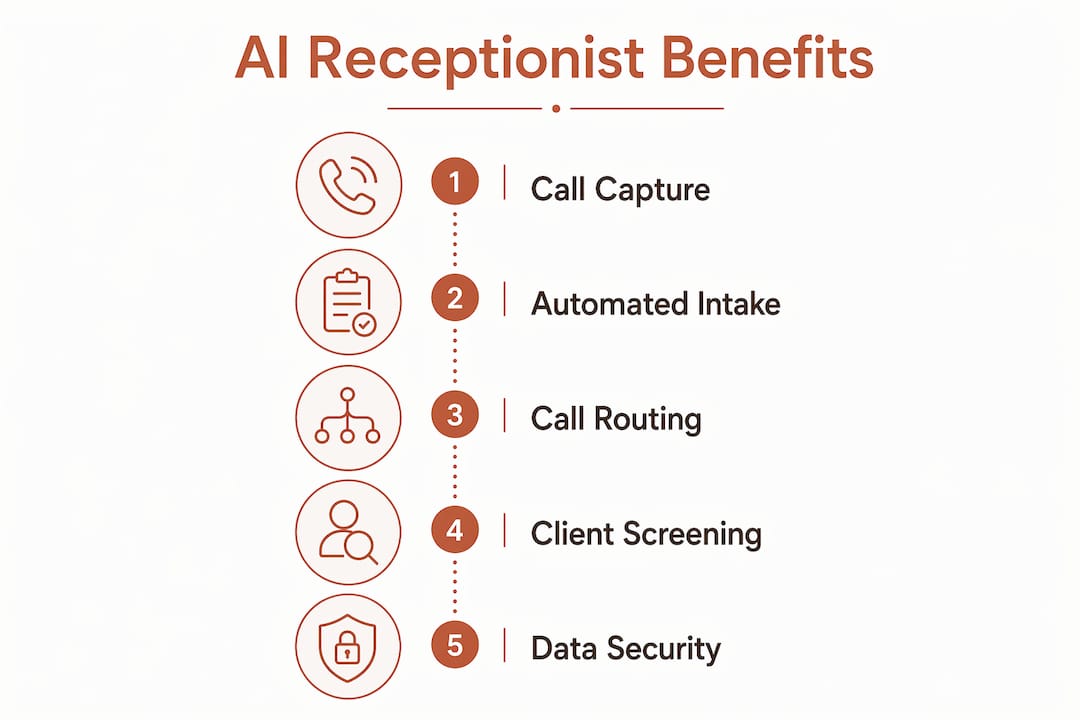
Setup is faster than most firms expect, but the quality of the outcome depends heavily on how well the system is configured before it goes live. The AI needs to know your practice areas, your intake questions, your escalation rules, and your calendar availability. Skipping that groundwork produces a generic experience that reflects poorly on the firm.
Steps for a smooth rollout:
- Map your current intake process before touching any software
- Define escalation triggers: what call types require immediate human transfer
- Connect the AI to your calendar, CRM, and case management platform
- Write intake scripts that match your firm’s tone and legal specialty
- Test with real call scenarios before going fully live
Integration with tools like Clio, MyCase, LawPay, and Google Calendar is standard across most leading platforms. Top AI legal receptionists connect directly to these systems to automate appointment scheduling and follow-up, so no data entry falls through the cracks.
Security is non-negotiable in legal communications. Reputable platforms encrypt client data and restrict access to protected information, keeping the firm compliant with confidentiality obligations. Before signing with any provider, confirm their data handling practices align with your state bar’s requirements.

Pro Tip: During the first few weeks, review 10–20 recorded calls each week. The AI can drift toward providing general legal information that crosses into advice. Catching that early, before a client relies on it, protects both the client and the firm.
Customization goes beyond scripts. Most platforms let you set the AI’s name, speaking style, and even the specific language it uses to describe your practice areas. For firms serving Hispanic clients, bilingual AI receptionist options handle Spanish and English calls with equal fluency, which prevents the language barrier from becoming a lost client.
How do the top legal AI receptionist services compare in 2026?
Six providers dominate the legal AI receptionist space in 2026. Each takes a different approach, and the right fit depends on your firm’s size, call volume, and workflow priorities.
| Provider | Best for | Key features | Integration capabilities | Customer support |
|---|---|---|---|---|
| RingCentral AI Receptionist | Firms needing reliable call management with broad integrations | Natural language call handling, smart routing, 24/7 availability | Extensive: CRM, calendar, UCaaS platforms | Business-grade support with SLA options |
| CaseGen.ai | Advanced intake automation and follow-up workflows | Multi-agent AI, full client intake, outreach automation, call blocking | CRM and case management integrations | Dedicated onboarding support |
| Answering Legal | Legal call management with screening focus | Call screening, message handling, spam blocking, legal-specific scripts | Standard CRM and calendar connections | Live support team |
| LEX Reception | Firms prioritizing caller experience and ease of use | Natural conversation, appointment booking, smooth call routing | Calendar and case management tools | Responsive client success team |
| Ruby | Hybrid AI and human answering | AI-to-human handoff, personalized support, flexible intake | CRM and scheduling integrations | 24/7 live agent backup |
| Smith.ai | Multilingual and bilingual call handling | Multilingual AI, lead intake, CRM and calendar sync | Deep CRM and calendar integration | 24/7 support with dedicated account management |
RingCentral AI Receptionist suits firms already running on RingCentral’s communications platform. The call routing is reliable, the natural language capability handles complex caller descriptions, and the integration depth is hard to match for firms with an existing tech stack.
CaseGen.ai goes further on the intake side than most competitors. Its multi-agent model assigns specialized roles within a single call, so the system triages, retrieves firm knowledge, and pushes toward lead conversion before any human gets involved. Firms with high call volume and a structured intake process get the most out of it.

Answering Legal keeps the focus narrow: legal call management, call screening, and blocking. That narrowness is a feature for practices that want a purpose-built tool without extra complexity.
LEX Reception earns its place on caller experience. The conversation flow feels natural, appointment booking is built in, and the routing logic is designed specifically for legal workflows rather than adapted from a generic business template.
Ruby is the right call when your firm wants a safety net. The AI handles routine calls, but a live agent steps in when the conversation goes somewhere the AI shouldn’t handle alone. That handoff is genuinely smooth, not a jarring transfer.
Smith.ai stands out for multilingual support. Spanish-speaking callers get a full intake experience in their language, and the CRM and calendar integrations mean that data lands in the right place regardless of which language the call happened in. For firms serving diverse communities, that capability closes a real gap.
Pricing across the category ranges from around $25–$65 per month for entry-level plans with limited call volume, up to $149–$299 per month for flat-rate plans with unlimited calls and full features. Most providers publish tiered plans; contact each vendor for legal-specific pricing.
Why are law firms adopting 24/7 AI receptionists faster than ever?
The adoption driver is simple: missed calls cost firms clients, and the scale of that problem is larger than most attorneys realize. A national study found that 35% of law firm calls go unanswered, and the firm that picks up first typically wins the client. That dynamic makes round-the-clock availability a competitive necessity, not a luxury upgrade.
The cost of not answering: The same research estimates the legal industry loses an estimated $109 billion annually from unanswered calls. Firms that adopted virtual receptionist services reported gaining 1–2 new leads per week as a direct result.
Beyond lead capture, the operational case is compelling. AI receptionists free staff from routine inquiries, reduce the interruptions that fragment attorney focus, and lower the cost of front desk coverage without sacrificing quality. A solo practitioner who previously let calls go to voicemail after hours now captures every inquiry without hiring anyone.
The technology has also matured. Early AI phone systems frustrated callers with rigid scripts and poor speech recognition. The layered agent models in use today handle legal-specific language, recognize urgency cues, and route calls with context rather than guesswork. That improvement in call quality is what moved adoption from early adopters to mainstream practice management. Firms that missed calls without a follow-up system in place were losing clients silently, and AI receptionists close that gap at a fraction of the cost of additional staff.
Diazluna offers a bilingual front desk built for law firms serving Hispanic clients
The providers compared above cover the general legal market well. If your firm serves a significant Spanish-speaking client base, the gap those platforms leave is a real one. A caller who reaches an English-only intake system and can’t communicate their situation clearly doesn’t become a client.
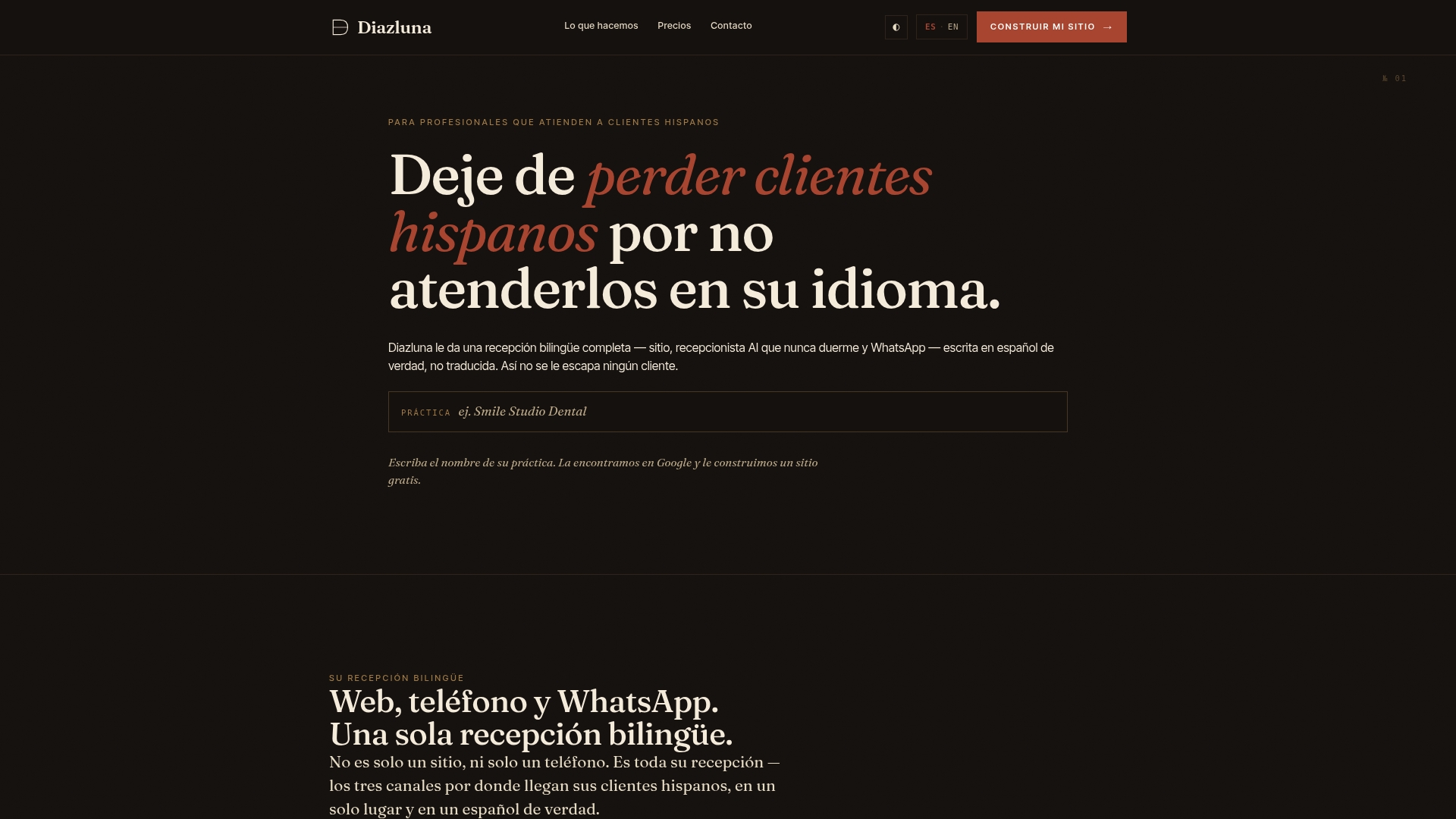
Diazluna takes a different approach. Rather than a standalone AI receptionist add-on, it delivers a complete bilingual digital front desk combining a fully optimized bilingual website, a 24/7 AI receptionist fluent in both Spanish and English, and WhatsApp integration. All three work together, so a Hispanic client can find the firm online, call in Spanish, and follow up on WhatsApp without hitting a language barrier at any step. The cost is a fraction of what a traditional agency charges for those services separately, and Google indexes the site within 24 hours of launch. For law firms where language access directly affects client retention, Diazluna is worth a close look.
Key Takeaways
A 24/7 legal AI receptionist captures every client call, automates intake, and routes urgent matters to attorneys, giving law firms continuous coverage without adding front desk staff.
| Point | Details |
|---|---|
| Core function | Answers calls, runs intake, schedules consultations, and routes urgent matters around the clock. |
| Adoption driver | 35% of law firm calls go unanswered; firms that respond first consistently win the client. |
| Pricing range | Entry plans start around $25–$65/month; full-featured flat-rate plans run $149–$299/month. |
| Integration priority | Connect the AI to your calendar, CRM, and case management tool before going live for best results. |
| Diazluna | Best fit for law firms serving Hispanic clients, combining bilingual AI reception, a bilingual website, and WhatsApp in one package. |