August 30, 2026
WhatsApp Is Not HIPAA Compliant

No, WhatsApp is not HIPAA compliant for U.S. covered entities. Meta will not sign a Business Associate Agreement for WhatsApp, WhatsApp Business, or the WhatsApp Business API, which alone disqualifies it for transmitting protected health information. A narrow exception exists when a patient specifically requests it, but that requires documentation, a warning about the risks, and reasonable safeguards, not a blanket policy allowing routine PHI on the app.
TL;DR:
- WhatsApp lacks a signed Business Associate Agreement from Meta, making it non-compliant with HIPAA for transmitting protected health information.
- The app does not provide enterprise audit logs, role-based access controls, or secure user authentication that HIPAA requires for handling ePHI.
- Default cloud backups and disappearing messages create risks that violate HIPAA record retention and breach notification obligations.
- The patient-request exception requires documented, informed consent, warning of risks, and proper logging to be defensible; casual or habitual use is risky.
- Using enterprise-grade, HIPAA-compliant messaging platforms with signed BAAs and comprehensive safeguards is essential to meet regulatory standards.
Table of Contents
- Why WhatsApp Fails the HIPAA Test
- The Patient-Request Exception: When a Patient Asks for WhatsApp
- Do WhatsApp Business or the Business API Change Anything?
- Backups, Disappearing Messages, and Device Risk
- Building a Compliance Checklist and Choosing an Alternative
- What Auditors Actually Want to See
- An Editorial Take: Access, Convenience, and Regulatory Safety Don’t Have to Fight Each Other
- An Adjacent Path: Bilingual Front-Desk Support Without the PHI Risk
- Sources
Why WhatsApp Fails the HIPAA Test
Encryption gets treated like a magic word in healthcare messaging debates, and that’s the mistake. WhatsApp does encrypt messages in transit using the Signal Protocol, but the HIPAA Security Rule demands far more than scrambled data between two phones. It requires administrative safeguards (risk analysis, workforce training, sanction policies), physical safeguards (device and facility controls), and technical safeguards (audit controls, access management, integrity controls, and transmission security) working together as a system.
WhatsApp checks maybe one of those boxes. It doesn’t check the rest, and it was never built to.
Start with the Business Associate Agreement, because this is the disqualifier compliance officers should care about most. Under HIPAA, any vendor that creates, receives, maintains, or transmits PHI on behalf of a covered entity is a business associate, and business associates must sign a BAA spelling out their security obligations and liability. Meta does not offer a BAA for WhatsApp under any tier, consumer or business. According to HIPAA Journal’s analysis of WhatsApp compliance, that single fact means any covered entity sending PHI through the app is operating outside HIPAA’s contractual framework entirely, regardless of how the message itself is encrypted.
Audit controls are the second failure point, and they’re less discussed but just as damaging. HIPAA requires the ability to record and examine activity in systems containing ePHI, so a compliance officer can answer basic questions: who accessed this record, when, from what device, and what did they do with it. WhatsApp offers no enterprise audit trail. There’s no admin console tracking which staff member viewed a message, no centralized log of who forwarded what to whom, and no way to enforce access policies tied to job role rather than a personal phone number.
That last detail matters more than it sounds. WhatsApp identity is tied to a mobile number, not a verified employee credential. A staff member who leaves the practice keeps their number (and potentially cached message history) unless someone manually intervenes. There’s no SSO or MFA integration layering enterprise-grade authentication on top of a consumer account.
Here’s the gap in plain terms:
- No signed BAA available from Meta under any plan
- No centralized audit logs tracking access to PHI-containing messages
- No admin-level access revocation tied to employment status
- No enforced retention policy that matches HIPAA recordkeeping expectations
- Identity verification tied to a phone number, not a credentialed workforce ID
The HHS Breach Notification Rule offers a useful lens here too. Encrypted PHI can qualify for safe harbor if a device is lost or stolen, since unreadable data generally isn’t considered a reportable breach. But that safe harbor covers one narrow scenario. It says nothing about the missing BAA, the absent audit trail, or the access-control failures that exist the moment PHI enters the app, breach or no breach.
Enforcement risk compounds this. The Office for Civil Rights (OCR) has repeatedly penalized covered entities for using consumer platforms without a BAA in place, treating the absence of a signed agreement as a standalone violation even when no breach occurred. A practice using WhatsApp for routine PHI conversations, appointment details tied to diagnoses, lab results, treatment questions, is exposed to that same category of risk every single day the practice keeps doing it.
The Patient-Request Exception: When a Patient Asks for WhatsApp
There’s one legitimate carve-out, and providers frequently misunderstand its scope. The HIPAA Privacy Rule at §164.522(b) permits a provider to honor a patient’s specific request to communicate through an unsecured channel, including consumer apps like WhatsApp. HHS guidance on this point was written primarily around email, but the same logic extends to any patient-initiated request for a non-BAA channel.
The exception is real. It is also narrower than most front-desk staff assume, and it comes with obligations that turn a casual “sure, text me on WhatsApp” into a documentation task.
To rely on this exception defensibly, a practice needs to:
- Get the request in writing, or document it clearly in the chart if given verbally, including the date and the specific channel requested.
- Warn the patient of the risk, explaining in plain language that WhatsApp is not a secured, HIPAA-compliant channel and that the practice cannot guarantee the same protections it applies to other systems.
- Apply reasonable safeguards anyway, such as avoiding unnecessary detail, not sending attachments with full records, and limiting the conversation to what the patient actually asked to discuss over that channel.
- Log the interaction in the patient’s record so a future audit shows exactly when and why WhatsApp was used, not just that it happened.
Skipping any of those steps turns a defensible exception into an undocumented policy gap, which looks identical to routine noncompliance during an OCR investigation.
The practical risk is that exceptions become habits. One patient asks for WhatsApp, staff gets comfortable with the app, and within a few months half the front desk is using it for scheduling, follow-up questions, even sensitive results, without a documented request behind most of those conversations. A compliance officer’s job here isn’t just approving the exception. It’s making sure it stays the exception.
Do WhatsApp Business or the Business API Change Anything?
Short answer: no. Compliance officers sometimes assume the “Business” label signals enterprise-grade security, the way it might with other software categories. It doesn’t, and Meta has never marketed either product as healthcare-ready.
WhatsApp Business adds a company profile, quick replies, and basic labels for a small business owner managing customer chats. WhatsApp Business API, aimed at larger organizations and usually accessed through a third-party provider, adds automation, webhooks, and higher messaging volume. Neither product line includes a path to a signed BAA from Meta, and neither adds the audit logging or centralized access governance the HIPAA Security Rule requires.
That distinction trips people up because “Business API” sounds like enterprise infrastructure. It’s closer to a bigger pipe for the same consumer-grade plumbing.
A few things to keep straight when evaluating either tier:
- Meta’s terms of service do not offer HIPAA support or a BAA for Business or API tiers.
- Third-party platforms that route messages through the WhatsApp Business API inherit Meta’s underlying limitation. A vendor layering its own BAA on top of WhatsApp API access needs scrutiny, since it’s Meta’s data-handling terms that govern the underlying transport, not just the reseller’s paperwork.
- Higher message volume and automation features increase PHI exposure risk rather than reducing it, since more automated conversations mean more unmonitored PHI moving through a channel with no enterprise audit trail.
If a vendor pitches a “HIPAA-compliant WhatsApp integration,” ask directly whether Meta itself signs the BAA or whether the vendor is offering its own agreement covering only its layer of the stack. That answer usually reveals the gap fast.
Backups, Disappearing Messages, and Device Risk
Beyond the contractual and audit failures, WhatsApp has a handful of specific technical behaviors that create PHI exposure most staff never think about until an incident forces the question.
Backups are the first one. WhatsApp backs up chat history to iCloud or Google Drive by default, and those cloud backups are not end-to-end encrypted unless the user has specifically opted into encrypted backup, a setting most people never touch. That means PHI sitting in a routine chat backup could be sitting in a cloud account with weaker protection than the message itself had in transit, based on the operational risks LegalClarity outlines around WhatsApp’s compliance gaps.

Disappearing messages create the opposite problem. HIPAA and related recordkeeping expectations require providers to retain certain records, support continuity of care, and preserve evidence for legal discovery when needed. A message that vanishes after 24 hours or a week might feel like a privacy feature, but it actively works against retention obligations a practice may need to meet.
Then there’s the everyday chaos of a personal device: screenshots taken without a trace, messages forwarded to a group chat with no PHI awareness, a phone left unlocked on a counter, or a number reassigned to a new person after a staff member leaves and their SIM gets recycled. None of that requires a hacker. It just requires normal human behavior on a platform with no controls built to catch it.
- Cloud backups aren’t encrypted by default; encrypted backup requires manual opt-in
- Disappearing messages conflict with HIPAA-adjacent retention and discovery expectations
- Forwarded messages and screenshots leave zero audit trail
- Reassigned phone numbers can expose historical PHI to an unrelated new owner
Pro Tip: Run a quick internal audit this week: ask every front-desk and clinical staff member whether they’ve ever sent a patient’s name, appointment reason, or health detail over WhatsApp. The answers usually surprise compliance officers who assumed the practice’s policy was already being followed.
Building a Compliance Checklist and Choosing an Alternative
Fixing this doesn’t require ripping out every communication tool overnight. It requires a sequence: stop the bleeding, document what happened, and choose a replacement that actually meets the bar WhatsApp never could.
Immediate steps, in order:
- Pause new PHI conversations on WhatsApp across the practice, effective immediately, with a written notice to staff explaining why.
- Audit existing WhatsApp threads for any PHI already exchanged, and log what was found for your records.
- Document any patient-request exceptions that genuinely apply, following the four steps outlined earlier, and flag anything that doesn’t meet that bar as a gap to close.
- Run a messaging-specific risk analysis, treating messaging as its own risk category rather than folding it into a general IT security review, an approach AccountableHQ’s guidance on WhatsApp and PHI recommends explicitly.
- Select and onboard a compliant vendor, using the checklist below, and formally retire WhatsApp for anything touching PHI.
When evaluating a replacement, the checklist should be non-negotiable on a few points:
- A signed Business Associate Agreement, not a vague privacy policy or terms of service
- Exportable, centralized audit logs showing who accessed or sent what, and when
- Single sign-on and multi-factor authentication tied to workforce identity, not personal phone numbers
- Mobile device management (MDM) support so a lost or stolen phone can be remotely wiped
- Configurable retention policies that match your practice’s documented schedule, with logs that survive staff turnover
- U.S.-based hosting and a clear data residency statement
- Native or API-level integration with your EHR, so messages tie back to the patient record automatically
Most practices land in one of three categories of solution: dedicated clinical messaging platforms built specifically for care teams, patient portals tied to the EHR that handle secure messaging as a built-in feature, or EHR-native messaging modules that skip a separate app entirely. Each has trade-offs in cost and workflow friction, but all three share the one thing WhatsApp cannot offer: a vendor willing to put their name on a BAA and back it with real audit infrastructure. For routine, non-PHI touchpoints like appointment confirmations, a tool such as WhatsApp appointment reminder automation can still play a role, as long as the line between scheduling logistics and clinical detail stays firm.
What Auditors Actually Want to See
An OCR investigator or internal auditor isn’t looking for perfection. They’re looking for evidence that the practice took messaging risk seriously and can prove it.
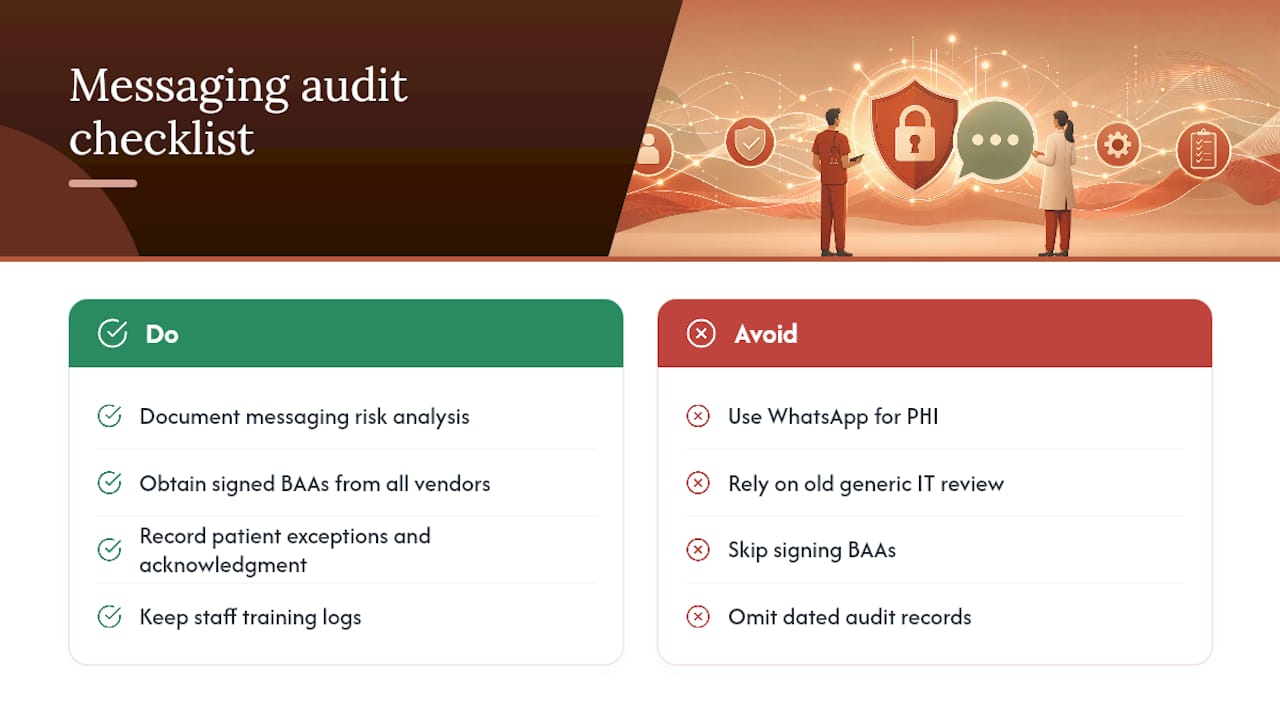
That means a documented, messaging-specific risk analysis on file, not a generic IT security review from three years ago. It means signed BAAs from every vendor handling PHI, following the structure in HHS’s sample Business Associate Agreement provisions. It means dated records of any patient-request exceptions, complete with the warning given and the patient’s acknowledgment. It means training logs showing staff were told WhatsApp is off-limits for PHI, and configuration screenshots proving retention and access settings were actually set, not just described in a policy binder somewhere.
When a practice migrates off WhatsApp, keep a short written record of the transition date, the replacement vendor, and how existing patient relationships (including bilingual ones) were preserved through the switch. That paper trail matters as much as the technology choice itself.
An Editorial Take: Access, Convenience, and Regulatory Safety Don’t Have to Fight Each Other
Compliance officers get pulled two directions on this issue, and I think most of them resolve the tension backwards. The instinct is to treat “convenient for patients” and “safe for compliance” as opposing forces, then pick a side. They’re not opposing forces. They’re two requirements that happen to need different tools.
Patients want fast, familiar communication, often in their preferred language. That’s a legitimate operational priority, not a distraction from compliance. The mistake is routing that convenience through a channel that was never built to carry clinical detail. Keep WhatsApp, if you use it at all, strictly for logistics: appointment confirmations, office hours, general questions with zero PHI. The moment a conversation touches a diagnosis, a test result, or treatment specifics, it needs to move to a platform with a signed BAA behind it.
The patient-request exception exists for a reason, but treat it as an exception in practice, not a workaround policy. Document it every time, or don’t rely on it at all.
— Francisco
An Adjacent Path: Bilingual Front-Desk Support Without the PHI Risk
Here’s where most practices get stuck: they know WhatsApp shouldn’t carry PHI, but they also know it’s often the fastest way to reach Spanish-speaking patients who feel more comfortable texting than calling. Diazluna solves that specific tension by keeping WhatsApp exactly where it belongs, appointment logistics, general questions, front-desk coordination, in both English and Spanish, while directing anything clinical toward the compliant channel your practice actually uses for PHI.
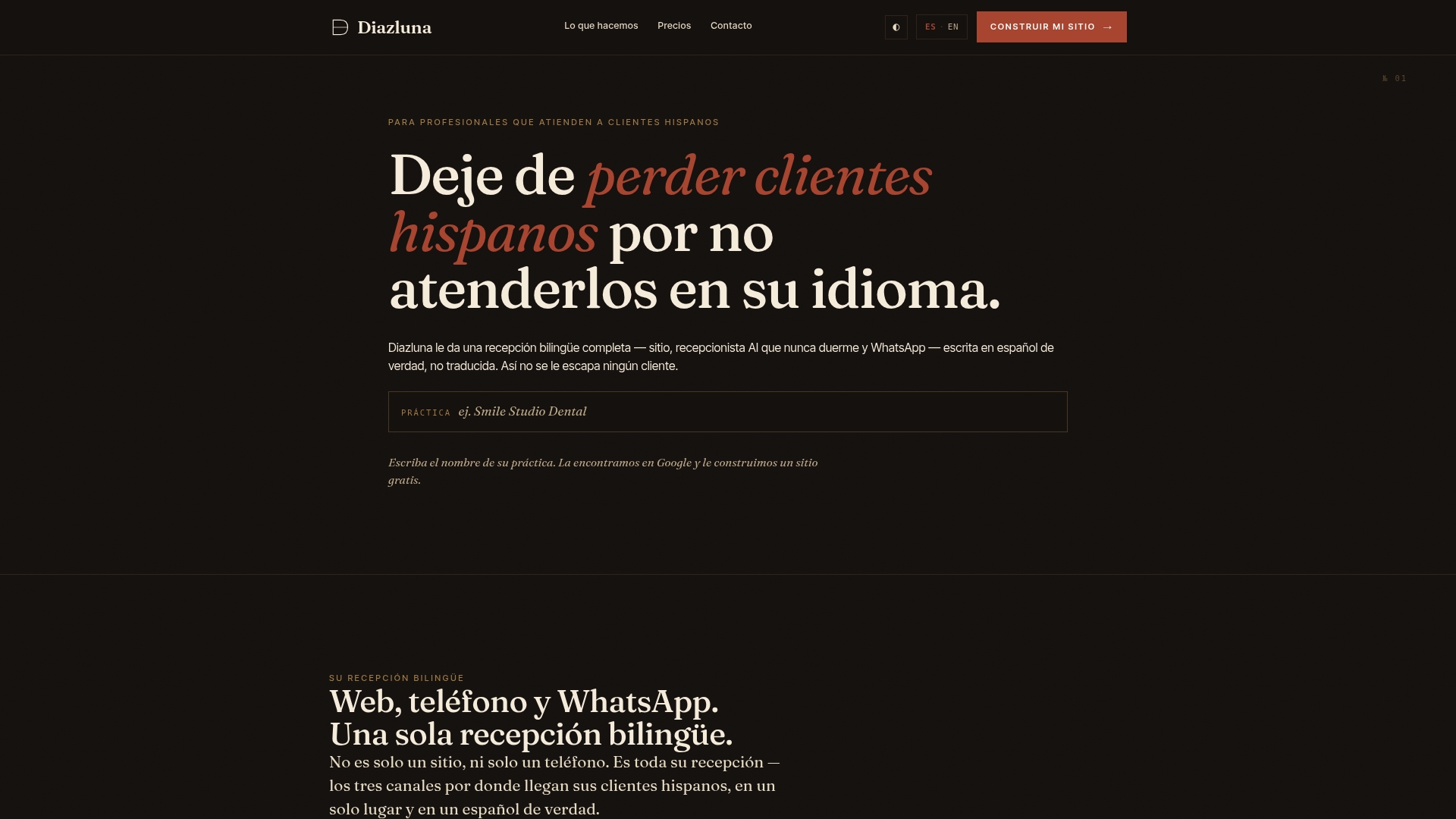
Diazluna combines a bilingual website, a 24/7 AI receptionist fluent in Spanish and English, and WhatsApp integration built for operational outreach, not clinical messaging. It’s the alternative to hiring a bilingual front-desk team or juggling separate translation and scheduling vendors, at a fraction of the cost, and it flags urgent cases for human follow-up instead of letting them sit in an inbox. If your practice serves Hispanic patients and wants that front-door experience handled well without ever pretending WhatsApp can carry protected health information, see how Diazluna’s bilingual front desk works, or check the dental-specific setup if you run a dental practice. Every PHI-related conversation still belongs on a platform with a signed BAA behind it. Diazluna handles everything that gets a patient to that conversation in the first place.
This article is general information, not a substitute for advice from a qualified lawyer. Consult a qualified legal professional about your own circumstances before acting on anything here.
Sources
- HHS — HIPAA Security Rule: Laws & regulations
- HIPAA Journal — Is WhatsApp HIPAA Compliant?
- LegalClarity — Is WhatsApp HIPAA Compliant? Risks and alternatives