August 9, 2026
Why Formal Spanish Differs From Informal Spanish

Formal and informal Spanish differ because register is encoded across every layer of the language at once: the pronoun you choose (tú, usted, or vos) triggers a completely different set of verb endings, command forms, and vocabulary. Say ¿Cómo estás? and you’re speaking to a friend. Say ¿Cómo está usted? and the same question becomes a professional greeting. The Royal Spanish Academy notes that informal address is spreading in some collaborative workplaces, yet formal address still anchors first impressions in professional and respectful interactions.
Pro Tip: In a U.S. professional setting, start with usted or a formal phrasing and mirror whatever register your interlocutor uses. Defaulting to formal rarely offends; defaulting to informal can.
Key Takeaways
Formal Spanish differs from informal Spanish because pronoun choice encodes respect, hierarchy, and social distance across verb endings, commands, vocabulary, and sentence structure simultaneously.
| Point | Details |
|---|---|
| Tú vs. usted is the core split | Tú signals familiarity; usted signals respect, distance, or hierarchy in professional contexts. |
| Grammar changes with the pronoun | Verb endings, imperative forms, and subjunctive use all shift when you switch between tú and usted. |
| Region overrides general rules | Vos is standard in Argentina and Uruguay; usted is used informally in parts of Colombia; vosotros survives only in Spain. |
| Default to formal, then mirror | Start with usted in any professional or unfamiliar setting; ask ¿Le puedo tutear? before switching. |
| Vocabulary shifts too | Formal Spanish favors nominalized, Latinate expressions; informal Spanish uses shorter, active phrasing. |
Table of Contents
- When to use tú, usted, or vos: social cues that decide register
- How register changes your grammar: pronouns, verb endings, and commands
- Regional differences: vos, vosotros, and the special case of Colombian usted
- Formal vs. informal phrase pairs for everyday professional situations
- How to shift registers mid-conversation without causing offense
- Practice exercises to reinforce register shifts
- Why register matters in every bilingual client interaction
- Sources
When to use tú, usted, or vos: social cues that decide register
The differences between formal and informal Spanish aren’t arbitrary. They map directly onto social relationships, and pedagogical materials consistently teach/01%3A_Hola_Como_te_llamas/1.06%3A_Gramatica-_Formal_o_informal) usted as the respectful default for strangers and elders, with tú reserved for friends and close acquaintances.
Situational cues that push toward usted:
- A significant age gap, especially when you are the younger person
- First meeting with a client, patient, or customer
- Hierarchical settings: supervisor, judge, official, or doctor
- Formal written communication (emails, letters, legal documents)
- Any situation where you are unsure of the other person’s preference
Cues that make tú natural:
- Peers of similar age and status in a casual setting
- Colleagues who have explicitly invited informal address
- Friends, family, and social contexts outside work
When you want to switch from formal to informal, the standard professional move is to ask: ¿Le puedo tutear? (“May I address you as tú?”). The RAE entry for tutear confirms this as the recognized practice for requesting informal address. Mirroring is equally valid: if your interlocutor shifts to tú, you can follow without asking. What you want to avoid is jumping to tú unprompted with someone older or in a position of authority.
A quick dialogue contrast shows how much the choice changes tone:
- Formal (new client): Buenos días. ¿En qué le puedo ayudar? (“Good morning. How may I help you?”)
- Informal (colleague): Hola. ¿En qué te puedo ayudar? (“Hey. How can I help you?”)
Same sentence structure, entirely different relationship signal.
How register changes your grammar: pronouns, verb endings, and commands
Choosing a register isn’t just a social decision. It rewires the grammar of every sentence you produce. Register affects subject pronoun frequency, subjunctive and conditional use, passive constructions, sentence length, and vocabulary, which means a single pronoun swap cascades through the whole utterance.
The table below shows the core conjugation differences across the three main second-person forms for present tense, imperative, and polite conditional.
| Form | Present (hablar) | Imperative (listen) | Polite conditional (could you…) |
|---|---|---|---|
| tú | hablas | escucha | ¿Podrías…? |
| usted | habla | escuche | ¿Podría…? |
| vos | hablás | escuchá | ¿Podrías…? |
A few things stand out. The usted imperative (escuche) uses the subjunctive stem, which is why formal commands feel more indirect and deferential. The vos imperative (escuchá) carries a stress shift to the final syllable and drops the irregular stem changes that tú forms sometimes carry. Tú and usted differ in verb forms and commands; mixing them mid-conversation is one of the most noticeable mistakes native speakers catch.
Formal speech also drops subject pronouns more often because the verb ending already signals the subject unambiguously. Informal speech, by contrast, uses explicit pronouns more frequently for emphasis or contrast: Tú lo haces así, yo lo hago de otra manera. Sentence structure in formal registers tends toward longer, nominalized constructions (la realización del procedimiento rather than hacer el procedimiento), while informal speech favors short, active sentences.
Practice prompts: Try converting these:
- ¿Puede usted confirmar su cita? → informal
- ¿Tienes un momento? → formal (Answers: 1. ¿Puedes confirmar tu cita? / 2. ¿Tiene un momento?)
Regional differences: vos, vosotros, and the special case of Colombian usted
Geography overrides general rules. Pronoun choice is heavily influenced by region: tú dominates in Spain and Mexico, vos replaces tú across the Río de la Plata countries, and some Colombian regions use usted even between close friends and family.
The RAE documents voseo conjugation and confirms the geographic areas where it is standard. For learners, the practical takeaway is that vos is not slang or substandard: in Argentina and Uruguay it is the prestige informal form. Vosotros, the informal plural used in Spain, has essentially no presence in Latin America, where ustedes covers both formal and informal plural address.
The Bogotá case is genuinely counterintuitive. Using usted with a close friend there signals warmth and intimacy, not distance. Arriving with a tú-first approach can actually read as slightly cold or foreign.
Pro Tip: If you work with U.S. Latino communities, the Spanish you hear most will reflect the dominant heritage community in your area. Mexican-American communities in the Southwest lean tú; communities with South American roots may use vos. Pay attention to which form clients use with each other.
Formal vs. informal phrase pairs for everyday professional situations
Ready-to-use phrase pairs make the abstract concrete. The vocabulary differences are real: formal Spanish favors Latinate, nominalized expressions; informal Spanish uses everyday verbs and contractions.
- Greeting: Buenos días, ¿en qué le puedo asistir? (formal) / Hola, ¿en qué te ayudo? (informal)
- Introducing yourself: Me llamo [nombre] y estoy aquí para atenderle. (formal) / Soy [nombre], ¿cómo estás? (informal)
- Polite request: ¿Podría proporcionarme su nombre completo? (formal) / ¿Me dices tu nombre? (informal)
- Scheduling: ¿Le vendría bien el martes a las tres? (formal) / ¿Te va bien el martes a las tres? (informal)
- Thank-you: Le agradezco su tiempo. (formal) / Gracias por tu tiempo. (informal)
- Closing: Quedo a su disposición para cualquier consulta. (formal) / Aquí estoy si necesitas algo. (informal)
A quick-reference overview of formal vs. informal “you” confirms that register mistakes in these everyday exchanges create social friction, especially in client-facing settings like clinics and law offices.
For a clinic check-in, the formal register sounds like this: Buenos días, señora García. ¿Tiene su cita programada para hoy? The informal version, appropriate once rapport is established: Hola, ¿tienes cita hoy? The difference in vocabulary (programada, señora) signals professional distance and respect before any relationship has been built. For bilingual client follow-up scripts that apply these distinctions in professional settings, Diazluna’s guide covers templates for both registers.
How to shift registers mid-conversation without causing offense
Switching from formal to informal mid-conversation is a skill, not just a vocabulary swap. Done abruptly, it can feel presumptuous. Done well, it deepens rapport.
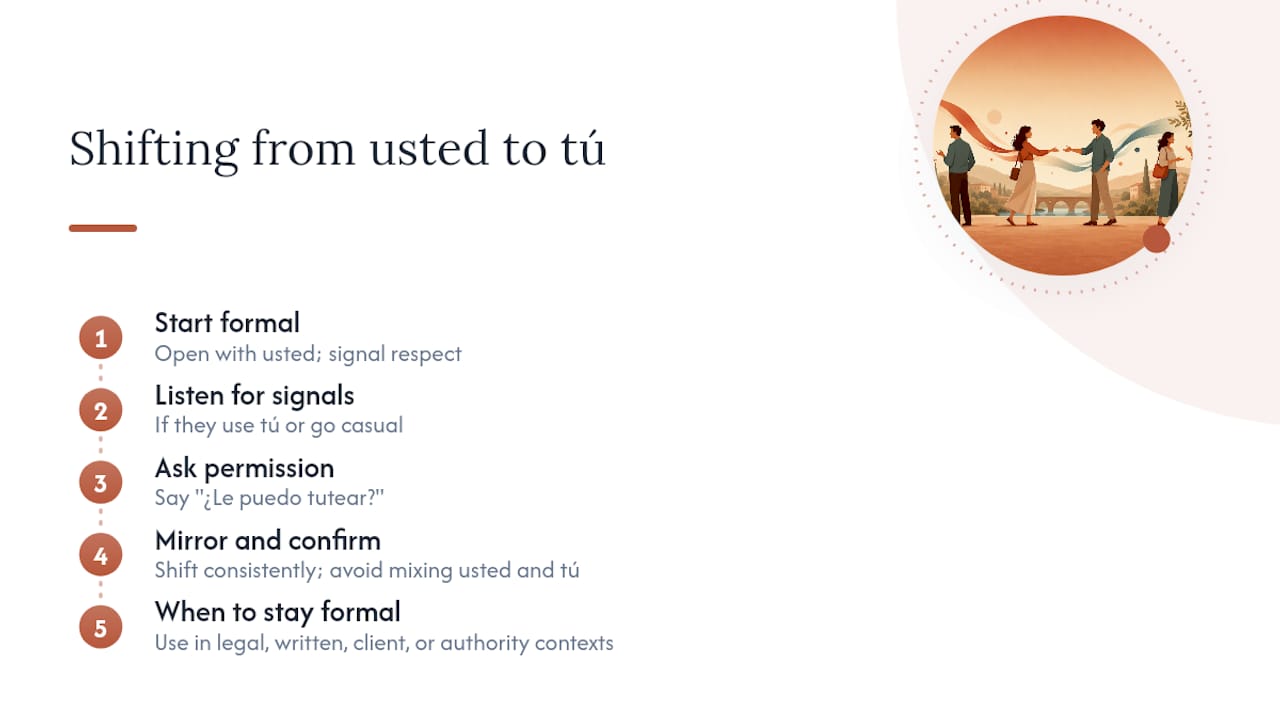
Step 1: Start formal. Open every new professional interaction with usted. This costs you nothing and signals respect immediately.
Step 2: Listen for signals. If the other person uses tú with you, or if the conversation becomes clearly casual and friendly, that is your cue.
Step 3: Ask permission explicitly. The phrase ¿Le puedo tutear? (“May I address you as tú?”) is the standard, professional way to make the switch. It acknowledges the social contract rather than ignoring it.
Step 4: Mirror and confirm. Once permission is granted, shift consistently. Mixing usted and tú in the same exchange is a common learner error and sounds unnatural to native speakers.
When to stay formal: Legal consultations, initial client meetings, written correspondence, and any interaction with someone significantly older or in a position of authority. A formal letter that opens with Estimado señor Martínez should stay in usted throughout, even if you know the person casually.
Sample script for the switch: “Ha sido un placer hablar con usted. ¿Le importaría si le tuteo de ahora en adelante?” (“It’s been a pleasure speaking with you. Would you mind if I addressed you informally from now on?”)
Practice exercises to reinforce register shifts
Exercise 1: Convert the register
Rewrite each sentence in the opposite register.
- ¿Tiene usted un momento para hablar? → informal
- ¿Puedes enviarme el documento? → formal
- Escuche, por favor. → informal
Answer key: 1. ¿Tienes un momento para hablar? / 2. ¿Puede enviarme el documento? / 3. Escucha, por favor.
Exercise 2: Role-play script
You are a receptionist at a dental clinic. A new patient calls. Write a four-line opening exchange: start formal, then negotiate the switch to informal after the patient uses tú with you.
Sample answer:
- Receptionist: Buenos días, consultorio del Dr. López. ¿En qué le puedo ayudar?
- Patient: Hola, quiero hacer una cita. ¿Tienes disponibilidad el viernes?
- Receptionist: Claro. ¿Le importa si le tuteo también?
- Patient: ¡Por supuesto!
Exercise 3: Regional identification
Decide which pronoun to use in each scenario.
- Speaking to a friend in Buenos Aires (informal) → vos
- Addressing a new client in Mexico City → usted
- Talking to a close friend in Bogotá → usted (common there even informally)
- Speaking to a group of colleagues in Madrid (informal) → vosotros
- Addressing a patient in a U.S. clinic (first contact) → usted
Why register matters in every bilingual client interaction
At Diazluna, the question of register comes up constantly in the work of building bilingual front-desk systems for dentists, attorneys, and healthcare providers. The difference between ¿Cómo está usted? and ¿Cómo estás? at the start of a client call isn’t trivial: it signals whether your practice understands the cultural expectations of the person on the other end of the line.
Hispanic clients, particularly first-generation immigrants and older adults, often expect formal address in professional settings. Using tú prematurely can read as dismissive or overly casual. Using usted correctly, by contrast, communicates respect before a single clinical or legal word is spoken. That first impression shapes whether a client books an appointment, returns, or refers others. Spanish tone and client retention are directly connected, and register is the most immediate signal of tone.
Diazluna’s AI receptionist is built to default to formal Spanish in initial client interactions and to adapt register based on conversational cues, because getting this right is not a linguistic nicety. It is a business outcome.
Sources
- Formal vs Informal Spanish: When to Use Tú, Usted, and Vos - Learn languages with italki
- Las formas de tratamiento — RAE
- Elon
- Tú and Usted = you | Spanish Grammar | Kwiziq Spanish
- Formal vs. Informal “You” | Free Online Spanish Lessons
- tutear — Diccionario de la lengua española (DLE) — RAE