July 13, 2026
Bilingual Client Follow-Up: A Guide for Professionals
Bilingual client follow-up is the practice of conducting post-contact communications in a client’s preferred language, using culturally appropriate tone, timing, and channels to strengthen engagement and trust. For dentists, attorneys, and healthcare providers serving Hispanic clients, this practice is not optional. Language barriers reduce adherence and drive clients away before they ever complete care or close a case. The role of bilingual client follow-up extends well beyond translation. It requires matching communication style, channel, and cadence to what Hispanic clients actually expect and respond to.
What is the role of bilingual client follow-up in professional services?
Bilingual client follow-up is the structured process of reaching clients after an initial contact in their preferred language, using the right tone and channel to keep them engaged. In healthcare, law, and dentistry, this process directly affects whether clients return, comply with instructions, or refer others to your practice.
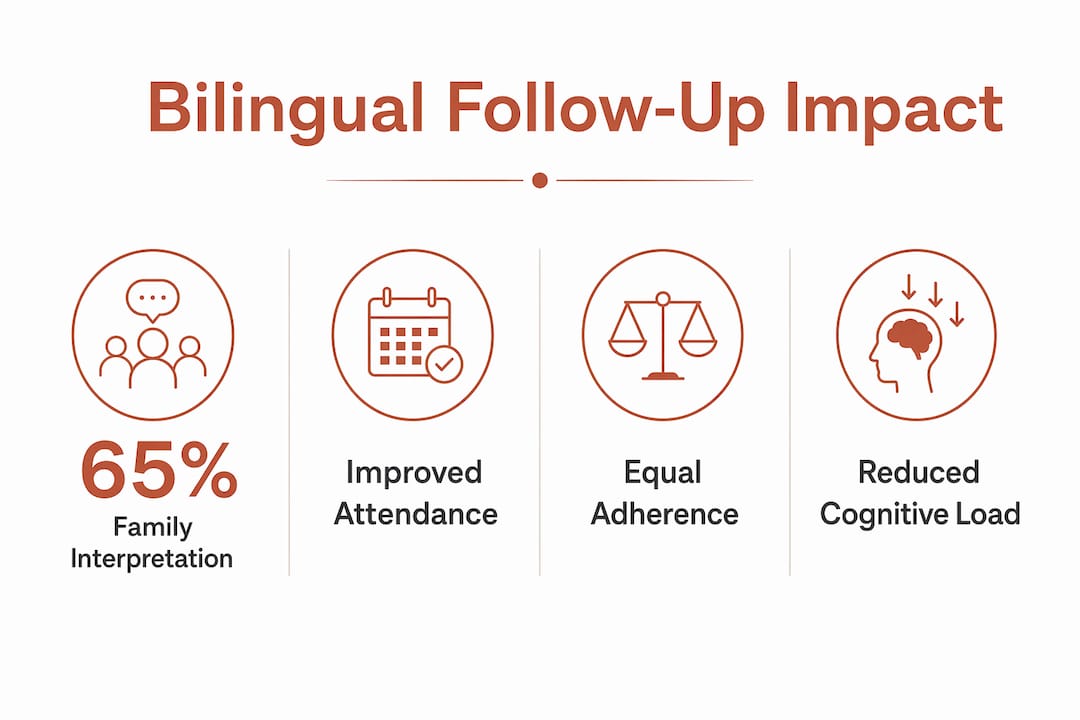
65% of non-English-preferred patients rely on family members for interpretation. That statistic reveals a systemic gap. Family interpreters introduce errors, omit details, and create liability exposure that no professional practice can afford to ignore.

The consequences go beyond individual appointments. Language discordance reduces attendance and engagement in post-discharge and follow-up settings. Clients who do not understand their next steps simply do not show up. In law firms, poor multilingual communication leads to trust loss, weaker referrals, and competitive disadvantage. The cost of ignoring bilingual follow-up is measurable and ongoing.
Professional bilingual follow-up solves this by delivering accurate, consistent, and culturally coherent communication at every touchpoint after the first contact.
How does bilingual follow-up address communication barriers with Hispanic clients?
Language barriers do not just create confusion. They create disengagement. A Hispanic client who receives a follow-up call in English, without a Spanish-speaking staff member available, is likely to disengage entirely rather than ask for help.
The risks of relying on informal interpreters are well documented:
- Family members may soften bad news, skip technical details, or misinterpret clinical or legal terminology.
- Untrained staff interpreting on the fly introduce liability and miscommunication risks.
- Clients lose confidence in a practice that cannot communicate with them directly.
- Informal interpreting places an unfair burden on family members, which clients notice and resent.
“Professional telephone interpreting eliminates follow-up adherence differences between Spanish-speaking and English-speaking patients. A retrospective study of 527 retina clinic patients found equal or better long-term care engagement when professional interpretation was used consistently.”
Professional interpretation equalizes adherence across language groups. That finding is significant. It means the gap between Spanish-speaking and English-speaking client retention is not cultural. It is a communication infrastructure problem with a direct solution.
Bilingual follow-up also reduces the cognitive load on clients. When a dental patient receives a post-procedure call in Spanish, they can ask questions freely, confirm instructions accurately, and feel respected. That experience drives return visits and referrals far more reliably than any marketing campaign.
Why do cultural nuances matter in bilingual follow-up?
Bilingual follow-up fails when it treats Spanish as a code to swap in for English. The two languages carry different social expectations, and a message that sounds professional in English can feel cold or even rude when translated directly into Spanish.
Effective bilingual follow-up requires cultural register switches beyond translation. Tone, warmth, formality, and message structure all differ between English and Spanish communications. A direct English follow-up text like “Your appointment is tomorrow at 9 AM. Confirm or cancel.” reads as efficient in English. In Spanish, the same message without a greeting or a warm closing can feel dismissive and cause clients to disengage.
The table below shows how communication expectations differ across key dimensions:
| Dimension | English follow-up norms | Spanish follow-up norms |
|---|---|---|
| Greeting | Optional or brief | Expected, warm, and personal |
| Tone | Direct and transactional | Respectful and relational |
| Formality | Casual is acceptable | Formal address preferred initially |
| Closing | Often omitted | Warm closing expected |
| Message length | Short and efficient | Slightly longer, context-inclusive |
Timing also matters. Calling a Hispanic client at 8:00 AM on a Monday may feel intrusive in a cultural context that values relationship before business. Early evening calls, after work hours, tend to generate better response rates. Frequency matters too. Aggressive follow-up cadences that work in English-speaking markets can feel disrespectful in Spanish-speaking ones.
Pro Tip: Write your Spanish follow-up messages with a native speaker, not a translation tool. Machine translation captures words but misses register. A message that sounds warm in Spanish builds trust; one that sounds robotic loses the client.
How do you build an effective bilingual follow-up workflow?
A bilingual follow-up workflow is a documented, repeatable system that delivers the right message, in the right language, through the right channel, at the right time. Building one requires deliberate decisions at each stage of the client communication lifecycle.
-
Identify language preference at intake. Ask every new client which language they prefer for follow-up. Document it in your client record. This single step prevents the majority of language mismatch errors downstream.
-
Use WhatsApp as a primary channel for Spanish-speaking clients. WhatsApp is the preferred channel for many Hispanic clients over email or phone. Practices that send appointment reminders, post-visit instructions, and check-in messages via WhatsApp see faster responses and higher engagement.
-
Maintain language consistency across every touchpoint. A client who speaks Spanish at intake should receive Spanish confirmation texts, Spanish voicemails, Spanish billing reminders, and Spanish follow-up calls. Switching languages mid-cycle signals disorganization and erodes trust.
-
Build a multi-channel cadence. Structured bilingual outreach using persistent, predictable multichannel messaging improves client engagement significantly. For a dental practice, this might mean a WhatsApp reminder two days before an appointment, a phone call the morning of, and a post-visit text the following day.
-
Standardize bilingual documentation. Every follow-up message template should exist in both English and Spanish. Instructions, consent reminders, and next-step summaries should be clear, specific, and written at an accessible reading level in both languages.
-
Deploy language-switch detection. When a client who initially communicated in Spanish sends a message in English, your system needs to recognize the switch and respond accordingly. Language-switch detection technology maintains consistency and prevents the system from sending Spanish messages to a client who has shifted to English.
Pro Tip: Train your front desk staff to flag language preference in the first 30 seconds of any call. A simple note in the client file saves every future staff member from guessing and every client from feeling invisible.
Bilingual first-call workflows that capture accurate intake and explain next steps clearly in the client’s preferred language reduce confusion and improve booking completion. The goal is coherence, not length.
What are the biggest challenges in bilingual follow-up?
Most bilingual follow-up failures trace back to system design, not staff effort. Practices that add Spanish as an afterthought end up with fragmented workflows that frustrate both clients and staff.
The most common pitfalls include:
- Monolingual CRM systems with translated templates. A system built for English communication will apply English logic to Spanish messages, including timing, tone, and structure. The result is Spanish text that reads like a bad translation.
- Channel fragmentation. When phone, text, email, and WhatsApp operate as separate silos, clients receive inconsistent messages. A Spanish-speaking client might get a Spanish WhatsApp reminder and an English email confirmation for the same appointment.
- Ignoring cultural rhythm in timing. Sending follow-up messages at times that feel intrusive or impersonal in Hispanic cultural contexts reduces response rates and signals a lack of cultural awareness.
- Overloading bilingual staff. Assigning all Spanish communication to one bilingual employee creates a bottleneck and a single point of failure. When that person is unavailable, Spanish-speaking clients receive no follow-up at all.
- Skipping the confirmation loop. English follow-up workflows often assume a non-response means acceptance. In Spanish-speaking client contexts, a non-response more often signals confusion or discomfort. A confirmation loop that invites a reply in Spanish closes that gap.
Pro Tip: Audit your follow-up workflow from the client’s perspective. Have a Spanish-speaking colleague go through your entire intake-to-follow-up cycle as a test client. The gaps they find will surprise you.
Multilingual communication treated as a strategic priority builds brand trust and drives referrals. Treated as an operational afterthought, it costs practices clients they never knew they lost.
Key Takeaways
Bilingual client follow-up requires language consistency, cultural register adaptation, and channel alignment to retain Hispanic clients and prevent adherence gaps across dentistry, law, and healthcare.
| Point | Details |
|---|---|
| Language preference at intake | Document every client’s preferred language at first contact to prevent downstream mismatches. |
| Cultural register matters | Spanish follow-up requires warmer tone, formal address, and relational closings that direct translation misses. |
| WhatsApp drives engagement | Hispanic clients favor WhatsApp over email or phone for follow-up communication. |
| Professional interpretation equalizes retention | Practices using professional bilingual follow-up close the adherence gap between Spanish and English-speaking clients. |
| System design determines success | Bilingual follow-up fails when CRM systems, channels, and templates are built for English and adapted as an afterthought. |
What I’ve learned about bilingual follow-up that most practices ignore
Most practices I’ve seen treat bilingual follow-up as a translation problem. They hire one bilingual staff member, run their English templates through a translation tool, and call it done. That approach fails quietly. Clients don’t complain. They just don’t come back.
The practices that actually retain Hispanic clients understand something different. Bilingual follow-up is a relationship signal. When a client receives a warm, accurate, timely message in their preferred language, they feel seen. That feeling drives loyalty more reliably than any discount or promotion.
The cost of getting this wrong is invisible on most balance sheets. You don’t see the referrals that never came. You don’t count the clients who called once, got an English voicemail, and booked somewhere else. But those losses are real, and they compound over time.
The practices that invest in authentic bilingual service as a core operational function, not a side task, build the kind of client loyalty that sustains a practice through market shifts. That investment pays back in retention, referrals, and reputation. I’ve seen it work, and I’ve seen the alternative.
— Francisco
How Diazluna supports bilingual follow-up for your practice
Consistent bilingual follow-up requires infrastructure, not just intention. Diazluna gives dentists, attorneys, and healthcare providers a bilingual front desk that handles Spanish and English communication across every channel, around the clock.
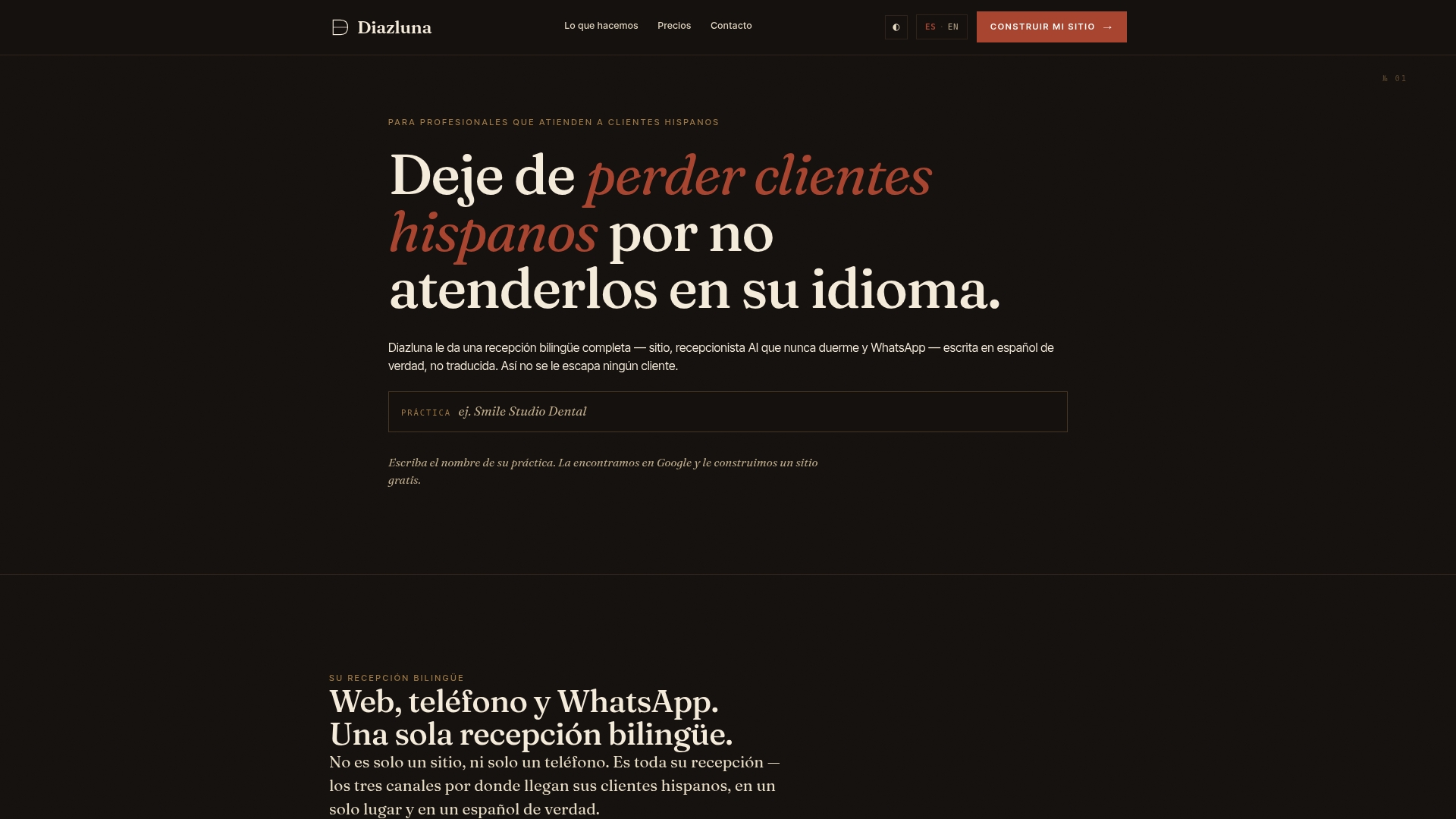
Diazluna combines a fully optimized bilingual website, a 24/7 AI receptionist fluent in both Spanish and English, and WhatsApp integration into one system. Practices using Diazluna report a significant reduction in client loss due to language barriers. Google indexes their bilingual sites within 24 hours. For legal firms, Diazluna’s bilingual communication platform delivers the multichannel, language-consistent follow-up that retains Spanish-speaking clients and generates referrals. No patchwork of separate services. One system that works.
FAQ
What is bilingual client follow-up?
Bilingual client follow-up is the practice of communicating with clients after initial contact in their preferred language, using culturally appropriate tone, timing, and channels. It goes beyond translation to include cultural register, message structure, and channel selection.
Why does bilingual follow-up matter for Hispanic clients?
65% of non-English-preferred patients rely on family members for interpretation, creating accuracy and liability risks. Professional bilingual follow-up removes that dependency and improves adherence and retention.
What channels work best for Spanish-speaking client follow-up?
WhatsApp is the preferred communication channel for many Hispanic clients over email or phone. Practices that use WhatsApp for appointment reminders and post-visit check-ins see faster responses and stronger engagement.
How does professional bilingual follow-up affect client retention?
Professional interpretation eliminates adherence gaps between Spanish-speaking and English-speaking clients. Practices that deliver consistent bilingual follow-up retain Hispanic clients at the same rate as English-speaking ones.
What is the biggest mistake in bilingual follow-up workflows?
The most common mistake is building follow-up systems in English and adding Spanish as a translation layer. This produces messages that are grammatically correct but culturally misaligned, which reduces client trust and response rates.