July 21, 2026
Affordable Bilingual Support Options in the U.S.: 2026 Guide
The most accessible affordable bilingual support options in the United States fall into four categories: free public school programs, nonprofit community services, government-mandated language assistance, and AI-powered digital tools. Families in Illinois, Texas, and California have the widest range of choices, but federal law requires language access across all states for health and social service programs.
Here is a quick map of what is available:
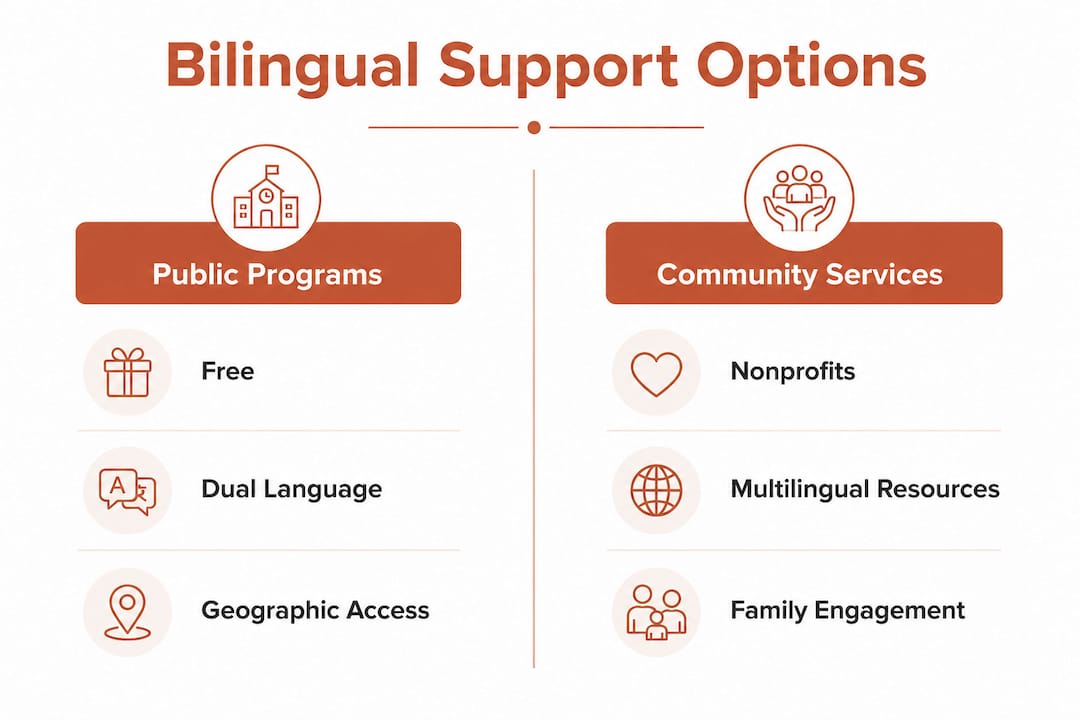
- Public school programs: Dual Language Immersion and Transitional Bilingual Education models, offered at no cost through local school districts
- Nonprofit organizations: Groups like Progresando, Instituto del Progreso Latino, and Erie Neighborhood House in Chicago offer free or low-cost classes and literacy support
- Government services: Federal and state agencies must provide free interpretation and translation for health and social services clients
- Digital tools: AI bilingual receptionists and language exchange apps that cost a fraction of hiring human staff
What affordable bilingual support programs exist in Illinois, Texas, and California?
Illinois, Texas, and California collectively serve the largest Spanish-speaking and multilingual student populations in the country, and each state has built a layered system of low-cost bilingual support.
Illinois
Progresando is a Chicago-based nonprofit offering literacy projects, newcomer family engagement, and educational guidance to immigrant families at low or no cost. Erie Neighborhood House provides ESL classes, workforce development, and family literacy programs across multiple Chicago neighborhoods. The Chinese American Service League (CASL) extends bilingual support to Cantonese and Mandarin-speaking families, covering ESL instruction, citizenship prep, and social services. Chicago Public Schools runs a dedicated Multilingual Multicultural Education department that coordinates bilingual and English Language Learner (ELL) services district-wide, and its International Newcomer Student Services program specifically supports recently arrived students.
Texas
Texas funds bilingual education through its Bilingual Education/English as a Second Language program, which school districts with 20 or more ELL students in the same grade are required by state law to provide. The Latino Family Literacy Project, active in Texas communities, trains parents to read with their children in both Spanish and English, reinforcing literacy at home without cost to families.
California

California’s Department of Consumer Affairs and state education agencies publish multilingual resources for families navigating public services. The state’s Seal of Biliteracy, awarded to graduating high school students who demonstrate proficiency in two or more languages, reflects California’s institutional commitment to bilingualism. Many California school districts also offer dual language programs starting in kindergarten, making early bilingual education accessible at no direct cost to families.
How do language assistance program models work in U.S. schools?
The four main bilingual education models used in American public schools differ primarily in how much they prioritize maintaining a student’s home language versus transitioning to English.
- Two-Way Dual Language Immersion: Mixes native English speakers and native speakers of another language (most often Spanish) in the same classroom. Both groups learn academic content in both languages, typically in a 50/50 or 90/10 split. Research consistently shows this model produces the strongest long-term bilingualism.
- One-Way Dual Language Immersion: Serves a single language group (usually ELL students) and delivers instruction in both languages. It promotes bilingualism without the cross-group mixing of the two-way model.
- Transitional Bilingual Education, Late Exit: Students receive instruction in their home language through fifth or sixth grade while gradually increasing English instruction. The goal is academic bilingualism, not just a bridge to English.
- Transitional Bilingual Education, Early Exit: Home language instruction phases out by second or third grade. The focus is English acquisition rather than long-term bilingualism.
Public schools and community programs that maintain both languages tend to produce students with stronger heritage language retention alongside academic English proficiency.
Pro Tip: When choosing a school program for your child, ask specifically whether it is a “maintenance” or “transitional” model. A maintenance program keeps the home language alive; a transitional one phases it out. The distinction shapes your child’s long-term bilingualism.
Where can you find free community and government language assistance?
Chicago’s nonprofit sector is one of the densest concentrations of free bilingual support services in the country. Instituto del Progreso Latino offers adult education, high school equivalency, and workforce training in Spanish and English. The Arab American Action Network (AAAN) provides Arabic-English bilingual services including legal aid, youth programs, and community organizing. Erie Neighborhood House and CASL round out a network that collectively serves dozens of language communities across the city.
At the government level, the Washington State Health Care Authority provides free interpretation and printed material translation for all Apple Health, PEBB, and SEBB members. Apple Health clients can reach interpreter services by calling 1-800-562-3022 (TRS: 711); PEBB and SEBB members call 1-800-200-1004. Illinois’s Department of Public Health similarly offers multilingual health materials and interpretation referrals. Chicago’s Language Access Ordinance requires city departments to provide free language services to residents with limited English proficiency.
For families navigating federal benefits, the Pennsylvania Department of Human Services model is instructive: telephonic interpretation and document translation are available at no cost, and residents can reach language access coordinators through the number printed on any DHS correspondence.
How AI and digital tools are changing the cost of bilingual support
AI-powered bilingual tools have shifted what “affordable language support” actually means for organizations and families. A bilingual AI receptionist can handle routine calls, appointment scheduling, and FAQs in both Spanish and English around the clock, at a fraction of what a human bilingual staff member costs. Diazluna, for example, prices its AI receptionist service starting around $9.99 per month plus per-call fees, compared to $45,000 or more annually for a dedicated bilingual hire.
AI-native bilingual answering services can significantly reduce language support costs compared to hiring dedicated bilingual staff, while maintaining native-level fluency and 24/7 availability. The model works because AI handles up to 90% of routine calls, freeing human agents for the interactions that genuinely need them.
The human-plus-AI model is now standard thinking in customer service design. AI addresses volume; humans handle complexity. For bilingual support specifically, that split is especially practical because most incoming calls follow predictable patterns.
A few things to check when evaluating any digital bilingual tool:
- Does it detect language automatically, or does the caller have to select it?
- Is it available 24/7, including weekends and holidays?
- Does it integrate with WhatsApp, which is the primary messaging channel for many Spanish-speaking families?
- Can it escalate to a live bilingual agent when needed?
For legal and medical interactions, certified human interpreters are still required by professional standards. AI tools serve well for routine and informal queries but do not replace certified interpreters in high-stakes settings.
Affordable bilingual support options in Texas, California, and beyond
Outside Illinois, Texas and California offer the most developed infrastructure for low-cost language assistance. Texas school districts with qualifying ELL populations are legally required to fund bilingual programs, which keeps the cost to families at zero. Community organizations like the Latino Family Literacy Project extend that support into homes, training parents as literacy partners in both languages.
California’s network is broad. The state’s Department of Consumer Affairs publishes resources in multiple languages, and many county health departments offer free telephonic interpretation. For families using language exchange apps, Tandem connects speakers of different languages for free conversational practice, which pairs well with formal instruction.
In high-cost metro areas like Los Angeles, fully staffing bilingual personnel around the clock is expensive enough that many clinics and law offices are turning to AI-first approaches. The advantages of a bilingual AI receptionist are especially clear for small practices that cannot justify a full-time bilingual hire but cannot afford to miss Spanish-speaking clients either.
Omnichannel delivery matters too. Providers that offer consistent bilingual support across phone, chat, email, and printed materials reach more families than those relying on a single channel.
How do the costs and benefits of bilingual support programs compare?
| Program type | Typical cost to family | Key benefit | Best fit |
|---|---|---|---|
| Public school dual language | Free | Strong long-term bilingualism | — |
| Nonprofit ESL/literacy classes | Free or low-cost | Flexible scheduling, community ties | Adults and families |
| Government interpretation services | Free | Covers health and social services | Families navigating public benefits |
| Language exchange apps | Free | Conversational practice, flexible | Self-directed learners |
| AI bilingual receptionist (for organizations) | Low monthly fee | 24/7 coverage, scalable | Small practices and service firms |
| Certified human interpreter | Per-session fee | Required for legal/medical contexts | High-stakes appointments |
The clearest pattern: publicly funded programs carry no direct cost but require enrollment and geographic access. Nonprofit services fill gaps for adults and newcomers. AI tools offer the best cost-to-coverage ratio for organizations, while certified interpreters remain the only appropriate choice for legal or clinical settings.
Key Takeaways
The most cost-effective path to bilingual support combines free public programs, community nonprofits, government-mandated services, and AI tools matched to the situation.
| Point | Details |
|---|---|
| Public school programs are free | Dual language and transitional bilingual programs cost families nothing in qualifying districts. |
| Chicago nonprofits cover multiple languages | Instituto del Progreso Latino, AAAN, Erie Neighborhood House, and CASL serve diverse communities at low or no cost. |
| Government interpretation is legally required | Washington State Health Care Authority and similar agencies provide free interpretation for health and benefits clients. |
| AI cuts organizational language costs sharply | AI bilingual receptionists are available starting at about $9.99 per month, in contrast to the $45,000 or more annual cost of hiring a dedicated bilingual staff member. |
| Certified interpreters remain essential | Legal and medical interactions require certified human interpreters regardless of AI availability. |
Professionals serving Spanish-speaking clients in dentistry, law, or healthcare can close the language gap without a full-time bilingual hire. Diazluna’s bilingual front desk service combines a bilingual website, a 24/7 AI receptionist in Spanish and English, and WhatsApp integration, all at a fraction of traditional staffing costs.