July 15, 2026
Types of Bilingual Support Services for Professionals

Bilingual support services are defined as human and technology-enabled solutions that remove language barriers between professionals and their Spanish-speaking clients. The three primary models recognized in 2026 are human interpretation (including Over-the-Phone Interpreting and Video Remote Interpreting), AI bilingual receptionists, and digital bilingual tools such as Translation Management Systems and website plugins. Each model serves a distinct communication need, from high-stakes legal consultations to routine appointment booking. Choosing the wrong type costs you clients. This guide breaks down every major category so you can match the right types of bilingual support services to your practice’s actual workload.
1. Over-the-Phone interpreting for fast, high-volume needs
Over-the-Phone Interpreting, known as OPI, is the fastest human interpretation model available. OPI connects callers within 45–60 seconds, making it the standard choice for emergency rooms, insurance intake lines, and any setting where speed matters more than visual contact.
OPI works best for straightforward exchanges: confirming appointments, explaining billing, or answering basic eligibility questions. The audio-only format limits its usefulness when a client’s body language or emotional state carries meaning. Hospitals use OPI for emergencies precisely because it scales without requiring a physical interpreter on site.

The cost per minute is lower than on-site or video options, which makes OPI practical for high call volumes. The trade-off is that complex or emotionally charged conversations lose nuance over audio alone.
Pro Tip: Reserve OPI for transactional calls. Route sensitive intake conversations to a higher-touch model.
2. Video Remote Interpreting for clinical and legal settings
Video Remote Interpreting (VRI) adds a live video feed between the client, the interpreter, and the professional. VRI is preferred in healthcare settings specifically because clinicians can observe facial expressions and non-verbal cues that affect diagnosis and informed consent.
Legal professionals also benefit from VRI when reviewing documents with clients or conducting depositions remotely. The visual layer restores much of the communication quality lost in audio-only formats. VRI requires a stable internet connection and a compatible device on both ends, which adds a small setup burden compared to OPI.
Response times for VRI are slightly longer than OPI but still measured in minutes, not hours. For practices serving Hispanic clients in dental, medical, or legal contexts, VRI fills the gap between a phone call and a full in-person interpreter.
3. On-site interpretation for high-stakes in-person interactions
On-site interpretation places a certified interpreter physically in the room. This model is the gold standard for criminal proceedings, complex medical diagnoses, child custody hearings, and any situation where the stakes of miscommunication are severe.
The interpreter reads the room, adjusts pacing, and catches cultural references that a remote model might miss. Physical presence also signals respect to the client, which matters in trust-sensitive fields like law and healthcare. The cost is the highest of the three human models, and scheduling requires advance notice.
On-site interpretation is not practical for routine daily interactions. Use it selectively for the conversations where getting it wrong has legal, medical, or ethical consequences.
4. AI bilingual receptionists for 24/7 routine coverage
An AI bilingual receptionist handles incoming calls and messages in both English and Spanish around the clock, without breaks or staffing gaps. AI receptionists provide instant booking, language detection, and answers to frequently asked questions, covering the routine volume that would otherwise fall through the cracks after hours.
The advantages of AI bilingual agents are clearest for dental offices, law firms, and medical practices that receive Spanish-language inquiries outside business hours. A prospective client who calls at 9:00 PM and reaches a fluent AI receptionist is far more likely to book than one who reaches voicemail. Diazluna’s AI receptionist operates in exactly this model, combining Spanish and English fluency with WhatsApp integration so no inquiry goes unanswered.
AI receptionists are not suited for sensitive intake conversations involving trauma, legal jeopardy, or complex medical history. Those calls require a human.
Pro Tip: Define a clear escalation trigger. When a caller mentions a legal deadline, a medical emergency, or expresses distress, the AI should transfer immediately to a live agent.
5. Human bilingual receptionists for empathetic intake
A human bilingual receptionist handles calls with the cultural fluency and emotional intelligence that AI cannot replicate. Bilingual agents must adapt to regional dialects and industry terminology to connect authentically with Hispanic clients, and quality is measured by the depth of lead details captured at first contact.
Human receptionists excel at reading hesitation, building rapport, and asking the follow-up questions that convert a cautious caller into a committed client. For law firms handling immigration cases or dental practices serving first-generation patients, this empathy is not optional. It is the difference between a booked appointment and a lost lead.
The limitation is availability. Human receptionists work set hours, take breaks, and cost more per interaction than AI. Most practices find that human receptionists handle complex intake during business hours while AI covers the rest.
6. Hybrid bilingual models combining AI and human agents
Hybrid models assign routine interactions to AI and escalate complex or sensitive calls to a live human agent. Failing to configure AI-to-human handoffs correctly lowers client trust and satisfaction in law, healthcare, and other high-stakes industries. The handoff protocol is the most critical design decision in any hybrid system.
A well-built hybrid model captures the cost efficiency of AI for the 70–80% of calls that are routine, while preserving human judgment for the interactions that require it. Hybrid services are increasingly the standard for professional practices managing complex client relationships across language lines.
The watch-out is inconsistency. If a client is transferred mid-conversation without context, trust breaks down. The AI must pass a complete summary to the human agent before the handoff completes.
7. Bilingual virtual assistants for remote administrative support
Bilingual virtual assistants work remotely and deliver administrative and customer support in both English and Spanish using cloud-based tools. 70% of English-Spanish virtual assistant placements in 2025 were in administrative roles, sales follow-up, social media moderation, and customer service ticket management.
This model suits practices that need ongoing back-office support rather than real-time call handling. A bilingual virtual assistant can manage appointment reminders, follow up on unpaid invoices, respond to email inquiries, and moderate social media comments, all in both languages.
The distinction from a bilingual receptionist is scope. Virtual assistants handle asynchronous tasks. Receptionists handle live, real-time client contact. Many practices use both.
8. Bilingual contact centers for multi-channel client support
A bilingual contact center provides phone, chat, email, SMS, and social messaging support through agents fluent in English and Spanish. Modern bilingual contact centers focus on effective communication that respects cultural context, not just translation. They serve customer service, technical support, and sales functions across multiple channels simultaneously.
Contact centers are best suited for businesses with high daily interaction volumes across several communication channels. A solo dental practice does not need a contact center. A regional healthcare network or a multi-location law firm does.
Authentic bilingual engagement in a contact center setting requires agents who understand regional Spanish dialects, not just textbook Spanish. A client from Oaxaca and a client from Puerto Rico use different vocabulary, idioms, and communication styles.
9. Website translation plugins for bilingual digital presence
WordPress translation plugins give business owners direct control over their bilingual website content, including SEO metadata in both languages. WordPress plugins provide SEO control that machine translation APIs alone cannot deliver, because they allow human review and cultural editing at the page level.
A bilingual website is often the first contact a Spanish-speaking client has with your practice. If the Spanish content reads like a machine translation, it signals that your practice does not genuinely serve that community. Plugins like TranslatePress allow you to edit translations directly on the front end of your site, which makes cultural adaptation practical rather than theoretical.
The limitation of plugins is maintenance. Every time you update your English content, the Spanish version needs a corresponding update. Without a review process, the two versions drift apart.
Pro Tip: Treat your Spanish website content as a separate editorial product. Assign someone to review it quarterly, not just at launch.
10. Translation Management Systems for professional multilingual workflows
A Translation Management System (TMS) governs the full lifecycle of multilingual content across an organization. TMS platforms offer multi-channel workflow governance that coordinates translators, reviewers, and automated tools within a single system. This is the right tool for practices producing high volumes of bilingual content: patient education materials, legal intake forms, marketing campaigns, and compliance documents.
A TMS is overkill for a solo practice with a five-page website. It is the right choice for a healthcare network or a law firm producing new bilingual content every week. The system tracks translation memory, which means previously approved translations are reused automatically, cutting both cost and inconsistency over time.
Bilingual website growth depends on content consistency across both languages. A TMS enforces that consistency at scale.
11. Comparing bilingual service types by key criteria
Selecting the right language support service requires matching service attributes to your actual business context. The table below compares the major categories on the criteria that matter most to professional practices.
| Service type | Speed | Cultural fluency | Availability | Best for |
|---|---|---|---|---|
| OPI (phone interpreting) | 45–60 seconds | Moderate | On-demand | Emergency and transactional calls |
| VRI (video interpreting) | 2–5 minutes | High | Scheduled or on-demand | Clinical and legal consultations |
| On-site interpretation | Scheduled | Highest | Advance booking required | High-stakes in-person proceedings |
| AI bilingual receptionist | Instant | Moderate | 24/7 | Routine intake and after-hours calls |
| Human bilingual receptionist | Real-time | High | Business hours | Complex, empathetic intake |
| Hybrid model | Instant to real-time | High | 24/7 | Mixed-volume professional practices |
| Bilingual virtual assistant | Asynchronous | High | Remote, flexible | Admin, follow-up, and ticket support |
| Contact center | Multi-channel | Varies | Extended hours | High-volume, multi-channel businesses |
| Website plugin | Immediate (self-serve) | Moderate | Always-on | Bilingual web presence and SEO |
| TMS | Workflow-based | High | Ongoing | High-volume multilingual content |
Pro Tip: Prioritize cultural fluency over basic language proficiency when evaluating any bilingual service vendor. A fluent speaker who does not understand your client’s regional dialect or cultural norms will lose the lead anyway.
Key takeaways
The most effective bilingual support strategy combines human interpretation for high-stakes interactions, AI receptionists for 24/7 routine coverage, and culturally adapted digital tools for web presence.
| Point | Details |
|---|---|
| Match model to interaction stakes | Use on-site or VRI for legal and clinical settings; use AI for routine and after-hours calls. |
| Cultural fluency outranks language skill | Agents must understand regional dialects and industry terms to capture quality leads at first contact. |
| Hybrid handoffs require explicit rules | Poorly configured AI-to-human transfers lower trust in law, healthcare, and sensitive client contexts. |
| Digital tools need human review | Website plugins and TMS platforms require quarterly editorial review to keep Spanish content accurate and culturally current. |
| AI covers the gap human staff cannot | A 24/7 AI bilingual receptionist captures Spanish-language leads after hours that would otherwise go to voicemail. |
What I’ve learned about bilingual services after years of watching practices lose clients
Most professionals I speak with treat bilingual support as a single checkbox. They hire one Spanish-speaking staff member, or they add a Google Translate button to their website, and they consider the problem solved. The data says otherwise.
The practices that actually retain Hispanic clients invest in layered support. They use AI for availability, humans for empathy, and culturally adapted content for credibility. None of these three elements replaces the others. A 24/7 AI receptionist with no cultural training captures the call but loses the client. A culturally fluent human receptionist who works 9 to 5 misses every after-hours inquiry.
What I find most underestimated is the role of regional dialect. Spanish is not one language in practice. A client from Guatemala and a client from Mexico City use different words for the same medical or legal concepts. An agent who speaks textbook Spanish but cannot navigate that variation will lose trust in the first two minutes of a call.
The future of this field is not AI replacing humans. It is AI handling volume so that human agents can focus entirely on the conversations that require genuine empathy and cultural intelligence. The practices that figure out that division of labor now will have a structural advantage over those that treat bilingual support as an afterthought.
— Francisco
Diazluna’s bilingual front desk for professional practices
Professionals serving Hispanic clients need more than a translation tool. They need a complete communication system that works in both languages, across every channel, at every hour.
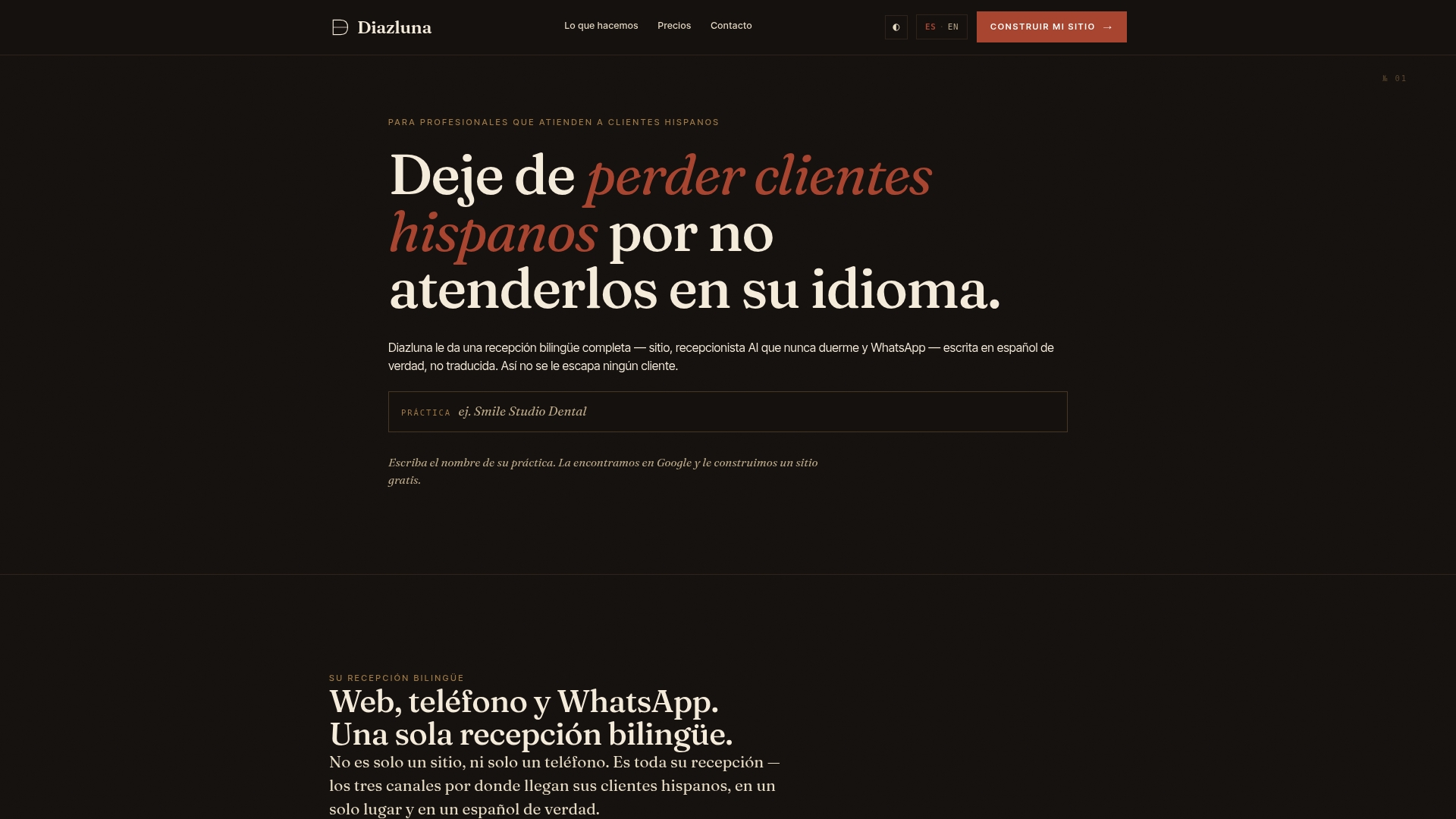
Diazluna delivers a bilingual front desk solution that combines a fully optimized bilingual website, a 24/7 AI receptionist fluent in Spanish and English, and WhatsApp integration, all built specifically for dental offices, law firms, and healthcare practices. Diazluna’s system is indexed by Google within 24 hours and is designed to capture every Spanish-language lead your current setup is missing. Practices using Diazluna report a significant reduction in client loss due to language barriers. For legal firms, Diazluna also offers specialized bilingual support for attorneys serving Spanish-speaking clients.
FAQ
What are the main types of bilingual support services?
The three primary categories are human interpretation models (OPI, VRI, and on-site), AI bilingual receptionists, and digital bilingual tools such as website plugins and Translation Management Systems. Each category serves a different combination of speed, cultural fluency, and interaction complexity.
When should a business use a human interpreter instead of AI?
Human interpreters are required for legal proceedings, clinical consultations, and any interaction involving sensitive personal information or high emotional stakes. AI bilingual receptionists are best suited for routine inquiries, appointment booking, and after-hours coverage.
How does cultural fluency differ from language proficiency in bilingual services?
Language proficiency means a person speaks Spanish correctly. Cultural fluency means they understand regional dialects, industry-specific terminology, and the social norms of the client’s background. Quality bilingual service is measured by the depth of lead details captured at first contact, which requires cultural fluency, not just grammar.
What is a hybrid bilingual receptionist model?
A hybrid model uses AI to handle routine calls and messages 24/7, then transfers complex or sensitive interactions to a live human agent. The handoff protocol must be explicitly configured. Poorly managed transfers reduce client trust, particularly in law and healthcare settings.
How do bilingual website plugins support client acquisition?
Bilingual website plugins allow professionals to publish and maintain Spanish-language content with full SEO control, including translated metadata and page titles. This makes the practice visible to Spanish-speaking clients searching in their preferred language, which expands reach without requiring a separate website build.