August 4, 2026
Cultural Nuance Business Communication Checklist for U.S.

Use this bilingual, culturally informed front-desk checklist to stop losing Hispanic clients to language barriers and legal gaps. With only about 5.9% of U.S. dentists identifying as Hispanic, most practices rely on non-bilingual staff to serve one of the fastest-growing patient populations in the country. Title VI of the Civil Rights Act of 1964 and Section 1557 of the Affordable Care Act both require federally funded practices to take reasonable steps to provide meaningful access for limited English proficient (LEP) clients. This cultural nuance business communication checklist gives you the scripts, workflows, and legal steps to meet that standard and keep clients coming back.
Table of Contents
- Your printable front-desk checklist for Hispanic clients
- What Title VI and Section 1557 actually require from your practice
- How the five cultural constructs shape every front-desk interaction
- Which channels actually reach Hispanic clients?
- Staff roles, scripts, and the daily workflow
- A realistic several-week pilot timeline and what it costs
- KPIs that tell you whether it’s working
- Key Takeaways
- Why tone is the variable most practices underestimate
- Diazluna gives you the bilingual front desk this checklist describes
- Useful sources for legal compliance and cultural guidance
Your printable front-desk checklist for Hispanic clients
Print this section and post it at the front desk. Each item maps to a specific interaction point.
Pre-visit
- Ask for preferred language and communication channel (phone, WhatsApp, SMS, or patient portal) when booking. Document it in the intake record alongside the client’s name.
- Confirm whether a family member will attend and whether the client wants them included in clinical conversations.
- Schedule a telephonic or video interpreter if no bilingual staff member is available.
Arrival and check-in
- Greet with: “Buenos días, señor/señora [Last Name]. ¿Cómo le puedo ayudar?” Use formal address until the client invites first names.
- Offer interpreter services explicitly: “Tenemos intérpretes disponibles sin costo. ¿Le gustaría usar uno?”
- Provide translated intake forms. Post interpreter-rights notices in Spanish at the reception desk.
During the visit
- Speak directly to the client, not to a family member acting as interpreter.
- If a family member is present, confirm the client’s consent before including them in clinical discussion.
- Use teach-back: “Para asegurarme de que expliqué bien, ¿me puede decir con sus propias palabras lo que haremos hoy?”
Post-visit
- Send a bilingual follow-up via WhatsApp or phone within 24 hours. See bilingual client follow-up guidance for ready-to-use message templates.
- Document: LEP status confirmed, interpreter used (name or service), and whether the client declined interpreter services.
- Confirm the next appointment in Spanish before the client leaves.
Operational checks (weekly)
- Verify Spanish signage is posted and legible.
- Confirm telephonic interpreter line is active and staff know the access number.
- Review that all “vital” forms (consent, financial, HIPAA) have approved Spanish translations.
Pro Tip: For small practices with no bilingual staff, a standard 10-line Spanish greeting script plus a single telephonic interpreter account (most services bill per minute) covers the legal minimum and costs far less than a single lost client.
What Title VI and Section 1557 actually require from your practice
Both laws apply to any practice that receives federal financial assistance, which includes Medicare and Medicaid reimbursements. The obligation is not to hire bilingual staff. It is to take reasonable steps to provide LEP individuals meaningful access.
HHS defines four factors that determine what “reasonable” looks like for your specific practice:
- Number and proportion of LEP clients you currently serve or are likely to serve.
- Frequency of contact those clients have with your practice.
- Importance of the service (dental care, legal representation, and medical care all rank high).
- Resources and cost available to the practice.
A solo dental office in a predominantly Spanish-speaking neighborhood faces a higher standard than a rural clinic that sees one Spanish-speaking client per year.
What you must document:
- LEP status identified at intake
- Interpreter used (name, service, or telephonic line)
- Client refusal of interpreter services (get it in writing when possible)
- Translated copies of all “vital” documents on file
On May 6, 2024, the Office for Civil Rights updated Section 1557 rules: minors generally cannot serve as interpreters except in genuine emergencies. Family members and friends carry similar risks, including mistranslation, omission of embarrassing details, and HIPAA exposure. Use a trained telephonic or video interpreter service as your default.
How the five cultural constructs shape every front-desk interaction
These five values, documented in SAGE research on Hispanic cultural constructs, are not abstract theory. They predict exactly how a client will respond to your greeting, your billing conversation, and your follow-up call.
- Confianza (trust): Clients decide whether to return based on whether they felt trusted and respected, not just whether the treatment was good.
- Familismo (family centrality): Proactively ask whether a family member should be included. Never assume the client decides alone.
- Personalismo (warm relationship): Small personal exchanges before clinical talk build the relationship. Ask about the family, not just the chief complaint.
- Respeto (respect through formality): Use Señor or Señora plus the last name until invited to use first names. Shift register only after the client signals comfort.
- Simpatía (social harmony): Clients may say “yes” or “fine” to avoid conflict. They will not return if something felt wrong.
Bilingual sample phrases for common moments
| Situation | Say this | Avoid this |
|---|---|---|
| Greeting | ”Buenos días, señora García. Bienvenida." | "Hey, Maria, come on back.” |
| Offering interpreter | ”Tenemos intérpretes sin costo. ¿Le gustaría uno?” | Assuming that no interpreter is needed because the client speaks some English |
| Family inclusion | ”¿Hay algún familiar que le gustaría incluir en la conversación de hoy?” | Addressing only the family member who speaks more English |
| Teach-back | ”¿Me puede explicar cómo va a tomar el medicamento?" | "Do you understand?” (yes/no invites Simpatía avoidance) |
| Cost discussion | ”Le voy a explicar las opciones de pago disponibles para usted.” | Handing over a printed bill without explanation |
Pro Tip: To surface questions without triggering Simpatía avoidance, use open-ended invitations: “¿Qué preguntas tiene para mí?” rather than “Do you have any questions?” The first assumes questions exist; the second invites a polite “no.”
Which channels actually reach Hispanic clients?
WhatsApp is the highest-engagement channel for Spanish-speaking clients. Send appointment reminders, post-visit instructions, and satisfaction questions there. Response rates are substantially higher than email or portal messages for this demographic.
Bilingual website serves two functions: it signals cultural respect before the first call, and it captures Spanish-language search traffic. A site indexed in both languages can appear in Google within 24 hours of launch, as Diazluna has documented with its clients.
Phone with Spanish greeting menu reduces friction at first contact. A simple “Para español, oprima dos” option, followed by a bilingual staff member or AI receptionist, prevents the hang-up that happens when a Spanish-dominant caller hears only English.
Patient portals and SMS work for appointment confirmations and lab results, but only if the messages are in the client’s preferred language. Sending an English-only portal message to an LEP client is a compliance gap, not just a UX problem.
Pro Tip: Pilot WhatsApp first. It requires no new software for most practices, costs nothing to set up, and gives you immediate data on response rates before you invest in a full bilingual website or AI receptionist.
Staff roles, scripts, and the daily workflow
Role assignments:
- Bilingual front-desk staff handle all Spanish-language calls, check-ins, and WhatsApp messages. They document LEP status in the practice management system (PMS) at every encounter.
- Non-bilingual staff follow the posted greeting script and immediately transfer to a bilingual colleague or telephonic interpreter line.
- Clinicians speak directly to the client during the visit, never through a family member without explicit consent.
- Manager reviews LEP documentation weekly and escalates any interpreter-access complaints within 24 hours.
Training checklist:
- Assess each staff member’s Spanish proficiency with a structured conversation test before assigning bilingual duties. Formal language assessments (such as the ACTFL Oral Proficiency Interview) provide documented evidence of competence.
- Provide a certified interpreter contact list and telephonic line access number to every staff member.
- Run a 30-minute role-play monthly covering: appointment scheduling, insurance explanation, consent discussion, and interpreter refusal.
- Review privacy rules: a bilingual staff member acting as interpreter is still bound by HIPAA. Document their role in the encounter record.
Script for interpreter refusal: “Entiendo que prefiere no usar un intérprete hoy. ¿Puede firmar aquí para confirmar que rechazó el servicio?” Keep the signed form in the client file.
A realistic several-week pilot timeline and what it costs
Week-by-week milestones:
- Week 1: Audit current LEP documentation gaps. Identify which forms need Spanish translation. Order telephonic interpreter access.
- Week 2: Train staff on greeting scripts, teach-back phrases, and interpreter protocols.
- Week 3: Launch WhatsApp as the first bilingual channel. Set a 2-hour response SLA during business hours.
- Weeks 4–5: Go live on all front-desk checklist items. Begin tagging LEP status in the PMS.
- Week 6: Pull first KPI data. Review no-show rate, WhatsApp response rate, and interpreter utilization.
- Weeks 7–8: Iterate on weak points. Decide whether to add a bilingual website or AI receptionist.
Ballpark cost bands:
- Low: Translated forms + telephonic interpreter account. Roughly $50–$150/month depending on call volume.
- Medium: Bilingual website + WhatsApp setup + staff training. One-time setup cost plus a modest monthly subscription.
- High: Full bilingual digital front desk with 24/7 AI receptionist and WhatsApp integration. Turnkey monthly subscription; Diazluna’s tiered packages cover this range.
For the fastest impact per dollar, prioritize Spanish signage, telephonic interpreter access, and a WhatsApp greeting in the first two weeks.
KPIs that tell you whether it’s working
Track these six metrics from day one of the pilot:
- Appointment conversion rate for Spanish-language contacts (calls, WhatsApp, web form)
- No-show rate segmented by language preference
- New client retention at 90 days for LEP clients
- Bilingual CSAT score via a single WhatsApp question: “¿Cómo calificaría su experiencia hoy? (1–5)”
- Interpreter utilization (number of encounters where a qualified interpreter was used)
- Time-to-first-response on WhatsApp and phone for Spanish contacts
Monitoring checklist:
- Assign one staff member as the KPI owner.
- Schedule a 15-minute weekly sync to review the dashboard.
- Record in the PMS: interpreter used, LEP status, and any refusal of services.
- At 30 days, compare no-show and conversion rates against your pre-pilot baseline. At 90 days, assess retention.
A 30–90 day window gives you enough data to make a confident scale-or-stop decision without over-investing in a channel that does not fit your client mix.
Key Takeaways
Practices that combine legal compliance, cultural tone, and bilingual channels retain Hispanic clients at measurably higher rates than those that address only one of the three.
| Point | Details |
|---|---|
| Capture language at intake | Record preferred language and channel in the PMS at every first contact. |
| Use qualified interpreters | Title VI and Section 1557 require it; minors are restricted since the May 6, 2024 OCR rule. |
| Apply the five cultural constructs | Confianza, Familismo, Personalismo, Respeto, and Simpatía shape every front-desk moment. |
| Pilot WhatsApp first | It is the highest-engagement channel and costs nothing to launch as a first bilingual touchpoint. |
| Diazluna covers the full checklist | Its bilingual website, 24/7 AI receptionist, and WhatsApp integration implement the checklist end-to-end. |
Why tone is the variable most practices underestimate
Most practice owners who decide to serve Hispanic clients focus on translation. They translate the intake form, add a Spanish option to the phone menu, and consider the job done. What they miss is that translation without cultural tone is a compliance exercise, not a retention strategy.
A client who hears “Maria, come on back” on the first visit has already received a signal: this practice does not know how to address me. That signal compounds. By the third interaction, the client has quietly decided to look elsewhere, and the practice never knows why. The no-show rate ticks up. The referral never comes.
The five cultural constructs are not soft skills. They are the operating system for how trust is built in this community. Practices that train staff to use formal address, invite family participation with consent, and phrase questions to surface real concerns rather than polite agreement see the difference in 90-day retention numbers. Diazluna’s clients have documented a measurable decrease in client loss after implementing bilingual front-desk workflows, and Google indexed their bilingual sites within 24 hours of launch.
Sustaining cultural competence requires more than a one-time training. Schedule a 30-minute role-play quarterly, review your KPI data monthly, and update your Spanish scripts when staff turns over. The checklist is the floor, not the ceiling.
Diazluna gives you the bilingual front desk this checklist describes
Every item on this checklist requires either trained bilingual staff, a qualified interpreter service, a bilingual website, or a channel like WhatsApp. Building that infrastructure from scratch takes weeks and ongoing management. Diazluna delivers all three components as a single monthly subscription: a fully bilingual website for dental practices, a 24/7 AI receptionist that handles Spanish and English calls, schedules appointments, and flags urgent cases with real-time summaries, and WhatsApp integration that keeps every client conversation in one place.
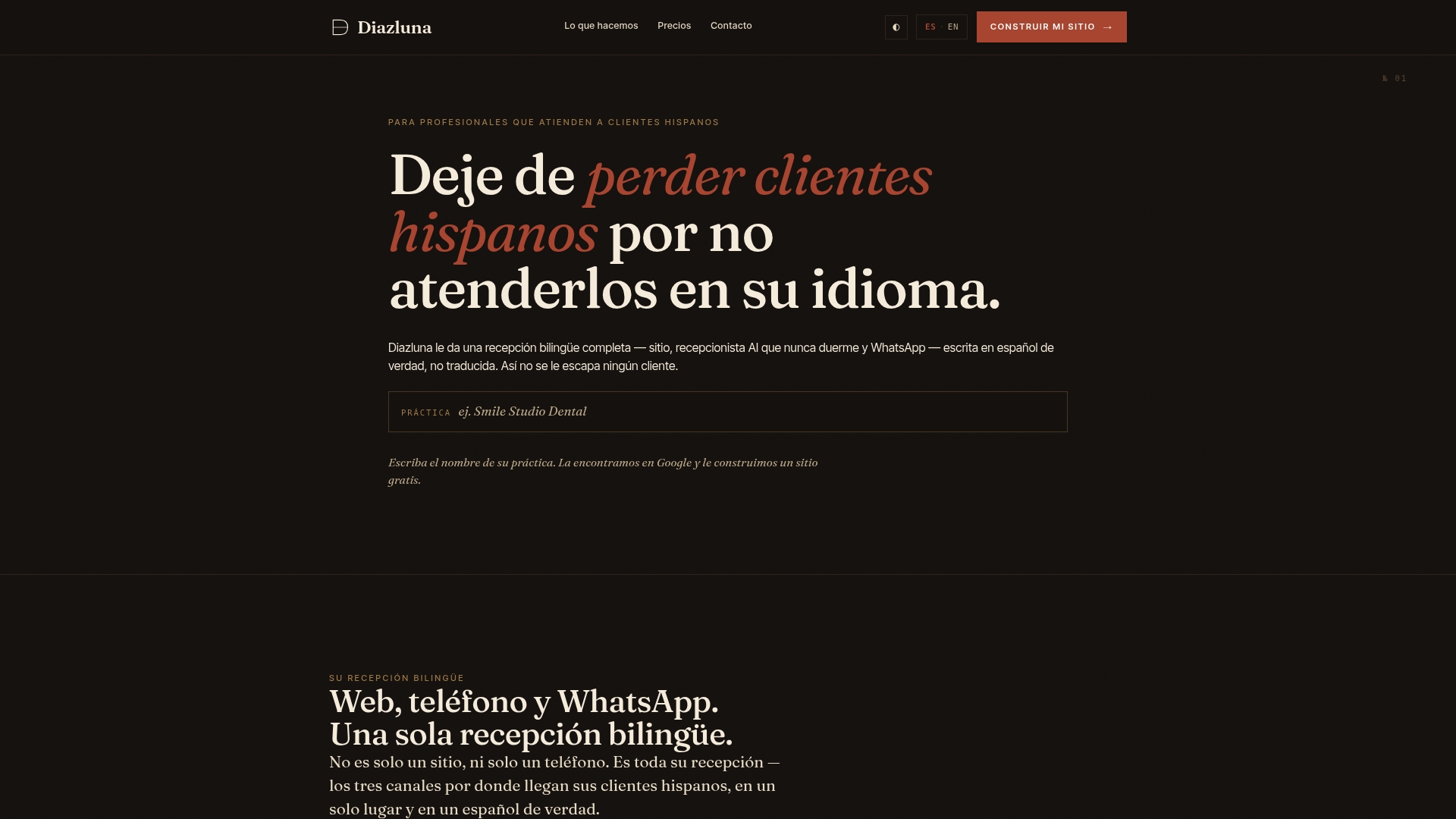
The platform maps directly to this checklist: automated Spanish greetings, LEP tagging in the workflow, interpreter fallback routing, and bilingual follow-up messages. Clients report a significant decrease in client loss after launch, and new bilingual sites index on Google within 24 hours. For practices that want the checklist implemented without building it piece by piece, see how Diazluna works for your practice.
Useful sources for legal compliance and cultural guidance
These primary sources cover legal obligations, interpreter standards, translated materials, and cultural competence frameworks for U.S. practices.
- HHS Office for Civil Rights — Civil Rights guidance for providers: The authoritative source for Title VI and Section 1557 obligations, LEP guidance, and documentation requirements.
- American Dental Association — Health Policy Institute: Source for the 5.9% Hispanic dentist statistic and broader workforce and access data.
- PLOS One — differing interpretations of health care encounters: Research on the risks of ad-hoc interpreting and the case for trained interpreter services.
- SAGE — Local voices on health care communication and Latino cultural constructs: Qualitative evidence linking cultural constructs to engagement, perceived discrimination, and retention.
- Markkula Center for Applied Ethics — Culturally competent care for Latino patients: Practical framework for family-centric decision-making and language access in clinical settings.
- University of Wisconsin Pediatrics — Working with Latin families: Staff training resource covering Simpatía, Respeto, Familismo, and communication strategies for clinical teams.
- Ohio State University — Cultural Sensitivity Pocket Guide: A printable reference covering Hispanic/Latino cultural norms, the 4 C’s mnemonic, and communication tips for front-desk and clinical staff.
“Cultural and linguistic barriers may have a great impact on the quality of health care received by immigrants. Health care professionals need practical tools to recognize and respond to these barriers at every point of contact.” — PMC, Latino immigrant patient communication study
This article provides general information about legal and compliance topics. Confirm current requirements with HHS, your state health department, or a qualified legal professional before implementing changes to your practice’s language-access policies.