July 8, 2026
Hire a Bilingual Virtual Receptionist in 2026

A bilingual virtual receptionist is a remote front desk professional who handles calls, scheduling, and client communication fluently in both English and Spanish. For business owners serving Hispanic clients in dentistry, law, or healthcare, this role is the single most effective way to stop losing patients and clients at the first point of contact. The U.S. Hispanic population represents one of the fastest-growing consumer segments, and a missed call in the wrong language is a missed client. This guide covers what to look for, what to pay, and how to get the right person onboarded fast.
Why hiring a bilingual virtual receptionist changes your client retention
Language is a direct growth factor. Bilingual receptionists expand market access and measurably improve satisfaction among Spanish-speaking clients. When a Spanish-speaking caller reaches a receptionist who responds in English only, the interaction often ends there. That caller does not reschedule. They call your competitor.
A qualified bilingual virtual receptionist handles calls, emails, appointment booking, and follow-up in both languages without switching between two separate staff members. This is not a translation service. It is a fully integrated front desk role performed remotely. The industry term for this function is “bilingual virtual receptionist services,” though you will also see it described as bilingual office support or multilingual customer service depending on the provider.

The business case is straightforward. Hiring remotely saves up to 70% in labor costs compared to an in-house employee. That savings includes payroll taxes, benefits, recruiting fees, and office overhead. For a small law firm or dental practice, that difference funds real growth.
What qualifications should you require when you hire a bilingual virtual receptionist?
The most common hiring mistake is treating a bilingual receptionist role like a general administrative position. It is not. The language requirement alone eliminates most candidates, and the ones who remain still need to be vetted carefully.
Core qualifications to require:
- Fluency in spoken English and Spanish, verified through a live oral assessment
- Experience with CRM platforms such as Salesforce, Zoho, or practice management software
- Demonstrated call management skills: greeting, routing, taking messages, and scheduling
- Familiarity with appointment booking workflows specific to your industry
- Cultural competency in both U.S. and Latin American communication norms
Live oral fluency assessments are non-negotiable. Written tests fail to detect tone, cadence, and cultural nuance. A candidate may pass a grammar quiz and still sound robotic or overly formal on a call with a Spanish-speaking patient. The live recorded call simulation catches that problem before it reaches your clients.
The distinction between a dedicated receptionist and a shared call center agent matters enormously. Shared agents rotate across multiple clients, which means they rarely learn your brand voice, your specific intake process, or the names of your staff. A dedicated bilingual receptionist becomes an extension of your team. That consistency shows up in every client interaction.
Pro Tip: Ask candidates to complete a recorded mock call in both languages before the final interview. Evaluate tone, pace, and how naturally they switch between English and Spanish under realistic conditions.
How much does it cost to hire a bilingual virtual receptionist?
Cost is where most business owners are surprised. The range is wide, and the pricing model you choose affects both your budget and the quality of service you receive.
Virtual receptionists from Latin America cost between $7 and $15 per hour, compared to $50,000 to $80,000 annually for a U.S.-based in-house hire. That translates to roughly $14,000 to $24,000 per year for a nearshore full-time receptionist. The savings are real, not theoretical.
Flat monthly fee plans for full-time bilingual receptionists typically range from $900 to $1,900 per month. These plans eliminate payroll taxes and recruiting fees entirely. For part-time coverage, some providers offer plans starting around $599 per month.
| Pricing model | Typical cost | What is included |
|---|---|---|
| Hourly (nearshore) | $7–$15/hr | Flexible hours, pay per use |
| Full-time monthly flat fee | $900–$1,900/mo | Dedicated staff, no payroll taxes |
| Part-time monthly flat fee | From $599/mo | Shared or dedicated, limited hours |
| U.S.-based in-house hire | $50,000–$80,000/yr | Full benefits, office costs included |
The flat monthly model works best for practices and firms with predictable call volume. The hourly model suits businesses with seasonal demand or limited budgets. Either way, the cost advantage over a local hire is significant enough to fund additional marketing or staffing in other areas.
Pro Tip: Request a breakdown of what is included in any flat fee before signing. Some plans exclude after-hours coverage or charge extra for WhatsApp and email handling.
Step-by-step process for hiring and onboarding a bilingual receptionist
The hiring cycle for a bilingual virtual receptionist is faster than most business owners expect. Specialized agencies deliver a shortlist within 48 hours and complete full onboarding in 3 to 11 business days. That speed is possible because pre-vetted candidate pools already exist.
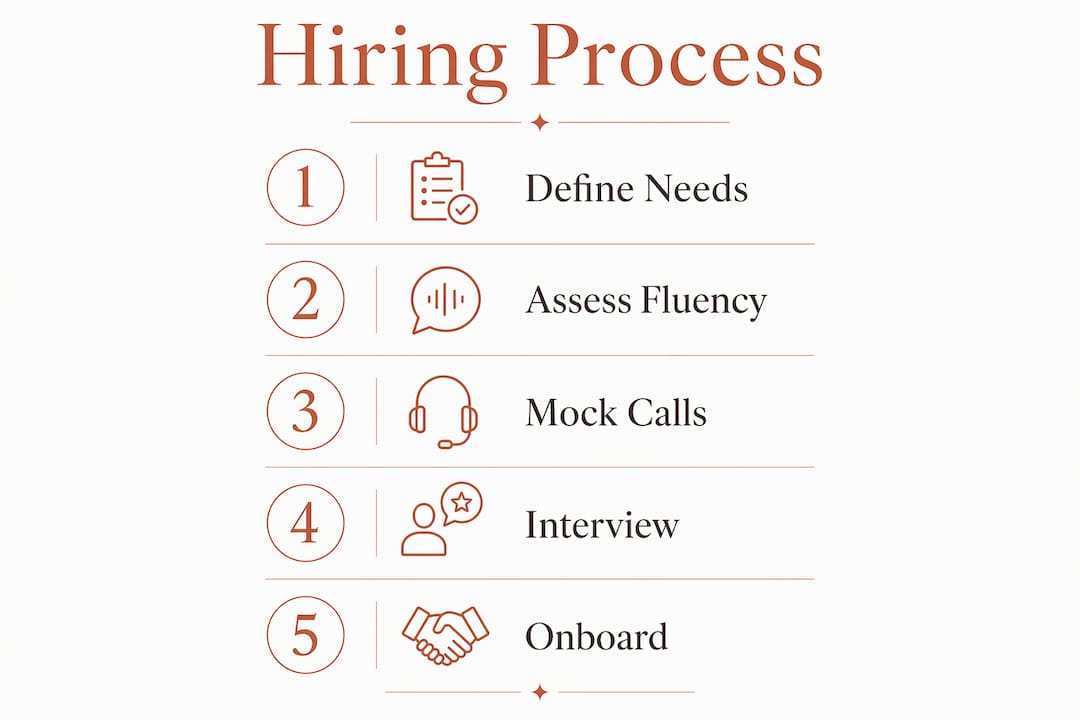
The hiring process in order:
- Define your needs. Specify hours, languages, industry, CRM used, and whether you need full-time or part-time coverage.
- Source candidates. Use a specialized bilingual staffing agency or a platform with pre-vetted nearshore talent.
- Conduct live fluency and skills testing. Require a recorded mock call in both English and Spanish, plus a CRM walkthrough if applicable.
- Interview shortlisted candidates. Focus on cultural fit, communication style, and familiarity with your industry’s terminology.
- Set up contract and payroll. Agencies typically handle compliance, contracts, and payment logistics for nearshore hires.
- Run a structured onboarding. Provide call scripts, brand voice guidelines, your intake process, and access to your scheduling system.
- Schedule early check-ins. Weekly performance reviews during the first month catch misalignments before they become habits.
Clients often onboard bilingual assistants within 3 to 5 business days when working with agencies that maintain active candidate pipelines. That timeline assumes you have your onboarding materials ready before the candidate starts.
| Hiring stage | Typical timeline | Key action |
|---|---|---|
| Define needs and brief agency | Day 1 | Write a clear job description with language requirements |
| Receive shortlist | Within 48 hours | Review profiles and select candidates for interviews |
| Conduct interviews and testing | Days 2–4 | Run live fluency assessments and mock calls |
| Select candidate and sign contract | Day 5 | Confirm hours, rate, and scope of work |
| Onboarding and training | Days 6–11 | Provide scripts, CRM access, and brand guidelines |
The onboarding materials you prepare directly determine how quickly the receptionist performs at full capacity. Practices that provide a written call script, a list of frequently asked questions, and a recorded walkthrough of their scheduling software see faster results than those who rely on verbal instructions alone.
For professional service firms, the bilingual front desk setup also benefits from integrating communication channels like WhatsApp, which many Hispanic clients prefer over phone calls.
Common challenges and best practices for managing bilingual receptionists
Post-hire management is where many business owners lose the gains they worked to create. A well-hired bilingual receptionist can underperform if the management structure is weak.
The most common challenges and how to address them:
- Brand voice drift. Receptionists who do not receive regular feedback gradually shift away from your preferred tone. Schedule monthly call reviews with written notes.
- Cultural miscommunication. Spanish spoken in Mexico differs in phrasing and formality from Spanish spoken in Colombia or Puerto Rico. Know your client base and hire accordingly.
- Isolation from the in-house team. Remote staff who feel disconnected disengage faster. Include them in team meetings and internal communications.
- Inconsistent call handling. Without a documented call flow, receptionists improvise. Write a clear script for every scenario: new client calls, appointment reminders, billing questions, and after-hours messages.
- No quality assurance process. Call monitoring and periodic scoring keep standards high. Review at least five calls per week during the first month.
Bilingual receptionists trained on your specific CRM and call flows deliver measurably better client experiences than general virtual assistants who adapt on the fly. The investment in proper onboarding and ongoing feedback pays off in client retention, not just first impressions.
Remote staffing with dedicated professionals preserves personal touch and brand consistency in a way that shared call center models cannot replicate. Your clients notice the difference, even if they cannot articulate why.
Key Takeaways
Hiring a dedicated, live-assessed bilingual virtual receptionist is the most cost-effective way to retain Spanish-speaking clients and maintain consistent brand communication across every touchpoint.
| Point | Details |
|---|---|
| Require live oral fluency testing | Written tests miss tone and cultural nuance; recorded mock calls reveal real communication ability. |
| Expect significant cost savings | Nearshore bilingual receptionists cost $14,000–$24,000 annually versus $50,000–$80,000 for U.S.-based hires. |
| Onboarding is faster than expected | Pre-vetted agencies deliver a shortlist in 48 hours and complete onboarding in under two weeks. |
| Dedicated beats shared models | A receptionist trained on your CRM and call flows delivers better client retention than rotating agents. |
| Ongoing management determines results | Weekly call reviews and documented scripts prevent brand voice drift and inconsistent service. |
What I have learned after watching businesses get this wrong
The most expensive mistake I see business owners make is hiring a bilingual receptionist based on a resume and a written language test. They onboard someone who reads Spanish fluently but speaks it with a cadence that feels foreign to their clients. The calls are technically bilingual. The clients still do not feel understood.
The second mistake is choosing a shared call center model because it looks cheaper on paper. It rarely is. When a rotating agent handles your calls alongside a dozen other clients, they cannot learn your intake process, your doctors’ names, or the specific questions your patients ask. Every call starts from zero. That is not a receptionist. That is an answering service.
What actually works is hiring a dedicated person, running them through a live recorded call simulation in both languages, and then investing two weeks in structured onboarding. The businesses I have seen do this well treat their bilingual receptionist like an in-house team member who happens to work remotely. They include them in staff meetings. They send feedback after call reviews. They update the call script when processes change.
A well-chosen bilingual receptionist does not just answer phones. They become the reason a Spanish-speaking client calls back, refers a friend, and stays with your practice for years. That is a growth asset, not an administrative expense. If you want to understand what a complete bilingual service package looks like in 2026, the components go well beyond a single hire.
— Francisco
How Diazluna handles bilingual front desk coverage for professional practices
Diazluna was built specifically for dentists, attorneys, and healthcare providers who serve Hispanic clients and cannot afford to lose them at the first call.
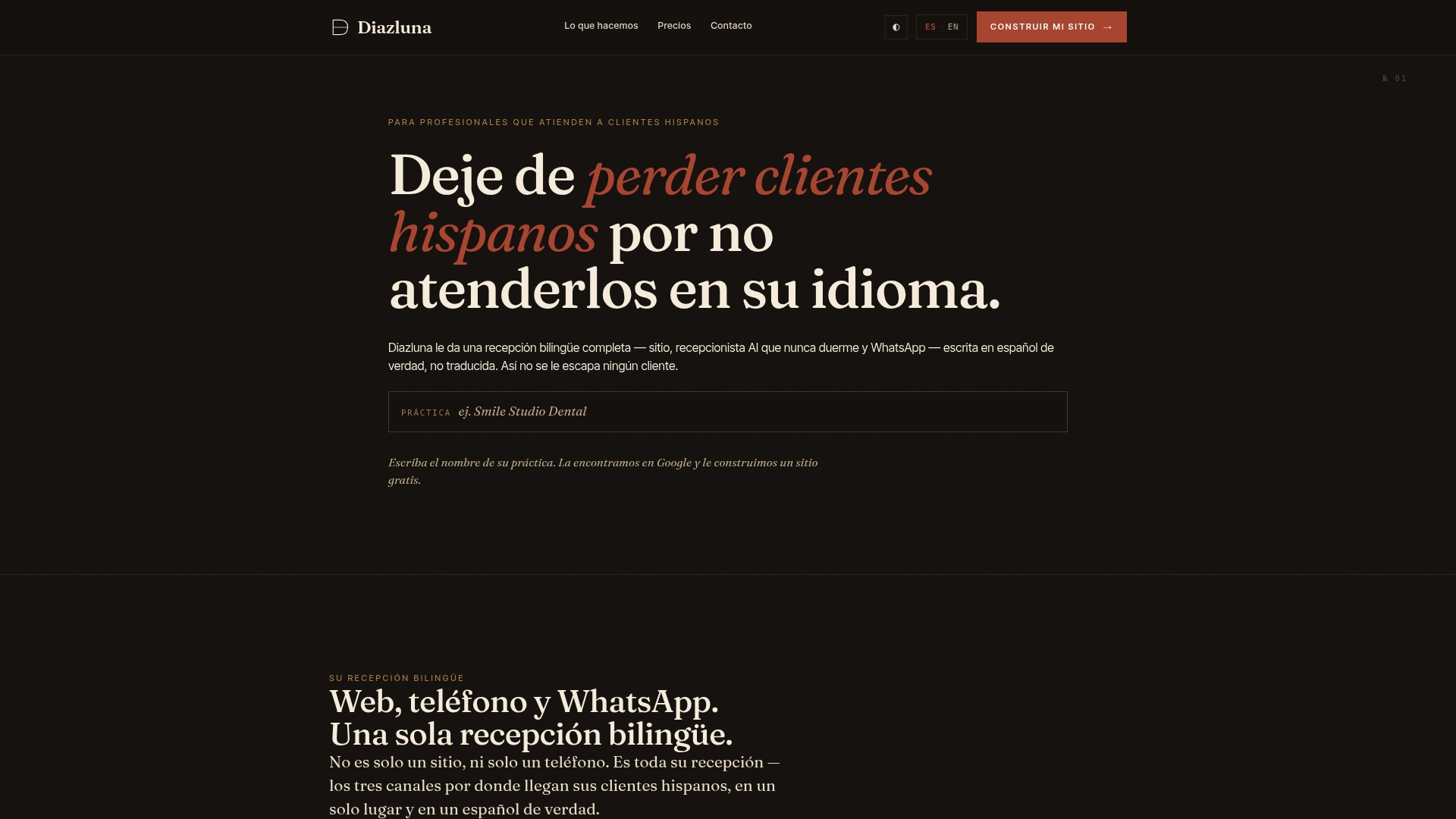
Diazluna’s bilingual front desk service combines a fully optimized bilingual website, a 24/7 AI receptionist fluent in English and Spanish, and WhatsApp integration. All three work together from day one. There is no separate agency for the website, a different vendor for the phone line, and a third platform for messaging. Diazluna delivers the full package at a fraction of what those pieces cost separately. For law firms specifically, the bilingual phone and web setup is built around the intake workflows attorneys actually use. If your practice serves Spanish-speaking clients and your front desk does not, Diazluna closes that gap.
FAQ
What does a bilingual virtual receptionist do?
A bilingual virtual receptionist handles inbound calls, appointment scheduling, client intake, and follow-up communication in both English and Spanish. They work remotely and function as a dedicated front desk professional for your practice or firm.
How long does it take to hire a bilingual virtual receptionist?
Specialized agencies deliver a shortlist within 48 hours and complete full onboarding in 3 to 11 business days. Having your call scripts and CRM access ready before the start date shortens that timeline further.
What is the cost of a bilingual virtual receptionist in 2026?
Full-time nearshore bilingual receptionists cost between $14,000 and $24,000 annually on flat monthly plans ranging from $900 to $1,900 per month. That compares to $50,000 to $80,000 per year for a U.S.-based in-house hire.
Should I hire a dedicated receptionist or use a shared call center?
A dedicated bilingual receptionist trained on your CRM and call flows delivers better client retention and brand consistency than a shared call center agent who rotates across multiple clients.
What is the most important qualification to verify before hiring?
Live oral fluency in both English and Spanish is the most critical qualification. Written tests do not capture tone, cadence, or cultural nuance. Always require a recorded mock call before making a hiring decision.