September 18, 2026
Hispanic Legal Marketing for U.S. Law Firms
To win Hispanic clients, prioritize a Spanish-first website, dedicated Spanish ad campaigns, and bilingual intake that answers calls, forms, and WhatsApp messages in Spanish. Do those three things and you’re already ahead of most firms chasing the Hispanic population growth the Census Bureau has documented for two decades. Providers like Diazluna exist specifically because that third piece, intake, is where most firms quietly lose the leads their marketing just paid for.
TL;DR:
- Hispanic legal marketing requires dedicated Spanish SEO with human-written, indexable pages and proper hreflang tags, not translated content or language toggles.
- Separate Spanish PPC campaigns with localized landing pages and budget allocations aligned to search behavior are essential for effective outreach.
- Building a bilingual front door with a 24/7 AI receptionist and WhatsApp messaging improves lead capture and follow-up, reducing intake gaps.
- Verifying native Spanish ability, transcreation experience, and active Spanish-language directory profiles prevents costly agency mistakes.
- Conduct a 60-day pilot to assess missed-call recovery, consultation attendance, and cost-per-lead metrics before scaling efforts.
Table of Contents
- What Does Effective Hispanic Legal Marketing Actually Require?
- How Do You Choose a Hispanic Marketing Partner?
- Is Your Firm Ready to Advertise in Spanish?
- What Does a Bilingual Digital Front Desk Look Like in Practice?
- Why Culturally Fluent Marketing Pays Off Over Time
- A Faster Way to Fix the Intake Gap
- Primary Sources and Further Reading
- Sources
- FAQ
What Does Effective Hispanic Legal Marketing Actually Require?
Hispanic legal marketing succeeds or fails on channel selection and follow through, not ad spend. Here’s the tactical order that works.
**Spanish SEO comes first, and it has to be real Spanish, not translated Spanish. This means a dedicated /es/ subdirectory with indexable URLs, proper hreflang tags, and pages written by someone who thinks in Spanish rather than a plugin that swaps words. Practitioner guidance on bilingual sites is blunt about this: Spanish pages need to be indexable and hreflang-tagged, not rendered through a client-side JavaScript toggle that Google never sees. A widget that flips English to Spanish on click looks fine to a visitor and invisible to a search crawler. Transcreation, adapting the message and tone rather than swapping vocabulary, consistently outperforms literal translation for both ranking and conversion, according to bilingual marketing guidance for professional practices.
Spanish PPC needs its own campaign, not a language toggle bolted onto an English one. Run separate Google Ads campaigns with Spanish keywords, Spanish ad copy, and landing pages that match the ad’s language exactly. Budget allocation should track where your local Hispanic population actually searches, not a flat percentage of total spend.
Social and messaging channels close the loop. Spanish-language video testimonials, community page engagement, and WhatsApp integration matter more here than in general-market legal advertising, because WhatsApp is often the default communication app for Spanish-speaking households rather than a secondary option.
Legal directories deserve real attention, and here’s the number that should reset your budget priorities:
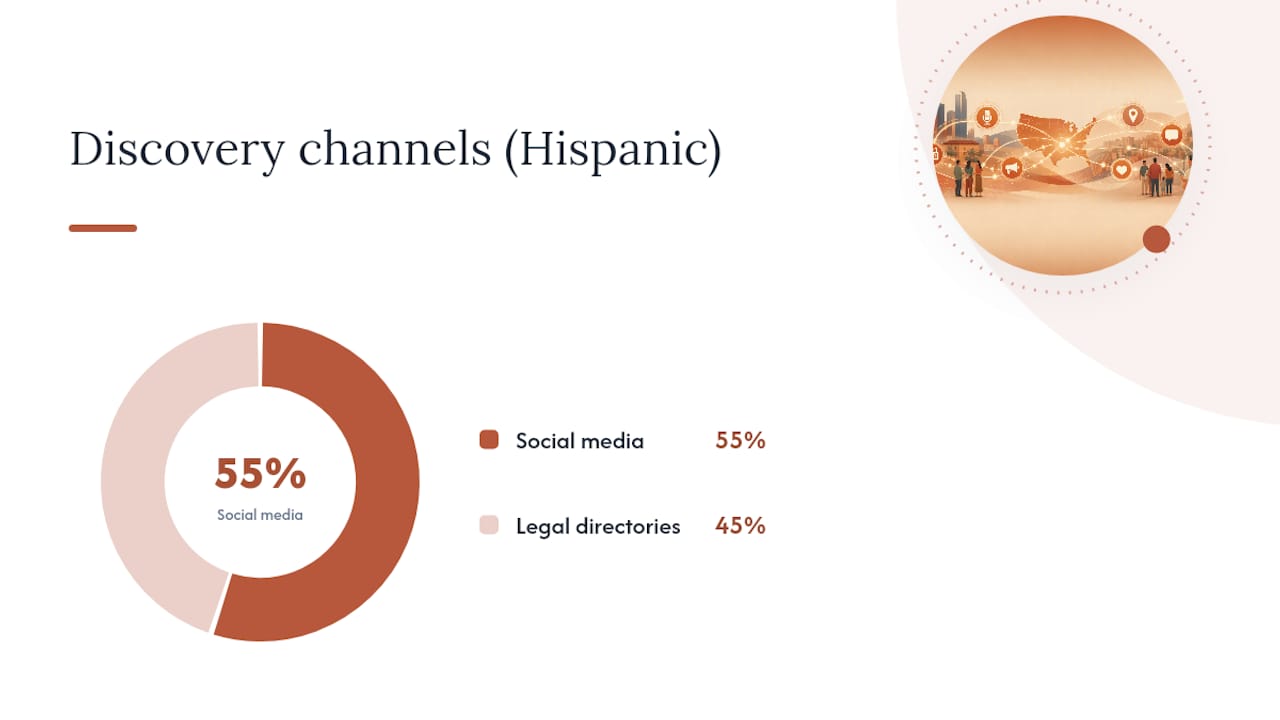
By the numbers: FindLaw’s research found that 55% of Hispanic households consulted social media when searching for an attorney and 45% used legal directories, a notably higher share than the general population for both channels.
That means directory profiles (Avvo, FindLaw, Abogado.com) with complete Spanish descriptions and a visible push for Spanish-language reviews aren’t optional extras. They’re a primary discovery channel for this audience specifically.
On messaging: lean into trust-centered themes. Family, respect, and community carry more weight than price-driven hooks. Testimonials work best when they’re genuinely bilingual, not dubbed, and your top content priorities should be practice-area pages, a clear intake explanation, and transparent fee information in Spanish.
- Spanish SEO: indexable
/es/pages, hreflang, human-written copy - Spanish PPC: separate campaigns, matched landing pages, localized budget
- Social/WhatsApp: native video, community engagement, fast response times
- Directories: complete Spanish profiles, active review requests
- Messaging: family and respect themes, bilingual testimonials, transparent fees
How Do You Choose a Hispanic Marketing Partner?
Most firms vet agencies on portfolio and price. For Hispanic legal marketing, that’s the wrong test. Here’s what actually predicts whether a partner will deliver.
- Confirm native Spanish capability, not a contractor who “took four years of high school Spanish.” Ask to see writing samples and, ideally, talk to the person who’ll write your copy.
- Ask for transcreation examples, specifically pages where the agency adapted tone and cultural references rather than translating sentence by sentence.
- Verify local search experience. Have they built indexable Spanish URLs with hreflang before, or will your site be their first attempt?
- Check their intake support. Do they help you build bilingual phone scripts and forms, or do they hand you traffic and walk away?
- Require a measurement plan before you sign anything, covering cost per lead, consultation show-up rate, and Spanish organic visibility.
Watch for three red flags: agencies that quote you a price for “adding Spanish” without mentioning transcreation at all, Spanish-language ads that click through to English-only landing pages, and no answer when you ask how intake will handle a Spanish caller after hours. Law on this exact problem is worth reading before you sign a contract. It argues that “se habla español” on a website banner means nothing if the person answering the phone doesn’t.
Pro Tip: Ask a prospective vendor to walk a Spanish-speaking caller through your current intake process, live, on the call. If they hesitate or improvise, that’s your answer about whether they’ve actually tested this before.
Require quarterly reporting on lead quality, not just lead volume. A firm generating 40 Spanish leads a month that never show up for consultations is worse off than one generating 15 that convert.
Is Your Firm Ready to Advertise in Spanish?
Before you spend a dollar on Spanish ads, run this audit. It takes an afternoon and it will save you months of wasted spend.
Test everything a Spanish-speaking client would touch. Call your own main line and ask for service in Spanish. Fill out your intake form in Spanish. Send a WhatsApp message to your business number, if you have one, and time the response. Check whether your Google Business Profile lists Spanish as a spoken language and whether your posted hours reflect real staff availability.
Minimum requirements before launch:
- A phone system that can route to a Spanish-speaking staff member or answering service
- Intake forms available in Spanish, not just a PDF you’ll translate “later”
- Payment terms and consent documents translated by a person, not a machine
- At least one trained bilingual staff member reachable during business hours
If you’re not there yet, interim solutions exist. Interpretation services, WhatsApp-based triage, or a bilingual AI receptionist can bridge the gap while you build permanent staffing.
Pro Tip: Track your dropped-call rate and missed-call recovery time for two weeks before launching any Spanish campaign. If either number is bad in English, it will be worse at Spanish, because Spanish-speaking callers are less likely to leave a voicemail with an English-only greeting.
Measure consultation attendance and conversion rate separately from lead volume once you launch. Volume without follow-through is the most common failure mode in this space.
What Does a Bilingual Digital Front Desk Look Like in Practice?
One way firms are closing the operational gap: pairing a Spanish-and-English website with a 24/7 AI receptionist and WhatsApp integration, so a Spanish-speaking caller at 9 p.m. gets a real response instead of a voicemail.
A sensible pilot looks like this:
- Launch one Spanish landing page for your highest-volume practice area
- Route Spanish calls and WhatsApp messages through a bilingual intake flow
- Measure missed-call recovery and consultation show-up rate for 60 days
- Compare cost per lead against your current English-only campaigns
Why Culturally Fluent Marketing Pays Off Over Time
Trust compounds. A Hispanic client who gets a real response in Spanish, from your website to your intake call, tells family members who tell neighbors. That referral chain is worth more than most ad budgets. Start with one pilot page and one measured intake change instead of overhauling everything at once. None of this only helps Spanish-dominant callers, either. Bilingual and English-preferring Hispanic families notice the same signals of respect.
— Francisco
A Faster Way to Fix the Intake Gap
Most firms don’t lose Hispanic clients at the ad level. They lose them at the phone, the after-hours voicemail, or the web form that only exists in English. A solution for that gap is a bilingual website, a 24/7 AI receptionist fluent in Spanish and English, and WhatsApp integration, bundled together instead of stitched across three vendors.
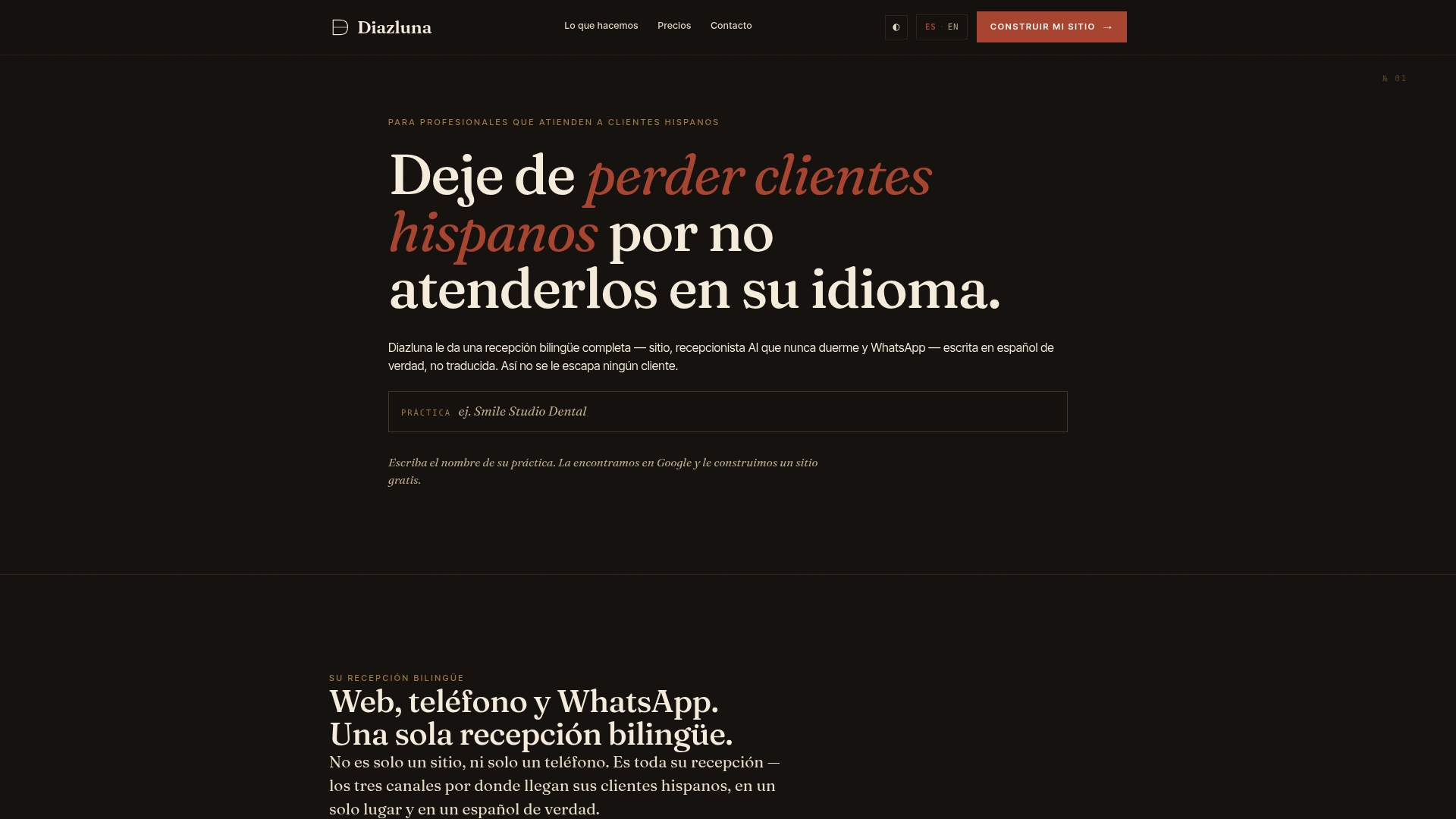
Hiring a full-service agency makes sense if you need custom campaign strategy across multiple channels. If what you actually need is a Spanish-and-English front door that never sleeps, Diazluna’s plans start at $99 a month for Solo Sitio, with Sitio + María adding the AI receptionist for $199 a month, and Sitio + María Pro at $349 a month for expanded call capacity. A one-time $399 activation fee applies. For a firm that wants a working Spanish intake path this quarter rather than next year, that’s a fast, low-commitment way to test the waters. Visit Diazluna to see a demo built around your practice area.
Primary Sources and Further Reading
- U.S. Hispanic population growth — U.S. Census Bureau
- Getting to the bottom of Hispanic clients’ unique legal needs — FindLaw
- Law
- Spanish Legal Digital Front Desk Guide — Diazluna
Sources
- Getting to the bottom of Hispanic clients’ unique legal needs — FindLaw
- U.S. Hispanic population growth — U.S. Census Bureau
- Bilingual & Spanish-language dental marketing in 2026 — Dentplicity
- Law
FAQ
What Makes Hispanic Legal Marketing Different from General Marketing?
It requires transcreated Spanish content, not translated content, plus operational readiness at intake so Spanish-speaking leads actually convert to consultations, not just clicks.
How Important Are Legal Directories for Reaching Hispanic Clients?
Very important. FindLaw’s research found 45% of Hispanic households used legal directories when searching for an attorney, about 10 points higher than the general population.
Does a Spanish Website Alone Improve Conversion?
No. A Spanish website helps discovery, but conversion depends on bilingual phone lines, forms, and staff who can complete the intake process in Spanish.
What Does Diazluna Cost for a Law Firm?
Diazluna’s Solo Sitio plan starts at $99 a month, Sitio + María (with the AI receptionist) is $199 a month, and Sitio + María Pro runs $349 a month, plus a $399 one-time activation fee, all listed at Diazluna.
How Long Should a Hispanic Marketing Pilot Run Before Judging Results?
A 60-day window is enough to measure missed-call recovery, consultation show-up rate, and early cost-per-lead trends before committing to a larger campaign.