September 1, 2026
Law Firm Spanish Website That Converts with 24/7 Bilingual
To capture Spanish-speaking clients, build native Spanish pages under your own domain and pair them with a 24/7 bilingual digital front desk that answers calls and WhatsApp messages around the clock. Nearly 94% of Hispanic adults browse primarily on mobile, so a slow, translated afterthought of a page loses leads before it loads. A properly indexed Spanish subdirectory plus real-time bilingual intake, the kind Diazluna builds for practices every week, closes that gap fast.
TL;DR:
- Building native Spanish pages with separate URLs, schemas, and content tailored to local dialects significantly improves search engine ranking and client engagement.
- Mobile performance optimization and culturally relevant, native content are crucial for converting Spanish-speaking visitors, who primarily browse on smartphones.
- A 24/7 bilingual intake system, including AI reception and WhatsApp integration, reduces missed calls and accelerates response times for Hispanic clients.
- Legal disclaimers, privacy policies, and forms must be professionally translated and culturally adapted to ensure compliance and build trust.
- Using a unified platform that delivers native content, technical SEO, and intake automation within weeks enhances market penetration and client retention.
Table of Contents
- Building a Law Firm Spanish Website: Your Priority Checklist
- Why Your Spanish Pages Need Their Own URLs and Schema
- Writing Spanish Legal Content That Converts, Not Just Translates
- Designing a 24/7 Spanish Front Desk That Doesn’t Break Under Pressure
- Legal Disclaimers and Privacy Rules for Your Spanish Pages
- Making Your Spanish Site Usable for Every Literacy Level
- Getting Hispanic Traffic to Your Spanish Site in the First Place
- Getting Staff Ready to Handle Bilingual Client Interactions
- Connecting Your CRM to the Bilingual Front Desk
- Why Translation Alone Fails Spanish-Speaking Clients
- How Diazluna Builds This for You in Weeks, Not Months
- Sources
Building a Law Firm Spanish Website: Your Priority Checklist
Most firms know they need a Spanish presence. Few know what order to build it in, so tasks stall or get half finished. Here’s the sequence that actually works.
- Set up Spanish URLs under
/es/and mirror every practice-area page, not just the homepage. A firm with immigration, personal injury, and family law pages in English needs the same three in Spanish, structurally parallel. - Fix mobile performance first. Compress images, cut unnecessary scripts, and test load speed on a mid-range Android phone, since that’s the device most Spanish-speaking visitors will actually use.
- Write native Spanish content, not literal translations, for practice-area pages, the contact page, and FAQs. A translated page reads like a translated page. Clients notice.
- Turn on 24/7 bilingual intake. That means an AI receptionist that speaks both languages, WhatsApp connected to the same system, and clear rules for when a call gets routed to a human attorney versus logged for morning follow-up.
- Add Spanish FAQ schema and track Spanish KPIs separately from your English site. Blended numbers hide whether the Spanish side is actually converting.
Skip step one and nothing after it matters. A JavaScript toggle that swaps text on the same URL creates zero new pages for Google to index, so the whole effort disappears from search entirely. The order above isn’t arbitrary. It’s the difference between a Spanish page that ranks and one that just sits there.
Why Your Spanish Pages Need Their Own URLs and Schema
Search engines and AI assistants need something concrete to index. A dropdown that swaps English for Spanish text on the same URL gives them nothing. Real Spanish pages living at /es/ (or a dedicated subdomain, though subdirectories generally consolidate authority better) are what get crawled, ranked, and cited.
The technical checklist for a Spanish section that actually performs, including detailed structured content and AI citation tactics, is outlined in this AI Content Optimization Guide for Legal Marketers:
- Subdirectory structure (
yourfirm.com/es/) with genuinely separate, indexable HTML for every page, not a client-side language switch. - Hreflang tags on every English/Spanish page pair, telling search engines which version to serve to which audience.
- Schema markup in Spanish, including FAQPage, LegalService, and Attorney schema, matched to the Spanish content on that page.
- Core Web Vitals tuned for mobile, since that’s how most Hispanic visitors arrive.
- Sitemap and Search Console inclusion for the Spanish section specifically, so you can monitor indexing separately from English pages.
- Internal links connecting Spanish pages to each other, plus outreach for Spanish-language backlinks from relevant local or Hispanic-focused directories.
One law firm SEO guide puts it bluntly: firms that treat Spanish as a checkbox rather than a real content strategy miss the market entirely. The same source notes that AI search tools increasingly favor well-structured, native-language pages when deciding what to cite in a Spanish-language answer.
Pro Tip: Run your Spanish URLs through Google’s Rich Results Test separately from your English pages. Schema errors on the Spanish side often go unnoticed for months because nobody checks that section on its own.
Writing Spanish Legal Content That Converts, Not Just Translates
Native copy beats translated copy every time, and the reasons go beyond grammar. Word choice, formality, and even the examples you use in a personal injury page land differently depending on whether your audience is largely Mexican, Puerto Rican, Central American, or Cuban. A phrase that sounds natural in one regional dialect can sound stiff or foreign in another.
Hire a native Spanish writer or a professional editor familiar with the Hispanic communities your firm actually serves, and build content around their input rather than running English copy through a translation tool. Effective Hispanic marketing requires cultural relevance, not word-for-word accuracy, and firms that skip this step tend to underperform even when their English marketing is strong.
Practical rules for the content itself:
- Adapt calls to action for Spanish readers instead of translating the English button text directly.
- Include Spanish-speaking attorney or staff bios where you have them; trust builds faster when a visitor sees someone who speaks their language.
- Build your Spanish FAQ section from actual Spanish keyword research, not a mirrored list of your English FAQ topics.
- Keep the same schema and page structure as your English site, but let the examples, testimonials, and CTAs shift to fit the audience.
- Review call transcripts and WhatsApp threads monthly to see what Spanish speakers actually ask, then update your FAQ pages accordingly.
A pattern worth watching: firms that simply run their existing site through translation software see significantly weaker engagement than firms writing original Spanish content, according to case comparisons of translated versus native-built pages. The content itself isn’t the whole story, either. Diazluna’s own analysis of Spanish tone and retention found that clients who reach a firm that “sounds” naturally bilingual, on the phone and on the page, stay engaged longer than clients handled through a translated experience layered on top of English-first service.
Designing a 24/7 Spanish Front Desk That Doesn’t Break Under Pressure
A Spanish website with no one to answer the phone in Spanish is a half-finished project. The intake layer is where most firms either win the client or lose them to a competitor who picked up faster.
- Map intake questions to practice area. A personal injury inquiry needs different urgency flags (accident date, injury severity, insurance involvement) than an immigration case (visa status, upcoming hearing dates, detention risk). Build separate intake scripts for each.
- Route WhatsApp into your case management system, not a separate inbox someone checks once a day. WhatsApp is often the primary communication channel for Hispanic clients, and a message that sits unread for six hours might as well not have been sent.
- Use an AI receptionist for after-hours coverage, and set firm rules for what gets escalated to a human immediately versus logged for the next business day. Urgent matters (detention, active injury, court deadlines) should always trigger a live handoff.
- Build in quality control. Attorneys serving limited-English-proficiency clients carry real ethical and competence obligations, and a garbled or overly literal AI translation during an urgent intake call can create genuine liability, not just a bad impression.
- Track missed-call rate, time-to-first-contact, and consultation conversion for the Spanish channel specifically. Firms running 24/7 intake consistently see fewer missed calls and faster response times, but only if someone is actually watching those numbers.
Pro Tip: Set a hard rule that any WhatsApp message flagged with a legal deadline or safety concern triggers an SMS alert to a human attorney within minutes, not a queue item for the morning. After-hours capture only helps if after-hours escalation actually works.
Diazluna’s own breakdown of what a Spanish legal digital front desk needs to include walks through this exact workflow in more detail, along with a look at how a 24/7 legal AI receptionist handles the handoff between automated triage and a live attorney.
Legal Disclaimers and Privacy Rules for Your Spanish Pages
Every disclaimer, privacy policy, and terms-of-service page on your English site needs a genuine Spanish counterpart, not a footer note that says “consulte con un abogado” and calls it done. If a Spanish-speaking visitor can’t read your privacy policy, you can’t reasonably claim they gave informed consent to anything on the site, including intake forms that collect personal or case-sensitive information.
Get your disclaimer language reviewed by someone fluent in legal Spanish, ideally a bilingual attorney or a professional legal translator, rather than running your English disclaimer through automated translation. Terms like “attorney-client privilege” or “statute of limitations” have specific legal weight, and a sloppy translation can create ambiguity about what the firm actually promised.
Two areas deserve particular attention. First, any intake form collecting Social Security numbers, immigration status, or medical details needs a Spanish privacy notice explaining exactly how that data gets used and stored, matching whatever standard you apply on the English side. Second, if your WhatsApp intake captures case details, your privacy policy needs to say so explicitly, in Spanish, before a client starts typing sensitive information into a chat window.
Keep the legal substance identical across both languages. The goal isn’t different rules for different clients. It’s making sure the same protections and disclosures that apply to English-speaking clients are actually understandable to Spanish-speaking ones. A firm that gets this wrong isn’t just risking a bad review. It’s risking a real compliance gap.
Making Your Spanish Site Usable for Every Literacy Level
Legal Spanish and everyday conversational Spanish are not the same register, and writing your Spanish pages at a bar-exam vocabulary level shuts out exactly the clients you’re trying to reach. Aim for the reading level of a regional newspaper, not a statute.
Break down complex terms in plain language the first time they appear. Instead of assuming a visitor knows what “removal proceedings” means, write it once with a short explanation, then use the term normally afterward. This matters more in Spanish than in English because your visitor pool spans a wider range of formal education and regional dialect than most firms account for.
Design choices matter as much as word choice. Larger body text, generous line spacing, and short paragraphs help readers who are scanning on a small phone screen, which, per the mobile-usage numbers cited earlier, describes most of your Spanish audience. Avoid dense legal blocks of text with no visual breaks. Use bullet points for eligibility requirements, numbered steps for what happens next in a case, and bold text sparingly to flag genuinely important deadlines or warnings.
Audio or video summaries of key pages help too, particularly for visitors who are more comfortable listening than reading dense legal text. A short video where a bilingual attorney explains, in Spanish, what to expect during a free consultation often converts better than a wall of text saying the same thing. The goal is comprehension, not just translation. A page that’s technically accurate but practically unreadable serves no one.
Getting Hispanic Traffic to Your Spanish Site in the First Place
A beautifully built Spanish section does nothing if no one finds it. Traffic to your English site won’t automatically flow to your Spanish pages, so you need a distinct plan to drive visitors there.
Start with Spanish-language paid search and social ads pointed directly at your Spanish landing pages, not your homepage. Google Ads and Meta both support Spanish-language targeting by location and interest, and sending that traffic to an English page (even a good one) wastes the click. Local Hispanic radio, Spanish-language community Facebook groups, and partnerships with local Hispanic churches or community organizations often outperform generic digital ads for legal services, since trust and referral carry more weight in these communities than in the broader market.
Content marketing works differently in Spanish too. Original Spanish blog posts answering common legal questions, built from actual Spanish keyword research rather than translated English topics, tend to rank faster because there’s simply less competing Spanish-language content in most practice areas. That’s an underused advantage: your Spanish FAQ page might face a fraction of the competition your English FAQ page does.
Google Business Profile listings with Spanish descriptions and Spanish-language reviews help local search visibility, and they’re free. Encourage satisfied Spanish-speaking clients to leave reviews in Spanish specifically. Diazluna’s bilingual marketing overview covers channel-specific tactics for firms building this out for the first time, including how to sequence paid and organic efforts so you’re not spending on ads before the landing experience is ready.
Getting Staff Ready to Handle Bilingual Client Interactions
Technology handles volume. People handle nuance, and even the best AI receptionist eventually hands a call to a human who needs to be ready for it. Train every staff member who might touch a Spanish-speaking client, not just your designated bilingual hire, on basic cultural expectations around formality and communication style.
Many Hispanic clients expect a warmer, more personal tone in initial conversations than a typical English-speaking American client might, and jumping straight into fees and procedure without any relationship building can read as cold or dismissive. Staff should know how to use formal “usted” versus informal “tú” appropriately, since getting this wrong in a first conversation can undercut the trust you’re trying to build.
Run practice scenarios covering your most common intake situations: a nervous first-time caller, a client asking about immigration status risk when discussing an unrelated legal matter, a WhatsApp message with mixed English and Spanish (common among bilingual second-generation callers). Staff should also know exactly when to escalate to a fully bilingual attorney rather than muddling through with limited Spanish, since a partial understanding of a legal issue is often worse than admitting the need for a handoff.
Document your intake scripts and cultural guidelines somewhere staff can actually reference them mid-call, not buried in a training manual nobody reopens after week one.
Connecting Your CRM to the Bilingual Front Desk
Every Spanish call, WhatsApp thread, and web form submission needs to land in the same system your English intake uses, tagged clearly by language and channel. Without that tagging, you can’t tell whether your Spanish investment is actually working, and you lose the ability to follow up consistently with Spanish-speaking leads.
Most modern legal CRMs support custom fields and tags, so set up a “Spanish/bilingual” flag at the point of first contact and carry it through the entire pipeline, from initial inquiry to signed retainer. This lets you pull a report showing exactly how many Spanish leads came in this month, how many converted to consultations, and where the biggest drop-off happens in that funnel.
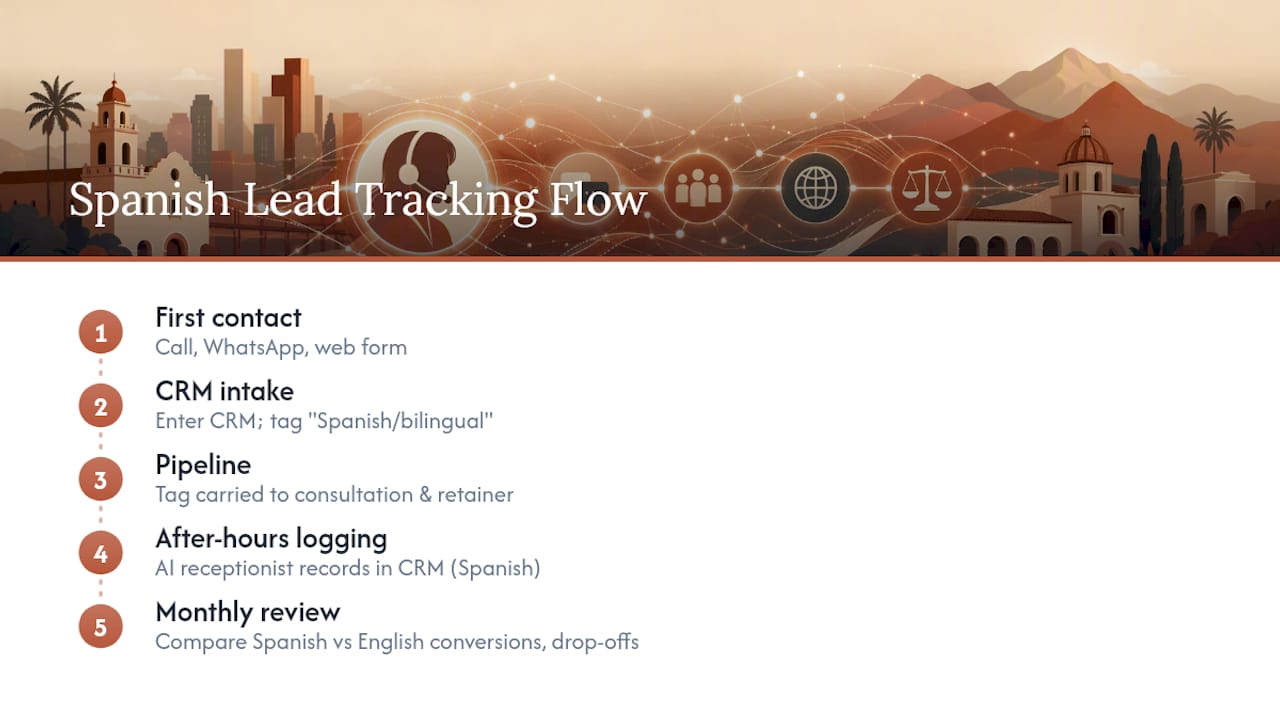
Integration also matters for follow-up. If a Spanish-speaking lead calls after hours and your AI receptionist logs the details, that information needs to flow into the CRM automatically, in a format a Spanish-speaking staff member can review the next morning without translating anyone’s notes. A gap here, where after-hours intake lives in one system and daytime follow-up lives in another, is one of the most common reasons firms lose leads they technically captured.
Review these numbers monthly alongside your English intake metrics. If your Spanish conversion rate lags noticeably behind English, that’s usually a signal about page content, response speed, or staff training, not a sign that Spanish-speaking clients are simply less likely to hire an attorney. Diazluna’s write-up on what a bilingual business website means for growth breaks down how firms typically structure this reporting once the CRM integration is in place.
Why Translation Alone Fails Spanish-Speaking Clients
The most common mistake I see isn’t a lack of effort. It’s firms translating their English site and calling it a Spanish strategy. That approach ignores the actual competence obligations at play. Attorneys serving limited-English-proficiency clients have a professional duty to communicate clearly, and a machine-translated page that garbles a legal term isn’t just bad marketing. It can undermine the representation itself.
I’ve seen the difference play out in something as simple as a contact form. A translated page asks for “lesión personal.” A native page asks about the accident in the reader’s own regional phrasing, and gets three times the completions. That gap isn’t really about language. It’s about whether the client feels the firm actually built something for them, or just tolerated their existence.
— Francisco
How Diazluna Builds This for You in Weeks, Not Months
Everything covered above, native Spanish pages, hreflang, 24/7 intake, WhatsApp integration, CRM tagging, is exactly what Diazluna builds as one connected system instead of five separate vendor contracts. Most firms trying to assemble this piecemeal end up paying a web developer, a translation service, an answering service, and a CRM consultant separately, and still end up with gaps between them. Diazluna delivers all three core pieces, the bilingual website, the AI receptionist, and WhatsApp integration, as one platform under your own domain.
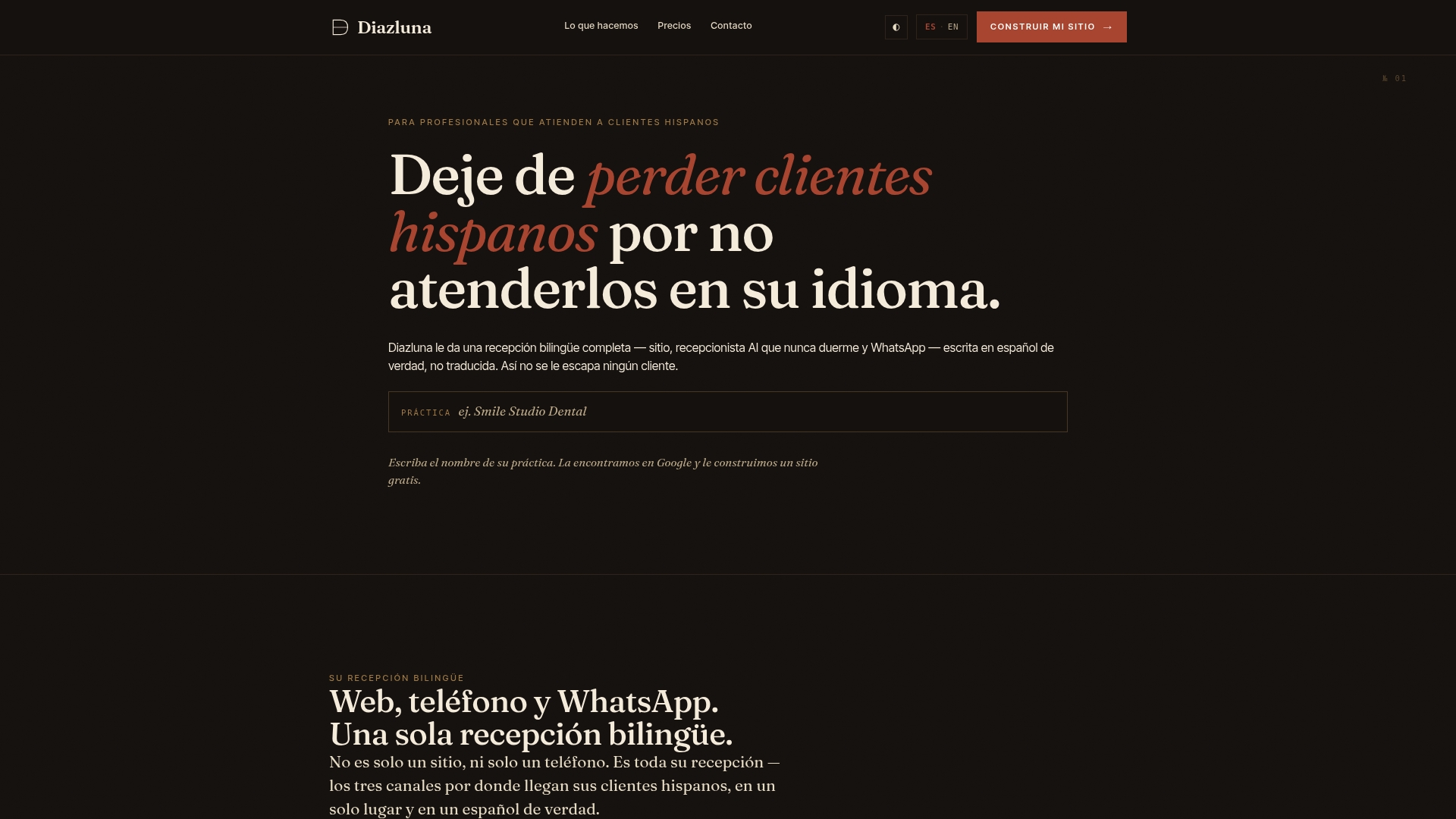
The onboarding process starts with your existing English site as the foundation. Diazluna builds native Spanish pages under your domain structure, configures hreflang and schema correctly from day one, and typically gets initial Spanish pages indexed by Google within 24 hours of launch. The AI receptionist and WhatsApp integration activate alongside the site, so you’re not launching a Spanish page with no one ready to answer the calls it generates. Firms using this setup report a real drop in lost Hispanic clients, the direct result of closing the gap between “found the site” and “reached a human.”
If your firm has been putting off a real Spanish presence because the technical checklist looks daunting, see how Diazluna’s attorney offering works, or head to Diazluna to request a demo and see your own site’s Spanish build mapped out.
Sources
- No se habla Espanol: Ethical and practical considerations for non Spanish-speaking attorneys — St. John’s Law Scholarship Repository
- A law firm’s guide to multilingual websites, SEO, and AI search — Custom Legal Marketing
- Benefits of 24/7 legal intake for law firms — Veza Reception