August 2, 2026
Spanish Legal Digital Front Desk: A Guide for Law Firms

A Spanish legal digital front desk is a bilingual intake and client communication system that handles inbound calls, messages, and appointment requests in both Spanish and English on behalf of a law firm, with secure data handling, real-time lead summaries, and direct handoff to attorneys. For U.S. law firms with Spanish-speaking clients, the most practical path is an integrated solution like Diazluna, which combines a bilingual website, a 24/7 AI receptionist, and WhatsApp coverage in a single monthly subscription rather than stitching together separate tools.
The U.S. Census Bureau reports that Spanish is by far the most spoken non-English language in the United States. For law firms in markets with large Hispanic populations, a missed Spanish call is not a minor inconvenience. It is a lost client who likely called a competitor next.
Table of Contents
- What a Spanish legal digital front desk actually includes
- How a bilingual front desk helps your firm convert and retain clients
- How the intake workflow actually runs
- Data security and confidentiality requirements for U.S. law firms
- Pricing models, onboarding timeline, and what to expect
- How to evaluate vendors and the right questions to ask
- Diazluna in practice: what implementation looks like
- Key Takeaways
- Why bilingual intake is an operational decision, not a feature
- Diazluna handles the bilingual front desk so your attorneys don’t have to
- Useful sources and further reading
What a Spanish legal digital front desk actually includes
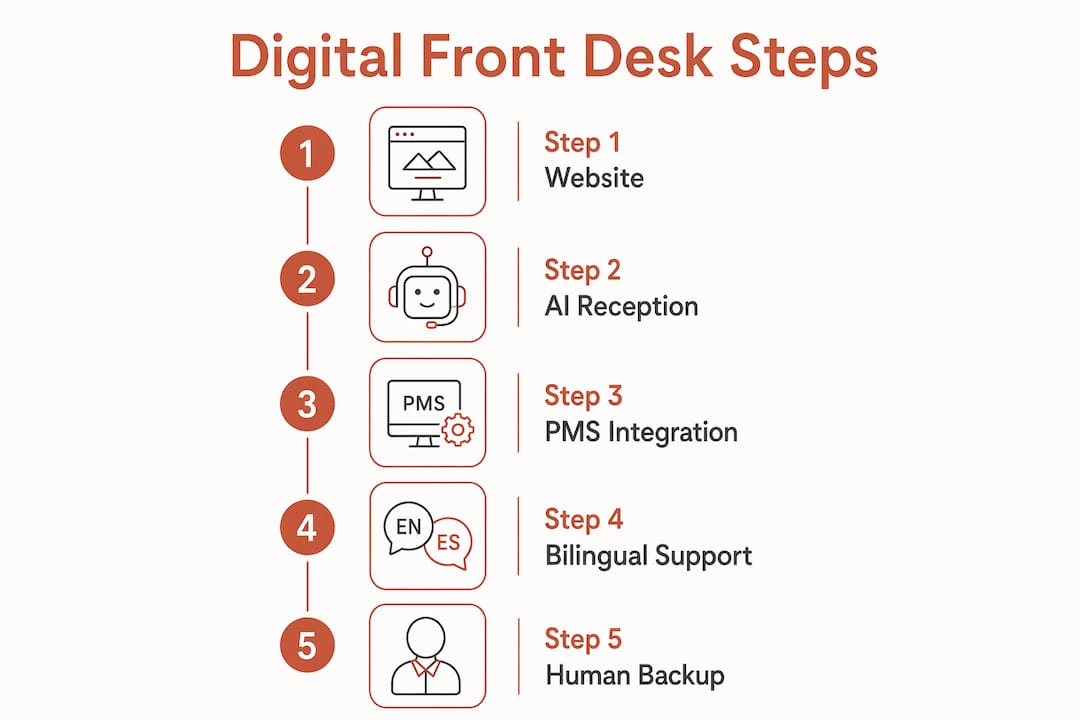
The phrase “digital front desk” gets used loosely, so it helps to break it into concrete components. A fully built-out bilingual legal front desk typically covers:
| Component | What it does | Essential for legal intake? |
|---|---|---|
| Bilingual website (Spanish + English) | Converts Spanish-speaking visitors into leads | Yes |
| 24/7 AI receptionist (voice + chat) | Answers calls and messages in both languages | Yes |
| WhatsApp and SMS integration | Meets Hispanic clients on their preferred channel | Yes |
| Intake forms and triage | Qualifies leads and captures case details | Yes |
| Appointment scheduling | Books consultations without staff involvement | Yes |
| Real-time lead summaries | Delivers structured notes to attorneys | Yes |
| PMS/CRM integration | Pushes lead data into the firm’s case management system | Yes |
| Secure client portal links | Provides encrypted document and message access | Recommended |
The American Bar Association highlights client portals as key tools for secure messaging, calendaring, and document sharing. When those portals connect to a bilingual front desk, the intake loop closes automatically.
Not all deployment models include every component. Here is how the three common models compare:
| Feature | Entry-level answering service | PMS-integrated platform | Full-service bilingual front desk |
|---|---|---|---|
| Spanish language quality | Machine translation or basic | Varies | Native-quality, authentic Spanish |
| WhatsApp/SMS | Rarely | Sometimes | Standard |
| PMS/CRM integration | No | Yes | Yes |
| Real-time lead summaries | No | Partial | Yes |
| Attorney handoff/escalation | Manual | Configured | Automated |
| Bilingual website included | No | No | Yes |
Red flags to watch for: no PMS integration, vague language about “Spanish support” that turns out to be machine translation, no defined escalation path to attorneys, and no secure lead handoff. A bilingual legal intake flow must include language detection, native-quality Spanish responses, and modern messaging channels as baseline requirements.
How a bilingual front desk helps your firm convert and retain clients
The business case is straightforward. When a Spanish-speaking caller reaches a firm that cannot communicate in Spanish, they hang up. When they reach a bilingual AI receptionist that greets them naturally in Spanish, asks the right intake questions, and schedules a consultation, they stay.
Direct benefits law firms typically see:
- Higher intake conversion from Spanish-speaking callers who previously dropped off
- Faster response time, since the AI receptionist handles calls immediately rather than routing to voicemail
- Fewer missed leads during evenings, weekends, and holidays
- Improved client experience for Hispanic clients who prefer Spanish for sensitive legal matters
- Reduced admin hours spent on manual intake and scheduling
Bloomberg Law’s technology analysis recommends that legal teams adopt specialized tools for intake, communication, and automation to increase billable productivity. The logic is simple: AI handles the gatekeeper functions so attorneys focus on substantive legal work.
Operationally, the ROI shows up in measurable KPIs. Track contact-to-intake conversion rate for Spanish callers, time-to-attorney handoff, intake-to-consultation appointment rate, and the reduction in missed Spanish calls month over month. Client engagement platforms reduce inbound volume and automate updates, which creates downstream opportunities for reviews and referrals.

Pro Tip: Set a baseline for Spanish-caller conversion before you launch a bilingual front desk. Even a rough count of Spanish voicemails left unanswered gives you a before/after comparison that justifies the subscription cost within the first 90 days.
How the intake workflow actually runs
Understanding the end-to-end flow helps a firm configure the system correctly from day one. Here is the typical sequence:
- Inbound contact arrives via phone, website chat, or WhatsApp.
- Language detection identifies whether the caller or sender is communicating in Spanish or English and routes accordingly.
- Automated triage questions gather case type, urgency, contact details, and preferred callback time.
- Lead summary creation structures the intake data into a clean note.
- PMS/CRM population pushes the summary automatically into the firm’s practice management system, eliminating manual transcription.
- Scheduling or attorney handoff either books a consultation directly or, for urgent matters, notifies the on-call attorney immediately.
The escalation step is where configuration matters most. Envoy’s virtual front desk guidance describes how audit trails and immediate host notifications are central to compliant, accountable contact handling. For law firms, that means defining keyword triggers, practice-area flags, and urgency thresholds that fire an attorney alert rather than a standard follow-up.
A sample bilingual exchange looks like this:
AI Receptionist (Spanish): “Gracias por llamar a [Firm Name]. ¿En qué le podemos ayudar hoy?” Caller: “Necesito hablar con un abogado sobre un accidente de trabajo.” AI Receptionist: “Entendido. ¿Puede darme su nombre y número de teléfono para que un abogado le llame lo antes posible?”
Human fallback should occur when a caller expresses immediate legal jeopardy, describes an emergency, or asks a question that requires legal judgment. The AI’s job is to qualify and route, not to advise.
Data security and confidentiality requirements for U.S. law firms
Law firms carry strict confidentiality obligations under state bar rules, and any vendor that touches client intake data must meet those standards. Before signing a contract, confirm the following:
- Encryption at rest and in transit for all call recordings, transcripts, and lead summaries
- Data processing addendum (DPA) that defines how the vendor handles, stores, and deletes client data
- Business associate agreement (BAA) if the firm handles matters where HIPAA applies (immigration medical exams, workers’ comp, personal injury with medical records)
- Retention and deletion policies that align with the firm’s own record-keeping obligations
- Audit logs that capture every interaction for compliance review
- Defined SLAs for attorney handoff response time, especially for urgent escalations
Clio’s practice management framework emphasizes that real value comes from systems that connect matters, clients, communications, and financial data so that AI workflows operate on firm context rather than isolated data points. When the front desk integrates with the PMS, manual transcription disappears, and so does the risk of a staff member misrecording a client’s name, case type, or contact detail.
Pro Tip: Ask every vendor for a sample data processing addendum before the demo. A vendor that cannot produce one quickly is a vendor that has not thought carefully about law-firm compliance requirements.

The HHS HIPAA guidance is the governing standard when health information is involved. For most civil litigation or immigration practices, HIPAA does not apply directly, but the security principles it establishes (encryption, access controls, audit trails) are a reasonable baseline for any legal intake vendor.
Pricing models, onboarding timeline, and what to expect
Most bilingual digital front desk solutions for law firms follow a tiered monthly subscription model. Common tiers look like this:
- Website only: bilingual site build and hosting, no receptionist
- Website plus AI receptionist: bilingual site, 24/7 phone and chat coverage, WhatsApp integration
- Full managed package: everything above plus expanded call capacity, site updates, and dedicated support
Per-call or per-minute add-ons exist for high-volume practices. Exact pricing varies by vendor and is not publicly listed for most providers, so request a quote during the demo.
Typical onboarding sequence:
- Discovery call to map practice areas, intake questions, and escalation contacts
- Bilingual site build and launch (often within days for template-based builds)
- Phone and WhatsApp routing configuration and test calls
- PMS integration setup and data-mapping review
- Pilot period with live Spanish callers and attorney feedback
- Full rollout with monitoring and adjustments
Timeline estimates: the bilingual site can go live quickly; the AI receptionist is typically operational in a short period; full PMS integration and workflow tuning usually take a few weeks depending on the complexity of the firm’s existing systems.
What the firm must provide for fast onboarding:
- PMS API credentials or integration access
- Standard intake questions by practice area
- Attorney availability windows and escalation contacts
- Preferred scheduling rules (same-day, next-day, by practice area)
How to evaluate vendors and the right questions to ask
Choosing a bilingual front desk vendor is an operational decision, not just a software purchase. The most successful law firms treat it as a workflow change that requires clear escalation rules and PMS integration from the start.
Prioritized evaluation criteria:
- PMS/CRM integration depth (does it push data automatically, or require manual export?)
- Spanish language quality (native speakers and authentic UX, not machine translation)
- 24/7 coverage with defined escalation paths
- WhatsApp and SMS support as standard channels
- Data security documentation (DPA, encryption, audit logs)
- Transparent onboarding timeline and pilot terms
Questions to ask in every demo:
- What is the API or integration method for our PMS, and how long does setup take?
- Where is client data stored, and what is your data residency policy?
- Can you show a sample lead summary as it would appear in our PMS?
- What is your SLA for attorney handoff on urgent escalations?
- Do you offer a pilot period, and what does it include?
Red flags:
- “Spanish support” that relies on real-time machine translation rather than native-quality responses
- No PMS integration, or integration described as “coming soon”
- Vague or missing data-handling documentation
- No defined escalation path to attorneys for urgent matters
- Surprise fees for WhatsApp, after-hours coverage, or PMS integration
Trust signals worth verifying: law-practice case studies, references from other firms in similar practice areas, security certifications, and a clear onboarding timeline with named milestones.
Diazluna in practice: what implementation looks like
A mid-size immigration law firm with a high volume of Spanish-speaking callers is a typical Diazluna use case. Here is how the engagement typically unfolds:
- Week 1: Diazluna builds and launches the bilingual website, optimized for both Spanish and English search. Firms report Google indexing of bilingual pages within 24 hours of launch.
- Week 1–2: The 24/7 AI receptionist goes live on phone and WhatsApp, handling inbound Spanish and English calls with native-quality responses.
- Weeks 2–6: PMS integration is configured, lead summaries begin populating the firm’s case management system automatically, and escalation rules are tuned by practice area.
- Ongoing: Diazluna’s managed package includes site updates, expanded call capacity, and monitoring so the firm does not need a dedicated in-house tech resource.
The Diazluna attorneys page outlines the legal-specific use cases, including real-time lead summaries and WhatsApp integration for firms with Spanish-speaking clients. Firms using the full-service package report a significant reduction in lost Spanish-speaking leads, the primary metric that justifies the subscription cost.
Key results tied to Diazluna’s trust signals:
- Reduced client loss from unanswered Spanish calls
- Bilingual pages indexed by Google within 24 hours of launch
- Improved Spanish-call conversion through native-quality AI responses
- Automated lead summaries delivered directly to attorney dashboards
Key Takeaways
A Spanish legal digital front desk works when it combines native-quality bilingual coverage, PMS integration, and clear attorney escalation paths into a single managed system rather than separate tools.
| Point | Details |
|---|---|
| Define the components first | A complete solution includes bilingual website, AI receptionist, WhatsApp, intake forms, and PMS integration. |
| PMS integration is non-negotiable | Without it, staff manually transcribe intake data, which eliminates the automation benefit entirely. |
| Require native Spanish quality | Machine translation fails on legal terminology and damages trust with Hispanic clients. |
| Secure data handling is a bar requirement | Confirm encryption, a DPA, and audit logs before signing any vendor contract. |
| Diazluna covers the full stack | Diazluna’s bilingual site, 24/7 AI receptionist, and WhatsApp integration are built specifically for law firms serving Spanish-speaking clients. |
Why bilingual intake is an operational decision, not a feature
Most law firms that struggle with Spanish-speaking client intake are not missing a feature. They are missing a workflow. A bilingual website with no receptionist coverage leaves Spanish callers in voicemail. An AI receptionist with no PMS integration creates a new manual task for staff. The technology only works when the pieces connect.
What gets underestimated is the language quality gap. A Hispanic client calling about an immigration matter or a personal injury case is often stressed and speaking quickly. Machine translation stumbles on regional idioms, legal terminology, and emotional register. A native-quality Spanish AI receptionist handles all three. That difference shows up in whether the caller stays on the line and books a consultation, or hangs up and tries the next firm.
The practical advice: start with your highest-volume Spanish channel, whether that is phone, WhatsApp, or web chat, and pilot the bilingual front desk there for 30 days before expanding. The conversion data from that pilot will tell you more than any vendor demo.
Diazluna handles the bilingual front desk so your attorneys don’t have to
Law firms serving Hispanic clients lose leads every day to a simple problem: no one answers in Spanish after hours, on weekends, or when the front desk is busy. Diazluna solves that with a bilingual website, a 24/7 AI receptionist fluent in both Spanish and English, and WhatsApp integration, all in one monthly subscription with no agency overhead.
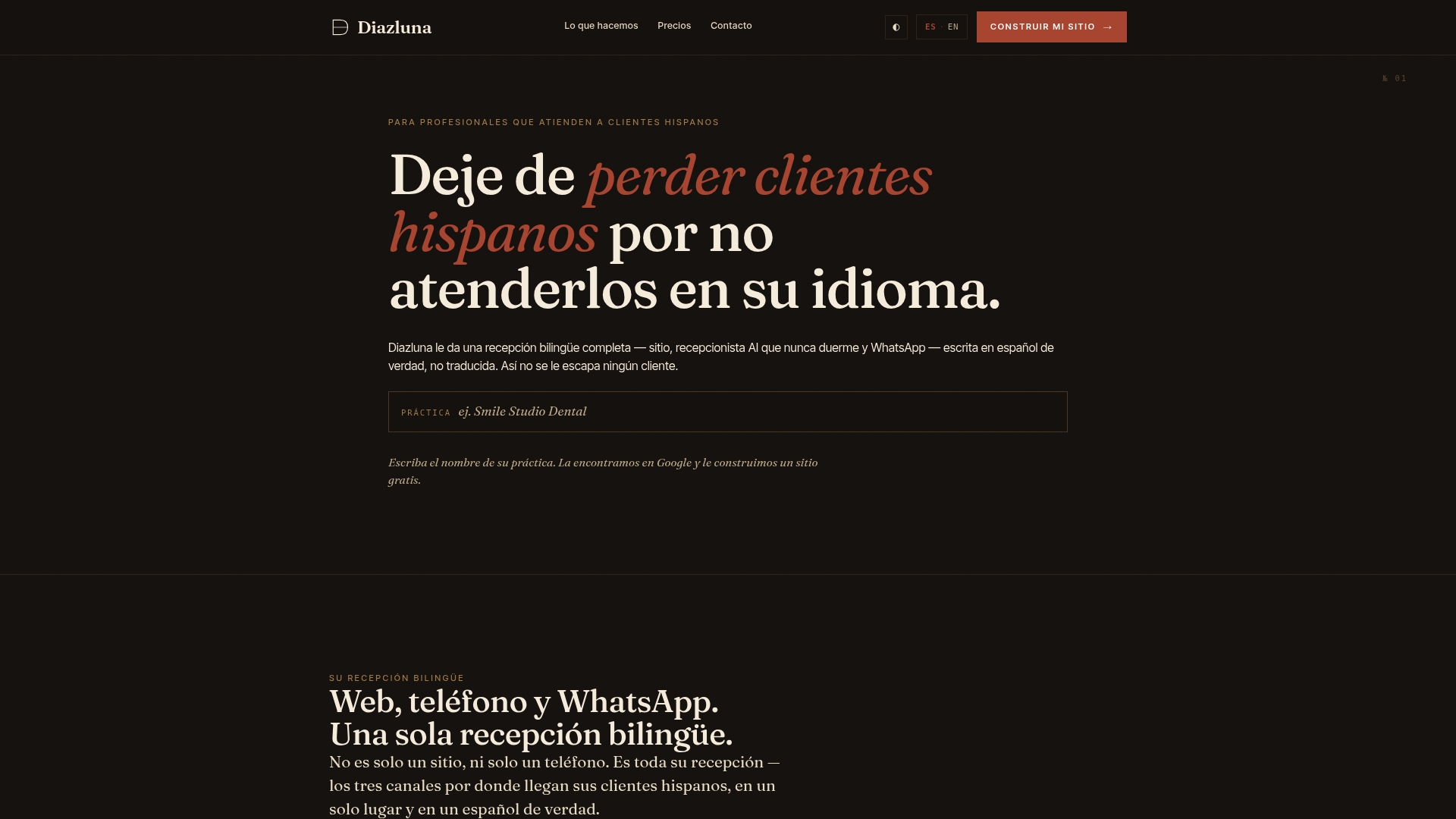
The setup is fast. The bilingual site goes live in days, the AI receptionist handles calls and messages within the first week, and lead summaries land directly in your PMS so attorneys see qualified intake without touching the phone. There are no separate contracts for the website, the receptionist, and the messaging channel. It is one system, built for practices that cannot afford to lose a Spanish-speaking client to a language barrier.
See how it works for law firms at Diazluna’s attorneys page, or explore the full bilingual front desk platform to request a demo and get your bilingual site set up at no cost.
Useful sources and further reading
The sources below back the claims in this article and are worth bookmarking for vendor due diligence and compliance review.
- American Bar Association — 10 Tech Tools for Law Firm Productivity: ABA’s own technology report covering client portals, PMS tools, and secure messaging for law firms.
- Bloomberg Law — What Types of Software Do Law Firms Use?: Analyst-level overview of legal tech categories including intake automation and AI-assisted workflows.
- Clio: Leading practice management platform; useful for understanding PMS integration standards and what connected legal workflows look like in practice.
- Envoy — Virtual Front Desk Software: Covers audit trails, visitor notifications, and escalation logic applicable to legal intake configuration.
- HHS — HIPAA: Governing standard for health information security; relevant when legal intake touches medical records.
- U.S. Census Bureau — Language Use: Primary data source on Spanish-language prevalence in the United States.
- Diazluna — Bilingual Front Desk for Attorneys: Law-firm-specific product page covering bilingual site, phone, WhatsApp, and PMS integration for firms with Spanish-speaking clients.
- Case Status — Lawyer Tools for a Modern Firm: Practical breakdown of client engagement tools, intake automation, and communication platforms for law firms.