September 9, 2026
Neutral Spanish Base Then Local Polish

Neutral Spanish is a smart choice for manuals, help centers, and any content where the goal is comprehension across many countries at once, but it is a weak choice for ads, landing pages, and anything that needs to convert. If your content has to sell, persuade, or build trust fast, plan on localizing. If it just needs to be understood by the widest possible audience at the lowest possible cost, neutral Spanish earns its keep.
TL;DR:
- Neutral Spanish is effective for technical, legal, and informational content but should be avoided in high-conversion marketing pages.
- Most neutral Spanish relies on Central Mexican usage and avoids regionalisms, but it cannot truly satisfy all Latin American accents.
- Use consistent pronouns, standard vocabulary, and clear formatting rules, and develop a glossary before starting to ensure language accuracy.
- Begin with a neutral base draft, review with native experts, and localize only where data shows it improves performance.
- Neutral Spanish acts as a staging tool, saving costs before investing in full regional localization for pages that directly influence trust or decision-making.
Table of Contents
- What Is Neutral Spanish for Marketing, and Does It Really Exist?
- When Should You Use Neutral Spanish for Marketing?
- Writing Rules for Clear, Pan-Hispanic Spanish Copy
- A Practical Checklist for Running a Neutral Spanish Project
- Building a Neutral Base With Local Polish: The Workflow
- How to Know If Neutral Spanish Is Actually Working
- What Neutral Spanish Looks Like in Law, Dental, and Healthcare Marketing
- Where to Go Deeper on Neutral Spanish Standards
- Why the Neutral-Versus-Localized Debate Misses the Point
- Sources
What Is Neutral Spanish for Marketing, and Does It Really Exist?
Neutral Spanish, sometimes called standard, international, or global Spanish, is a constructed register built to avoid words, slang, and grammar tied to any one country. It strips out regionalisms so a single piece of copy can run in Mexico, Argentina, Spain, and Miami without sounding foreign to any of them. That’s the pitch, anyway.
The convention has roots in dubbing and mass media. Television and film studios in the mid-20th century needed one Spanish soundtrack that could sell across two dozen countries without dubbing each market separately, so they built a leveled dialect that avoided obvious regionalisms. Cost drove the decision, not linguistics.
Here’s where it gets contested. Many linguists argue that a Spanish that satisfies every regional audience equally does not strictly exist, because neutrality is a judgment call, not a fixed dialect. Critics also point out that industry “neutral” conventions tend to lean on Central Mexican usage for historical reasons tied to dubbing hubs, which means the baseline carries a regional bias even while claiming to have none.
A few things are worth holding onto as you read further:
- Neutral Spanish is a pragmatic tool, not an official dialect recognized by any language authority.
- The Real Academia Española and ASALE set the orthographic and grammatical rules that most “neutral” style guides borrow from, even though neither institution defines a neutral register itself.
- What counts as neutral for a Spanish-Spain audience can read as stiff or foreign-inflected for a Mexican or Colombian one, and vice versa.
When Should You Use Neutral Spanish for Marketing?
Match the content type to the approach before you write a single line of copy. Getting this sequencing backward, localizing low-stakes content and running ad campaigns in neutral Spanish wastes budget in both directions.
- Technical documentation and manuals. Product guides, safety instructions, and setup docs benefit from neutral Spanish because comprehension matters more than emotional resonance.
- Legal notices and terms of service. Precision and consistency across markets outweigh regional flavor here, and legal review teams generally prefer one controlled version.
- Global blog pillars and knowledge bases. Top-of-funnel educational content that ranks in search and serves many countries at once is a strong fit for a neutral base.
- High-volume, low-emotion support content. FAQs, help center articles, and onboarding emails work fine in neutral Spanish because the reader’s goal is information, not connection.
- Ad copy, landing pages, and product UX. Avoid neutral Spanish here. Conversion depends on cultural fit, and generic phrasing reads as corporate and distant.
- Community-facing or emotionally loaded creative. Anything tied to identity, humor, or local pride needs a native voice, not a leveled one.
A quick decision rule: multiply purpose, conversion risk, and audience specificity. Low conversion risk and broad audience mean neutral Spanish is fine. High conversion risk or a tightly defined audience means localize, even if it costs more upfront. Localization vendors consistently recommend this split between high-volume informational content and creative, conversion-critical marketing.
Writing Rules for Clear, Pan-Hispanic Spanish Copy
The linguistic choices that make neutral Spanish work come down to a handful of consistent habits, not a secret formula.
Word choice. Favor pan-Hispanic vocabulary over regional slang. Use computadora or ordenador only after checking your primary market, but default to widely understood terms like carro or auto over hyper-local words like guagua (bus, in some Caribbean usage) that a large share of readers won’t recognize.
Pronoun policy. Pick tú or usted deliberately and stick with it across the whole piece. Avoid voseo (vos instead of tú, common in Argentina, Uruguay, and parts of Central America) unless you’re writing specifically for those markets. Mixing pronoun systems inside one document is one of the fastest ways to make copy feel amateurish to a native reader.
Grammar and verb forms. Skip region-specific constructions like the periphrastic future favored in some Caribbean speech, and avoid the vosotros form entirely unless you’re writing for Spain specifically, since it doesn’t exist in Latin American usage at all.
Formatting details matter more than people expect:
- Use the period for decimals sparingly and be explicit; Spanish-speaking countries split between comma and period for decimal marks, so spell out currency amounts when precision counts.
- Write dates as day, month, year (12 de marzo de 2026) rather than the US month-first format.
- Keep punctuation conventions consistent, including opening question and exclamation marks (¿ and ¡) where grammatically required.
Pro Tip: Build a living glossary of approved and banned terms before your first draft, not after. Microsoft’s own neutral Spanish ministyle guide is a genuinely useful template for structuring one, even if you’re not writing software documentation.
A Practical Checklist for Running a Neutral Spanish Project
Treat neutral Spanish as a project with defined stages, not a style you apply and forget.
- Define the goal before writing. Is this content meant to inform, support, or convert? That answer decides everything downstream.
- Rank your markets by revenue priority. Mexico, Spain, Colombia, and the US Hispanic market rarely carry equal weight, so decide which markets get local polish first.
- Score conversion sensitivity. High-stakes pages (checkout, lead forms, pricing) need more scrutiny than a blog post or FAQ entry.
- Set a budget and success metrics upfront. Know what “working” looks like in numbers before you launch, not after.
- Build your core assets. A neutral glossary, a written style guide, CMS tagging for region-specific variants, and a translation memory to keep terminology consistent as you scale.
- Draft in neutral Spanish first. Write the base version clean, without regional shortcuts baked in.
- Route it through in-country review. A native reviewer from at least one priority market should flag anything that reads as awkward or off-key before publication.
- Pilot on a small page set. Publish a handful of pages, watch performance, and resist the urge to scale before you have data.
- Scale or localize based on results. If pilot pages perform, roll the approach out. If they underperform, that market gets full localization instead.
Watch for red flags that override the neutral approach entirely: persistent underperformance on conversion metrics in one market, or repeated qualitative feedback (support tickets, reviews, social comments) calling the copy stiff or foreign. Both are signals to stop patching and localize properly.
Building a Neutral Base With Local Polish: The Workflow
The two-step model, neutral base first, targeted local edits second, is the approach localization vendors point to most often as the practical middle ground between full localization and one-size-fits-all copy.
Here’s roughly how the stages break down:
- Week 1: Drafting. A bilingual copywriter or linguist produces the neutral base, using your glossary and style guide as guardrails.
- Week 2: In-country review. A native reviewer from your top one or two markets checks tone, idiom, and cultural fit, and flags anything that needs local adaptation.
- Week 3: Targeted local edits. Apply changes only where the reviewer flagged an issue. Most of the base stays untouched.
- Ongoing: Maintenance. Update the shared glossary and translation memory every time a new regional edit gets approved, so future content starts from a stronger baseline.
For technical teams, tools like a translation memory system and CMS content flags (marking which strings are neutral versus market-specific) keep the base maintainable as the content library grows. A well-tagged CMS lets you push local edits without duplicating entire pages, which is where a lot of marketing teams waste time and budget. If your team is building or rebuilding a bilingual website, setting up that tagging structure early saves months of rework later.
How to Know If Neutral Spanish Is Actually Working
Run the test before you commit budget to a full rollout, not after.
- Segment your metrics by market. Click-through rate, bounce rate, and conversion rate mean little in aggregate; you need to see Mexico versus Spain versus the US separately.
- A/B test neutral against localized versions. Run a neutral landing page against a localized one in your top market and compare conversion rate directly.
- Phase blog pillar rollouts. Publish neutral pillar content first, then localize only the pages that show strong traffic but weak engagement.
- Watch qualitative signals too. In-country reviewer notes, customer support transcripts, and social listening often catch friction that traffic numbers miss entirely.
Statistic to watch: click-through rate and bounce rate segmented by country tend to be the earliest warning signs that neutral copy isn’t landing in a specific market, often weeks before conversion data confirms the same pattern.
What Neutral Spanish Looks Like in Law, Dental, and Healthcare Marketing
Professional services face a sharper version of this problem. Some providers in dentistry, law, and healthcare serve Hispanic clients who are often making an appointment, not browsing a catalog. That means the language on your website and in your front desk tools has to be precise on the first try.
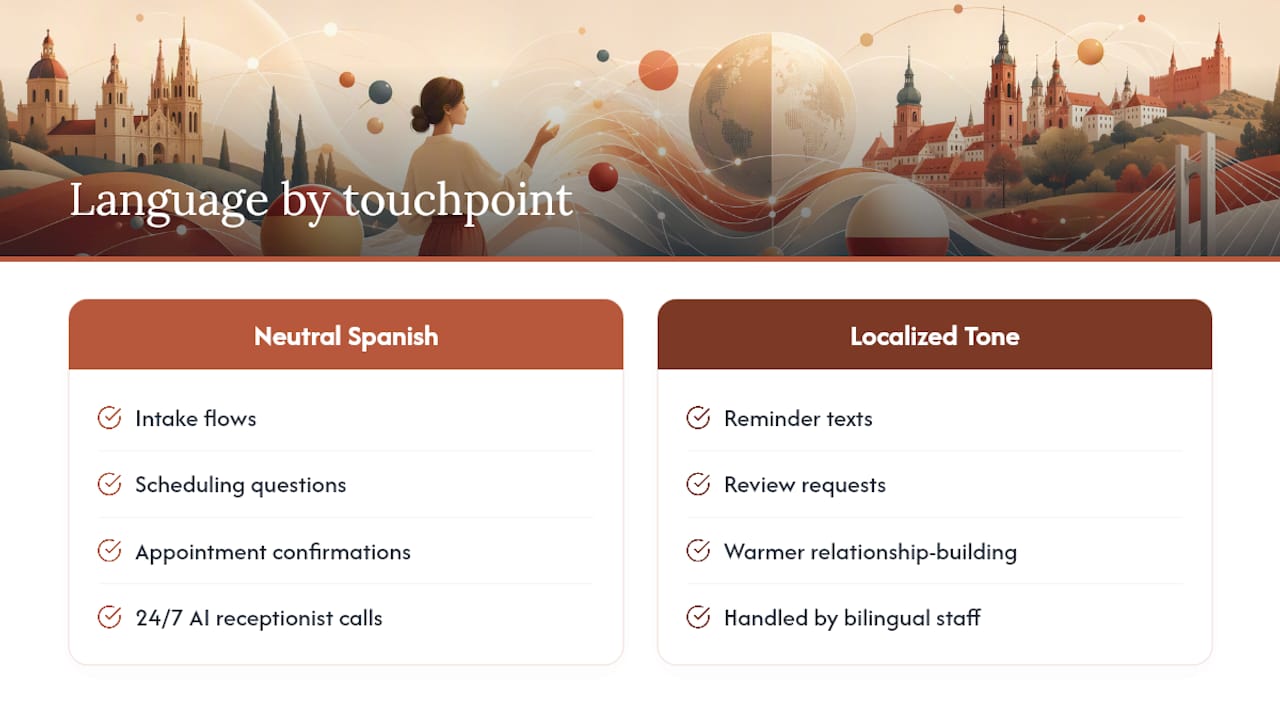
A 24/7 AI receptionist handling both English and Spanish calls needs consistent, neutral phrasing for scheduling and intake questions, prioritizing clarity over regional flair. WhatsApp message templates fall into the same category. Where neutral language breaks down is in the tone of a reminder text or a review request, moments where a client notices whether the practice sounds like it actually speaks their language or just translated a script.
The quick win for most practices: keep intake flows and appointment confirmations in clean, neutral Spanish, then let a bilingual staff member or a tone-aware website handle the warmer, relationship-building moments in a more localized voice.
Where to Go Deeper on Neutral Spanish Standards
Start with Microsoft’s neutral Spanish ministyle guide for a working template of neutral phrasing rules. The Real Academia Española and ASALE remain the reference point for spelling and grammar standards that most style guides build on. For vendor-side thinking on when to localize versus stay neutral, RWS’s breakdown and content agencies like Preferic offer practical frameworks for building your own glossary and translation memory from scratch.
Why the Neutral-Versus-Localized Debate Misses the Point
Most advice on this topic treats neutral Spanish and full localization as a binary choice, pick one and commit. That framing wastes money in both directions. Teams that localize everything burn budget translating FAQ pages that nobody reads closely. Teams that go neutral everywhere lose conversions on the pages where a native voice actually moves the needle.
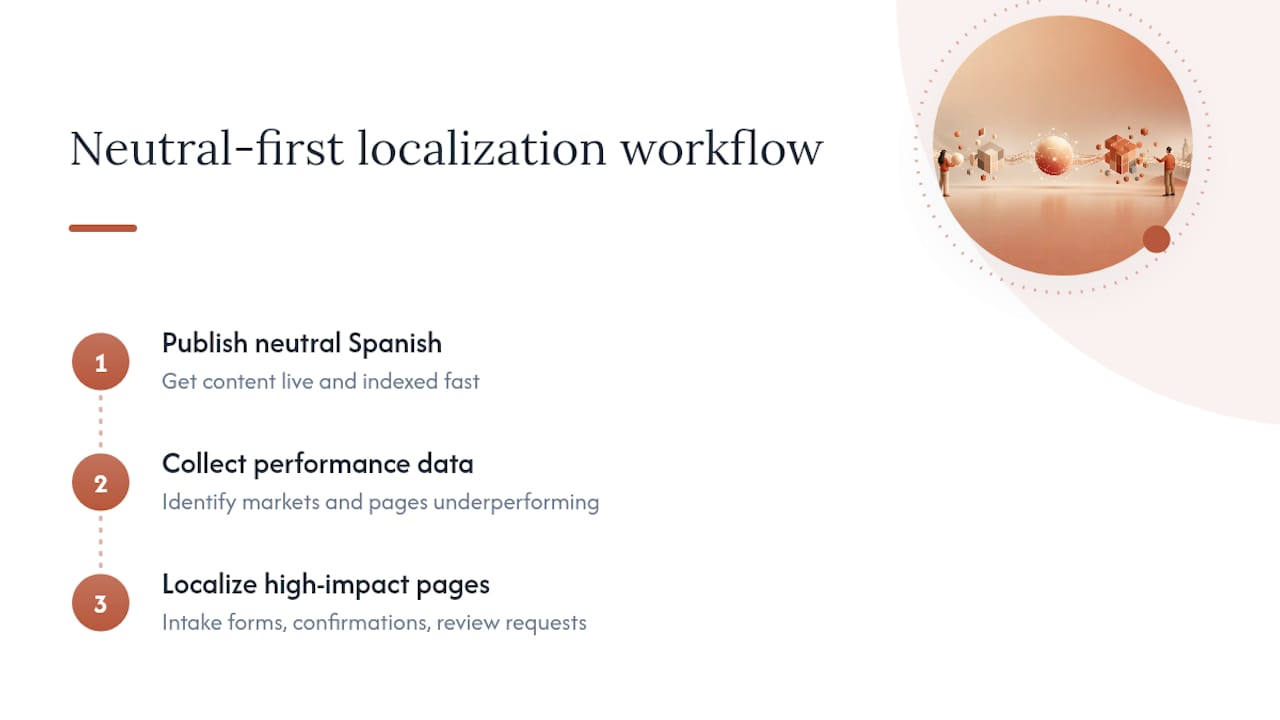
The research backs a narrower, more useful claim: neutral Spanish is a staging tool, not a destination. It’s the fastest way to get broad content live and indexed, and it buys you time to figure out, with real data, which markets deserve the extra investment in local polish. The mistake isn’t choosing neutral Spanish. It’s never circling back to localize once the data tells you where it’s underperforming.
If you’re building bilingual content for a professional practice, prioritize the pages where a client actually decides whether to trust you: intake forms, appointment confirmations, review requests. Everything else can stay neutral until proven otherwise.
— Francisco
Sources
- What Is Neutral Spanish, and Does It Really Exist? | GALA
- When (and when not) to localize into neutral Spanish — RWS
- English-to-Spanish translation guide — Translated