September 5, 2026
Spanish Dental SEO: Publish 3 Spanish Pages and Fix
Spanish dental SEO means two things working together: Spanish-language pages built to rank, and a bilingual front desk (phone, WhatsApp, scheduling) built to actually answer when someone calls. The highest-leverage move is publishing a handful of prioritized Spanish pages this month while making sure a real Spanish speaker or a validated bilingual system picks up the phone. Practices that fix both sides at once, the approach Diazluna reports on with its own bilingual clients, see faster Google indexing and far fewer lost leads than practices that fix only the website.
TL;DR:
- Publishing three prioritized Spanish pages in core service, new patient, and contact sections significantly reduces lead loss within a week.
- Correct hreflang tags, subdirectory usage, and visible language toggles ensure Google serves the right language and improves search visibility.
- Bilingual front-desk staff or AI solutions paired with WhatsApp improve patient trust and reduce miscommunication, especially during after-hours inquiries.
- Proper regional keyword research and native review of content increase relevance and ranking for diverse Spanish-speaking communities.
- Tracking Spanish-specific activity separately helps measure the return on investment and guides incremental improvements over a 90-day testing period.
Table of Contents
- The One-Page Checklist To Stop Losing Spanish Leads
- Building Spanish Pages That Rank And Convert
- How Do You Research Spanish Dental Keywords Correctly?
- Google Business Profile And Local Search In Spanish
- Why Bilingual Front-Desk Operations Decide Whether Spanish SEO Pays Off
- Measuring Whether Your Spanish SEO Is Actually Working
- The Trust Gap Nobody Budgets For
- When An All-In-One Bilingual Front Desk Makes Sense
- Sources
The One-Page Checklist To Stop Losing Spanish Leads
Most practices lose Spanish-speaking leads before marketing ever gets a chance to work. The fix takes about a week, not a redesign.
- Publish three pages first: your top revenue service (implants, Invisalign, whatever pays the bills), a “new patient” page, and a contact/financing page, all in Spanish.
- Add hreflang tags (
es-us/en-us) so Google serves the right language to the right searcher, and keep Spanish content in its own subdirectory like/es/rather than mixing it into English URLs. - Put a visible language toggle in the header, not buried in a footer link nobody scrolls to find.
- Translate your meta titles and descriptions, not just body copy. A Spanish page with an English meta tag confuses both Google and the searcher.
- Write and post a Spanish phone script at the front desk today, even a simple one, so whoever answers isn’t improvising.
- Add a WhatsApp click-to-chat button on mobile. Many first-generation Hispanic patients text before they call.
- Test one keyword, like “dentista cerca de mí” or “dentista de emergencia,” and confirm your Google Business Profile lists Spanish as a service language.
Building Spanish Pages That Rank And Convert
Translation and localization are not the same job. A Spanish page that ranks well and converts patients reads like it was written for a Spanish-speaking patient, not run through a translator and pasted in.
Start with the pages that carry the most weight: your core services, new-patient onboarding, financing options, and contact information. These are where patients decide whether to call, and where clinical or consent language needs a native-fluent reviewer, not a machine translation tool. Bilingual dental Spanish translation covers consent forms, insurance terms, and procedure names, and getting those wrong erodes trust fast.
A few structural choices matter more than people expect:
- Use a subdirectory (
yoursite.com/es/) rather than a subdomain. It consolidates domain authority instead of splitting it. - Keep the language toggle visible on every page, not just the homepage.
- Set hreflang tags correctly so Google doesn’t show your English page to a Spanish searcher, or vice versa.
- Translate intake PDFs and appointment confirmation texts, not just the marketing pages.
Pro Tip: Send your Spanish confirmation texts in Spanish, even if the booking happened in English. Families often share one phone number, and a Spanish text signals the practice actually serves them.
Family-focused messaging outperforms generic corporate copy here. Hispanic patients frequently research bilingual healthcare websites as a full-family decision, according to Dentplicity’s bilingual marketing guidance, so a page that speaks to “su familia” tends to convert better than one that just swaps pronouns from English.
How Do You Research Spanish Dental Keywords Correctly?
Spanish speakers don’t search the way a direct translation assumes. “Dentist near me” doesn’t map cleanly to one phrase. Depending on region and generation, patients search “dentista cerca de mí,” “clínica dental,” or even mix English and Spanish in the same query. Treating this like a straight keyword swap is where most Spanish dental SEO efforts quietly fail.
Regional variation matters too. Terms common in Mexican Spanish don’t always match Puerto Rican or Central American phrasing, and a practice serving a mixed community should test more than one variant rather than betting on a single term.
A workable research process looks like this:
- Pull English keyword data first, then have a native Spanish speaker generate real equivalent phrases, not literal translations.
- Check search volume for each variant using standard keyword tools before committing a page to one term.
- Write Spanish title tags and meta descriptions that match intent, not just vocabulary. “Emergencia dental” signals urgency in a way a flat translation of “dental emergency” sometimes doesn’t.
- Add schema markup (LocalBusiness, Service) in Spanish where your CMS allows it, since structured data helps search engines match your page to the right query language.
- Run every new page past a native speaker before publishing. This single step catches more embarrassing errors than any SEO plugin.
Bilingual digital marketing strategies for practices walks through how to turn this keyword research into an actual content calendar instead of a one-time project.
Google Business Profile And Local Search In Spanish
Your Google Business Profile is often the first thing a Spanish-speaking patient sees, before they ever reach your website. It needs its own language signals, not just an English listing with a Spanish page linked somewhere.
- Write a Spanish version of your business description directly in the GBP fields, not just in a linked blog post.
- List “Spanish” under languages spoken and mention it again naturally in your services section.
- Add WhatsApp as a messaging channel if your platform supports it. It’s often the first channel a Hispanic patient tries.
- Respond to Spanish-language reviews in Spanish. A generic English reply to a Spanish review reads as a mismatch and undercuts the trust you’re trying to build.
- Check GBP Insights for search terms that triggered your listing. If Spanish-language queries are showing impressions but low click-through, your listing language may need work before your website does.
- Get listed in local Hispanic community directories and chambers of commerce, which tend to carry real local SEO weight beyond generic citation sites.
Optimizing your Google Business Profile in Spanish breaks this down field by field if you want a full walkthrough.
Why Bilingual Front-Desk Operations Decide Whether Spanish SEO Pays Off
A Spanish website with no Spanish answer at the phone is the single most common failure in this space, and it’s the one nobody budgets for. Language concordance, meaning the patient and the person answering speak the same language directly, improves trust, comfort disclosing sensitive information, and even reduces the odds of a misunderstanding turning into a clinical error, according to a peer-reviewed review of language access in healthcare. Formal interpreters help, but patients consistently report stronger rapport when the conversation is direct.
You have a few real options, each with tradeoffs:
- Bilingual front-desk staff, ideally language-tested rather than assumed fluent, since a mismatch here damages trust fast.
- Phone or video interpreter services, useful for coverage gaps but sometimes feel impersonal to the patient.
- An integrated 24/7 bilingual AI receptionist paired with WhatsApp, which handles routine scheduling and intake in both languages without staffing every shift.
Whatever you choose, set routing rules and a response SLA (same-day, ideally same-hour, for a Spanish inquiry). A simple phone opening like “Gracias por llamar a la clínica, ¿en qué puedo ayudarle?” costs nothing and signals immediately that the call landed in the right place.
Pro Tip: Audit your own front desk by having a Spanish-speaking friend call during business hours. If they get stuck in an English phone tree, that’s your real bottleneck, not your website.
Measuring Whether Your Spanish SEO Is Actually Working
Track Spanish activity separately from English activity, or you’ll never know which investment is paying off.
- Tag every Spanish page and campaign with UTM parameters, and set up call and WhatsApp tracking numbers specific to Spanish channels.
- Track four core numbers weekly: Spanish form completions, Spanish calls and WhatsApp messages, booking conversion rate by language, and new-patient starts attributed to Spanish channels.
- Run a 90-day test: publish your priority Spanish pages, add WhatsApp click-to-chat, and route Spanish contacts to one validated receiver.
- Check weekly, not monthly. A stalled metric in week three is cheaper to fix than one discovered in week eleven.
- Set a decision threshold before you start, something like meaningful growth in Spanish bookings by day 90, so you’re not guessing at the end whether it worked.
The Trust Gap Nobody Budgets For
Most practices treat Spanish SEO as a content problem. It’s not. The failure point I see over and over is the same one: a nicely translated website backed by an English-only phone tree. The patient found you, tried to book, and hung up. That’s not a marketing failure. It’s an operations failure wearing a marketing costume.
Client data shows the fix isn’t complicated. Practices that align a bilingual site with a bilingual front desk, phone, WhatsApp, and scheduling working together get indexed by Google quickly and lose fewer leads than practices running a Spanish site with an English-only intake process. If you’re resource-constrained, don’t start with a full site rebuild. Start with why bilingual support beats piecing together separate agencies, three pages, a WhatsApp button, and one person or system trained to answer in Spanish. Test it for 90 days before spending on anything bigger.
— Francisco
When An All-In-One Bilingual Front Desk Makes Sense
Piecing this together yourself means hiring a translator, training front-desk staff, setting up WhatsApp Business, and hoping nothing falls through the cracks on a Friday afternoon. One subscription includes a fully bilingual website, a 24/7 AI receptionist fluent in Spanish and English that handles calls and scheduling, and WhatsApp integration with real-time summaries for urgent cases.
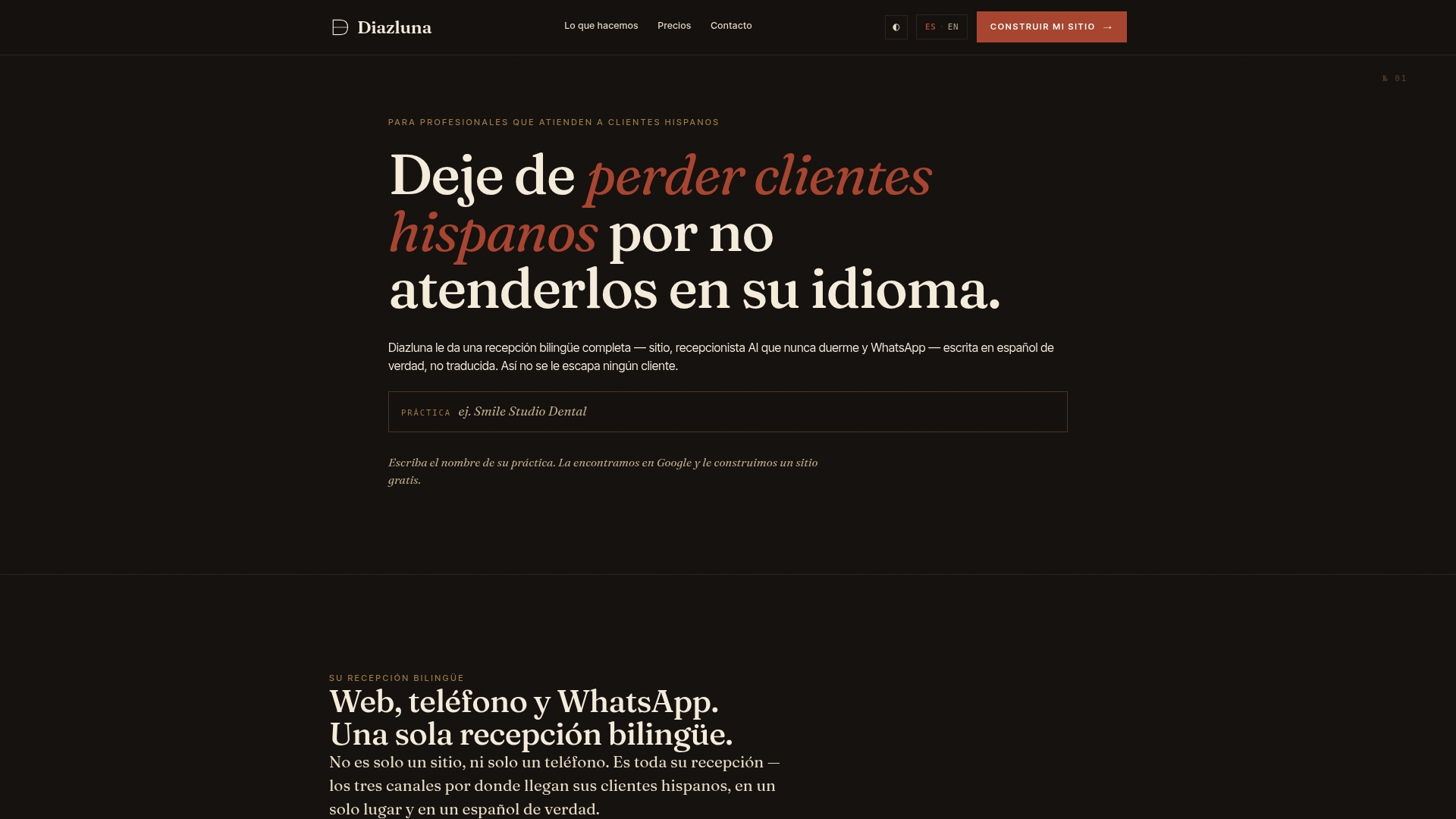
It makes the most sense when you don’t have the budget for a dedicated bilingual hire, or when your current setup means Spanish-speaking patients hit voicemail after hours. If you already have strong bilingual staff during business hours but lose calls overnight, the AI receptionist alone closes that gap without adding headcount. For practices building this from scratch, the full bilingual platform at Diazluna covers the website, phone, and WhatsApp side in one setup, priced well below hiring separate vendors for each piece. Book a demo to see how it would route your own patient calls before your next marketing dollar goes out the door.
Sources
For deeper data on access gaps, read the ADA’s national trends report on dental utilization and cost barriers, the PMC review on language concordance, and Dentplicity’s bilingual marketing guide for implementation detail. For general dental SEO technique, Todd Stager’s dental SEO guide is a solid reference.
This article is general information, not a substitute for advice from a qualified doctor. Consult a qualified healthcare professional about your own circumstances before acting on anything here.
- Language access in healthcare: aligning policy and evidence (PMC review)