September 28, 2026
U.S. Clinics: 3 Spanish Texting Consent Elements for HIPAA

You need a Spanish-language texting consent form whenever your practice or business sends appointment reminders, health information, or marketing texts to Spanish-speaking patients or clients. That form must include three things: a plain notice that text messages are not a secure channel, explicit opt-in language the person signs or checks before you send anything, and a clear opt-out method. The templates and steps below map directly to HIPAA and the FCC’s one-to-one consent rule.
TL;DR:
- Spanish-language consent forms must include a clear security notice stating that text messages are not secure and could be seen by others.
- Separate consent is required for appointment, health, and marketing messages, with explicit opt-in language and signature or checkbox for each message type.
- Forms must inform recipients how to opt out, with instructions like replying “ALTO” or “STOP” in Spanish, and include a timestamp, signature, and method of collection for compliance.
- HIPAA, FCC, and FTC rules impose different consent and revocation standards, requiring specific sender identification, timely opt-out processing, and separate consent for marketing versus health messages.
- Building an effective workflow involves collecting signed consent via paper, web, or SMS double opt-in, and automating opt-out responses while retaining proper records for legal and audit purposes.
Table of Contents
- Checklist: required fields and plain Spanish phrasing every compliant form needs
- Ready-to-use sample templates in Spanish
- How HIPAA, TCPA, and FTC rules shape what your form must say
- How to collect and document Spanish texting consent in daily workflows
- How these templates were built and reviewed
- Why most Spanish consent forms fail on clarity, not law
- A bilingual front desk that keeps Spanish consent workflows running
- Sources
- FAQ
Checklist: required fields and plain Spanish phrasing every compliant form needs
A texting consent form is only as strong as its weakest field. Skip the risk notice, or bury the opt-out instructions in fine print, and you have a form that looks compliant but will not hold up under scrutiny. Here is what belongs on every version, whether it lives on paper, a web page, or inside an SMS flow.
Start with the security notice. The Washington State DSHS Spanish-language consent form is a useful model: it states plainly, in Spanish, that text messages and unencrypted email are not secure and could be seen by someone else. A workable line for your own form:
Los mensajes de texto y el correo electronic sin cipher no son un método seguro de comunicación. Es possible que otras personas puedan ver esta información.
That single sentence, placed above the signature line rather than in a footnote, is what turns a generic sign-up sheet into a real risk disclosure.
Next comes the opt-in itself. HIPAA does not require a specific form of words, but HHS guidance on educating patients recommends documenting that the patient understood the risk and still chose to proceed. For marketing or general business texts, the FCC’s one-to-one consent rule goes further: it requires prior express written consent tied to the specific sender, not a blanket agreement buried in a website’s terms. A workable Spanish opt-in line:
Doy mi consentimiento para recibir mensajes de texto de [Nombre de la Clínica/Empresa] relacionados con [tipo de mensaje]. Entiendo que puedo cancelar esta autorización en cualquier momento.
Pair that with a checkbox (“Marque aquí para acceptor”) and a signature and date field. Do not merge appointment reminders and marketing offers into one checkbox: HIPAA-covered informational texts and promotional texts carry different consent standards, so give each its own line.
A complete form includes:
- A phone number field labeled clearly (“Número de teléfono móvil”) with a note that it is the number that will receive texts.
- A message-type description explaining what the recipient will get: appointment reminders, billing notices, health information, or promotional offers, listed separately.
- A date field next to the signature, since consent records need a timestamp to prove when the person agreed.
- Opt-out instructions in Spanish: “Para dejar de recibir mensajes, responda ‘ALTO’ o ‘STOP’ en cualquier momento.”
- A HELP instruction: “Para obtener ayuda, responda ‘AYUDA’ o llame al [número de teléfono].”
- A recordkeeping line for your own staff use, noting who collected the consent and how (in person, by phone, or online).
Pro Tip: Keep the Spanish text at a sixth-to-eighth grade reading level. Short sentences and common words (using “cancelar” instead of “revoker,” for example) matter more for comprehension than legal precision.
The recordkeeping field deserves its own attention, separate from the form language. Every signed consent, whether on paper or captured through a web form, needs a home: a scanned PDF in the patient chart, a database entry with a timestamp, or both. Without that record, you have no way to prove consent existed if a patient or regulator later asks. Staff should log the date, the method of collection, and the name of the person who witnessed or processed the signature, since that log is what supports you if a complaint or audit ever comes up.

Ready-to-use sample templates in Spanish
Two situations call for two different templates. A dental office sending appointment reminders has different obligations than a small business sending promotional offers over SMS, and the forms should reflect that.
The clinical or healthcare version needs to acknowledge the security risk explicitly, since it may carry protected health information. A working template:
“Aviso y Consentimiento para Comunicación por Mensaje de Texto
Yo, ___________________________ (nombre del patients), entiendo que [Nombre de la Clínica] puede communicate conmigo por mensaje de texto para recordatorios de citas, resultados de laboratorio, instrucciones de doodads, o información de facturación.
Entiendo que los mensajes de texto no son un método seguro de comunicación y que existe la posibilidad de que otras personas puedan ver esta información.
Doy mi consentimiento para recibir estos mensajes en el número de teléfono que proporcioné: ___________________________.
Entiendo que puedo cancelar este consentimiento en cualquier momento respondiendo ‘ALTO’ al mensaje o notificando a la clínica por escrito.
Firma: ___________________________ Fecha: ___________________________”
Clinics building a broader intake packet around this consent form often pair it with other Spanish new-patient intake forms, since texting consent usually gets collected alongside the rest of the paperwork rather than as a standalone document.
The general organizational or marketing version is shorter, but it needs its own explicit opt-in and a clear statement about message frequency, since the FCC’s one-to-one consent standard applies with particular weight to promotional messages.
“Consentimiento para Recibir Mensajes de Texto
Doy mi consentimiento para recibir mensajes de texto de [Nombre de la Empresa] sobre [tipo de mensaje: promociones, actualizaciones, recordatorios]. La frecuencia de los mensajes puede variar. Pueden aplicar tarifas de mensajes y datos según su plan de telefonía.
Entiendo que puedo cancelar mi suscripción en cualquier momento respondiendo ‘ALTO’. Para ayuda, responda ‘AYUDA’.
Consulte nuestra política de privacidad en: [enlace a la política de privacidad].
Nombre: ___________________________ Firma: ___________________________ Fecha: ___________________________”
The FTC’s CAN-SPAM compliance guide requires that opt-out mechanisms be free and honored promptly, which is why the frequency disclosure and the STOP instruction both need to be visible rather than buried in small print.
Government sample forms consistently favor short, direct sentences over legal phrasing, based on the structure of Washington State’s Spanish-language consent form, which uses plain declarative statements rather than dense legal clauses. That pattern matters more for comprehension than any specific word choice.
Before using either template, run through a short customization pass:
- Replace bracketed placeholders with your actual business or clinic name, consistently, throughout the form.
- Specify exact message frequency where you can (“una vez por semana” rather than a vague “occasionally”).
- Link to your actual privacy policy rather than leaving the placeholder text in place.
- Confirm the signature field works for your collection method, whether that is a physical signature, an electronic signature captured on a tablet, or a checkbox on a web form.
How HIPAA, TCPA, and FTC rules shape what your form must say
Three separate federal frameworks touch a Spanish texting consent form, and each pulls the language in a slightly different direction.
HIPAA governs any text that could reveal protected health information, such as an appointment reminder that names a specific provider or a lab result notification. HHS guidance on educating patients does not ban texting PHI, but it recommends that providers disclose the security risk and document that the patient understood it before sending unencrypted messages. That guidance is also where the BAA question comes in: HHS explains that a Business Associate Agreement is required whenever a vendor creates, receives, maintains, or transmits PHI on a covered entity’s behalf, which includes most third-party texting platforms and many interpretation or translation services that touch PHI.
The FCC’s TCPA rules govern texts sent for marketing or informational purposes outside the direct patient care context, and they are stricter about the mechanics of consent. The FCC’s Second Report and Order implements a one-to-one prior express written consent rule: a lead generator or shared platform can no longer collect one consent and route messages to multiple sellers. Each specific sender needs its own documented consent, and the consumer must be able to identify who they are agreeing to hear from. The order also reinforces that revocation can happen through any reasonable method, including a simple reply of “STOP,” and that businesses must honor it without requiring a phone call or a written letter.
That distinction is why the sample templates above name a specific business or clinic rather than using a generic “our organization” phrase. A form that does not identify the sender by name does not satisfy the one-to-one standard, no matter how clear the Spanish wording is otherwise. Businesses building out SMS workflows around this rule may find it useful to review a practical breakdown of the FCC’s one-to-one consent changes, since the operational details (what counts as a valid reply, how quickly opt-outs must take effect) are where most compliance gaps actually show up.
The FTC’s CAN-SPAM framework applies mainly to commercial electronic messages, and its compliance guide requires that opt-out requests be honored within ten business days and that the opt-out mechanism never charge a fee or require more than a simple reply. That ten-day window is the outer limit: most SMS platforms process a STOP reply immediately, and building your workflow around instant processing is safer than relying on the maximum allowed delay.
Put together, these three frameworks translate into a short practical checklist for the form itself:
- Name the specific business or provider sending the texts, never a generic category or shared platform name.
- Separate consent for appointment or informational texts from consent for marketing texts, since HIPAA and TCPA treat them differently.
- Include a working STOP and HELP instruction in Spanish that ties to an automated, immediate response.
- Confirm your texting vendor has signed a BAA if any message could contain PHI.
How to collect and document Spanish texting consent in daily workflows
Getting the form right is half the job. The other half is building a workflow that actually captures, stores, and honors that consent consistently, across paper intake, electronic health record entry, web forms, and SMS double opt-in.
- Paper intake: Hand the Spanish consent form to the patient or client alongside other intake paperwork, have them sign and date it, then scan the signed copy into the patient chart or client file the same day. Paper works well for in-person visits but creates a lag between collection and digital storage, so build a same-day scanning habit into front-desk routines.
- EHR or CRM entry: Once the signed form is scanned, log the consent event as a discrete entry, not just an attached file. Record the date, the method of collection, and the staff member who processed it, since a searchable log is what supports you during an audit.
- Web form: Embed the Spanish consent language directly on your intake or contact page, with a required checkbox before submission. Web forms scale well for new-patient portals but need a timestamped confirmation email or on-screen message so the person has proof they consented.
- SMS double opt-in: Send an initial Spanish confirmation text immediately after paper or web intake, asking the recipient to reply “SI” or click a confirmation link. Store that reply as the authoritative consent record, since a double opt-in closes the gap between someone providing a phone number and someone actually agreeing to receive texts on it.
Each method has a tradeoff. Paper is familiar to older patients but slower to digitize. Web forms scale but assume comfortable internet access. SMS double opt-in is the strongest evidence of active consent but adds one extra step the person has to complete.
Whichever method you use, three operational habits matter more than the form itself:
Pro Tip: Automate the STOP and HELP replies at the platform level rather than routing them to a staff inbox. A delayed opt-out response is the most common compliance gap auditors flag.
Verify identity before texting anything sensitive, particularly for shared phone numbers common in family households. Retain signed consents for as long as your state’s medical records retention period requires, and longer if your malpractice carrier recommends it. And before choosing a texting or messaging vendor, confirm they will sign a Business Associate Agreement if any message could touch PHI: HHS guidance on remote communication technologies makes clear that a vendor becomes a business associate the moment it creates, receives, or stores PHI on your behalf, which covers most SMS platforms and many interpretation services. Practices automating this step often review how an AI medical intake assistant handles vendor and BAA questions before adopting one, since the automation layer is exactly where a missed BAA tends to surface.
How these templates were built and reviewed
The Spanish-language phrasing in this article was assembled by reviewing government-issued Spanish consent forms, including Washington State’s DSHS notice and consent form, alongside federal guidance from HHS and the FCC. The goal was to keep the legal substance intact while simplifying sentence structure for a general adult reading level in Spanish, since a form full of legal jargon defeats the purpose of informed consent regardless of language.
Each template went through a plain-language pass: replacing formal or legalistic Spanish terms with everyday equivalents, shortening sentences, and making sure the security notice, opt-in, and opt-out instructions each stood as their own clearly separated line rather than running together in a dense paragraph. That structure matters because a Spanish-speaking patient skimming a form under time pressure at a front desk needs to find the opt-out instructions in seconds, not hunt through a paragraph.
This is not a substitute for review by your own legal counsel or compliance officer, particularly if your practice operates across multiple states with different medical records retention rules. Treat the templates above as a starting draft that reflects current federal guidance, not a finished legal document ready for deployment without a final check against your specific state’s requirements.
Organizations that want a version of these templates adapted to their own name, message types, and message frequency can build from the structure above directly, adjusting the bracketed sections to match their own operations before putting the form in front of patients or clients.
Why most Spanish consent forms fail on clarity, not law
The compliance gap on Spanish texting consent forms is rarely legal. Most forms already contain the right legal elements: an opt-in line, some mention of risk, an opt-out instruction. What they get wrong is readability. A form translated word for word from an English legal template, full of formal constructions and passive voice, technically discloses the risk without anyone actually understanding it. That is not a compliance win. It is a liability sitting quietly on file until someone challenges it.
The conventional advice, hire a translator and get a certified translation, misses the actual problem. Certified translations are accurate. They are rarely written for an eighth-grade reading level, and comprehension, not accuracy, is what protects a practice when a patient later claims they never understood what they signed.
Prioritize plain language over legal completeness. A shorter, clearer Spanish form that a patient actually reads beats a comprehensive one they sign without absorbing. Build the workflow around that principle first, and the legal boxes tend to check themselves.
— Francisco
A bilingual front desk that keeps Spanish consent workflows running
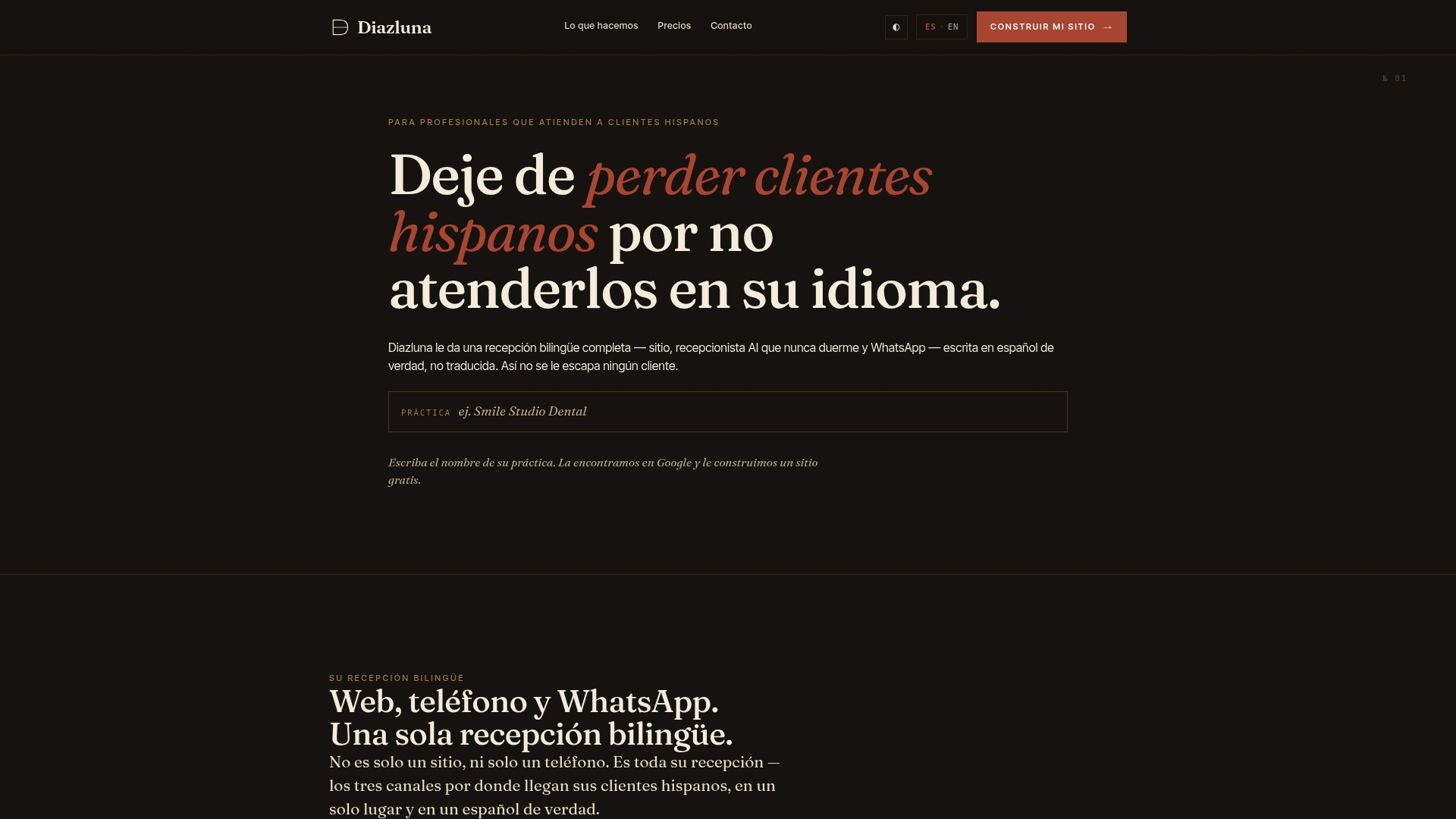
Building and maintaining Spanish consent forms is one piece of a larger front-desk problem: making sure Spanish-speaking patients and clients get consistent, accurate communication at every touchpoint, not just on the intake form. Diazluna handles that layer for dental, legal, and healthcare practices with a bilingual website, a 24/7 AI receptionist named María that manages calls and messages in Spanish and English, and WhatsApp integration for two-way messaging.
That combination matters for consent specifically. María can walk a Spanish-speaking caller through the same opt-in language used on your written form, log the consent event, and route anything urgent to staff in real time. WhatsApp messages built around clear opt-in and opt-out language, similar to the WhatsApp consent examples many practices already use, plug into the same workflow.
A practice handling a handful of Spanish-speaking patients a week can likely manage consent forms with the templates above and a simple filing system. A busier front desk juggling paper intake, a web form, and SMS reminders across two languages is where a managed system earns its cost.
The client offers tiered plans including a bilingual website, options adding an AI receptionist, and full-service management with expanded capacity, available monthly or annually, with an activation fee for setup. Details and current pricing are on the Diazluna site.
Sources
The legal and template guidance above draws on four primary sources. HHS guidance on educating patients explains why healthcare providers should disclose texting risks and document that disclosure. The FCC’s Second Report and Order sets out the one-to-one prior express written consent rule and revocation rights that govern marketing and informational texts alike. Washington State’s DSHS Spanish-language consent form provided the plain-language structure and signature field layout used in the templates above. The FTC’s CAN-SPAM compliance guide sets the standard for opt-out mechanisms and response timing on commercial messages.
- HHS: Resource for health care providers — educating patients
- FCC: One-to-One Consent Rule (Second Report and Order) — Frequently Asked Questions
- DSHS 27-156 SP: Notice and consent of communication via text or unencrypted email (Spanish)
- FTC: CAN-SPAM Act compliance guide for business
FAQ
How do you say “consent form” in Spanish?
A consent form is most commonly called a “formulario de consentimiento” in Spanish, and in medical settings you will also see “consentimiento informado,” meaning informed consent. Both terms appear on official U.S. government forms, including the DSHS Spanish-language text messaging consent form.
Can I text someone from Mexico to the USA?
International texting between Mexico and the United States is technically possible through most mobile carriers, but it operates under different rules and pricing than domestic SMS, and carrier terms vary. For any business or clinical communication, the consent standards in this article apply specifically to U.S.-based recipients under U.S. law, so check your carrier’s international messaging terms separately for cross-border personal texts.
How do you send text messages in Spanish?
Most SMS platforms and phone keyboards support Spanish characters and accents natively, so sending a text in Spanish works the same as sending one in English on virtually any modern phone or messaging platform. The consent language itself, not the technical sending process, is what determines compliance for businesses and clinics.
What is the medical consent form called in Spanish?
A medical consent form is called a “formulario de consentimiento médico” or simply “consentimiento informado” in most U.S. healthcare settings. For texting specifically, the more precise term is “consentimiento para comunicación por mensaje de texto,” which appears in forms like the one from Washington State’s DSHS.
What should I do if I get an unwanted Spanish text message?
Reply “ALTO” or “STOP” to the sender first, since legitimate businesses are required to honor that request. If the texts continue or look like spam, the FTC recommends reporting them by forwarding the message to 7726, which spells “SPAM” on most phone keypads.