August 26, 2026
What Is an AI Medical Intake Assistant, and How Does It

An AI medical intake assistant is a conversational agent that collects patient registration and clinical-history information, then writes a clinician-ready summary into the chart before the visit. It talks to patients through chat, text, voice, or a check-in kiosk, asks follow-up questions the way a nurse would, and hands your staff a finished record instead of a stack of handwriting to decipher.
Practices that adopt one typically see three things change fast:
- Front-desk staff spend less time typing patient answers into the EHR
- Intake data arrives structured and complete, with fewer blank fields and illegible entries
- Clinicians get a short summary and flagged concerns before they walk into the room
If you’re comparing vendors, skip ahead to the checklist in the “what to look for” section below before you sign anything.
Key Takeaways
AI medical intake works when EHR integration, clinician escalation rules, and multilingual channel support are treated as core requirements, not optional add-ons.
| Point | Details |
|---|---|
| Definition | An AI medical intake assistant is a conversational agent that gathers patient history and writes a clinician-ready summary before the visit. |
| Integration is the real value driver | Structured write-back via FHIR, HL7, or API prevents automation from just shifting data entry work to staff. |
| Compliance is non-negotiable | Every vendor and subcontractor touching patient data needs a signed BAA, plus encryption and audit logging. |
| Pilot before you scale | Track intake completion rate, time per patient, no-show change, and clean-claim rate during a limited rollout. |
| Bilingual example | Diazluna combines a bilingual website, 24/7 AI receptionist, and WhatsApp intake for practices serving Hispanic patients. |
This article is general information, not a substitute for advice from a qualified doctor. Consult a qualified healthcare professional about your own circumstances before acting on anything here.
Table of Contents
- What Sets AI Medical Intake Apart From a PDF Form
- How AI Intake Works From Trigger to Chart
- What Practices Actually Gain From Adopting AI Intake
- HIPAA, BAAs, and What to Require From Any Vendor
- What to Look for When Choosing a Vendor
- A Bilingual Example Worth Studying
- Where AI Medical Intake Is Headed Next
- Where AI Intake Still Falls Short
- What I’d Prioritize First
- Diazluna Handles Bilingual Intake So You Don’t Juggle Three Vendors
- Sources
What Sets AI Medical Intake Apart From a PDF Form
A static digital form asks the same ten questions regardless of who’s answering. An AI healthcare assistant adjusts the conversation based on what the patient just said, the way a good intake nurse would follow up on “yes, I have chest pain sometimes” with “how often, and does it happen with activity?”
That adaptive questioning, powered by natural language processing, is the real dividing line. The system reads free text, not just checkboxes, and can catch context a rigid form misses entirely, like a patient mentioning a new medication in an unrelated field.
Medical intake automation shows up across several patient touchpoints:
- SMS and web chat for pre-visit intake sent as a link after booking
- Voice or phone-based agents for patients who prefer talking or lack reliable internet
- Kiosk check-in for walk-ins or patients arriving without completing intake beforehand
- WhatsApp for patients, particularly Hispanic and immigrant populations, who already use it as their primary messaging app
The output isn’t just filled-in fields. A well-built digital intake assistant produces structured data for the chart, a short clinical summary for the provider, and a full transcript available for audit or clinician review if something needs a second look.
How AI Intake Works From Trigger to Chart
The workflow usually starts the moment a patient books. A secure link goes out by SMS, email, or WhatsApp, often paired with a reminder two to three days before the appointment so the conversation happens with time to spare, not in the waiting room. Patients who don’t respond get a kiosk fallback when they arrive.
From there, the conversation branches based on answers. A patient reporting shortness of breath gets different follow-up questions than one booking a routine cleanic visit, and clinical triage rules determine what gets escalated immediately to staff versus what waits for the provider to review at the visit.
The technical backbone matters more than the chat interface. Integration guides consistently point to structured field write-back via FHIR or HL7 or a direct API as the difference between a tool that actually saves time and one that just moves the typing from the patient to your staff. Some implementations, as described in case studies of AI-driven patient intake, even accept photo uploads, like a picture of a rash, and route follow-up questions based on what the image shows.
- Booking triggers the first outreach message automatically
- Reminders fire two to three days out to maximize completion before arrival
- Kiosk mode catches anyone who missed the digital step
- Escalation rules route anything flagged urgent straight to a human
Pro Tip: Ask any vendor to show you their data mapping document before you sign. If they can’t produce one showing exactly which intake fields map to which EHR fields, expect a messy implementation.
What Practices Actually Gain From Adopting AI Intake
The time savings show up first at the front desk. Staff who used to spend minutes per patient keying in handwritten forms get that time back for scheduling, insurance calls, and actual patient interaction.

Vendor and adopter reports cited by industry coverage of conversational intake describe front-desk time reductions in the 60 to 80% range per patient, along with no-show drops above 30% in early adopter cases. Those numbers come from vendor-reported case studies rather than controlled trials, so treat them as a directional signal, not a guarantee.
Cleaner intake data has a second-order effect that’s easy to overlook: fewer downstream claim denials. When insurance and clinical details are captured completely and correctly on the front end, billing teams spend less time chasing corrections later.
- Reduced wait times because intake happens before arrival, not in the lobby
- Higher patient engagement, especially when the format matches how patients already communicate
- Fewer no-shows tied to automated, well-timed reminders
A systematic review of chatbots used for medical history-taking found consistent improvements in data completeness and patient engagement, though the reviewers noted that larger randomized trials are still needed to confirm effects on clinical outcomes.
HIPAA, BAAs, and What to Require From Any Vendor
Any AI healthcare assistant that touches patient health information needs a signed Business Associate Agreement, full stop. That requirement extends past the primary vendor to every tool in the chain, including messaging providers, transcription services, and any subcontractor with access to the data.
Not every vendor will sign one. General-purpose chat tools built for customer service, not healthcare, often can’t or won’t offer a BAA, which makes them a compliance liability no matter how well they work.
Beyond the BAA itself, look for:
- Encryption in transit and at rest, not just one or the other
- Audit logging that tracks who accessed what, and when
- Minimum-necessary data design, meaning the assistant only collects what’s clinically relevant
- Documented patient consent captured at the start of the conversation
Pro Tip: Ask the vendor to name every subcontractor in their data path and confirm each one has signed a BAA. A single unsigned link in that chain puts your practice at risk, not the vendor.
What to Look for When Choosing a Vendor
Start with integration readiness. Ask whether the vendor has a working connector for your specific EHR, whether they can show a data mapping document, and whether they’ll run a test environment before going live. A tool that promises to “integrate with anything” but can’t name your EHR by name is a red flag.
- Confirm EHR connector availability and request a live demo with your actual system
- Review their data mapping approach field by field, not just at a high level
- Test multichannel and multilingual support with a real patient scenario, not a scripted demo
- Verify human-in-loop escalation rules for anything clinically ambiguous
- Set a pilot period with defined success metrics before committing to a full rollout
For the pilot itself, track a small set of numbers:
- Intake completion rate before the visit
- Time per patient at check-in, compared to your pre-pilot baseline
- Change in no-show rate over the pilot period
- Clean-claim rate on visits that used the AI intake versus those that didn’t
Architecture patterns described by platforms like Keragon’s patient intake automation show a consistent pattern: an orchestration layer connecting forms, eligibility checks, and the EHR, with audit logs preserving a paper trail for every step. That structure, not the chatbot interface, is what determines whether the tool actually reduces work.
A Bilingual Example Worth Studying
Diazluna built its bilingual front-desk platform specifically for practices serving Hispanic patients, pairing a bilingual website with a 24/7 AI receptionist and WhatsApp integration for intake and scheduling. Clients report fewer lost Hispanic patients due to language gaps and Google indexing within 24 hours of launch, with fuller case detail available on request.
Bundling the website, receptionist, and messaging into one platform matters operationally: practices avoid juggling three vendors and three separate handoffs during setup, which is often where implementations stall.
- One vendor relationship instead of three separate contracts
- Spanish and English handled natively, not through translation layers
- WhatsApp support built in, matching how many Hispanic patients already communicate
Where AI Medical Intake Is Headed Next
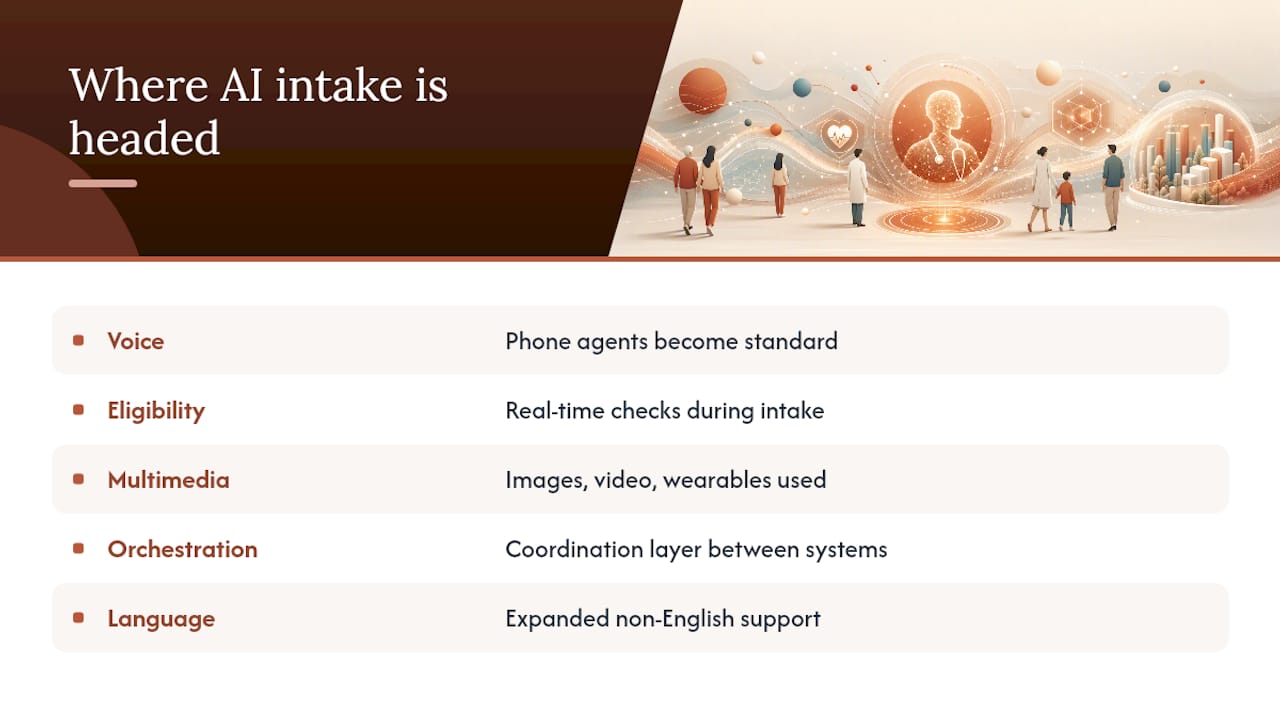
Voice is the clearest near-term shift. Phone-based AI agents that handle intake conversationally, without a patient ever opening an app or link, are moving from novelty to standard offering as natural language processing gets better at handling accents, background noise, and interrupted speech.
Expect tighter integration with insurance verification too. Rather than intake and eligibility checking running as separate steps, more platforms are folding real-time eligibility checks into the same conversation, so a patient’s coverage gets confirmed before they ever sit in a waiting room.
Multimedia input will keep expanding beyond the occasional photo upload. Symptom-tracking through images, short video clips for mobility or skin concerns, and even wearable data feeding into intake conversations are all in active development across the industry, though adoption will likely stay uneven by specialty for a while.
The bigger shift, though, is philosophical: vendors are increasingly framing these tools as orchestration layers that sit between forms, the EHR, eligibility services, and messaging platforms, rather than as a replacement for any single piece, as described by Streamline AI. That framing matters because it sets expectations correctly. A practice buying an AI healthcare assistant isn’t buying a smarter form. It’s buying a coordination layer that has to talk to systems that weren’t built to talk to each other.
Language support will keep expanding too, driven less by technology limits and more by demand from practices that serve populations where English isn’t the default. That’s less a prediction than an observation of where adoption is already concentrated.
Where AI Intake Still Falls Short
Accuracy isn’t perfect, and it shouldn’t be treated as if it were. Free-text responses can be misread or miscategorized, particularly with complex medical histories, unusual phrasing, or patients switching between languages mid-conversation. That’s precisely why human-in-loop review for clinical ambiguity isn’t optional. It’s the backstop that catches what the model gets wrong.
Patient acceptance varies more than vendor pitches suggest. Older patients, those less comfortable with technology, and patients with limited digital access sometimes resist or struggle with conversational intake, which is exactly why kiosk fallback and phone options need to stay available rather than being phased out for cost reasons.
There’s also a real risk of the tool shifting work rather than eliminating it. If the assistant isn’t properly integrated with the EHR, staff end up reviewing and re-entering data anyway, which erases most of the time savings the practice was counting on. That’s the core warning in vendor and industry guidance: the automation layer, not the chat interface, is where the value actually lives.
Trust is the quieter challenge. Some patients are simply uneasy discussing symptoms with something that isn’t a person, especially around sensitive topics like mental health or reproductive care. No current system fully solves that discomfort. The best implementations acknowledge it by making a human option easy to reach, not by pretending the discomfort doesn’t exist.
What I’d Prioritize First
Start with one specialty or appointment type, not a full rollout. Measure completion rate and no-show change before expanding. Keep clinicians reviewing anything ambiguous rather than trusting full automation. And treat language support as an access issue, not a nice extra. It determines who actually gets served.
— Francisco
Diazluna Handles Bilingual Intake So You Don’t Juggle Three Vendors
Diazluna is the alternative to running separate contracts for your website, your answering service, and your messaging platform. It bundles a bilingual website, a 24/7 AI receptionist fluent in Spanish and English, and WhatsApp integration into one subscription, built specifically for dental, legal, and medical practices serving Hispanic clients.
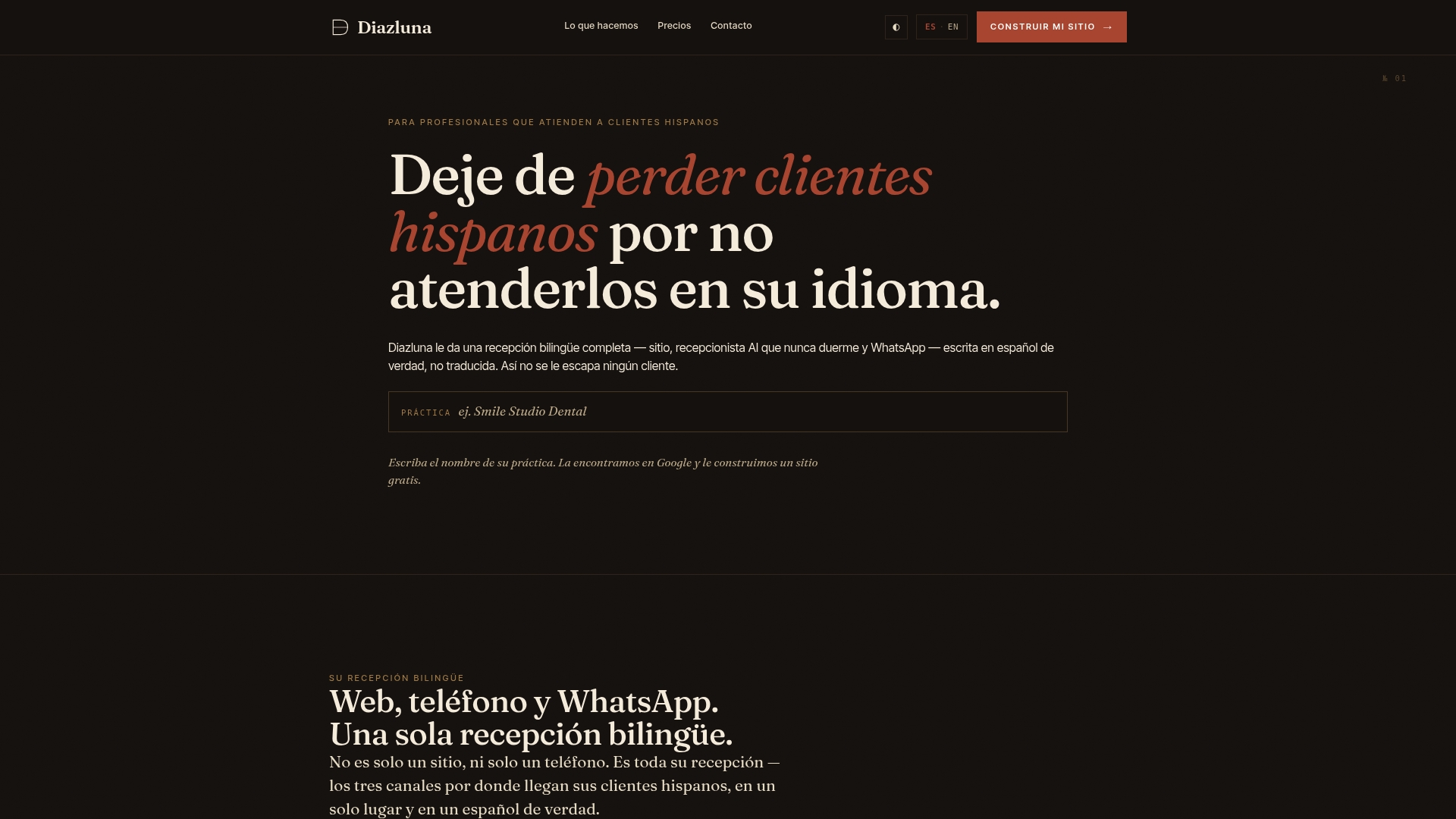
That matters most for practices where a language gap has meant losing a patient before they ever booked. The AI receptionist handles calls, messages, and scheduling around the clock, and urgent cases get flagged and transferred to your staff in real time rather than sitting in a queue overnight. Practices considering a pilot for bilingual dental intake or a 24/7 AI receptionist can start with Diazluna’s platform page to see pricing tiers and request a demo. Case-study detail and client outcomes are available on request for practices evaluating a pilot.
Sources
- Systematic review: Chatbots in medical history‑taking (PMC)
- AI medical intake in 2026: replacing clipboards with conversational forms | Perspective AI