September 13, 2026
Download 4 Spanish New Patient Dental Forms and Clinic

Download four core documents before your first visit: a patient registration form, a medical history questionnaire, a HIPAA privacy acknowledgment, and an informed consent form, all in Spanish. The ADA offers a downloadable Spanish patient health-history form that covers most practices’ needs, or check your dental office’s website for a clinic-specific PDF first.
TL;DR:
- Most Spanish dental forms should be recent, ideally with a visible revision date, and verified by a healthcare professional to ensure accuracy and cultural appropriateness.
- Download forms from reputable sources like the ADA, university clinics, or community health centers to reduce translation errors and improve clarity.
- Completing paperwork before the appointment using a downloadable fillable PDF, with preparation of medication lists and ID, minimizes in-office delays and errors.
- Properly translated consent and HIPAA forms must include clear procedural details, known risks, and signature fields reviewed by a native speaker to ensure legal validity.
- Implementing bilingual reminders and digital workflows can significantly improve form completion accuracy and reduce intake mistakes in Spanish-speaking patients.
Table of Contents
- What Are the Core Spanish New-Patient Dental Forms?
- Where Can You Download Reliable Spanish Templates?
- How Do You Complete These Forms Before Your Appointment?
- What Do Consent and HIPAA Forms Mean in Spanish?
- Quick Spanish Glossary for Dental Intake Forms
- How Bilingual Front-Desk Tools Cut Down on Intake Errors
- How Do You Verify a Spanish Form Is Accurate and Culturally Appropriate?
- Can Dental Offices Legally Customize Spanish Forms Themselves?
- What Mistakes Do Offices Make With Spanish Dental Forms?
- Practice Manager Perspective: Quick Next Steps
- A Practice-Side Option for Faster Spanish Intake
- Sources
- FAQ
What Are the Core Spanish New-Patient Dental Forms?
Every new patient packet in Spanish, regardless of which office hands it to you, tends to break down into the same four documents. Understanding what each one asks for saves time and prevents the awkward pause at the front desk when you realize you left your insurance card at home.
Registration form. This one collects your basic identifying information: full name, date of birth, home address, phone number, emergency contact, and insurance details. Straightforward, but it sets up everything else.
Medical history questionnaire. This is the longest form and the one that matters most clinically. Spanish-language versions typically ask about heart conditions, diabetes, and other chronic illnesses, plus a full list of current medications with dose and frequency, known allergies, and your primary-care physician’s contact information, according to Columbia University’s dental clinic template.
HIPAA/privacy acknowledgment. This is separate from your medical history for a reason: it confirms you received and understood the practice’s privacy notice, not that you’re disclosing health information. Signing it means you know how your data will be stored and shared, nothing more.
Informed consent. This form documents that you understand the risks, benefits, and alternatives of proposed dental work before treatment starts, and it usually includes a translator or witness signature line.
Some offices add optional paperwork: a financial agreement outlining payment responsibility, a COVID-19 screening questionnaire, or pediatric addenda for minors. None of these replace the four core documents above.
Where Can You Download Reliable Spanish Templates?
Not every Spanish dental form online is worth trusting. The safest sources are institutions with a track record: the ADA’s Spanish health-history form, university dental clinics like Columbia and Stanford Health Care, and community health center packets such as the one from CSVS.
A reliable template usually shows a few consistent signs:
- A revision date printed somewhere on the page, often near the footer or header.
- Translator or witness signature fields, not just a spot for the patient’s own signature.
- Bilingual or side-by-side labeling rather than a single dense block of translated text.
- A clear provider signature block confirming who reviewed the form with the patient.
Steer clear of any form that reads like it was run through a translation app: awkward phrasing, missing accent marks, or medical terms that don’t match standard usage are red flags. Prefer PDFs hosted directly on a health system, dental school, or federally qualified health center’s own domain over generic template repositories.
Pro Tip: Before printing a form for your office, open it on a phone screen. If the Spanish text overflows the fillable boxes or the checkboxes shift out of alignment, patients filling it out at home will run into the same problem.
How Do You Complete These Forms Before Your Appointment?
Getting through the paperwork ahead of time is the single biggest favor you can do yourself and the front-desk staff. Here’s the order that works:
- Download the fillable PDF or print a physical copy from your dental office’s website.
- Gather your photo ID and insurance card before you start filling anything out.
- Write out your current medications, including exact names, doses, and how often you take them, rather than relying on memory in the chair.
- Note your primary-care physician’s name and phone number for the medical history section.
- If you’re filling out forms for a minor, bring a guardian’s ID and any custody paperwork the office might request.
Complete everything at home if you can. If that’s not possible, plan to arrive 20 to 30 minutes before your scheduled time so you’re not rushing through medical history questions in the waiting room, a timeline the ADA’s own guidance recommends for first-time visits. Getting the medication list right matters more than people expect: dentists cross-reference it against anesthesia plans and antibiotic prescriptions, so a vague answer like “blood pressure pill” isn’t enough.
What Do Consent and HIPAA Forms Mean in Spanish?
Informed consent isn’t a formality. It’s a legal safeguard that confirms you had a real chance to ask questions, in the language you’re most comfortable with, before agreeing to treatment. Consent sections typically spell out the procedure being performed, the risks involved, reasonable alternatives, and a signature line, often with a separate slot for a translator or witness.
A properly built consent form covers these elements:
- The specific procedure name and a plain-language description of what it involves.
- Known risks and possible complications, stated directly rather than buried in dense legal text.
- Alternative treatment options, including the choice to do nothing.
- Signature lines for the patient, and where needed, a translator or witness.
HIPAA acknowledgments work differently: they confirm you received the practice’s privacy notice and understand how your records get used, not that you’re granting new permissions. A clear “preferred language” checkbox on the intake packet helps staff route you to Spanish paperwork automatically instead of guessing.
The real risk sits in translation quality. Machine-translated consent language can misstate legal or medical terms badly enough to undermine the form’s legal standing, which is exactly why templates from the Elica Health Centers and similar community clinics rely on professionally reviewed language rather than automated translation. Look for a dated template with translator fields and a provider signature block. Those three details tell you someone checked the form’s accuracy before it reached you.
Quick Spanish Glossary for Dental Intake Forms
You don’t need fluent Spanish to recognize what a form is asking. A handful of terms cover most of what shows up on intake paperwork:
- Historial médico — medical history
- Alergias — allergies
- Medicamentos actuales — current medications
- Contacto de emergencia — emergency contact
- Seguro dental — dental insurance
- Consentimiento informado — informed consent
- Firma del paciente — patient signature
- Enfermedades del corazón — heart disease
For the medication section, a common phrase is “Nombre del medicamento, dosis y frecuencia” (medication name, dose, and frequency). Emergency contact fields usually ask for “Nombre y número de teléfono” (name and phone number). Offices that offer side-by-side Spanish and English fields, rather than a single translated column, cut down on errors from patients who mix Spanish and English or use regional variations. For a deeper staff-facing list, these dental Spanish terms cover the vocabulary front-desk teams run into most.
How Bilingual Front-Desk Tools Cut Down on Intake Errors
Paper forms only work if someone actually fills them out correctly before showing up. Automated bilingual reminders, sent by text or WhatsApp with a link to the right Spanish PDF, tend to raise how many patients arrive with paperwork already done, because the reminder removes the guesswork about which form to use. That matters clinically: a rushed, in-office translation of a medication list or consent form is exactly the scenario that leads to mistakes.
Pairing verified Spanish templates with a bilingual digital workflow, rather than translating on the fly at the front desk, closes that gap. Staff training resources on Spanish phone scripts help front-desk teams confirm appointment details and paperwork status without relying on guesswork or a rushed translation mid-call.
How Do You Verify a Spanish Form Is Accurate and Culturally Appropriate?
Accuracy and cultural fit aren’t the same thing, and a form can fail at either one independently. Accuracy means the medical and legal terminology says what it’s supposed to say. Cultural appropriateness means the phrasing sounds natural to a Spanish speaker rather than technically correct but stiff.
Start by checking whether a native Spanish speaker, ideally someone with a healthcare background, has reviewed the document. A form translated by a bilingual staff member who understands dental terminology will read differently than one run through automated translation software. Watch for regional word choices too: terms common in Mexican Spanish sometimes differ from those used in the Caribbean or Central American Spanish, and a form written for one audience can feel slightly off to another. Neutral, widely understood vocabulary works best for a mixed patient base.
Test the form the way a patient would. Read each question aloud in Spanish and ask whether it makes sense without needing the English version next to it. If a sentence only makes sense once you mentally translate it back to English, it needs revision. Also check that formatting, checkboxes, date fields, signature lines, doesn’t shift or break when the Spanish text runs longer than the English original, which happens often since Spanish sentences tend to run about 15 to 20 percent longer.

Finally, ask a few bilingual patients or staff members for informal feedback before rolling a new template out practice-wide. Real reactions catch problems that a solo review misses.
Can Dental Offices Legally Customize Spanish Forms Themselves?
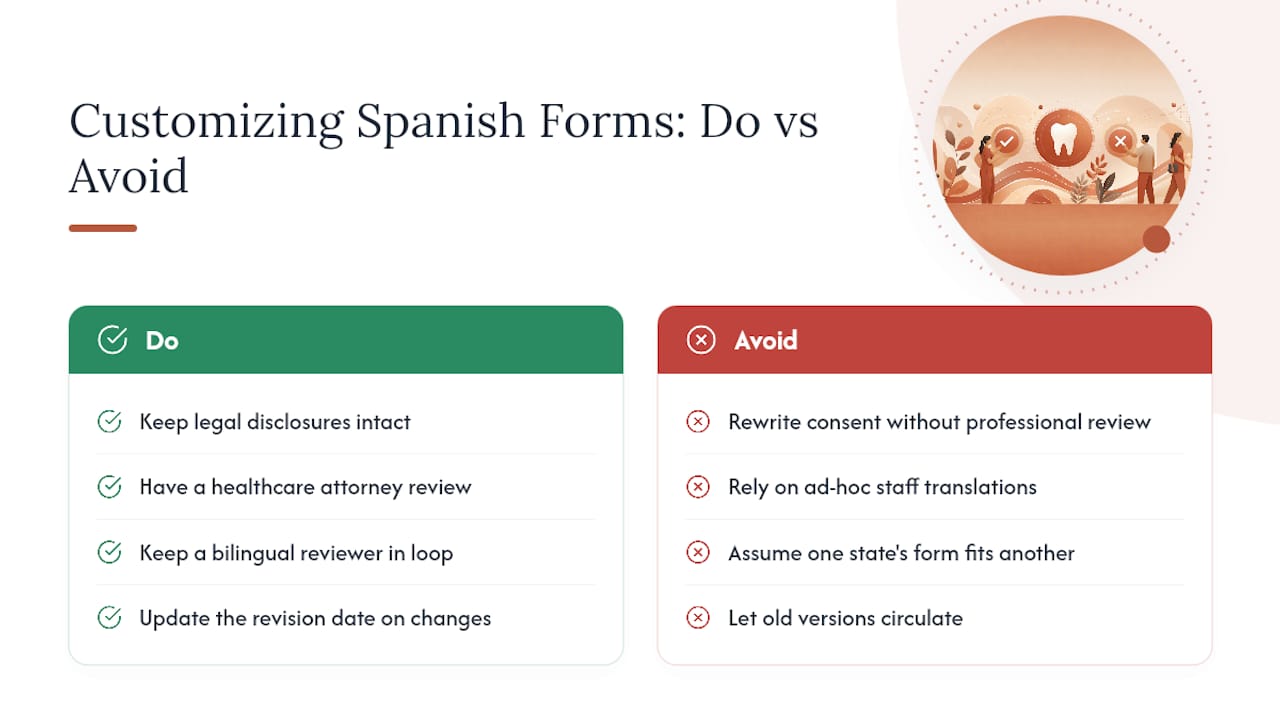
Yes, but customization carries responsibility. Dental practices are generally free to adapt Spanish forms to match their own procedures, state consent requirements, or HIPAA language, as long as the substance of the legal disclosures stays intact. Swapping a clinic’s name and logo onto a template is simple. Rewriting consent language without professional review is where offices get into trouble.
State dental boards vary on exactly what informed consent must include, and some states require specific disclosures for procedures like sedation or extractions that others don’t. A form that satisfies California’s consent requirements might miss something a state with stricter disclosure rules expects. If your practice operates across state lines or serves patients who split care between offices, it’s worth having a healthcare attorney check that your Spanish consent language matches your English version’s legal disclosures, not just its general meaning.
Translation itself isn’t a legal act, but a poorly translated consent form can become a liability if a patient later argues they didn’t understand what they signed. That’s why community clinics and university dental programs invest in professionally reviewed templates rather than ad-hoc staff translations. If your office edits a template like the one from CSVS, keep a bilingual staff member or outside reviewer in the loop, and update the revision date every time the content changes so old versions don’t circulate by mistake. Practices publishing verified Spanish forms on their own websites also tend to rank better for local Spanish-language searches, something dental SEO specialists often flag as an overlooked advantage.
What Mistakes Do Offices Make With Spanish Dental Forms?
The most common error is using an outdated template that nobody has revisited in years. Dental terminology and insurance language shift, and a form last updated five years ago may reference procedures or privacy rules that no longer apply. Always check for a revision date, and if there isn’t one, treat that as a warning sign rather than an oversight.
Another frequent problem is relying on machine translation for consent or HIPAA language. Automated tools handle simple vocabulary fine but often stumble on legal phrasing, sometimes changing the meaning of a risk disclosure just enough to matter if a dispute ever arises.
Offices also tend to skip the language-preference checkbox, forcing staff to guess which language a patient needs rather than asking directly. A simple checkbox on registration solves this and speeds up the whole intake process.
Formatting breaks are underrated too. Spanish text runs longer than English, and a form designed in English first, then translated, often ends up with cramped checkboxes or signature lines that don’t leave enough room. Test every template in its final Spanish layout before printing a stack of them.
Last, some practices leave out a dental-anxiety scale or comfort-preference question, a small addition that helps staff prepare before a nervous patient even sits in the chair, whether that patient reads English or Spanish. It costs one line on the form and gives clinical staff a useful heads-up.
Practice Manager Perspective: Quick Next Steps
If there’s one habit worth building, it’s keeping verified Spanish templates live and current on your website instead of buried in a filing cabinet, and prompting patients in Spanish before they even walk in. Train front-desk staff to point to translator or witness fields whenever consent language gets confusing, and never let a patient sign something they didn’t fully follow. And to the patient reading this before an appointment: bring your medication list and ID. That one step prevents most of the delays I’ve seen at check-in.
— Francisco
A Practice-Side Option for Faster Spanish Intake
There are alternatives to hiring extra bilingual front-desk staff for practices that keep losing Spanish-speaking patients to missed calls or half-finished paperwork. Some services combine a bilingual website, a 24/7 AI receptionist fluent in Spanish and English, and WhatsApp messaging into one system, so a patient can get a Spanish form link sent to their phone the moment they book, instead of filling it out cold in the waiting room.
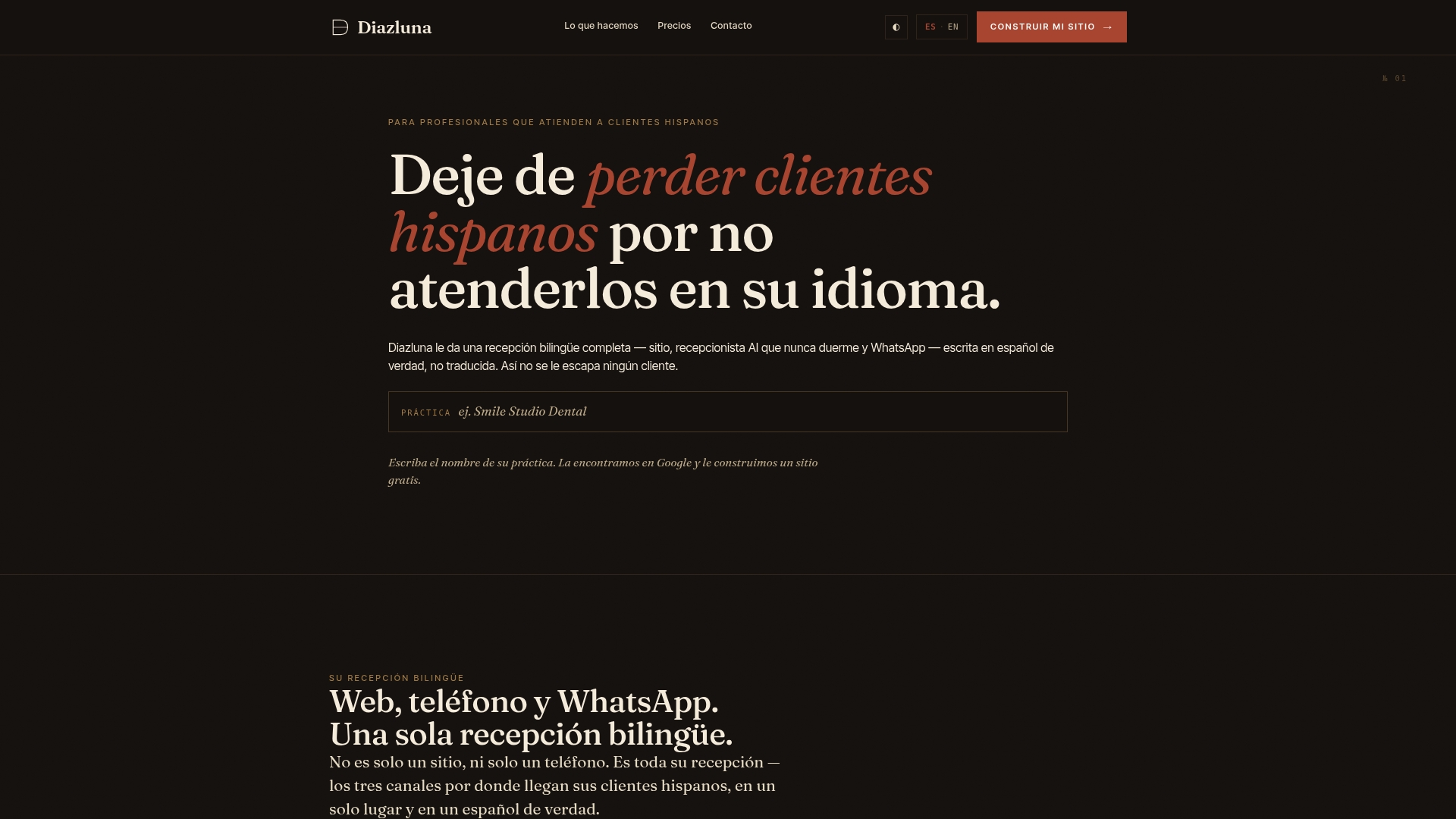
This isn’t a replacement for the forms themselves. It’s a way to make sure patients actually receive the right Spanish paperwork, get reminded to complete it, and reach a real answer in their own language if a question comes up before the appointment. For practices that want fewer no-shows and fewer rushed translations at the front desk, Diazluna’s dental page walks through how the bilingual website, AI receptionist, and WhatsApp integration work together, and pre-appointment completion tends to improve once reminders and forms arrive in the same bilingual workflow. If your practice wants to see how it fits your patient volume, visit Diazluna to check current plans.
This article is general information, not a substitute for advice from a qualified doctor. Consult a qualified healthcare professional about your own circumstances before acting on anything here.
Sources
- ADA downloadable Spanish patient health-history form
- Columbia University dental clinic Spanish health-history PDF
- Stanford new-patient health questionnaire (Spanish)
- CSVS dental adult visit Spanish packet
- Elica Health Centers adult consent to perform dentistry (Spanish)
FAQ
What Are the New Patient Forms in Spanish?
They’re the same four core documents every dental office uses, translated into Spanish: patient registration, medical history, a HIPAA privacy acknowledgment, and informed consent, usually available as downloadable PDFs like the ADA’s Spanish version.
What Are Some Important Spanish Words for Dentists?
Key terms include “historial médico” (medical history), “alergias” (allergies), “medicamentos actuales” (current medications), and “consentimiento informado” (informed consent). A fuller staff-facing list appears in this dental Spanish glossary.
What Is the Intake Form in Spanish?
The intake form, or “formulario de admisión,” combines registration and medical history questions into one packet patients fill out before their first visit, covering personal details, insurance, and health background.
What Is a Patient Registration Form?
It’s the document that collects your basic identifying and contact information: full name, date of birth, address, emergency contact, and insurance details, separate from the medical history questionnaire that follows it.
How Can Dental Offices Make Spanish Forms Easier to Complete Correctly?
Sending forms ahead of the appointment through a bilingual reminder system, rather than handing them out in the waiting room, gives patients time to fill them out accurately and ask questions in advance. Tools like Diazluna’s bilingual workflow are built around exactly that kind of pre-visit outreach.