August 3, 2026
Top Patient Communication Tools for Spanish-Speaking
A bilingual digital front desk combining a fully optimized Spanish-English website, a 24/7 AI receptionist, and WhatsApp integration is the fastest way for U.S. practices to reliably serve Spanish-speaking patients. Before you evaluate any vendor, confirm they deliver on these six criteria:
- Full Spanish parity across scheduling, messaging, and billing (not just a translated homepage)
- HIPAA-compliant messaging with a signed Business Associate Agreement (BAA)
- WhatsApp integration for the channel your patients already use
- 24/7 bilingual AI receptionist with live escalation for urgent cases
- EHR or practice management system (PMS) integration
- Dialect and tone customization for your specific patient population
Start by running two or three vendors through the scorecard in Section 8, then contact Diazluna for a free site setup to see what full-platform parity looks like in practice.
Table of Contents
- Why bilingual patient communication matters for U.S. practices
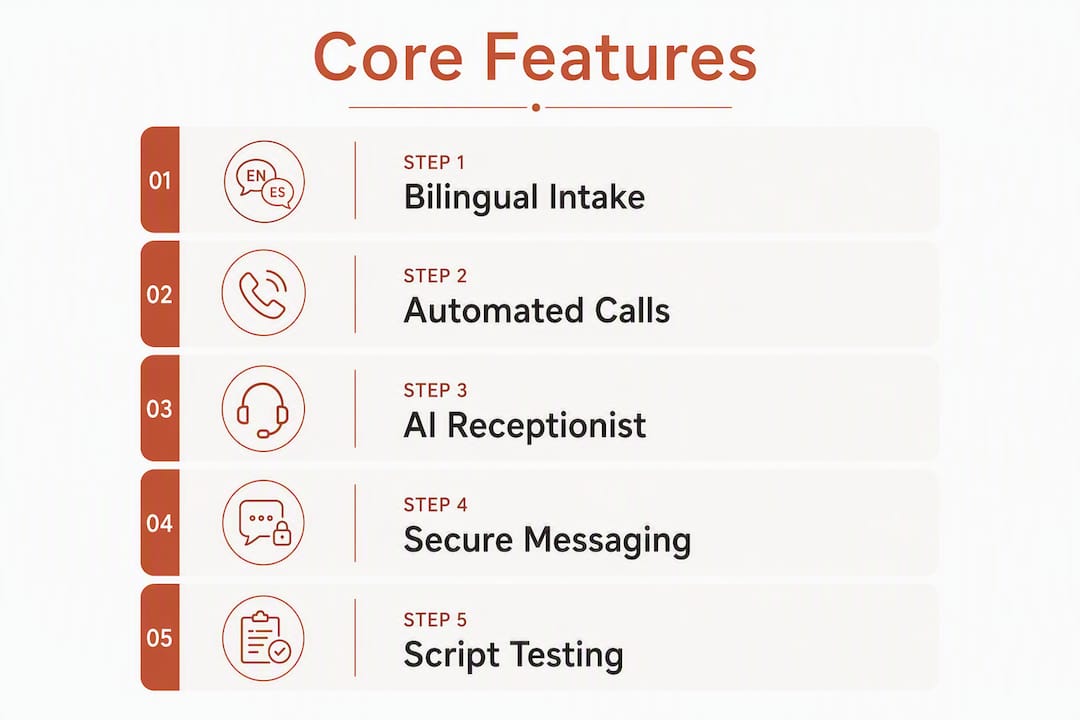
- What core features must a top patient communication tool include?
- How does a bilingual digital front desk actually work day-to-day?
- What HIPAA and security requirements apply to Spanish-language messaging?
- What does implementation actually cost and how long does it take?
- How do you measure whether your bilingual front desk is working?
- What questions should you ask any vendor before you buy?
- How Diazluna implemented a bilingual front desk and what happened
- Key Takeaways
- What the industry keeps getting wrong about bilingual patient tools
- Diazluna covers the full bilingual front desk, not just the website
- Authoritative resources for further reading
Why bilingual patient communication matters for U.S. practices
Around 45 million people in the U.S. speak Spanish at home, making Spanish the most requested language for medical interpretation nationwide. That is not a niche demographic. For a dental, legal, or medical practice in most metro areas, it is a significant share of the addressable patient base.
When communication relies on staff improvising translations or patients bringing family members to interpret, the operational cost is real: longer appointment times, higher no-show rates, and patients who simply stop calling. A bilingual front desk reduces all three by routing Spanish-speaking patients into a consistent, confident communication flow from first contact through payment.
The AHRQ QuestionBuilder en Español is one example of how seriously the federal government takes Spanish-language patient access. It is a free app that helps patients organize questions before appointments, photograph insurance cards, and save medication details. Tools like this only work if the practice side of the conversation is equally prepared.
What core features must a top patient communication tool include?
Platform parity is the critical differentiator. Practices see higher engagement when the portal, scheduling, messaging, and billing flows all operate in Spanish, not just the website copy. Here is what that looks like in practice:
Must-have feature checklist:
- Bilingual website and patient portal with full Spanish navigation, not machine-translated text bolted onto an English layout
- Secure Spanish messaging that meets HIPAA encryption requirements and keeps PHI out of unprotected SMS threads
- Bilingual appointment scheduling and reminders via SMS, email, and WhatsApp
- Spanish-capable billing and payment flows so patients can complete transactions without switching languages mid-process
- WhatsApp integration, since it is the dominant messaging channel for many Spanish-speaking households
- 24/7 bilingual AI receptionist with clear escalation to a human or certified interpreter for clinical questions
- EHR/PMS integration so confirmed appointments and patient data flow directly into your existing system
- Dialect and tone customization to match the regional Spanish your patients actually speak
Pro Tip: Before full rollout, test your Spanish messaging scripts with a small cohort of existing Spanish-speaking patients. A phrase that reads naturally to a Mexican-American patient in Texas may feel formal or off-tone to a Puerto Rican patient in New York. Tone testing early prevents retention problems later. See why Spanish tone matters for a practical framework.
For dental practices specifically, bilingual intake forms are one of the highest-leverage starting points. They reduce front-desk friction and cut the time staff spend re-entering patient data.
How does a bilingual digital front desk actually work day-to-day?
A well-built bilingual front desk routes every Spanish-language inquiry into a dedicated flow automatically, then transfers urgent clinical issues to staff with a real-time summary. No manual triage, no bilingual staff member fielding every call.
A typical patient journey looks like this:
- Patient finds the practice via a bilingual website or Google search in Spanish
- They submit an intake form or send a WhatsApp message in Spanish
- The AI receptionist acknowledges the inquiry instantly, confirms availability, and books the appointment
- An SMS or WhatsApp reminder goes out 48 hours before the visit, in Spanish
- The confirmed appointment syncs to the PMS/EHR automatically
- Post-visit, a follow-up message in Spanish requests a review or confirms next steps
Example: A Spanish-speaking caller phones after hours. The AI receptionist answers in Spanish, screens the reason for the call, and either books an appointment or flags the case as urgent and sends a summary to the on-call staff member. The caller never hits a voicemail in English. The practice never loses the lead.
Pro Tip: AI receptionist workflows for medical Spanish vary significantly by vendor. Ask for a live demo using a real after-hours Spanish call scenario before you commit.
AI interpretation tools can offer instant, dialect-aware responses and 24/7 availability, but always verify HIPAA compliance and confirm the escalation path to a certified human interpreter for complex clinical conversations.
What HIPAA and security requirements apply to Spanish-language messaging?
Spanish messaging must meet the same HIPAA safeguards as English. Language does not change the compliance obligation. Before signing any vendor contract, verify:
- BAA availability: the vendor must sign a Business Associate Agreement if PHI passes through their platform
- End-to-end encryption for all messaging channels, including WhatsApp threads
- Data residency and retention policies that match your state’s requirements
- Audit logs for all patient communications
- Interpreter confidentiality procedures when AI or human interpreters access clinical information
| Requirement | What to verify |
|---|---|
| BAA | Vendor signs before go-live; covers all channels |
| Encryption | End-to-end for SMS, WhatsApp, and portal messages |
| Audit logs | Timestamped records of all patient interactions |
| Data retention | Defined retention period; deletion on request |
| Interpreter access | Confidentiality agreement for any third-party interpreter |
When using AI interpretation, document the tool used and its limitations in the patient record. For any conversation involving diagnosis, treatment decisions, or informed consent, escalate to a certified medical interpreter. Automated tools handle scheduling and administrative communication well; they are not a substitute for clinical interpretation in high-stakes situations.
What does implementation actually cost and how long does it take?
Most SaaS bilingual front desk implementations run 1–2 weeks for a site-only setup and 4–8 weeks for full integration with EHR/PMS, staff training, and go-live. Here is a realistic milestone sequence:
- Discovery (Week 1): audit current patient communication gaps, identify Spanish-speaking patient volume, confirm EHR/PMS
- Bilingual content prep (Weeks 1–2): gather practice information, tone preferences, and dialect notes
- Site build (Weeks 2–3): bilingual website goes live with Spanish-parity pages
- AI receptionist and WhatsApp setup (Weeks 3–4): configure call flows, scripts, and escalation rules
- Integration and testing (Weeks 4–6): connect to EHR/PMS, test booking flows end-to-end
- Staff training (Week 6): front-desk team learns handoff protocols and how to review AI summaries
- Go-live (Week 6–8): full launch with monitoring
- 30/60/90-day optimization: review KPIs, refine scripts, adjust tone based on patient feedback
Pricing shapes vary by vendor. Common models include:
- Site-only tier: monthly subscription covering the bilingual website
- Site + AI receptionist tier: adds 24/7 call handling and WhatsApp integration
- Full managed package: includes site updates, expanded call capacity, and ongoing content management
Onboarding fees and per-appointment add-ons appear in some contracts. Ask for an all-in monthly cost before comparing tiers.
How do you measure whether your bilingual front desk is working?
Track these metrics from day one. The numbers will tell you whether the investment is paying off within the first 90 days.
| KPI | 30-day target | 90-day target | Reference |
|---|---|---|---|
| Spanish patient bookings | Baseline established | Measurable increase vs. pre-launch | Internal tracking |
| No-show rate (Spanish patients) | Monitored | Declining trend | Internal tracking |
| Patient portal adoption (Spanish) | Initial registrations | Over 17% adoption increase benchmark | athenahealth case data |
| Average response time (Spanish inquiries) | Under 5 minutes | Consistent | Vendor dashboard |
| Staff time on manual translation | Baseline logged | Significant reduction | Internal tracking |
30-day priorities: establish your baseline for each metric, confirm the AI receptionist is routing Spanish calls correctly, and verify the WhatsApp integration is delivering reminders.
90-day priorities: compare no-show rates before and after launch, review portal adoption among Spanish-speaking patients, and run a tone-testing review with a sample of recent patient interactions.
What questions should you ask any vendor before you buy?
Vendors must demonstrate bilingual parity, BAA and encryption, EHR integration, dialect customization, and Spanish-language support before you sign. Use this list during demos:
- Can you show a live demo of a Spanish patient booking an appointment end-to-end?
- What Spanish dialects does your AI receptionist support?
- How does the system escalate to a human interpreter?
- Will you sign a BAA before go-live?
- What encryption standard covers WhatsApp and portal messages?
- Which EHR/PMS systems do you integrate with natively?
- What is your average onboarding timeline?
- Do you provide staff training in Spanish?
- Can we customize the tone and scripts for our patient population?
- What is your SLA for system uptime and response time?
- Can you provide references from practices with a similar Spanish-speaking patient mix?
- What does data export look like if we switch vendors?
Vendor scorecard (weight by priority):
| Category | Weight | Score (1–5) |
|---|---|---|
| Security and BAA | 30% | |
| Price and contract terms | 10% |
Score each vendor, multiply by weight, and compare totals. Any vendor scoring below 3 on security should be disqualified regardless of overall score.
How Diazluna implemented a bilingual front desk and what happened
Diazluna’s own deployment covers the full stack: bilingual website, 24/7 AI receptionist, and WhatsApp integration, built specifically for Hispanic-serving dental, legal, and medical practices. The results from publisher data are concrete.
Implementation highlights:
- Site build and WhatsApp integration completed in the first two weeks
- AI receptionist configured with dialect-specific scripts before go-live
- Staff trained on reviewing AI call summaries and handling escalations
- Tone testing conducted with a sample patient cohort prior to full launch
The most consistent lesson from Diazluna deployments: tone matters as much as translation. Practices that tested their Spanish scripts with actual patients before launch saw faster adoption and fewer patient complaints about the automated experience. Bilingual follow-up workflows built into the system also reduced the manual outreach burden on front-desk staff.
Pro Tip: Do not skip the tone-testing step even when your AI receptionist vendor claims “native Spanish.” Regional phrasing differences between, say, Central American and Caribbean Spanish can affect whether a patient feels welcomed or confused.
Key Takeaways
Practices that deploy full-platform bilingual communication — site, AI receptionist, and WhatsApp — see measurable gains in Spanish patient bookings, no-show reduction, and portal adoption within 90 days.
| Point | Details |
|---|---|
| Platform parity over translation | Scheduling, billing, and messaging must all work in Spanish, not just the homepage. |
| BAA before go-live | Never launch a bilingual messaging tool without a signed Business Associate Agreement covering all channels. |
| Tone testing is non-negotiable | Test Spanish scripts with a real patient cohort before full rollout to catch dialect and tone mismatches. |
| 90-day KPI baseline | Track bookings, no-shows, portal adoption, and response time from day one to validate ROI. |
| Diazluna as a turnkey option | Diazluna’s site + AI receptionist + WhatsApp package is built for Hispanic-serving practices and includes free site setup. |
What the industry keeps getting wrong about bilingual patient tools
The conventional wisdom says “add a Spanish option” and you have solved the language gap. You have not. A translated homepage with an English-only booking flow, an English voicemail system, and a billing portal that switches back to English mid-transaction is not a bilingual practice. It is a bilingual facade.
What actually moves the needle is operational parity: every touchpoint a patient hits, from the first Google search to the post-visit payment reminder, works in Spanish without friction. That is a systems problem, not a translation problem. Practices that treat it as a translation problem spend money on a Spanish website and then wonder why their no-show rate among Spanish-speaking patients has not changed.
The other thing most guides underestimate is dialect. Spanish is not one language in practice. A script that resonates with a patient from Guadalajara may feel cold or overly formal to a patient from the Dominican Republic. The practices that get this right run small-cohort tone tests before launch. The ones that skip it often find out the hard way, through patient feedback or simply through patients who stop responding.
Diazluna covers the full bilingual front desk, not just the website
Most practices that come to Diazluna have already tried the piecemeal approach: a translated website from one vendor, a scheduling tool from another, and a staff member fielding Spanish calls manually. The result is gaps, inconsistency, and patients who fall through.
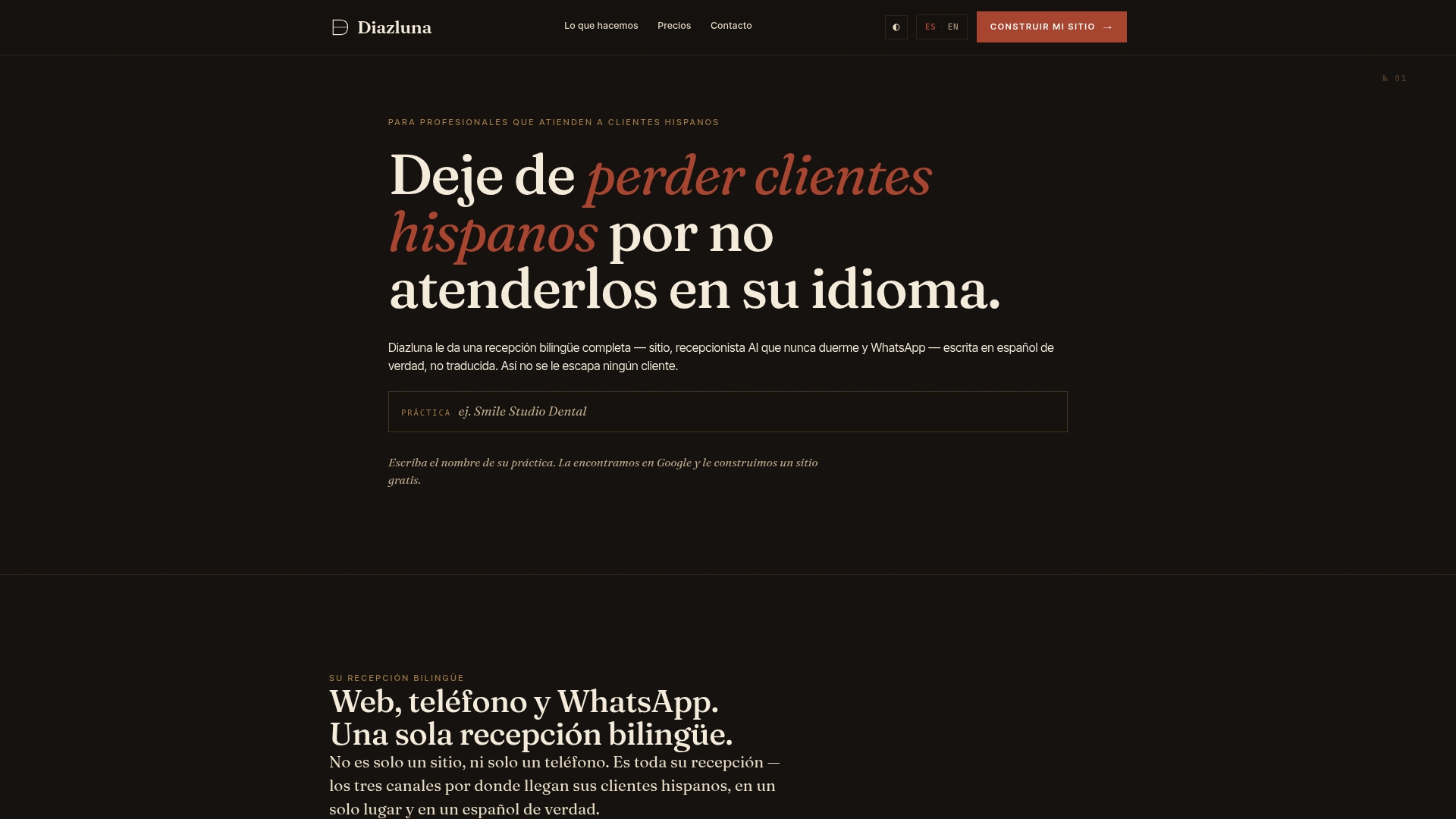
Diazluna packages the three things that actually matter into one monthly subscription: a fully bilingual website built for your specialty, a 24/7 AI receptionist that handles Spanish and English calls with dialect-aware scripts, and WhatsApp integration so patients can reach you on the channel they already use. The site setup is free. BAA coverage, EHR integration support, and tone customization are included, not add-ons.
Dental practices can see the specialty-specific package at Diazluna for dentists. For a broader look at what the full front desk includes, visit the main Diazluna page and request a demo or free site setup today.
Authoritative resources for further reading
Use these during vendor evaluation to verify claims and benchmark your requirements:
- AHRQ QuestionBuilder en Español — Free government app helping Spanish-speaking patients prepare questions, photograph insurance cards, and organize medication details before appointments. Recommend it to patients as a complement to your bilingual portal.
- athenahealth multilingual patient engagement guidance — Covers platform-level bilingual support requirements and includes real-world adoption data; use it to benchmark portal adoption goals.
- HITEQ Center multilingual patient resources directory — Searchable table of patient engagement tools with multilingual status; filter by Spanish to identify portal and education tools with verified language support.
- Diazluna bilingual front desk — Primary landing page for practices evaluating a turnkey site + AI receptionist + WhatsApp package.
- Diazluna for dentists — Specialty-specific package details for dental practices serving Hispanic patients.
When running vendor demos, bring the athenahealth parity checklist and the vendor scorecard from Section 8. Any vendor that cannot demonstrate full Spanish parity across scheduling, billing, and messaging during a live demo is not ready for your practice.