August 20, 2026
After-Hours Legal Spanish Line: Why It Matters for Firms
Yes, it matters, and it matters more than most firms budget for. A reliable after-hours Spanish line protects your highest-value cases: the arrest calls, the accident calls, the ones that come in at 11pm on a Saturday. Three reasons to act now:
- First-to-answer wins the case. Whoever picks up first, in the caller’s language, usually keeps the client.
- Community trust follows access. Spanish-speaking callers remember who answered when it mattered.
- Missed calls are a silent leak. Every unanswered after-hours call is a competitor’s new client.
Start this week: pull your last 90 days of after-hours call logs and flag calls under 10 seconds. That’s your leakage number.
Key Takeaways
After-hours Spanish intake protects high-value legal leads by answering in the caller’s language at the moment they decide who to trust.
| Point | Details |
|---|---|
| First-to-answer wins cases | Bilingual after-hours response captures urgent leads before competitors reach them. |
| One line beats two numbers | A single bilingual line with language routing keeps reporting clean and coverage consistent. |
| Compliance guardrails are non-negotiable | Intake staff must gather facts only, with encrypted storage and documented consent. |
| Track short calls to find leakage | Calls under 10 seconds after hours signal Spanish speakers hanging up on English greetings. |
| Diazluna maps to the checklist | Its bilingual website, AI receptionist, and WhatsApp integration cover 24/7 coverage, CRM logging, and escalation in one subscription. |
Table of Contents
- Why Firms Weigh a Separate Spanish After-Hours Line
- What Spanish-Speaking Callers Need After Hours
- What After-Hours Spanish Intake Is Worth to Your Firm
- One Bilingual Line or a Separate Spanish Number?
- How to Set Up After-Hours Spanish Coverage
- Confidentiality and Compliance in After-Hours Spanish Intake
- How to Choose a Bilingual After-Hours Provider
- Practice-Area Intake Flows for After-Hours Spanish Calls
- Mistakes Firms Make With Spanish After-Hours Coverage
- Measuring Success: KPIs for After-Hours Spanish Intake
- Decide Now: A Three-Question Pilot Checklist
- Why I Prioritize After-Hours Spanish Intake
- The Bilingual Front Desk Built for After-Hours Spanish Intake
- Sources
Why Firms Weigh a Separate Spanish After-Hours Line
Firms often consider a dedicated Spanish number for marketing reasons: it signals commitment to the community, looks good on a billboard, and feels like proof of accessibility. Some also believe it helps with internal compliance tracking.
The tradeoffs are real, though. A second number fragments your call reporting, confuses referral sources, and can dilute brand consistency across campaigns. It also costs money to advertise and staff separately.
- Marketing appeal: a Spanish number reads as a direct invitation.
- Reporting cost: two numbers mean two sets of call data to reconcile.
- Perception risk: a second-tier number can feel like a second-tier service if it’s answered less reliably than the main line.
In most cases, the perceived benefit is illusory. What callers actually want is a fast, competent answer in Spanish, not a specific phone number.
What Spanish-Speaking Callers Need After Hours
Most after-hours Spanish calls are triggered by crisis: an arrest, a car accident, a domestic incident, or an immigration detention with a filing deadline hours away. These callers aren’t browsing. They’re deciding, in real time, whether your firm can help them right now.
In the first 60 seconds, they need to hear Spanish immediately, get a brief reassurance that help is available, and receive a clear next step. Anything slower and they hang up.
- Immediate Spanish-language greeting, not a transferred or translated one.
- A short reassurance line before any intake questions.
- One clear next action: “An attorney will call you back within the hour” or similar.
A caller in crisis doesn’t evaluate your firm’s credentials. They evaluate whether the person on the phone understood them in the first ten seconds.
That single moment decides whether the call becomes a client or a missed opportunity, a pattern confirmed by research on why bilingual answering is no longer optional for law firms.
What After-Hours Spanish Intake Is Worth to Your Firm
Speed to lead decides who wins the case, especially after hours when most firms let calls roll to voicemail. A 24/7 answering service that captures and triages calls the moment they arrive keeps that lead in play instead of handing it to whichever competitor answers first.
Hypothetical illustration: say your firm gets 40 after-hours calls a month and currently answers none of them live. If a bilingual intake solution captures even half, and a quarter of those convert to retained matters, that’s five new cases a month you weren’t getting before. Multiply by your average case value and the math gets serious fast.
Some providers report client-capture increases of 20 to 40 percent in diverse markets once bilingual intake is properly implemented.
Pro Tip: Pull your call logs and filter for calls under 10 seconds during after-hours windows. Short-duration calls are a strong signal of Spanish-speaking callers who heard an English greeting and hung up. Cross-reference with area codes that skew Hispanic to estimate your real leakage before you spend a dollar on a fix.
One Bilingual Line or a Separate Spanish Number?
A single bilingual-capable line with language detection almost always outperforms a separate Spanish number operationally, even though the separate number feels more direct as a marketing move.
One line, language routing: Cleaner reporting, one number to advertise, consistent staffing standards, easier to scale.
Separate Spanish number: Feels targeted, but fragments call data, requires duplicate staffing coverage, and risks becoming the “backup” line that gets answered less reliably.
- Reporting: one line keeps every call in a single dataset.
- Staffing: one line means your bilingual coverage standard applies to every call, not just the ones dialed on a special number.
- Marketing: a single number is simpler to print on every ad, sign, and card.
Unless you’re running a distinct Spanish-language sub-brand or a regulator requires separate reporting, one bilingual line beats two fragmented ones almost every time.
How to Set Up After-Hours Spanish Coverage
Firms typically choose from four models: hiring in-house bilingual staff, outsourcing to a human answering service, using a language-line interpreter service, or adopting an integrated bilingual digital front desk that combines a website, AI receptionist, and messaging.
Cost profiles vary sharply. A full-time bilingual receptionist is often the most expensive route once you account for benefits, scheduling gaps, and the vacation problem, while outsourced or integrated options tend to run leaner.
A workable after-hours workflow looks like this:
- Call or message arrives outside business hours.
- Language is detected automatically, or the caller selects Spanish via IVR or greeting.
- A bilingual live agent or AI receptionist answers and gathers essential facts.
- The system triages urgency (emergency versus routine intake).
- Urgent matters escalate to an on-call attorney; routine matters get a scheduled callback.
- Every detail logs into the firm’s CRM automatically.
Before committing to any model, run through this integration checklist:
- Bilingual visibility on your website, not just a phone number buried in the footer.
- A working WhatsApp number for clients who prefer messaging over calls.
- CRM fields built for bilingual intake notes.
- Calendar sync for callback scheduling.
- A documented escalation phone tree with after-hours service-level agreements.
Pro Tip: Test your own after-hours line in Spanish, at night, from an unfamiliar number. If you can’t tell within 30 seconds whether the call is being handled competently, your prospects can’t either.
Confidentiality and Compliance in After-Hours Spanish Intake
After-hours intake staff must gather facts, never legal advice. That line matters for unauthorized-practice-of-law risk and for protecting privilege from the first phone call.
Minimum guardrails for any after-hours Spanish intake process:
- Intake staff collect facts only; no legal advice, no case evaluations.
- Encrypted storage for intake notes and messages, including WhatsApp threads.
- Explicit consent and language-preference capture at the start of every call.
- A documented retention policy for intake records.
International guidance on access to legal aid stresses that people should receive legal information in a language they actually understand, which makes a Spanish confidentiality notice like “Esta llamada es confidencial y será revisada únicamente por nuestro equipo legal” a reasonable standard opening line.
Pro Tip: Script the first 30 seconds word for word in Spanish, including the confidentiality notice. Improvised bilingual scripts are where most compliance gaps start.
How to Choose a Bilingual After-Hours Provider
Ask any vendor these questions before signing anything:
- Is Spanish coverage truly 24/7, or does it drop overnight and on holidays?
- Do agents understand legal vocabulary, not just conversational Spanish?
- What’s the escalation process for genuine emergencies?
- Does the system integrate with your CRM, WhatsApp, and website intake forms?
- How is data secured and stored?
- Is pricing a flat subscription, or does it charge per minute?
Request these minimum service-level items in writing: live-answer rate, maximum callback time, escalation latency for emergencies, and standardized bilingual note templates.
Watch for red flags: per-minute surcharges specifically on Spanish calls, bilingual coverage that quietly thins overnight, and any inability to plug into your existing intake workflow. A vendor that can’t answer the integration question clearly is telling you something about how the rest of the relationship will go.
Practice-Area Intake Flows for After-Hours Spanish Calls
Different emergencies need different fields captured fast.
Immigration: Location, detention facility name, A-number if the caller has it, and any immediate filing deadline. Speed matters because detention timelines move quickly, a dynamic covered in resources on immigration intake urgency.

Personal injury: Medical status at the scene, insurance information, accident date, time and location, witness names, and a short authorization to request medical records.
Criminal and family emergencies: Arrest details or charges, next hearing date, protective-order status, and an immediate safety triage before anything else, with fast escalation to on-call counsel.
Mistakes Firms Make With Spanish After-Hours Coverage
The most common mistake is relying on one bilingual employee for round-the-clock coverage. Vacations and sick days create silent gaps every single time. Other frequent errors: advertising “Se habla Español” without real after-hours coverage to back it up, charging extra for Spanish calls, and running multiple numbers that fragment your reporting.
Vendor red flags mirror these mistakes: no clear escalation path, no CRM integration, inconsistent overnight staffing, and per-minute surcharges that quietly discourage routing Spanish callers at all. If you’re stuck mid-evaluation, a quick fix is forwarding after-hours Spanish calls to any verified bilingual staffer’s cell as a stopgap while you vet a real solution.
Measuring Success: KPIs for After-Hours Spanish Intake
Track live-answer rate after hours, call abandonment rate, the share of calls answered in the detected language, leads captured per time block, and consult-scheduled conversion rate.
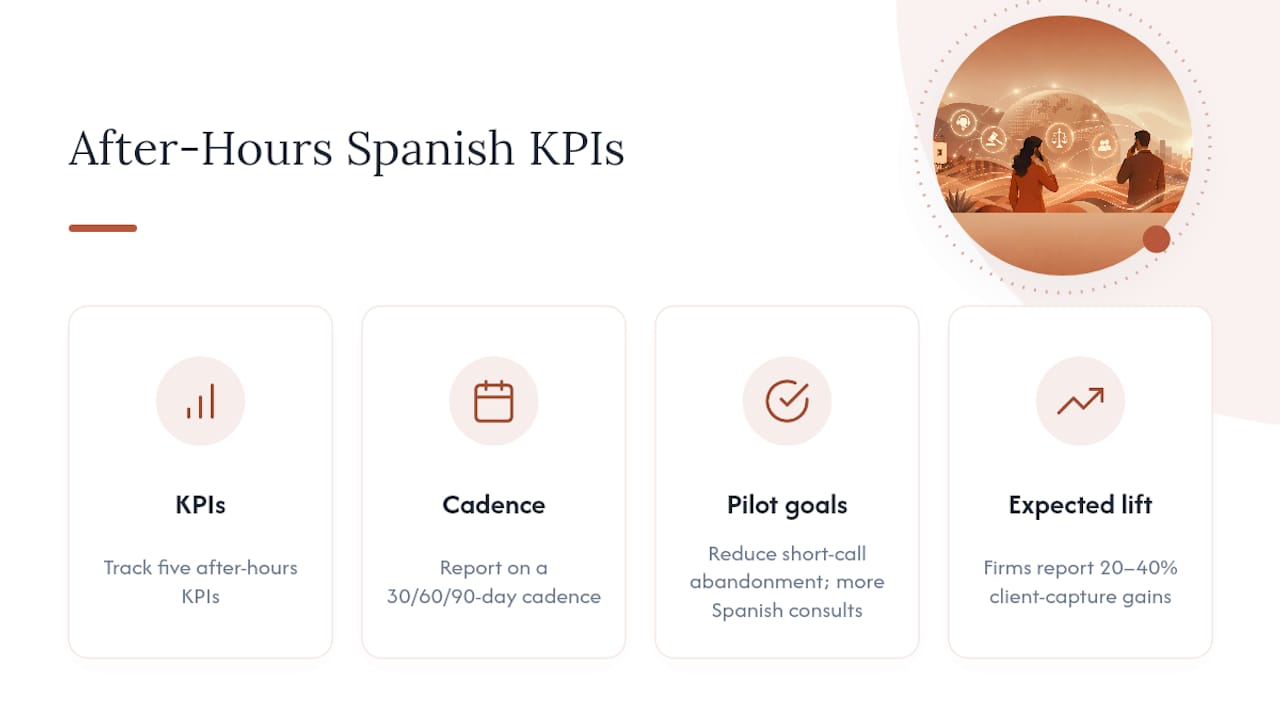
Report on a 30/60/90-day cadence. For a pilot, set success thresholds around reduced short-call abandonment, more Spanish-language consults booked, and a measurable lift in after-hours conversion, since firms report client-capture gains in the 20 to 40 percent range once bilingual intake runs consistently.
Decide Now: A Three-Question Pilot Checklist
Ask yourself: Do you lose Spanish calls after hours today? Would one lost case a month justify fixing this? Can you commit to a 30 to 90-day pilot?
If you answered yes twice, run the pilot. Measure short-call reduction and scheduled consults, then loop in operations, marketing, and your on-call attorneys.
Why I Prioritize After-Hours Spanish Intake
Every bilingual intake project I’ve worked on starts with the same discovery: firms are losing calls they never even see in their reports. One immigration practice found a detained client’s family had called three times overnight before finally reaching someone who understood them. A tool like Diazluna exists precisely to close that gap before it costs a firm the case.
The Bilingual Front Desk Built for After-Hours Spanish Intake
Everything covered in the checklist above, the 24/7 coverage requirement, CRM integration, secure data handling, and clear escalation rules, maps directly onto how Diazluna’s bilingual digital front desk is built.
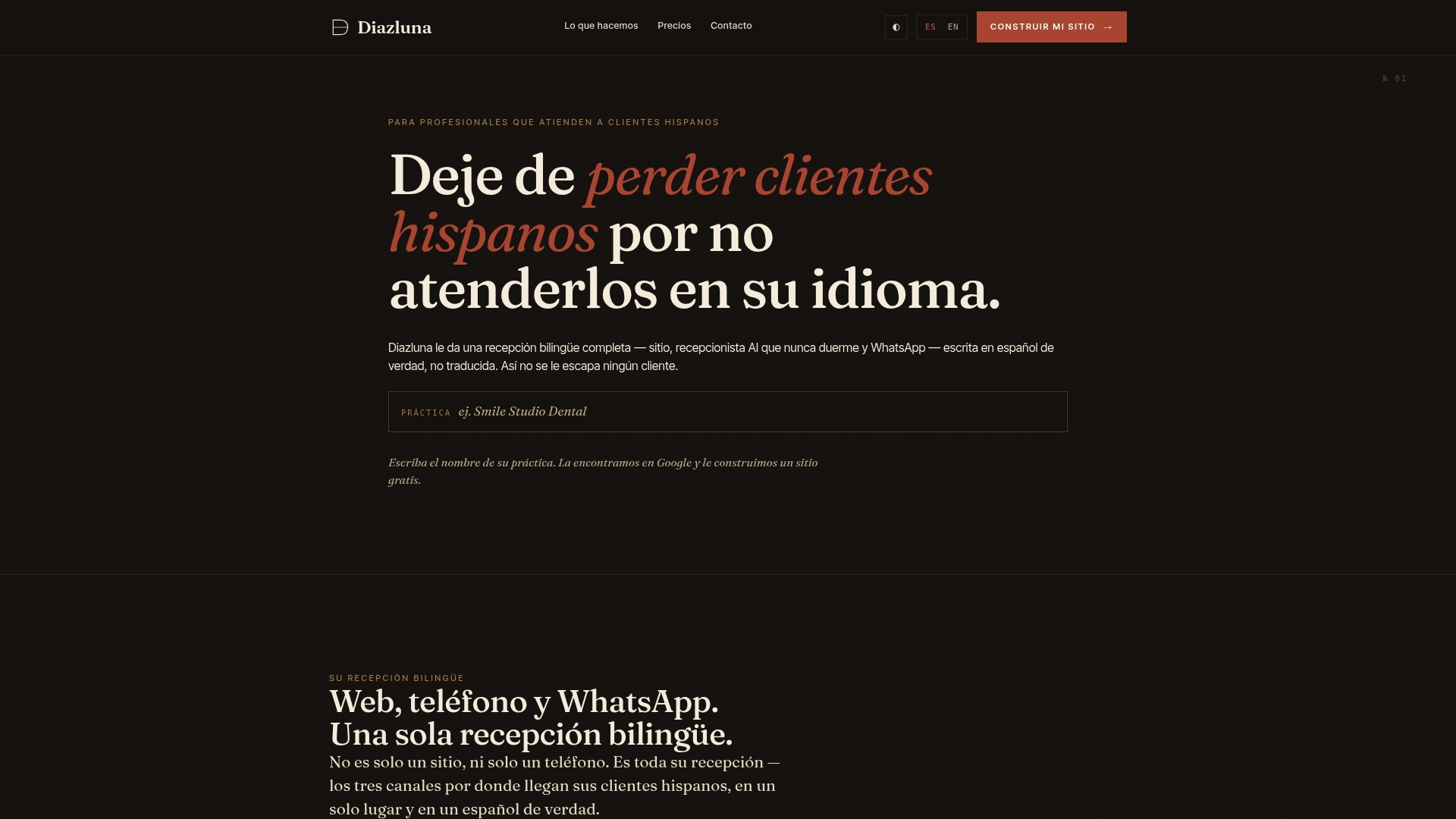
Instead of stitching together a separate answering service, a language line, and a website vendor, Diazluna combines a fully bilingual website, a 24/7 AI receptionist fluent in Spanish and English, and WhatsApp integration in one subscription. Calls and messages get triaged automatically, urgent matters escalate to your on-call attorney, and intake notes log where your team already works. Firms using the platform have reported faster Google indexing and fewer lost Hispanic clients within days of setup.
If you’ve been running the numbers on lost after-hours calls, start a pilot with Diazluna’s bilingual front desk for attorneys and track your live-answer rate for 30 days before deciding anything long term.
Sources
- Why Bilingual Answering Is No Longer Optional for Law Firms in 2026
- Bilingual Answering Service for Law Firms: Why Spanish Intake Wins More Cases | KaiCalls Blog
- UN Principles and Guidelines on Access to Legal Aid in Criminal Justice Systems (2012)