July 20, 2026
Why After-Hours Spanish Support Matters for Your Practice

After-hours Spanish support is defined as bilingual client assistance delivered outside standard business hours, ensuring Spanish-speaking clients receive timely, accurate, and culturally aware help when they need it most. This is not a nice-to-have feature for service professionals. It is a direct driver of client retention, operational efficiency, and revenue protection. 76% of online consumers prefer customer care in their native language, and 40% actively avoid brands that do not offer it. That single statistic explains why after-hours Spanish support matters more than most professionals realize.
Why after-hours Spanish support matters for client retention
Client loyalty is built or broken in the moments when something goes wrong. Those moments rarely happen between 9 AM and 5 PM.
70% of clients feel higher loyalty to companies that offer native language support. That loyalty gap is not abstract. It shows up in appointment cancellations, referrals that never happen, and clients who quietly switch to a provider who answered their call at 8 PM on a Tuesday. The benefits of after-hours assistance are clearest when you consider what a Spanish-speaking client experiences without it: a voicemail in English, a callback that may never come, and a feeling that the practice does not really serve them.

Increasing client retention by just 5% can boost profits by 25%–95%. That range is wide, but the direction is consistent. Retention is one of the highest-leverage activities in any service business, and language access is one of the most direct paths to it.
The importance of Spanish support also extends to first impressions. A Spanish-speaking client who calls after hours and reaches a bilingual receptionist immediately signals that the practice values them. That signal is stronger than any marketing message.
“Language is a gateway to cultural understanding, enabling empathy in customer service. This is especially true during emotionally charged after-hours calls, when clients are often anxious, confused, or in pain.”
- Reduced anxiety: Clients who communicate in their native language report lower stress during support interactions, which leads to more accurate information exchange.
- Higher first-contact resolution: Bilingual agents resolve issues faster because they understand the client’s full context, not just a translated version of it.
- Stronger referral behavior: Satisfied Spanish-speaking clients refer within their communities at high rates. One resolved after-hours call can generate multiple new clients.
- Lower churn risk: 74% of clients are likely to leave after a poor service experience. After-hours language gaps create exactly that kind of experience.
What happens when after-hours bilingual support is missing?
The operational cost of missing after-hours Spanish calls is concrete and measurable. It does not stay contained to the evening. It compounds.
Voicemail and auto-attendants during after hours fail to comply with service level agreements and create poor client experiences that directly increase churn risk. A Spanish-speaking client who hits an English-only voicemail at 7 PM does not call back in the morning with the same goodwill. They often do not call back at all.
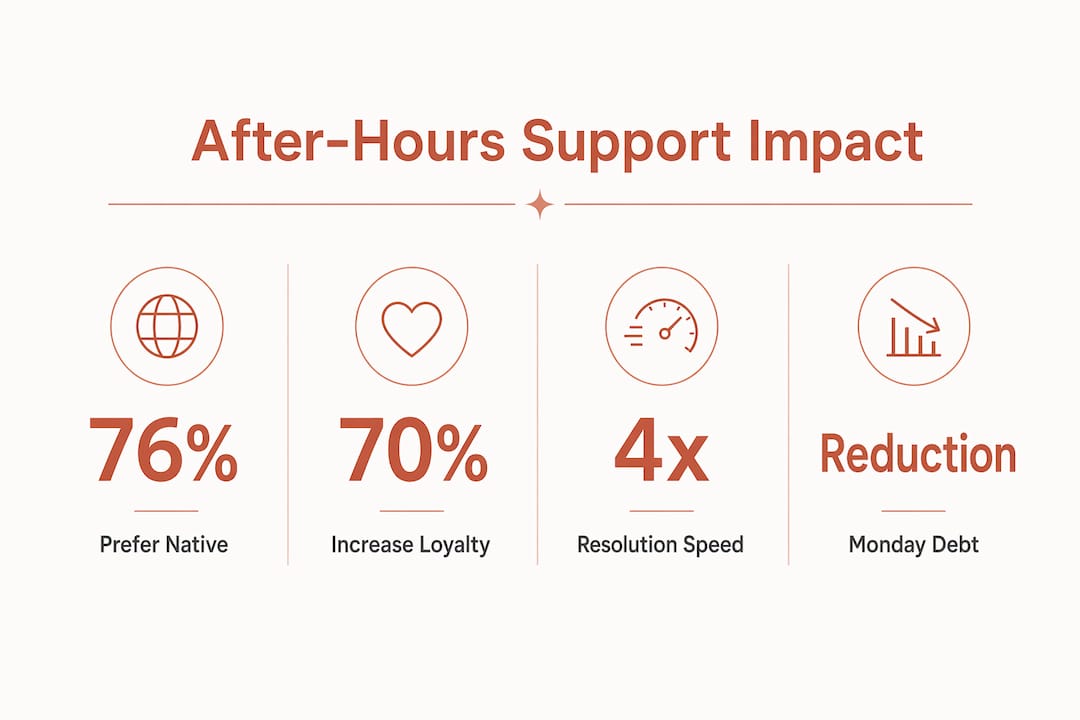
The concept of “Monday morning debt” describes what accumulates when after-hours calls go unresolved. By monday morning, a practice faces a backlog of unanswered messages, unresolved issues, and frustrated clients who have had hours to reconsider their loyalty. Without structured after-hours coverage, businesses accumulate a backlog that lowers client satisfaction and delays resolutions, and this effect falls disproportionately on bilingual service calls.
Here is what that operational failure looks like in practice:
- Missed call, no resolution. A Spanish-speaking client calls with an urgent question. No bilingual agent is available. The client leaves no voicemail or leaves one in Spanish that no one can action.
- Backlog builds overnight. By morning, three similar calls have stacked up. Each requires individual follow-up, pulling staff away from scheduled work.
- SLA breach. Response time commitments are missed. In legal and healthcare settings, this carries compliance risk beyond client dissatisfaction.
- Client churns silently. The client does not complain. They simply book with a practice that answered.
| Operational gap | Direct consequence | Downstream effect |
|---|---|---|
| No bilingual after-hours agent | Unanswered or mishandled calls | Client churn and lost referrals |
| English-only voicemail | Zero first-contact resolution | Monday morning backlog |
| No CRM logging after hours | Lost context for follow-up | Repeated client frustration |
| No escalation protocol | Urgent issues go unresolved | SLA breaches and compliance risk |
Pro Tip: Set a bilingual CRM note standard for every after-hours call. Even a brief structured note in both English and Spanish cuts follow-up time significantly and gives the morning team full context before they dial.
How does cultural nuance improve issue resolution?
Translation and bilingual support are not the same thing. This distinction is where most practices get it wrong.
Multilingual human agents provide empathy and cultural nuance that automated translations cannot replicate. A machine translation tool converts words. A native-speaking agent understands what the client actually means, including the hesitation, the urgency, and the cultural context behind how they phrase a concern. In dentistry, law, and healthcare, that difference directly affects the quality of care and advice a client receives.
Consider a legal client calling after hours about an immigration matter. The words they use may be technically translatable, but the emotional weight, the specific regional phrasing, and the underlying concern require a trained bilingual agent to interpret correctly. A mistranslated urgency level can mean the difference between a resolved issue and a missed deadline.
- Automated translation tools handle straightforward, low-stakes queries reasonably well. They fail on nuanced, emotional, or complex service interactions.
- Bilingual FAQ systems reduce call volume for common questions but cannot adapt to unexpected client needs or emotional states.
- Native-speaking bilingual agents read tone, adjust communication style, and build trust in a single call. That trust is the foundation of client retention.
Effective after-hours Spanish support requires authentic service by native speakers trained in cultural nuance and service empathy. This minimizes misunderstood issues and builds the kind of trust that keeps clients loyal for years.
Pro Tip: When evaluating bilingual support options, ask specifically whether agents are native Spanish speakers or trained translators. The difference in client satisfaction is significant, particularly for healthcare and legal calls.
What practical strategies improve after-hours Spanish coverage?
Implementing bilingual after-hours support does not require rebuilding your entire operation. It requires a structured approach with the right components in place.
After-hours answering services reduce Monday morning backlogs by triaging issues and logging structured notes into a CRM, which directly improves first-contact resolution. That triage function is the core of any effective after-hours system. Without it, calls become noise. With it, they become data that improves every subsequent client interaction.
Triage and escalation logic is the starting point. Not every after-hours call carries the same urgency. A dental emergency requires a different response than a billing question. A structured triage protocol routes each call to the right outcome: immediate escalation, scheduled callback, or self-service resolution.
- Blended agent models combine a live bilingual receptionist for high-priority calls with an AI receptionist for routine inquiries. This keeps costs manageable while maintaining quality for complex interactions.
- CRM integration means every after-hours interaction is logged with structured notes before the morning shift begins. The client never has to repeat themselves.
- WhatsApp integration is particularly effective for Spanish-speaking clients. WhatsApp is the dominant messaging platform in Latin American communities, and offering it as an after-hours channel removes friction immediately.
- Phased rollouts let practices test after-hours coverage on their highest-volume days first, typically Thursday and Friday evenings, before expanding to full coverage.
Multilingual support impacts every stage from pre-sales to renewals. Partial language coverage creates gaps that heighten churn risk at every point in the client relationship. A phased rollout addresses this by closing the highest-risk gaps first.
The most effective model for most service practices combines a bilingual AI receptionist for after-hours intake with a clear escalation path to a live agent for urgent matters. Diazluna’s approach builds exactly this structure, pairing a 24/7 AI receptionist fluent in both Spanish and English with WhatsApp integration and a fully bilingual website. For professionals serving Hispanic clients, this means no lead is lost because the office was closed. You can read more about authentic bilingual service and what it actually requires in practice.
Key Takeaways
After-hours Spanish support is the single most direct way service professionals can protect client retention, reduce operational backlog, and build trust with Spanish-speaking clients.
| Point | Details |
|---|---|
| Language preference drives loyalty | 76% of clients prefer native language support; 40% avoid brands that do not offer it. |
| Retention has a direct profit link | A 5% increase in retention can raise profits by 25%–95%, making language access a financial priority. |
| Missing calls creates compounding costs | Unanswered after-hours calls build backlogs, breach SLAs, and accelerate client churn. |
| Translation is not bilingual support | Native-speaking agents provide cultural nuance and empathy that automated tools cannot replicate. |
| Triage and CRM logging are non-negotiable | Structured after-hours notes cut follow-up time and protect first-contact resolution rates. |
What I have seen working with bilingual service practices
The practices that struggle most with Spanish-speaking client retention share one pattern: they invested in Spanish marketing but not in Spanish service. They translated their website, ran Spanish-language ads, and then routed after-hours calls to an English-only voicemail. The disconnect is jarring for clients, and it is invisible to the practice until the numbers start to slip.
The practices that get it right treat bilingual support as an operational standard, not a marketing feature. They staff for it, log for it, and build escalation protocols around it. The results are not subtle. Client retention improves, referral rates climb, and Monday mornings become manageable instead of chaotic.
The hardest part is not the technology. It is the mindset shift from “we have a Spanish option” to “we serve Spanish-speaking clients completely.” That shift requires covering the hours when clients actually need help, which are often the hours when the office is closed. A dental client with a toothache at 9 PM does not wait until morning. A legal client with an urgent question on a Friday evening does not wait until Monday. The practices that answer those calls build relationships that last years. The ones that do not lose clients they never knew they had.
For professionals who want to go deeper on the operational side, the after-hours Spanish legal receptionist guide covers the specific protocols that protect firm profitability after hours.
— Francisco
How Diazluna supports bilingual after-hours client engagement
Diazluna was built specifically for service professionals who serve Hispanic clients and cannot afford to lose them to language gaps after hours.
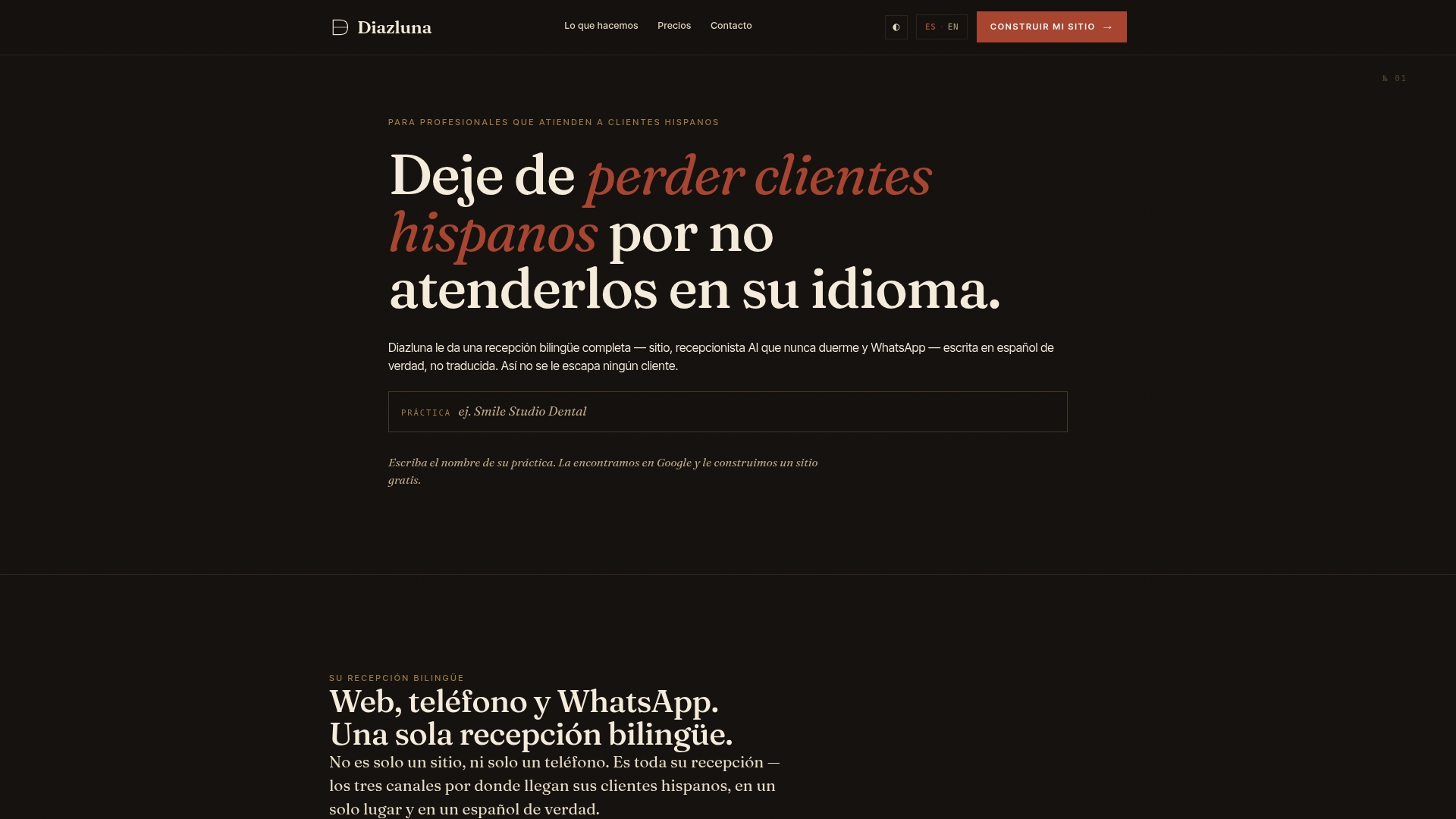
Diazluna’s core offering combines a fully bilingual website, a 24/7 AI receptionist fluent in Spanish and English, and WhatsApp integration. All three work together so that a Spanish-speaking client who calls, texts, or searches after hours reaches a system that understands them and responds correctly. For dental practices, the bilingual front desk solution is built around the specific communication needs of Hispanic-serving practices, from appointment intake to urgent care triage. Diazluna delivers this at a fraction of the cost of traditional agencies, and clients report a significant decrease in missed leads from the first month.
FAQ
Why does after-hours Spanish support matter for small practices?
Small practices lose the most from missed after-hours calls because each client represents a larger share of revenue. Bilingual after-hours coverage prevents client loss during the hours when Spanish-speaking clients are most likely to call.
What is the difference between bilingual support and translation tools?
Bilingual support uses native-speaking agents who understand cultural context and emotional nuance. Translation tools convert words but miss the tone, urgency, and cultural meaning that drive accurate issue resolution.
How does after-hours Spanish support affect customer satisfaction?
Service industries that cover after-hours bilingual support reduce client frustration, improve issue resolution, and build stronger relationships. Client satisfaction with Spanish services rises when clients feel heard in their own language.
What is “Monday morning debt” in bilingual support?
Monday morning debt is the backlog of unresolved after-hours calls that accumulates over a weekend. Without structured bilingual triage and CRM logging, this backlog delays resolutions and lowers first-contact resolution rates for the entire week.
Can an AI receptionist replace a human bilingual agent after hours?
An AI receptionist handles routine intake, appointment scheduling, and FAQ responses effectively after hours. For urgent or complex calls, a clear escalation path to a live bilingual agent is still required to protect client satisfaction and SLA compliance.