July 19, 2026
Why Bilingual Support Beats Traditional Agencies

Bilingual support is defined as delivering native-level language fluency and cultural competency to clients in their preferred language, not simply translating words from one language to another. For dentists, lawyers, and healthcare providers serving Hispanic clients, this distinction determines whether a client books an appointment or calls someone else. Businesses offering fluent bilingual service see customer satisfaction scores rise by up to 25% and avoid losing over $12,000 annually to language barriers. That figure alone explains why bilingual support beats traditional agencies on every metric that matters to a professional practice.
Why bilingual support beats traditional agencies for Hispanic client retention
Language barriers cause a specific kind of client loss that never shows up in your data. When a Spanish-speaking patient calls a dental office and no one can help them clearly, they hang up and call the next practice on the list. That loss gets recorded as a missed call, not a language failure. Invisible churn driven by language is one of the most underreported revenue problems in professional services. Cancellation forms and intake surveys rarely include “language barrier” as an option, so the real cause stays hidden.
Bilingual support fixes this by making the first contact feel safe and familiar. For Hispanic clients seeking legal advice or a healthcare provider, speaking with someone in Spanish is not a convenience. It is a trust signal. A client who feels understood in their native language is far more likely to complete intake, return for follow-up appointments, and refer family members. Native language support increases referral likelihood within Hispanic communities because trust travels through word of mouth in same-language networks.
The revenue case is equally clear. Bilingual service implementations report a 15–35% increase in bookings and a 21:1 return on investment. That is not a marginal gain. For a dental practice or law firm adding even a handful of new Hispanic clients per month, the compounding effect on annual revenue is significant. Bilingual support shifts from being a cost center to a direct revenue driver, and the math supports treating it as infrastructure rather than an optional add-on.
- Client trust: Clients in sensitive fields like healthcare and law require emotional safety before they share personal information. Native-language communication provides that safety.
- Referral amplification: Satisfied Spanish-speaking clients refer within tight community networks, multiplying the value of each retained client.
- Retention over acquisition: Keeping an existing client costs far less than acquiring a new one. Bilingual support reduces the friction that causes early dropout.
How traditional agencies fall short in bilingual client communication
Traditional agencies approach bilingual service as a translation problem. They take content or scripts written in English and convert them into Spanish. The result is technically accurate but culturally flat. A translated intake script sounds like a translated intake script. It lacks the rhythm, idiom, and warmth that Spanish-speaking clients recognize as genuine. Translation-first outsourcing consistently fails to build the trust needed for lasting client relationships in professional services.

The structural problems run deeper than tone. Traditional agencies bill by headcount and operate in siloed workflows. A marketing team, a phone support team, and a web team each handle their piece without sharing terminology or brand voice guidelines. The result is a client who hears one version of your practice’s name and services on the phone and reads something different on your website. That inconsistency erodes credibility, especially with clients who are already navigating an unfamiliar system in a second language.
AI-native bilingual teams increase output 10–30 times and lower overhead costs compared to siloed traditional agency models. That gap in efficiency means a traditional agency charges more and delivers less consistency. For a dental practice or law firm on a fixed budget, that trade-off is hard to justify when specialized bilingual support exists at a fraction of the cost.
Pro Tip: Before signing with any agency for bilingual support, ask them to demonstrate a live call or chat interaction in Spanish. Generic translation quality becomes obvious within 60 seconds of a real conversation.
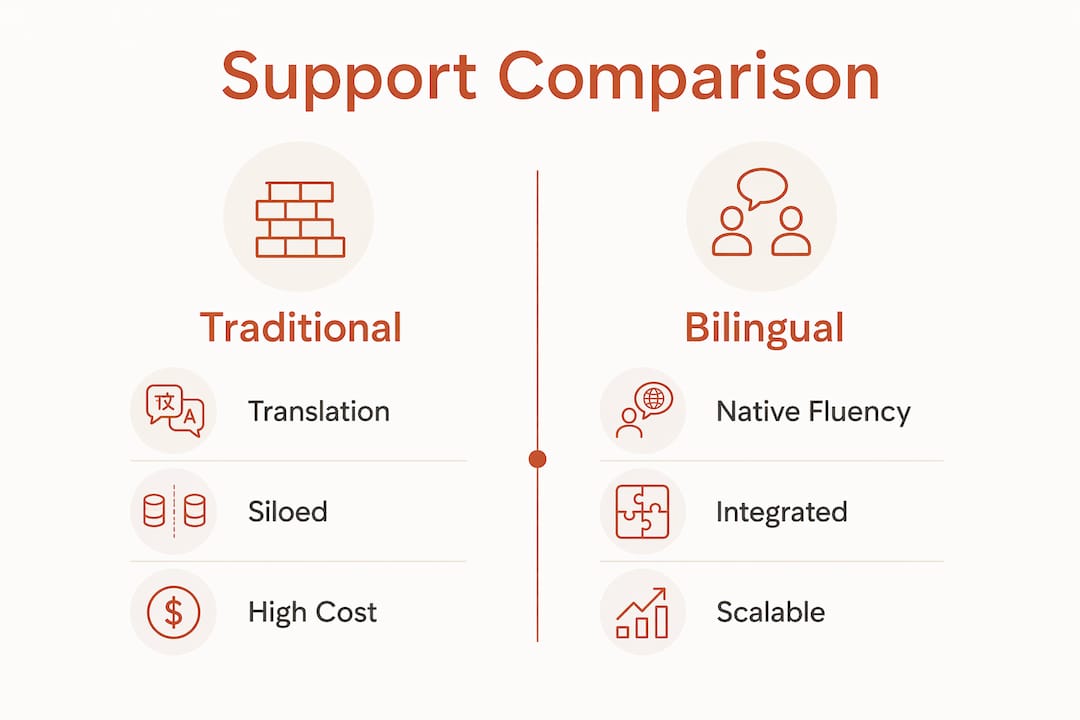
The continuity problem also matters. Traditional agencies rotate staff. A new agent handling your Spanish-speaking clients does not know your intake process, your fee structure, or the specific terminology your practice uses. Every rotation resets the relationship. Specialized bilingual teams that operate as long-term partners retain institutional knowledge and maintain brand voice consistency across every client interaction.
How AI makes bilingual support scalable and affordable
A hybrid model is the current standard for high-quality bilingual support. AI handles tier-one queries, appointment confirmations, and basic intake questions around the clock. Native-speaking human agents handle complex cases, sensitive conversations, and escalations. This structure outperforms both pure-human teams and generic translation models in cost and client satisfaction. It also solves the 24/7 accessibility problem that no human-only team can solve affordably.
The critical distinction is what the AI is trained on. Generic machine translation tools pull from broad public data and produce output that sounds robotic and impersonal. AI trained on your practice’s actual content, including your service descriptions, your intake questions, and your brand voice, produces responses that sound like your practice. That difference is audible to Spanish-speaking clients who have experienced both.
- Audit your current contact points. Identify every place a Spanish-speaking client might reach your practice: phone, website chat, WhatsApp, and email.
- Map tier-one queries. List the 10 most common questions your front desk answers. These are the first candidates for AI handling in both English and Spanish.
- Train on your content. Any AI tool you deploy must be trained on your specific terminology, not generic healthcare or legal language.
- Set escalation rules. Define exactly when a conversation moves from AI to a human agent. Sensitive topics like billing disputes or medical history always require a human.
- Measure and adjust. Track resolution rates and client satisfaction scores separately for Spanish and English interactions to identify gaps.
Pro Tip: WhatsApp is the preferred communication channel for many Hispanic clients. Any bilingual support setup that excludes WhatsApp is missing the channel where your clients are most comfortable.
AI-powered bilingual support enables consistent service quality at scale by learning from real company content rather than generic datasets. For a solo dental practice or a small law firm, this means enterprise-level bilingual accessibility without enterprise-level staffing costs.
Practical steps for dentists, lawyers, and healthcare providers
Effective bilingual support in professional services requires more than hiring a Spanish speaker for the front desk. It requires a system with defined processes, quality checkpoints, and the flexibility to grow with your client base. The advantages of bilingual services compound over time only when the underlying structure is sound.
Start with data. Look at your intake forms, your missed call logs, and your appointment no-show rates. If a disproportionate share of no-shows or missed calls comes from Spanish-speaking clients, you have a language gap. That data tells you where to invest first, whether that is phone support, website content, or follow-up communication.
Quality management in multilingual support requires standardized onboarding, shared escalation protocols, and aligned performance metrics across language teams. Without these, quality diverges between your English and Spanish client experiences. That divergence is exactly what traditional agencies allow to happen because their teams operate in separate silos.
- Dedicated bilingual intake: Assign a specific phone line or WhatsApp number for Spanish-speaking clients so they reach someone fluent from the first contact.
- Shared terminology guide: Create a one-page glossary of your practice’s key terms in both English and Spanish. Every team member and any AI tool you use should follow it.
- Bilingual follow-up protocols: Appointment reminders, post-visit instructions, and billing communications should all be available in Spanish. Clients who receive follow-up in their language show higher compliance and return rates.
- Performance tracking by language: Measure client satisfaction, appointment completion, and referral rates separately for Spanish-speaking clients. This reveals whether your bilingual support is actually working.
Outsourced bilingual support gives small practices the flexibility to scale without hiring full-time staff. A bilingual virtual receptionist can handle overflow calls, after-hours inquiries, and WhatsApp messages without the overhead of a full-time employee. That flexibility is one of the clearest advantages of bilingual services for independent practices.
Key Takeaways
Bilingual support beats traditional agencies because it delivers native fluency, cultural trust, and integrated technology that generic translation-first models cannot replicate.
| Point | Details |
|---|---|
| Language barriers cause hidden revenue loss | Practices lose clients and revenue to language gaps that never appear in standard reporting. |
| Native fluency builds referral networks | Spanish-speaking clients who feel understood refer family and friends within tight community networks. |
| Traditional agencies lack cultural depth | Translation-first approaches produce flat, impersonal communication that fails to build trust in legal and healthcare settings. |
| AI hybrid models reduce cost and expand access | AI handling tier-one queries with human escalation delivers 24/7 bilingual service at a fraction of traditional staffing costs. |
| Quality requires systems, not just speakers | Standardized onboarding, escalation protocols, and performance metrics keep bilingual service consistent as your practice grows. |
Bilingual support is infrastructure, not a line item
I have watched practices spend thousands on website redesigns and paid ads while their Spanish-speaking callers hit a wall at the front desk. The disconnect is striking. You can rank on the first page of Google for “dentist near me” in a heavily Hispanic zip code and still lose every Spanish-speaking caller who reaches your voicemail in English only.
The mistake I see most often is treating bilingual support as a staffing question rather than a systems question. Practices hire one bilingual receptionist and consider the problem solved. When that person is out sick, on vacation, or moves on, the gap reopens immediately. The clients who called during that window do not come back. They found someone else.
What actually works is building bilingual communication into every layer of client contact: the website, the phone system, the follow-up messages, and the intake process. When a Spanish-speaking client can find your practice online in Spanish, book through WhatsApp, and receive appointment reminders in their language, you have removed every friction point between them and your chair. That is the competitive advantage in growing Hispanic markets that most practices are still leaving on the table.
The practices I have seen grow fastest in Hispanic communities are not the ones with the biggest marketing budgets. They are the ones where a Spanish-speaking client can call at 9:00 PM on a Tuesday and reach someone who sounds like they belong to the same community. That is not a luxury. That is the baseline expectation, and authentic bilingual service is what delivers it.
— Francisco
How Diazluna delivers bilingual support for professional practices
Diazluna builds the bilingual front desk that dentists, lawyers, and healthcare providers need to serve Hispanic clients without losing a single contact to a language barrier.
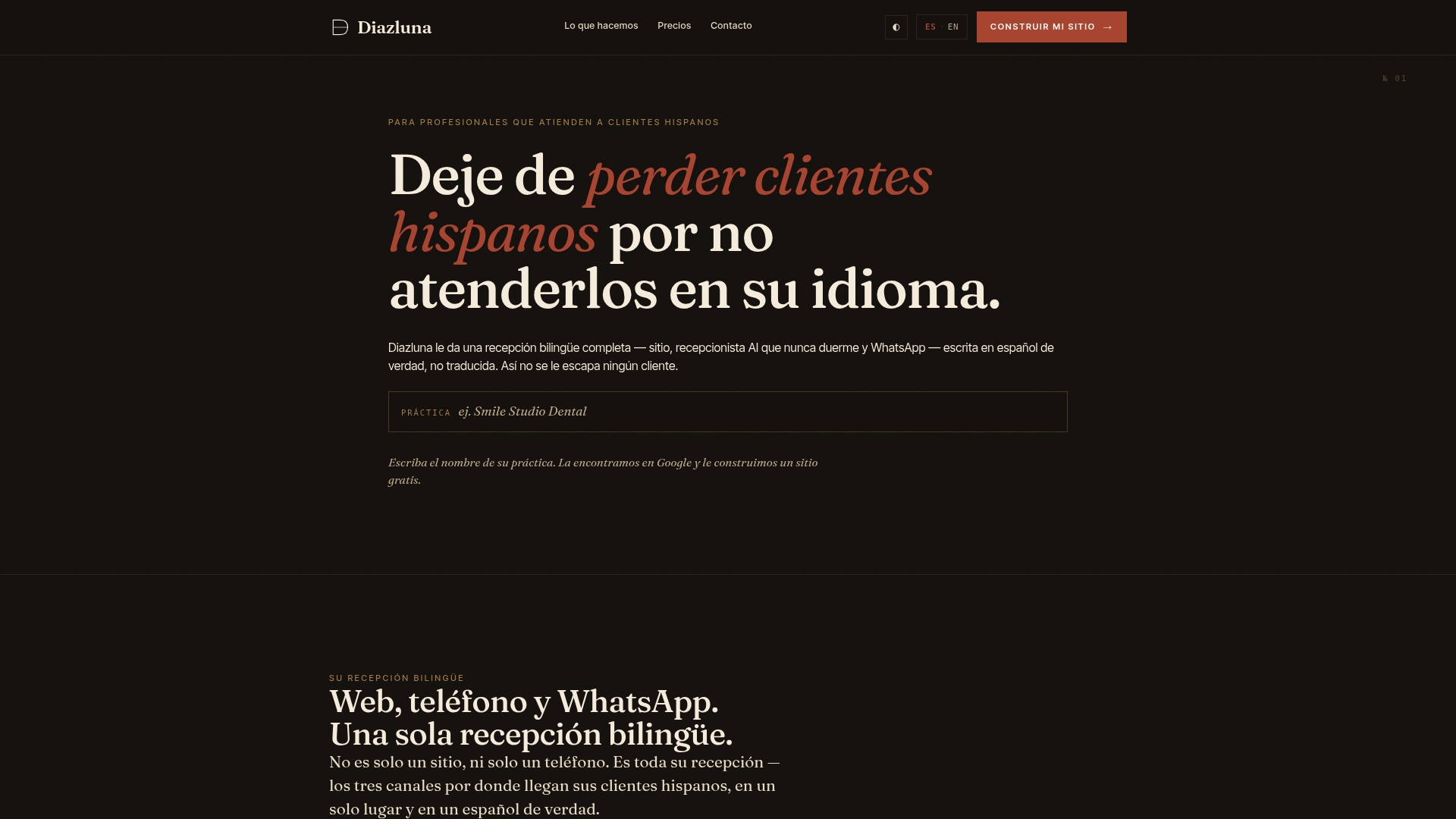
Diazluna combines a fully optimized bilingual website, a 24/7 AI receptionist fluent in both English and Spanish, and WhatsApp integration into one service. Each component is trained on your practice’s actual content, not generic scripts. The result is a client experience that sounds like your practice in both languages, available around the clock. Practices using Diazluna report a significant reduction in client loss and Google indexes their bilingual site within 24 hours of launch. For dental practices ready to stop losing Spanish-speaking patients, the bilingual front desk for dentists is the place to start. For a full overview of services across law, healthcare, and dentistry, visit Diazluna’s main page.
FAQ
What is bilingual support in professional services?
Bilingual support is the delivery of client communication in both English and Spanish by staff or systems with native fluency and cultural competency. It goes beyond translation to include tone, terminology, and cultural context appropriate for Hispanic clients.
Why does bilingual support outperform traditional agencies?
Traditional agencies use translation-first workflows that produce flat, impersonal communication. Specialized bilingual support embeds native fluency and brand voice consistency, which builds the trust that drives retention and referrals in Hispanic communities.
How does AI improve bilingual customer service?
A hybrid model using AI for tier-one queries and native-speaking agents for complex cases outperforms pure-human teams in both cost and client satisfaction. AI trained on your specific content delivers consistent, on-brand responses in Spanish around the clock.
What is the revenue impact of bilingual support?
Bilingual service implementations report a 15–35% increase in bookings and a 21:1 return on investment. Practices also avoid over $12,000 annually in revenue lost to language barriers.
How do I measure whether my bilingual support is working?
Track client satisfaction scores, appointment completion rates, and referral rates separately for Spanish-speaking clients. Aligned performance metrics across language groups reveal gaps that aggregate data hides.