July 31, 2026
Bilingual Healthcare Website Advantages for Hispanic

A bilingual healthcare website gives Spanish-preferring patients a trustworthy, language-concordant entry point — and it delivers measurable operational ROI within months, not years.
TL;DR:
- Language-concordant digital access improves patient trust, comprehension, and safety outcomes, per published research in the Journal of Immigrant and Minority Health
- Translated sites can double organic web traffic and reduce operator call time by more than 30% within three months
- Diazluna packages a bilingual website, AI receptionist, and WhatsApp integration into one front-desk solution, with Google indexing reported within 24 hours
Table of Contents
- What are the real bilingual healthcare website advantages for patient outcomes?
- Which operational metrics actually improve after launching Spanish-language pages?
- What features should you build or translate first?
- How do Spanish pages rank faster than their English equivalents?
- Why does translation quality determine patient safety and SEO performance?
- What does a realistic bilingual site pilot look like?
- What does the evidence actually show?
- What questions should you ask any bilingual website vendor?
- Key Takeaways
- Why the sequence matters more than the scope
- Diazluna gives your practice a complete bilingual front desk
- Useful sources
What are the real bilingual healthcare website advantages for patient outcomes?
Spanish-preferring patients report greater trust and more comprehensive care when they interact with language-concordant resources. That trust gap is not a soft metric. Research published in the Journal of Immigrant and Minority Health found that patients receiving care from Spanish-qualified providers reported greater trust and more thorough coverage of health issues compared with those relying on informal interpreters or ad-hoc strategies.
The clinical stakes are concrete. Language barriers in U.S. healthcare are linked to longer emergency department stays, higher readmission rates, increased medical errors, and lower patient satisfaction. A bilingual website does not replace a bilingual provider, but it removes the first friction point: a patient who can read their intake form, understand their appointment instructions, and find their provider’s services in Spanish arrives better prepared and more likely to follow through.
Statistic: A narrative review synthesizing 20 studies found that local-language service delivery consistently benefits patient compliance and satisfaction across health systems.
Beyond literal translation, health literacy matters. Plain-language Spanish copy, culturally relevant imagery, and familiar microcopy (“¿Tiene preguntas? Llámenos”) signal to patients that the practice understands them. Most consumers engage more on sites in their native language — in healthcare, that engagement translates directly into appointment completions and preventive-care uptake.
Which operational metrics actually improve after launching Spanish-language pages?
The gains show up fast and in places finance teams notice. A translated site nearly doubled web traffic and reduced operator call time by more than 30% within three months in a documented case. Fewer Spanish-speaking patients calling to clarify what the website should have explained means shorter queues, lower per-call costs, and staff time redirected to clinical work.

Track these KPIs from day one:
| KPI | What it tells you |
|---|---|
| Organic Spanish-language traffic | Whether Spanish pages are being found |
| Appointment conversion rate (Spanish sessions) | Whether visitors are booking |
| Average operator call time | Whether self-service content is working |
| Interpreter spend | Whether on-demand interpretation costs are falling |
| 30-day patient retention | Whether new Spanish-speaking patients return |
| Preventive-care appointment rate | Whether health literacy content drives action |
Language access also correlates with improved preventive-care use and reduced interpreter costs when implemented strategically. A simple ROI frame: if a practice spends $3,000 on bilingual page translation and reduces monthly interpreter spend by $800 while adding four new Spanish-speaking patients per month, payback arrives in under six months. The commercial and operational case for bilingual sites is well-documented for practices of any size.
What features should you build or translate first?
Translate transactional and clinical flows before anything else. A Spanish homepage with an English intake form is a broken experience that costs you the patient at the moment of highest intent.
Priority feature checklist:
- Fully translated homepage, service pages, and provider bios
- Bilingual intake forms and consent documents
- Appointment booking in Spanish (labels, confirmation emails, reminders)
- WhatsApp or chat in Spanish for real-time questions
- Spanish-language meta titles, descriptions, and CTAs (not just body copy)
- Hreflang tags and localized schema markup
- Bilingual FAQs covering insurance, hours, and first-visit expectations
- Culturally relevant imagery and plain-language health education content
Pro Tip: Sequence translations by risk and conversion value: consent forms and intake first, then appointment booking, then patient education. Translating a blog post before the intake form is a common and costly mistake.
How do Spanish pages rank faster than their English equivalents?
Spanish-language SERPs in many U.S. metros are less competitive than their English counterparts. Practices that implement full multilingual SEO — human translation, hreflang, and a localized Google Business Profile — can rank for Spanish queries in months rather than the year-plus typical for equivalent English keywords.
Technical checklist:
- Use a subdirectory structure (
/es/) rather than a subdomain for SEO consolidation - Translate all metadata: page titles, meta descriptions, image alt text, schema
- Implement
hreflang="es"orhreflang="es-US"with self-referencing tags on every page - Add Spanish-language schema (LocalBusiness, MedicalClinic, FAQPage)
- Optimize your Google Business Profile with Spanish-language descriptions and encourage bilingual reviews
Quick technical audit (run this before launch):
- Crawl the site with Screaming Frog or Sitebulb and flag pages missing hreflang
- Check Google Search Console for Spanish-query impressions and click-through rates
- Verify schema with Google’s Rich Results Test on Spanish URLs
- Confirm GBP categories and service descriptions appear in Spanish
- Test all Spanish CTAs and form submissions end-to-end
Auto-translate plugins are a liability. Google can detect machine-only output, and the clinical accuracy risks are real. Human-reviewed translation with MTPE (machine translation post-editing) is the floor, not the ceiling.
Why does translation quality determine patient safety and SEO performance?
Machine-only translation fails on two fronts simultaneously: it introduces clinical errors that can harm patients, and it produces content Google may treat as low-quality. Both outcomes are avoidable with the right workflow.
Quality-control steps:
- Use certified medical translators for consent forms, discharge instructions, and clinical FAQs
- Apply MTPE workflows for scalable content like blog posts and service descriptions
- Require bilingual clinical review before publishing any patient-facing health information
- Maintain version control for consent forms so Spanish and English copies stay synchronized
- Audit translated content quarterly for terminology drift
Pro Tip: Assign one bilingual staff member as the content governance owner. Even a 30-minute monthly review catches the terminology inconsistencies that erode patient trust over time.
Federal language-access obligations under Title VI of the Civil Rights Act and CMS guidance require covered entities to provide meaningful access for patients with limited English proficiency. Confirm your specific obligations with qualified legal counsel — requirements vary by funding source and practice type.
What does a realistic bilingual site pilot look like?
A 3–6 month pilot focused on priority pages delivers measurable traffic results within weeks and retention data within months.
| Phase | Timeline | Key actions | Metrics to check |
|---|---|---|---|
| Discovery | Weeks 1–4 | Audit existing content, set baselines, identify priority pages | Baseline traffic, call volume, interpreter spend |
| Implementation | Months 1–3 | Translate priority pages, launch hreflang, update GBP | Spanish impressions in Search Console, form completions |
| Monitoring | Months 3–6 | Weekly KPI review, fix indexing issues, add content | Organic Spanish traffic, appointment conversion |
| Scale | Months 6–12 | Expand to patient education, FAQs, seasonal content | Retention rate, preventive-care uptake, interpreter cost delta |
30-day quick-start steps for a small practice:
- Identify your five highest-traffic pages and translate them with a certified medical translator
- Set up GA4 language-aware events to segment Spanish-session behavior
- Add hreflang tags and submit Spanish URLs to Google Search Console
- Update your Google Business Profile with Spanish descriptions and services
- Add a WhatsApp contact option with a Spanish greeting to the homepage
What does the evidence actually show?
Language access consistently improves both clinical and operational outcomes. The NCBI StatPearls review documents that patients with language barriers face more medical errors, longer ED stays, and lower satisfaction — and that appropriate language access reduces these risks. A 20-study narrative review found local-language service delivery improves compliance and satisfaction across health systems.
On the operational side, the Argos case example shows website translation doubling traffic and cutting operator call time by more than 30% within three months. Translating transactional workflows — intake, consent, booking — produces the largest share of those gains.
Diazluna outcomes (publisher-reported): Practices using Diazluna’s bilingual front-desk package have reported a significant decrease in client loss attributable to language barriers, and new sites have been indexed by Google within 24 hours of launch. These results align with the broader pattern: fast indexing comes from clean technical implementation, and client retention improves when every touchpoint, from the first Google search to the intake form, is in the patient’s language. For practices exploring bilingual content and loyalty, the connection between language access and long-term patient relationships is well-supported.
What questions should you ask any bilingual website vendor?
The right vendor demonstrates healthcare translation experience, security practices, and measurable SEO capability — not just a portfolio of translated pages.
12 questions to ask:
- Do your translators hold medical translation certification (ATA, NAATI, or equivalent)?
- What is your MTPE workflow, and who performs bilingual clinical review?
- How do you handle HIPAA compliance for any patient data that passes through your systems?
- Can you implement hreflang, localized schema, and GBP optimization?
- What analytics setup do you provide, and which KPIs do you track?
- What is your SLA for updating translated content after clinical or regulatory changes?
- Do you support WhatsApp, phone, and chat in Spanish?
- Can you provide references from healthcare clients with measurable outcomes?
- How do you handle version control for consent forms and intake documents?
- What is your process for cultural review beyond literal translation?
- Do you offer a pilot scope with defined deliverables before a full engagement?
- How do you handle indexing and Search Console verification for Spanish URLs?
Red flags: reliance on free auto-translate plugins, no healthcare-specific references, no analytics or tracking plan, and no bilingual QA process. A vendor who cannot describe their MTPE workflow is not ready for clinical content. For more on evaluating bilingual support options versus general agencies, the distinction in healthcare experience matters more than price.
Understanding patient engagement technology is also worth your time before scoping a vendor — it helps you ask sharper questions about integration and measurement.
Key Takeaways
A bilingual healthcare website reduces patient loss, improves clinical safety, and delivers measurable operational ROI — provided translation covers transactional flows first and technical SEO is implemented correctly.
| Point | Details |
|---|---|
| Patient trust and safety | Language-concordant digital access reduces errors, improves comprehension, and raises satisfaction for Spanish-preferring patients. |
| Operational ROI | Translated sites can double traffic and cut operator call time by more than 30% within three months. |
| Translate transactions first | Intake forms, consent documents, and appointment booking deliver more ROI than translating marketing copy alone. |
| Technical SEO matters | Hreflang, localized schema, and a Spanish GBP profile are required for Spanish pages to rank and be indexed quickly. |
| Diazluna | Diazluna’s bilingual front-desk package (website, AI receptionist, WhatsApp) reduces client loss and achieves Google indexing within 24 hours. |
Why the sequence matters more than the scope
Most practices I see approach bilingual websites the same way they approach a site redesign: translate everything at once, launch, and wait. That approach buries the highest-value work under months of content production. The research is clear that transactional flows — consent, intake, booking — drive the largest share of operational gains. A practice that translates its blog archive before its intake form has its priorities exactly backwards.
The other thing practitioners underestimate is the trust signal that language concordance sends before a patient ever walks through the door. The Journal of Immigrant and Minority Health study found that Spanish-preferring patients reported greater trust with language-qualified providers — but that trust begins at the first digital touchpoint, not the exam room. A Spanish-language website that loads fast, reads clearly, and lets a patient book an appointment without switching to English is doing clinical work before the visit starts.
Measurement is where most pilots stall. Track interpreter spend and operator call time from week one. Those numbers move quickly and make the ROI case to any skeptical administrator faster than a patient satisfaction survey ever will.
Diazluna gives your practice a complete bilingual front desk
No Spanish-speaking patient should reach your homepage and leave because the experience felt foreign. Diazluna delivers a fully optimized bilingual website, a 24/7 AI receptionist fluent in both English and Spanish, and WhatsApp integration — all three, at a fraction of what a traditional agency charges for any one of them.
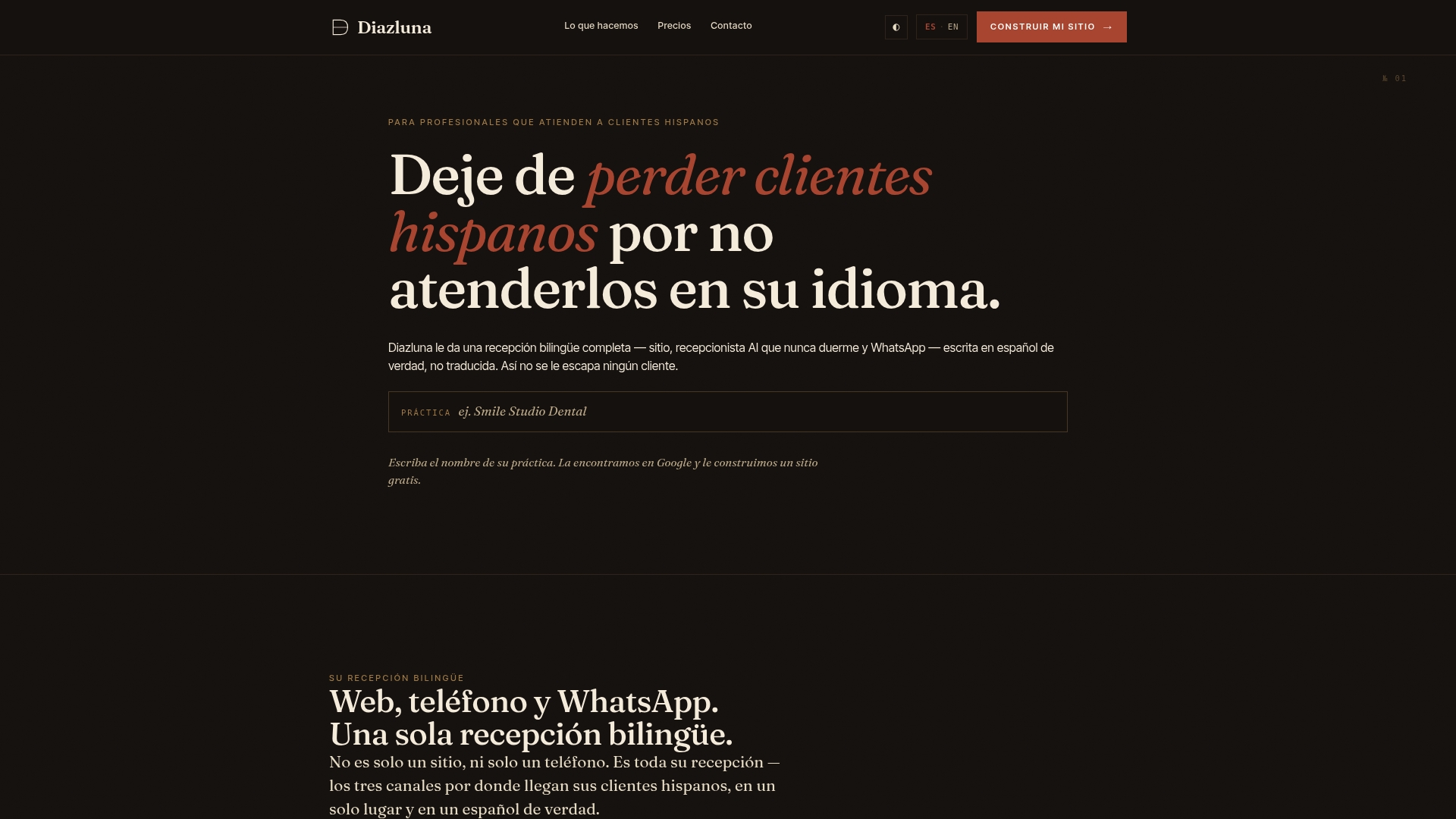
Dental and primary care practices serving Hispanic patients use Diazluna to stop losing patients at the first digital touchpoint. Google indexes new sites within 24 hours, and the AI receptionist handles inquiries around the clock so your front desk staff focuses on patients in the room. If your practice is ready to convert Spanish-speaking searchers into booked appointments, see how Diazluna works and request a walkthrough today.
Useful sources
- Language Barrier — StatPearls, NCBI Bookshelf: Peer-reviewed clinical overview of how language barriers increase medical errors, ED stays, and readmissions in U.S. healthcare.
- Language Concordance and Interpreter Use in Primary Care — Journal of Immigrant and Minority Health: Focus-group study with 62 Spanish-preferring patients documenting trust, comprehension, and care quality differences by language strategy.
- The Role of Local Languages in Effective Health Service Delivery — Springer: Narrative review of 20 studies linking local-language service delivery to improved compliance and satisfaction.
- How Language Access Pays Off — Argos Multilingual: Industry case evidence showing traffic doubling and operator call-time reduction exceeding 30% after website translation.
- Multilingual SEO for Healthcare — Pinnacle Pursuit SEO: Practical guidance on hreflang, GBP localization, and why Spanish queries rank faster in many U.S. metros.
- Healthcare Website Translation — BeTranslated: Covers metadata translation, schema, and consumer engagement data supporting full-page localization.
Review CMS language-access guidance and the National CLAS Standards directly for your practice’s specific obligations under federal law.