August 11, 2026
Spanish Phone Scripts Every Dental Office Needs
Here are the copy/paste dental office Spanish phone scripts your front desk can use starting today, with English translations and pronunciation notes included.
Standard greeting (formal): “Buenos días, Consultorio Dental [Name], le habla [Staff Name]. ¿En qué le puedo ayudar?” Good morning, Dental Office [Name], this is [Staff Name]. How can I help you? Pronunciation tip: “Buenos” = BWEH-nos. “Ayudar” = ah-yoo-DAR.
Casual variation (if your office uses a warmer tone): “¡Hola! Gracias por llamar a [Name]. ¿Cómo le puedo ayudar hoy?” Hi! Thanks for calling [Name]. How can I help you today?
New patient booking: “Con gusto le agendamos una cita. ¿Cuál es su nombre completo y fecha de nacimiento?” We’d be happy to schedule an appointment. What is your full name and date of birth?
Insurance question: “Déjeme verificar su seguro. ¿Me puede dar el nombre de su plan y su número de miembro?” Let me verify your insurance. Can you give me your plan name and member number?
Appointment confirmation: “Le llamo para confirmar su cita el [día] a las [hora]. ¿Puede confirmar que asistirá?” I’m calling to confirm your appointment on [day] at [time]. Can you confirm you’ll be there?
Cancellation/no-show: “Vimos que no pudo venir hoy. ¿Le gustaría reagendar su cita?” We noticed you weren’t able to make it today. Would you like to reschedule?
Voicemail: “Ha llamado a [Office Name]. Nuestro horario es de lunes a viernes, de [hora] a [hora]. Por favor deje su nombre y número y le devolveremos la llamada. Gracias.” You’ve reached [Office Name]. Our hours are Monday through Friday, [time] to [time]. Please leave your name and number and we’ll call you back. Thank you.
When to transfer: If a caller describes severe pain, swelling, or bleeding, or if your staff member is not confident in Spanish, transfer immediately. Say: “Un momento, por favor. Le voy a comunicar a alguien que le puede ayudar mejor.” (One moment, please. I’ll connect you with someone who can help you better.)
Key Takeaways
Scripted Spanish phone communication, built into your IVR, training, and QA system, is the most direct way to reduce lost Hispanic patient calls and increase appointment conversion.
| Point | Details |
|---|---|
| Start with the IVR | Add “Para continuar en español, oprima el nueve” before any other change; it stops call abandonment immediately. |
| Print and post scripts | Keep the greeting, hold, transfer, and emergency phrases at every phone station for instant staff reference. |
| Run a 30-minute role-play | Cover new patient booking, insurance, and emergency scenarios before scripts go live on real calls. |
| Score calls weekly | Use the 0–2 QA scorecard on at least two calls per staff member per week to catch gaps early. |
| Diazluna for turn-key coverage | Diazluna’s bilingual AI receptionist, website, and WhatsApp integration handle Spanish calls 24/7 without additional staffing. |
Table of Contents
- What do good dental phone calls in Spanish actually look like?
- How do you score and coach Spanish phone calls consistently?
- The full Spanish script library for every dental call scenario
- How do you handle a Spanish-speaking patient in pain on the phone?
- How should your IVR and text messages handle Spanish-speaking callers?
- How do you train front-desk staff to use these scripts confidently?
- What HIPAA rules apply to Spanish phone calls?
- How do you handle mixed-language calls and language barriers gracefully?
- How do you answer common patient questions about procedures and payment in Spanish?
- Pronunciation and cultural etiquette tips for speaking respectfully in Spanish
- Why scripted Spanish calls are worth more than most offices realize
- A turn-key bilingual front desk built for dental practices serving Hispanic patients
- Sources
What do good dental phone calls in Spanish actually look like?
Every call, regardless of language, follows the same four-step structure. Drill this with your team until it’s automatic.
Step 1: Greet and identify Open warmly and state the office name. In Spanish: “Buenos días, [Office Name], le habla [Name]. ¿En qué le puedo ayudar?”
Step 2: Identify the need Ask an open question to understand why they’re calling. “¿Cuál es el motivo de su llamada hoy?” (What is the reason for your call today?)
Step 3: Triage, book, or verify Depending on the call type, either collect appointment details, verify insurance, or assess urgency. For booking: “¿Cuándo le queda más conveniente venir?” (When is it most convenient for you to come in?) For insurance: “¿Tiene seguro dental? ¿Cuál es el nombre de su plan?” (Do you have dental insurance? What is the name of your plan?)
Step 4: Confirm and close Repeat the key details back and close warmly. “Entonces, su cita es el [día] a las [hora] con el Dr. [Name]. ¿Tiene alguna otra pregunta?” (So, your appointment is on [day] at [time] with Dr. [Name]. Do you have any other questions?)
Sample call transcript:
Staff: “Buenos días, Sonrisa Dental, le habla María. ¿En qué le puedo ayudar?” Patient: “Quiero hacer una cita.” Staff: “Con mucho gusto. ¿Es su primera visita con nosotros?” Patient: “Sí.” Staff: “Perfecto. ¿Cuál es su nombre completo?” Patient: “Carlos Ramírez.” Staff: “Gracias, Carlos. ¿Tiene seguro dental?” Patient: “Sí, Delta Dental.” Staff: “Excelente. Tenemos disponibilidad el martes a las diez de la mañana. ¿Le funciona?” Patient: “Sí.” Staff: “Listo. Su cita es el martes a las diez con el Dr. López. Le enviaremos un mensaje de confirmación. ¿Tiene alguna pregunta?” Patient: “No, gracias.” Staff: “¡Hasta pronto, Carlos!”
Pro Tip: Avoid the word “problema” when a patient describes discomfort. Use “molestia” (discomfort) or “situación” instead. It sounds less alarming and keeps the tone calm and professional.
How do you score and coach Spanish phone calls consistently?
Phone scripts make things run more smoothly for dental offices and help convert more calls into booked appointments, but only when staff use them consistently. A simple QA scorecard gives managers a concrete way to measure that consistency and coach toward it.
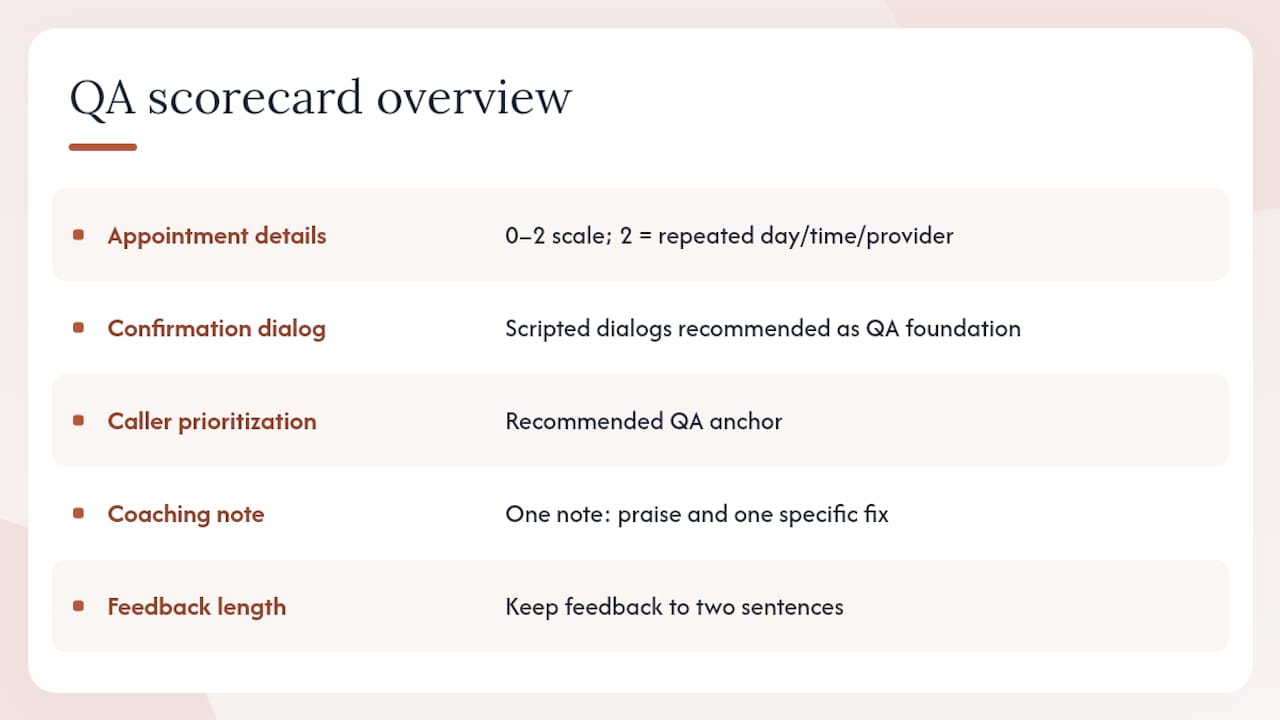
Score each criterion on a 0–2 scale: 0 = not done, 1 = partially done, 2 = done correctly.
Example filled row: For “Appointment details accurate,” a score of 2 sounds like: “Su cita es el jueves a las dos de la tarde con el Dr. García. ¿Confirma?” The staff member repeated the day, time, and provider before asking for confirmation. A score of 1 means they stated the time but forgot the provider name. A score of 0 means no confirmation was offered at all.
After each call review, write one coaching note: what the staff member did well and one specific line to improve. Keep it to two sentences. Lengthy feedback after every call creates resistance; short, specific notes get implemented.
The Front Office Academy’s Master Phone Call Guide recommends caller prioritization and scripted confirmation dialogs as the foundation of any QA system. Build your scorecard around those two anchors and you’ll catch most conversion problems before they become patterns.
The full Spanish script library for every dental call scenario
This is the section to print and laminate at the front desk. Scripts are grouped by scenario. Each includes a pronunciation note and a short coaching cue.
New patient intake and booking
First call: “Gracias por llamar a [Office Name]. ¿Es su primera vez con nosotros?” Thanks for calling [Office Name]. Is this your first time with us?
“¿Cómo se enteró de nosotros?” (How did you hear about us?) — ask this every time; it tracks referral sources.
Insurance collection: “¿Tiene seguro dental? ¿Me puede dar el nombre de su compañía de seguros y su número de miembro, por favor?” Do you have dental insurance? Can you give me your insurance company name and member number, please?
Pronunciation: “Seguro” = seh-GOO-roh. “Compañía” = kohm-pah-NYEE-ah.
Insurance and “do you take my plan?” calls
In-network: “Sí, aceptamos su seguro. Su plan cubre parte del costo del tratamiento.” Yes, we accept your insurance. Your plan covers [X]% of the treatment cost.
Out-of-network: “No estamos en la red de su seguro, pero podemos ayudarle a usar sus beneficios fuera de la red. Muchos pacientes solo pagan una pequeña diferencia.” We’re not in your insurance network, but we can help you use your out-of-network benefits. Many patients only pay a small difference.
Coaching cue: Never say “we don’t take your insurance” and stop there. Always follow with the out-of-network option.
Price shopper calls
“Entiendo que el costo es importante. Nuestros precios son competitivos y ofrecemos planes de pago. ¿Le gustaría saber más sobre nuestras opciones?” I understand cost is important. Our prices are competitive and we offer payment plans. Would you like to know more about our options?
Payment/financing pivot: “Trabajamos con planes de pago sin interés para que el tratamiento sea más accesible. ¿Le puedo dar más información?” We work with interest-free payment plans to make treatment more accessible. Can I give you more information?
Appointment confirmations and reminders
“Hola, le llamo del Consultorio [Name] para confirmar su cita el [día de la semana], [fecha], a las [hora]. Por favor llámenos si necesita cambiar su cita. Nuestro número es [número].” Hello, I’m calling from [Name] Office to confirm your appointment on [day of the week], [date], at [time]. Please call us if you need to change your appointment. Our number is [number].
Date/time phrasing: “el lunes a las tres de la tarde” = Monday at 3 PM. “el martes a las diez de la mañana” = Tuesday at 10 AM.
Cancellations, reschedules, and no-shows
Cancellation: “Entiendo. ¿Le gustaría reagendar para otra fecha? Tenemos disponibilidad esta semana.” I understand. Would you like to reschedule for another date? We have availability this week.
No-show follow-up: “Notamos que no pudo venir a su cita de hoy. Queremos asegurarnos de que esté bien. ¿Le gustaría hacer una nueva cita?” We noticed you weren’t able to make your appointment today. We want to make sure you’re okay. Would you like to make a new appointment?
Voicemail, hold, and transfer phrasing
Hold: “¿Me permite ponerle en espera un momento? Regreso enseguida.” May I put you on hold for a moment? I’ll be right back.
Transfer: “Le voy a transferir con [Name], quien le puede ayudar mejor. Un momento, por favor.” I’m going to transfer you to [Name], who can help you better. One moment, please.
Translation gloss: common dental terms
The University of Minnesota’s Adult Conversational Spanish in Dentistry guide recommends plain-language alternatives over literal technical translations. Use these:
- Cleaning: “limpieza” (leem-PYEH-sah) — say “limpieza de los dientes” for clarity
- Filling: “empaste” (em-PAHS-teh) or “relleno” — “empaste” is more widely understood
- Root canal: “tratamiento de conducto” (trah-tah-MYEHN-toh deh kohn-DOOK-toh) — for low-literacy patients, say “tratamiento para salvar el diente” (treatment to save the tooth)
- Pain: “dolor” (doh-LOR)
- Emergency: “urgencia” (oor-HEN-syah)
- Swelling: “hinchazón” (een-chah-SOHN)
- Bleeding: “sangrado” (sahn-GRAH-doh)
Pro Tip: For patients with limited health literacy, replace “tratamiento de conducto” with “tratamiento para salvar el diente.” It communicates the same thing without triggering fear from a term they may have heard negatively.
Coach notes: Memorize the greeting, the hold phrase, and the transfer line. Read the insurance and confirmation scripts verbatim until they feel natural. The glossary terms should be posted at the desk for quick reference.
How do you handle a Spanish-speaking patient in pain on the phone?
Emergency calls are where language barriers cause the most harm. A patient in pain who can’t communicate clearly will either hang up or show up at an ER. The goal is to assess quickly, stay calm, and get them in the chair.
Pain assessment script:
“¿Dónde siente el dolor?” (Where do you feel the pain?) “En una escala del uno al diez, ¿qué tan fuerte es el dolor?” (On a scale of one to ten, how strong is the pain?) “¿Tiene sangrado?” (Do you have bleeding?) “¿Tiene hinchazón en la cara o en la boca?” (Do you have swelling in your face or mouth?) “¿Tiene fiebre?” (Do you have a fever?)
Calming phrases:
“Entiendo que está sufriendo. Vamos a ayudarle lo antes posible.” I understand you’re in pain. We’re going to help you as soon as possible.
“Todo va a estar bien. Estamos aquí para ayudarle.” Everything is going to be okay. We’re here to help you.
Clinical communication frameworks like SPIKES emphasize avoiding technical terms and leading with empathy during high-stress calls. On the phone, that means short sentences, a calm voice, and no jargon before you’ve established what the patient is experiencing.
Escalation steps:
- If the patient reports severe swelling, difficulty breathing, or swallowing, instruct them to call 911 immediately: “Por favor llame al 911 ahora mismo.” (Please call 911 right now.)
- If pain is a 7 or above with swelling or fever, offer a same-day appointment: “Tenemos un espacio hoy. ¿Puede venir a las [hora]?” (We have a spot today. Can you come at [time]?)
- If pain is moderate and no systemic symptoms are present, schedule the next available appointment and advise: “Puede tomar ibuprofeno para el dolor hasta su cita.” (You can take ibuprofen for the pain until your appointment.)
- Document the call: note pain level, symptoms reported, and what was offered. Add it to the patient record before the next call.
Pro Tip: Train one staff member per shift to be the designated Spanish emergency contact. Post their name at the front desk. When a Spanish-speaking patient calls in pain, route immediately, not after two transfers.
How should your IVR and text messages handle Spanish-speaking callers?
Getting the IVR right is the single highest-leverage change most dental offices can make before investing in any other bilingual infrastructure. Dental call center guidance recommends an immediate Spanish-language option to prevent Spanish-speaking callers from abandoning the call before reaching anyone.
- Add a Spanish IVR prompt as the first or second option. Use: “Para continuar en español, por favor, oprima el nueve.” Record this with a native Spanish speaker if possible; text-to-speech (TTS) works as a fallback but sounds noticeably robotic to native speakers.
- Route Spanish callers directly to a bilingual staff member or a bilingual voicemail box. Never route them to a general queue where they’ll be greeted in English only.
- Send an SMS confirmation immediately after booking. Keep it under 160 characters: “Hola [Name], su cita en [Office] es el [día] a las [hora]. Responda SI para confirmar o llámenos al [número].”
- Send a 24-hour reminder SMS. “Recordatorio: su cita es mañana, [día], a las [hora]. ¿Necesita cambiarla? Llámenos al [número].”
- Use WhatsApp for pre-visit instructions. WhatsApp is the dominant messaging platform for many Hispanic communities. A short message works well: “Hola [Name], recuerde traer su identificación y tarjeta de seguro a su cita de mañana. ¡Hasta pronto!”
- For sensitive follow-ups (treatment plans, payment details), use WhatsApp or a patient portal link rather than SMS. “Para información sobre su tratamiento, haga clic aquí: [link]. Es seguro y privado.”
- Store Spanish-language call notes in the EHR. Flag the patient’s preferred language so every future interaction starts in Spanish without the patient having to ask.
For practices exploring how AI can handle these routing decisions automatically, the AI receptionist guide for dental practices covers how automated bilingual systems manage call handoffs and message summaries in real time.
How do you train front-desk staff to use these scripts confidently?
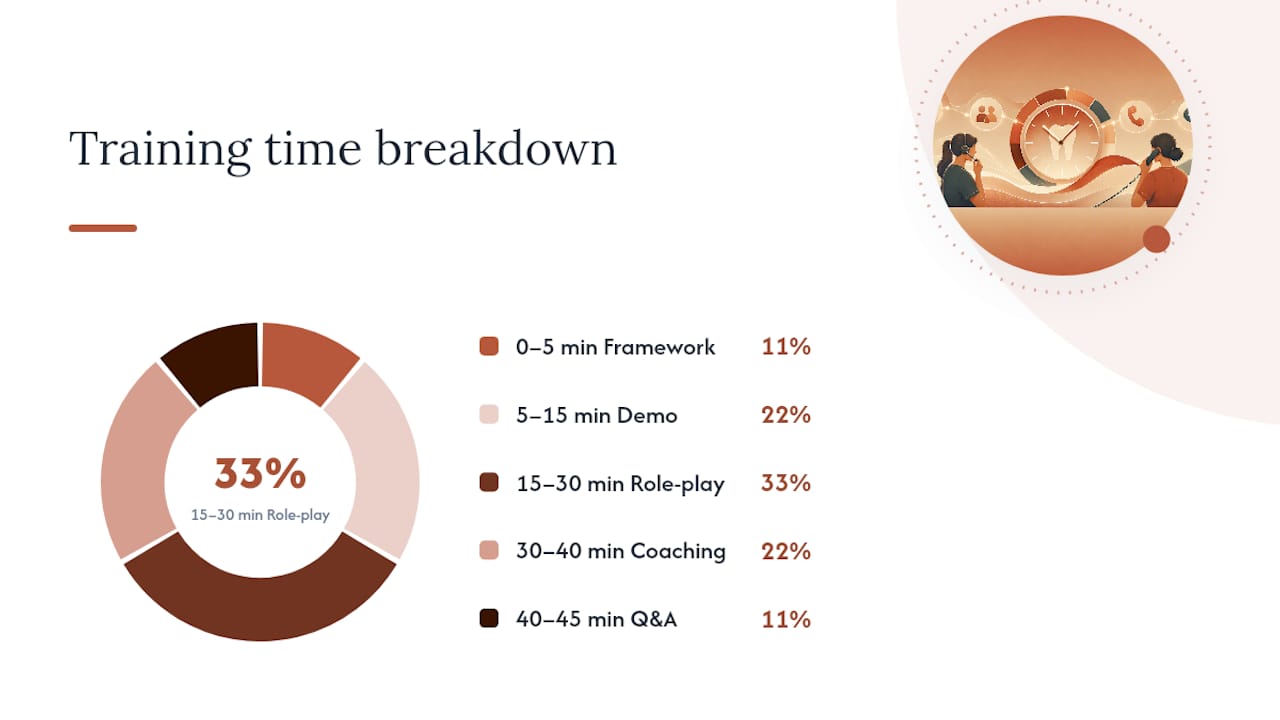
A script on paper is worth nothing if staff freeze the moment a Spanish-speaking patient calls. Thirty to forty-five minutes of structured role-play changes that.
Training agenda:
- 0–5 minutes: Manager reads the four-step call framework aloud. Staff follow along with printed scripts.
- 5–15 minutes: Manager demonstrates a full new-patient call in Spanish using the script. Staff observe and note any phrases they don’t recognize.
- 15–30 minutes: Pair role-play. One staff member plays the patient, one plays the front desk. Rotate through three scenarios: new patient booking, insurance question, and emergency triage.
- 30–40 minutes: Live coaching. Manager listens to one round of each scenario and gives one specific note per person.
- 40–45 minutes: Q&A and glossary review. Post the dental terms glossary at the front desk before the session ends.
Role-play scenario cues:
Scenario 1 — New patient booking: Patient says “Quiero hacer una cita, es mi primera vez.” Coach cue: Did staff ask how they heard about the office? Did they collect insurance info?
Scenario 2 — Insurance question: Patient says “¿Aceptan mi seguro de Medicaid?” Coach cue: Did staff offer the out-of-network explanation if the answer is no? Did they avoid dead-ending the call?
Scenario 3 — Emergency: Patient says “Tengo mucho dolor y mi cara está hinchada.” Coach cue: Did staff run through the five pain-assessment questions? Did they offer a same-day slot or escalate appropriately?
Pro Tip: Record one role-play per session with the staff member’s permission. Listening back to your own call is the fastest way to catch filler words, rushed phrasing, or a tone that sounds impatient. Five minutes of playback beats thirty minutes of verbal feedback.
Cross-training checklist for non-front-desk staff:
- Can answer the phone within three rings using the standard Spanish greeting
- Knows the hold phrase and transfer phrase in Spanish
- Can collect name, date of birth, and callback number in Spanish
- Knows when to escalate an emergency call immediately
- Has the printed script at their workstation
Cross-training with scripts reduces call abandonment because backup staff can answer within the three-ring rule and still deliver a consistent message. A hygienist who picks up the phone and says “Un momento, por favor” instead of “I don’t speak Spanish” keeps the patient on the line.
What HIPAA rules apply to Spanish phone calls?
HIPAA applies regardless of the language spoken. Verifying the caller’s identity before discussing any protected health information is non-negotiable, and the verification step needs to be scripted so it happens on every call.
Identity verification options:
-
“Para proteger su privacidad, necesito verificar su identidad. ¿Me puede dar su fecha de nacimiento y los últimos cuatro dígitos de su número de seguro social?” To protect your privacy, I need to verify your identity. Can you give me your date of birth and the last four digits of your social security number?
-
“¿Me puede confirmar su nombre completo y la fecha de su última visita?” Can you confirm your full name and the date of your last visit?
Consent for messages:
Before sending appointment details or treatment information via SMS or WhatsApp, document consent in the patient record. A simple note works: “Patient consented to receive appointment reminders via WhatsApp on [date].”
Key rules to post at the front desk:
- Never discuss a patient’s treatment details in a public area of the office, even in Spanish.
- If a family member calls on behalf of a patient, verify that the patient has authorized them to receive information.
- Do not leave detailed clinical information on voicemail. Stick to: “Please call us back at [number] regarding your appointment.”
- Document every call where PHI was discussed, including the verification step completed.
Pro Tip: For sensitive information like treatment plans or payment balances, offer a secure channel: “Para información más detallada sobre su tratamiento, le podemos enviar un mensaje seguro por el portal del paciente. ¿Le gustaría eso?” This keeps the conversation compliant and gives the patient a clear next step.
The AHRQ provides broader guidance on patient communication safety that informs these verification and documentation practices.
How do you handle mixed-language calls and language barriers gracefully?
Not every Spanish-speaking patient speaks only Spanish. Many will switch between English and Spanish mid-call, or speak a regional dialect that differs from standard Mexican Spanish. Staff don’t need to be fluent. They need a few key phrases and a clear escalation path.
When a caller switches to English mid-call, match them. Don’t force Spanish if they’re more comfortable in English. The goal is the patient’s comfort, not a language exercise.
When staff hit a wall, the right move is a warm transfer, not silence. “Un momento, por favor. Le voy a comunicar con alguien que le puede ayudar.” (One moment, please. I’m going to connect you with someone who can help you.) Said calmly, this phrase keeps the patient on the line and signals competence rather than confusion.
For calls where no bilingual staff member is available, a bilingual voicemail box is the fallback. Record the outgoing message in Spanish and commit to a callback within two hours during business hours. Post that commitment in the voicemail greeting: “Le devolveremos la llamada en menos de dos horas.” (We’ll call you back in less than two hours.)
Regional vocabulary differences are real. “Carro” and “coche” both mean car; “empaste” and “relleno” both mean filling. When a patient uses a term you don’t recognize, ask: “¿Me puede explicar un poco más?” (Can you explain a little more?) It’s a natural, respectful way to clarify without making the patient feel misunderstood.
For practices serving patients from multiple Spanish-speaking countries, the bilingual patient intake guide covers how to document language preferences and regional notes in the patient record so every future call starts in the right register.
How do you answer common patient questions about procedures and payment in Spanish?
These are the questions your front desk hears every week. Having a scripted answer ready prevents staff from improvising and saying something inaccurate.
“¿Cuánto cuesta una limpieza?” (How much does a cleaning cost?) “El costo de una limpieza varía según su seguro. Con seguro, muchos pacientes no pagan nada. Sin seguro, el costo es de [$X]. ¿Tiene seguro dental?” The cost of a cleaning varies depending on your insurance. With insurance, many patients pay nothing. Without insurance, the cost is [$X]. Do you have dental insurance?
“¿Aceptan pagos a plazos?” (Do you accept payment plans?) “Sí, ofrecemos planes de pago. Podemos hablar de las opciones cuando venga a su cita.” Yes, we offer payment plans. We can discuss the options when you come to your appointment.
“¿Me va a doler?” (Is it going to hurt?) “Usamos anestesia para que no sienta dolor durante el procedimiento. Puede sentir un poco de presión, pero no dolor.” We use anesthesia so you don’t feel pain during the procedure. You may feel some pressure, but not pain.
“¿Cuánto tiempo dura la cita?” (How long does the appointment last?) “Una limpieza dura aproximadamente una hora. Un tratamiento más complejo puede durar más. Le diremos exactamente cuánto tiempo necesitará cuando confirme su cita.” A cleaning lasts approximately one hour. A more complex treatment may take longer. We’ll tell you exactly how much time you’ll need when you confirm your appointment.
“¿Qué debo traer a mi primera cita?” (What should I bring to my first appointment?) “Por favor traiga su identificación, su tarjeta de seguro dental si tiene, y llegue diez minutos antes para completar los formularios.” Please bring your ID, your dental insurance card if you have one, and arrive ten minutes early to complete the forms.
Research on oral health communication barriers shows that validated tools like KROHL-S reveal significant oral health literacy gaps among Spanish-speaking adults. Plain-language answers to these questions, delivered consistently, directly address that gap before the patient ever sits in the chair.
Pronunciation and cultural etiquette tips for speaking respectfully in Spanish
Pronunciation matters less than tone. A staff member who mispronounces “cita” but sounds warm and unhurried will build more trust than someone who speaks textbook Spanish with an impatient edge.
Pronunciation priorities:
- “Cita” (appointment) = SEE-tah, not SIT-ah
- “Seguro” (insurance) = seh-GOO-roh
- “Dolor” (pain) = doh-LOR
- “Mañana” (tomorrow) = mah-NYAH-nah
- “Gracias” = GRAH-syahs, not GRAT-see-us
Cultural etiquette that matters on the phone:
Use “usted” (formal “you”) with all patients until they invite informality. Spanish has two forms of “you,” and defaulting to the formal one signals respect. Switching to “tú” without invitation can feel presumptuous, especially with older patients.
Greet with warmth before getting to business. Hispanic communication norms often include a brief personal exchange before the transactional part of a call. A simple “¿Cómo está usted hoy?” (How are you today?) before diving into appointment details takes five seconds and signals that the patient is a person, not a slot to fill.
Never rush a Spanish-speaking patient off the phone. If a call is running long because of a language barrier, the right move is patience, not speed. A patient who feels hurried will not book. One who feels heard will.
Avoid “No entiendo” (I don’t understand) as a standalone response. It ends the exchange. Instead, use “¿Me puede repetir eso, por favor?” (Can you repeat that for me, please?) It keeps the conversation moving and puts the request on the staff member, not the patient.
Why scripted Spanish calls are worth more than most offices realize
The conventional wisdom in dental front-office training is that scripts make calls feel robotic. The opposite is true when the scripts are well-written. A staff member who knows exactly what to say next is calmer, warmer, and more focused on the patient than one who is improvising.
The deeper issue is what happens when a Spanish-speaking patient calls and no one is prepared. Research on communication barriers and dental anxiety shows that language gaps directly increase anxiety and reduce treatment adherence. That’s not a soft finding. It means patients who can’t communicate clearly are less likely to keep appointments, less likely to follow post-treatment instructions, and less likely to refer family members.
A scripted, empathetic Spanish call doesn’t just book an appointment. It signals to the patient that your office is a place where they belong. That signal is worth more than any marketing campaign, because it converts a first call into a long-term patient relationship.
The offices that get this right don’t treat bilingual communication as an add-on. They build it into the phone system, the training schedule, the QA scorecard, and the follow-up workflow. The scripts in this guide are the starting point, not the finish line.
A turn-key bilingual front desk built for dental practices serving Hispanic patients
Running these scripts manually requires trained staff, consistent coaching, and someone monitoring the QA scorecard every week. Diazluna’s bilingual front desk for dental practices handles the phone, the website, and WhatsApp in one integrated platform, so no Spanish-speaking patient falls through the cracks between channels.
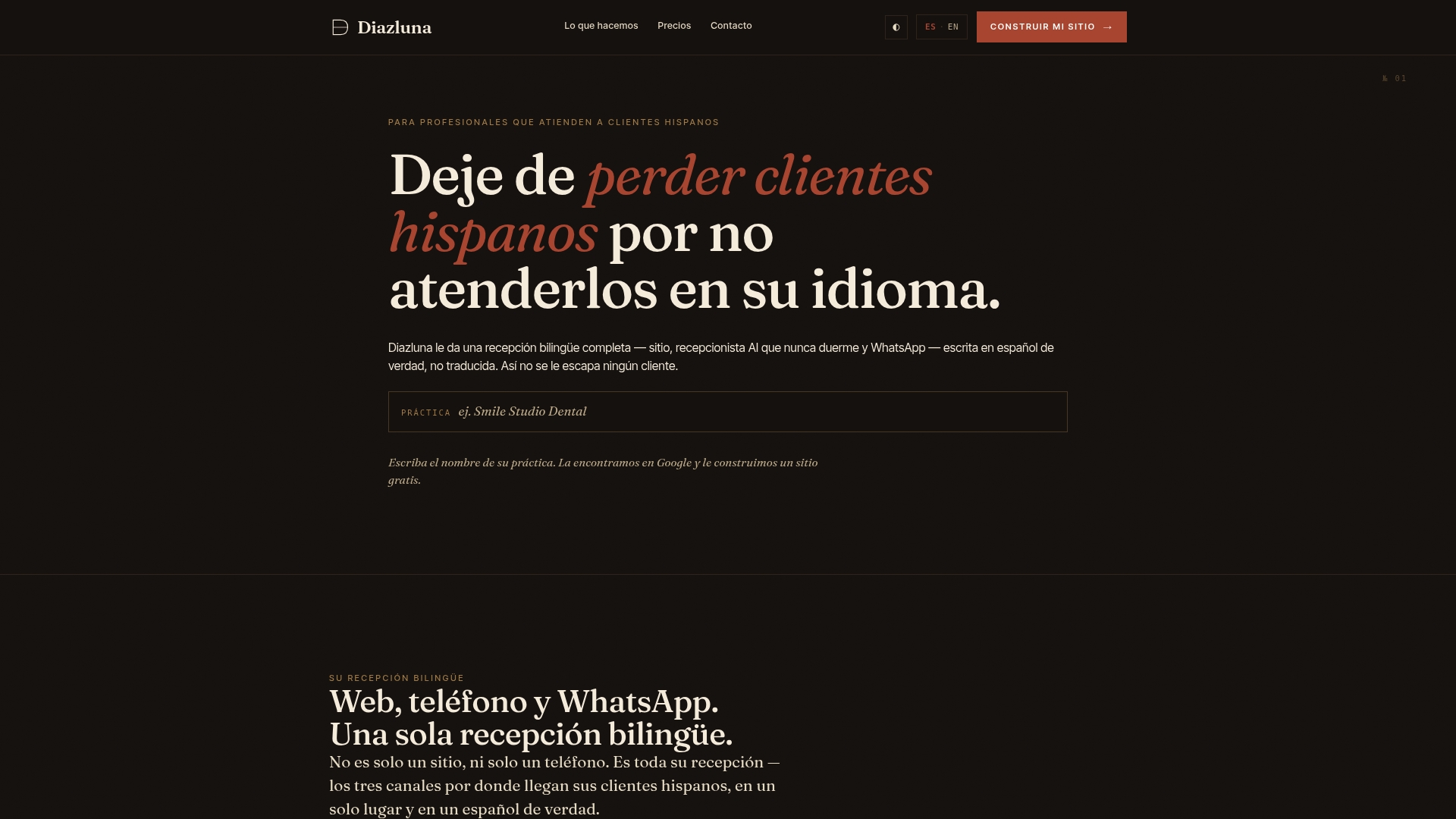
The platform combines a 24/7 AI receptionist fluent in Spanish and English, a fully optimized bilingual website, and WhatsApp integration, all at a fraction of the cost of staffing a bilingual front desk around the clock. Urgent calls get flagged and summarized in real time so your clinical team always knows what came in overnight. Free setup is included, and a demo is available to show exactly how the system handles the call scenarios covered in this guide. Visit Diazluna to see the options and get started.
Sources
These sources informed the scripts, QA criteria, IVR guidance, and training agenda throughout this guide.
- Breaking barriers: Validation of a Spanish oral health knowledge tool to enhance patient–provider communication | PLOS One
- How to Create a Successful Dental Call Center
- Adult Conversational Spanish in Dentistry (University of Minnesota PDF)
- Phone scripts make things run more smoothly for the dental office and bring in new patients | DentistryIQ
- Master Phone Call Guide (Front Office Academy PDF)