July 30, 2026
24/7 Spanish Dental Answering Service: A Buyer's Guide
The right move for any U.S. dental practice with a significant Hispanic patient base is a HIPAA-compliant bilingual front desk that operates around the clock in both English and Spanish. Three reasons this matters now:
- Patient access: Spanish-speaking patients call after hours, on weekends, and during lunch. A missed call is a missed appointment.
- HIPAA protection: Any service that touches patient intake must sign a Business Associate Agreement (BAA) and handle PHI securely.
- Appointment capture: Every unanswered new-patient call is revenue that walks to the next practice that picks up.
Diazluna combines a 24/7 bilingual AI receptionist, a fully optimized bilingual website, and WhatsApp integration into one integrated solution built specifically for Hispanic-serving dental practices.
Table of Contents
- Who actually needs a 24/7 Spanish dental answering service?
- What must-have features should you verify before signing?
- Which channels should your bilingual dental service cover?
- How do you verify HIPAA compliance and protect patient PHI?
- What should you budget for a bilingual dental answering service?
- What does implementation actually look like?
- Sample bilingual scripts and triage flow
- What results should you expect from a bilingual 24/7 front desk?
- How do you move forward quickly?
- Key Takeaways
- The integrated model is what most practices actually need
- Diazluna covers the full bilingual front desk for your dental practice
- Useful sources and further reading
Who actually needs a 24/7 Spanish dental answering service?
Not every practice needs the same level of bilingual coverage. Here is where the investment pays off fastest:
- Solo practices with a significant Hispanic patient share — one front-desk person cannot cover phones, check-ins, and chair-side questions simultaneously. Calls drop.
- Multi-site clinics — coordinating bilingual coverage across locations with in-house staff is expensive and inconsistent.
- Practices with limited or no bilingual staff — a monolingual front desk creates a real access gap for Spanish-dominant patients calling about pain or insurance.
- Clinics wanting WhatsApp and web-based Spanish intake — a growing share of Hispanic patients prefer messaging over phone calls, especially for appointment confirmations and reminders.
- After-hours emergency triage — dental pain does not wait for Monday morning. Practices without a structured after-hours protocol lose patients to urgent care clinics and emergency rooms.
A solo practice might need basic AI coverage and WhatsApp. A multi-doctor group likely needs full phone answering, PMS integration, and escalation protocols. The bilingual dental patient intake benefits are real at both scales, but the configuration differs.
What must-have features should you verify before signing?
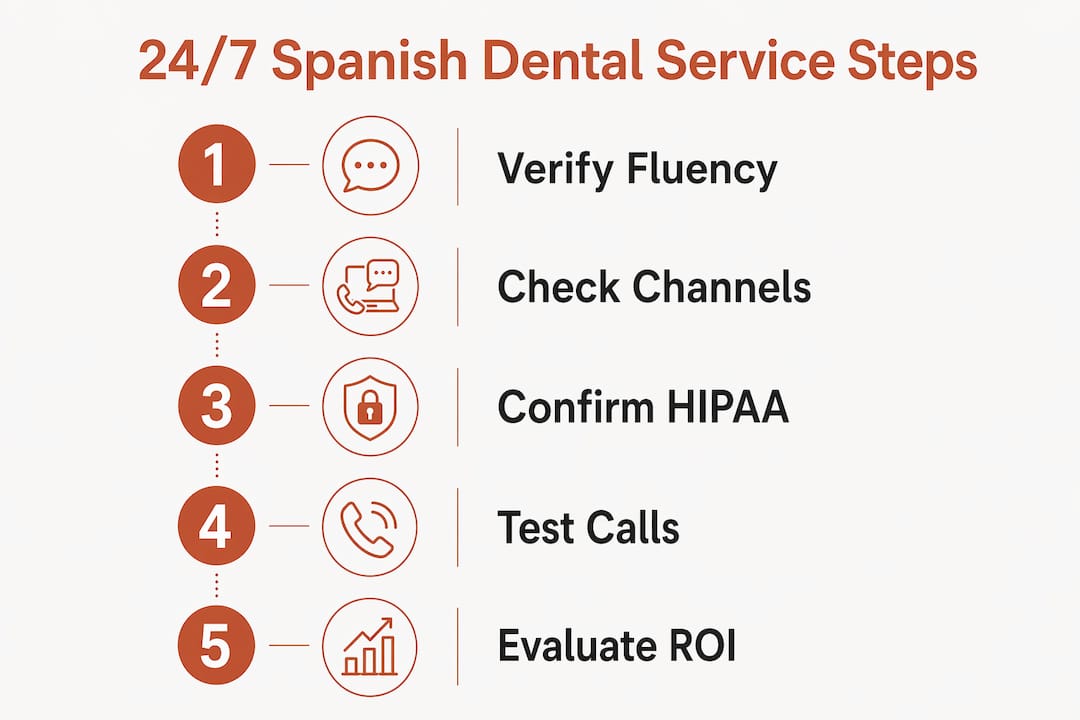
Use this checklist on every vendor call before you commit.
HIPAA and legal:
- Signed BAA before any PHI is handled. No BAA, no deal.
- Documented staff training records and incident response procedures.
- Encryption in transit (TLS) and at rest confirmed in writing.
Bilingual quality:
- Ask how Spanish fluency is validated. Native speaker review and role-play test calls are the minimum bar. Localized phrasing, not literal translation, is what patients actually understand.
- Request a live Spanish-language demo call with a simulated emergency scenario.
Operational requirements:
- Live transfer capability vs. message-only. Know which you are getting.
- 24/7 staffing or AI coverage with documented uptime SLA.
- Appointment booking integration with your practice management system (PMS).
- Clear escalation rules: who gets called for a true dental emergency at 2 AM?
Red flags to walk away from:
- No BAA or vague “we’re HIPAA-aware” language.
- Per-minute billing with no cap and no transparency.
- Triage protocol described as “agents use their judgment.”
- Long-term contracts with no trial period.
Pro Tip: Before signing, run a role-play test call in Spanish with a simulated toothache scenario. Ask the agent or AI to classify urgency and describe the escalation path. If the response is generic or the Spanish sounds translated rather than natural, that is your answer.
Which channels should your bilingual dental service cover?
A complete bilingual dental answering solution covers four channels, each serving a different patient need.
- Phone (live or AI): New-patient intake, appointment booking, insurance questions, and emergency triage. Requires live transfer capability for true emergencies and callback scheduling for routine calls.
- AI receptionist: Voice-based onboarding means the AI learns your specific procedures, insurance plans, and scheduling rules. Intent classification routes calls correctly without a human agent on every call.
- WhatsApp: Two-way scheduling, appointment reminders, and post-visit follow-up. Particularly effective for existing patients and for Spanish-dominant patients who prefer messaging. Diazluna’s WhatsApp integration handles this natively.
- Website chat and intake forms: Spanish-language landing pages and intake forms capture new patients who search in Spanish. A bilingual website is not optional if you want to rank for Spanish-language dental searches in your market.
For new patients, phone and website are the primary entry points. For existing patients, WhatsApp and SMS reminders reduce no-shows. Emergency triage runs through phone first, with escalation protocols that notify the on-call clinician directly.
How do you verify HIPAA compliance and protect patient PHI?
A signed BAA is mandatory for any third-party service that handles protected health information on behalf of your practice. That is not a formality. It is a legal requirement under HIPAA, and it defines each party’s obligations if a breach occurs.
Technical controls to confirm in writing:
- TLS encryption for all data in transit.
- At-rest encryption for stored messages and call recordings.
- Role-based access controls so only authorized staff can view PHI.
- Audit logs with timestamps for all PHI access.
- Routine security testing and vulnerability assessments.
Operational controls:
- Limit PHI in SMS and unencrypted messages. Call summaries should not include full patient records.
- Staff training records available on request.
- Documented incident response process with defined notification timelines.
Verification steps:
- Request the actual BAA text before signing the service agreement.
- Ask for a SOC 2 Type II report or a security summary if the vendor has one.
- Confirm data retention and deletion policies in writing.
Key compliance checkpoint: A vendor who hesitates to provide BAA text or cannot describe their encryption setup in plain language is a vendor whose security posture you cannot verify. Require documentation, not assurances.
What should you budget for a bilingual dental answering service?
Pricing structures vary widely, and the total cost of ownership is rarely the headline number.
Common cost components:
- Monthly platform or base fee.
- Per-call or per-minute charges on top of the base.
- Setup or onboarding fees (some vendors waive these).
- Add-ons for advanced triage, PMS integration, or WhatsApp.
- Bilingual surcharges — some vendors charge extra for Spanish. Confirm upfront whether bilingual support is included or billed separately.
How to frame the comparison: A full-time bilingual front-desk employee costs a substantial amount annually in salary alone, before benefits. A traditional human answering service typically runs on per-minute billing. An integrated AI-driven solution like Diazluna bundles website, phone, and WhatsApp into one monthly cost, which is where the cost advantage over traditional agencies becomes concrete.
ROI calculation to run: Estimate the average revenue per new patient over their lifetime with your practice. Multiply by the number of calls your current setup misses per week. That gap is the floor for what bilingual 24/7 coverage is worth.
Red flags in pricing: opaque per-minute add-ons, automatic contract renewals, and escalation charges that only appear in the fine print.
What does implementation actually look like?
| Milestone | Typical Timeline |
|---|---|
| Discovery call and practice onboarding | Day 1 |
| Script and escalation approval | Days 1–2 |
| AI receptionist live (basic coverage) | Within 24 hours |
| WhatsApp integration active | 24 hours |
| Full PMS calendar integration | 1–2 weeks |
| Staff training and test calls complete | 1–2 weeks |
Diazluna’s onboarding is voice-based: the AI learns your practice through a structured call covering procedures, insurance plans, scheduling rules, and emergency protocols. Many practices are live within 24 hours for basic AI receptionist coverage.
Who to involve internally:
- Office manager (scripts, escalation rules, scheduling preferences).
- Lead clinician (emergency protocols and after-hours thresholds).
- Billing or insurance lead (insurance FAQ content).
- IT contact (PMS integration credentials and access).
Deliverables to demand before go-live: documented call scripts, escalation matrix, integration documentation, and staff training materials.
Sample bilingual scripts and triage flow
Short script structures for the four most common scenarios:
New patient intake (English/Spanish):
- EN: “Thank you for calling [Practice Name]. Are you a new patient? I can help you schedule your first visit.”
- ES: “Gracias por llamar a [Nombre del consultorio]. ¿Es su primera visita con nosotros? Con gusto le agendo una cita.”
Emergency triage prompt:
- EN: “Are you experiencing severe pain, swelling, or bleeding? I’ll connect you with our on-call team right away.”
- ES: “¿Tiene dolor fuerte, hinchazón o sangrado? Le comunico de inmediato con nuestro equipo de guardia.”
Triage urgency classification:
- Emergency (severe pain, trauma, swelling, uncontrolled bleeding) → Immediate escalation to on-call clinician. Do not take a message.
- Urgent (moderate pain, lost crown, broken tooth, no swelling) → Book next available slot, same day if possible. Notify front desk.
- Routine (cleaning, checkup, insurance question) → Standard scheduling flow.
Pro Tip: Never use a literal translation of dental terms like “root canal” (conducto radicular is technically correct but confusing to many patients). Use “tratamiento del nervio” instead. Culturally familiar phrasing builds trust faster than clinical accuracy alone.
Evaluating Spanish fluency means more than checking a box. Bilingual virtual receptionist validation should include native speaker review of scripts and at least two live role-play calls before go-live.
What results should you expect from a bilingual 24/7 front desk?
The core business case is straightforward: practices that answer every call in the patient’s preferred language capture more new patients and lose fewer existing ones to competitors who do. Bilingual answering coverage reduces friction for Hispanic patients and increases appointment capture. It is both an access improvement and a direct revenue play.
Measurement methods that work:
- Track new-patient call volume before and after implementation (your phone system or AI platform should log this).
- Compare appointment capture rate for Spanish-language calls specifically.
- Monitor no-show rates for patients who received WhatsApp reminders vs. those who did not.
- Survey Spanish-speaking patients on their intake experience at 30 and 90 days.
Diazluna’s integrated approach combines website, AI receptionist, and WhatsApp under one system, which means intake data is centralized rather than scattered across three vendors. The bilingual customer service benefits for Hispanic patients go beyond language: they include trust, comfort, and the likelihood of referring family members.
Trust signals to verify with any vendor: signed BAA, documented uptime SLA, bilingual fluency validation process, and confirmed PMS integration capability.
How do you move forward quickly?
Three steps before you commit to any vendor:
- Verify HIPAA/BAA: Request the BAA text. Confirm encryption and audit log details in writing.
- Validate bilingual triage: Run a Spanish-language role-play call with an emergency scenario. Evaluate fluency, escalation speed, and clinical appropriateness.
- Confirm integrations and pricing transparency: Ask for a full pricing breakdown including per-call fees, add-ons, and contract terms. Confirm your PMS is on their integration list.
For fast validation: schedule a demo, request a trial period, and run the role-play test before you go live. Internally, the office manager and lead clinician should both sign off. Keep the signed BAA, SLA documentation, and integration specs on file for your HIPAA compliance records.
Key Takeaways
A HIPAA-compliant, bilingual 24/7 dental answering service requires a signed BAA, verified Spanish fluency, and confirmed PMS integration before any practice goes live.
| Point | Details |
|---|---|
| BAA is non-negotiable | Require signed BAA text before any PHI is handled; no exceptions. |
| Bilingual fluency must be validated | Run a Spanish-language role-play call with an emergency scenario before go-live. |
| Triage quality is the differentiator | The best services classify urgency and escalate true emergencies; message-only is not enough. |
| Measure impact at 30 and 90 days | Track new-patient call capture and no-show rates to confirm ROI after launch. |
| Diazluna’s integrated model | Combines bilingual website, 24/7 AI receptionist, and WhatsApp in one solution for Hispanic-serving dental practices. |
The integrated model is what most practices actually need
The conventional advice is to find a good answering service and bolt it onto whatever you already have. That approach creates three separate vendor relationships, three billing cycles, and three points of failure when a Spanish-speaking patient calls at 10 PM with a toothache.
What I have seen work consistently is the integrated model: one system that handles the website, the phone, and WhatsApp in both languages, with a single onboarding process and a single point of accountability. When the AI receptionist, the intake form, and the WhatsApp reminder all speak the same language and pull from the same patient record, the experience is coherent. Patients notice. They refer family members. That is the actual ROI.
Diazluna was built on exactly this premise: that Hispanic-serving dental practices do not need three vendors, they need one system that works. The bilingual front desk model reduces friction at every touchpoint, and the 24/7 coverage means no new patient call goes unanswered because the hygienist is mid-cleaning.
Diazluna covers the full bilingual front desk for your dental practice
Most dental practices serving Hispanic patients are losing new-patient contacts not because they lack good care, but because their intake system has gaps: no Spanish on the website, no after-hours phone coverage, no WhatsApp. Diazluna closes all three at once.
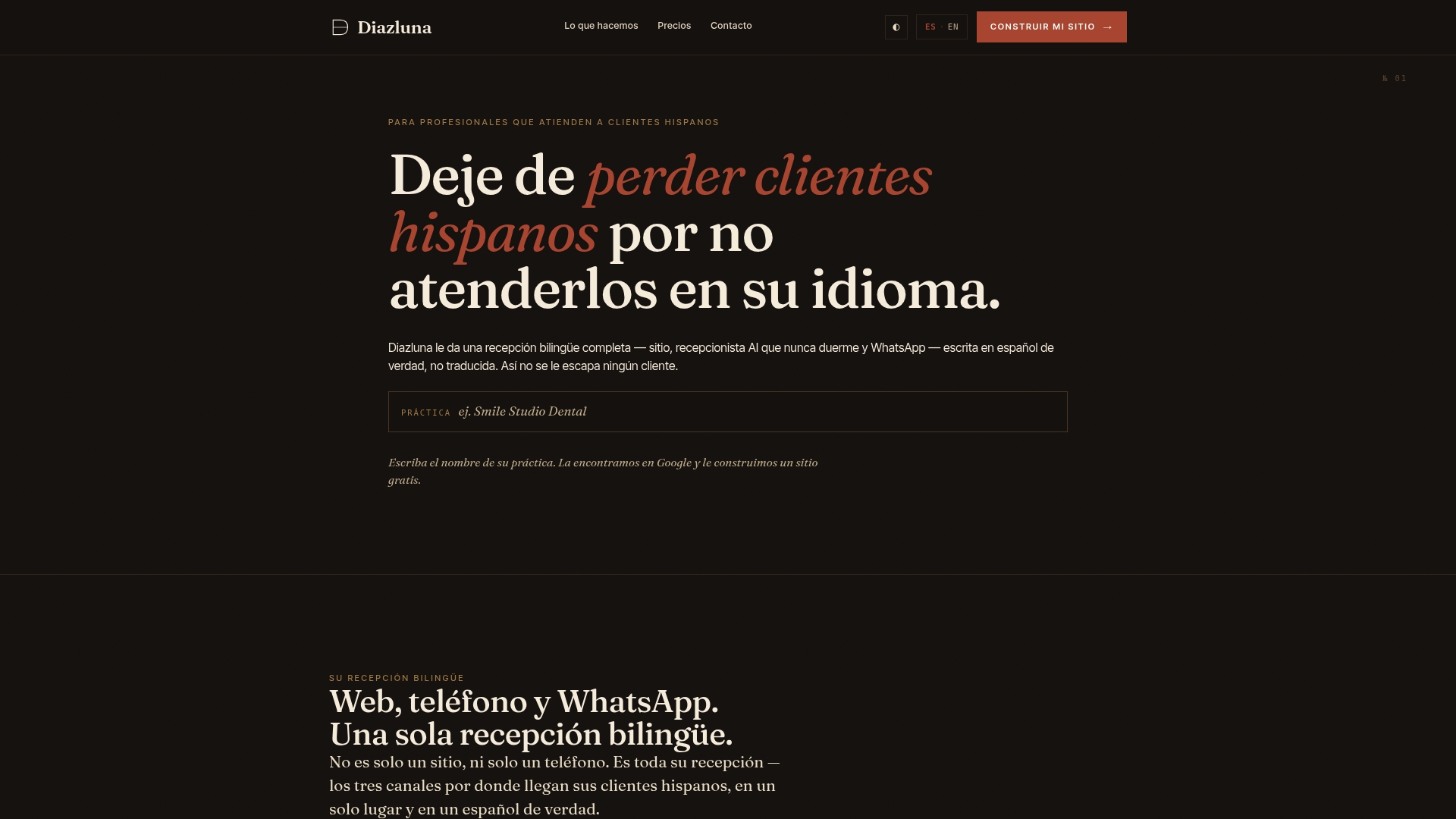
The Diazluna dental solution includes a bilingual website, a 24/7 AI receptionist fluent in English and Spanish, and WhatsApp integration, all HIPAA-ready and built for practices that cannot afford to lose a single Spanish-speaking patient to a competitor who answered. Onboarding is voice-based and many practices go live within 24 hours. No three-vendor stack, no bilingual surcharges, no long setup process. Schedule a demo or start a trial at diazluna.ai to see the full setup for your practice.
Useful sources and further reading
- ADA HIPAA 20 Questions — The American Dental Association’s plain-language HIPAA guidance for dental practices, including BAA requirements and PHI handling. Start here when verifying vendor compliance claims.
- Diazluna — Bilingual front desk for dentists — Dentist-specific product page covering phone, website, and WhatsApp bilingual features, integration details, and onboarding steps.
- Diazluna — Bilingual patient intake benefits — Explains the operational and revenue case for bilingual intake channels in dental practices.
- Hire a bilingual virtual receptionist in 2026 — Practical validation framework including role-play testing and fluency evaluation criteria.
Use the ADA resource when reviewing BAA language and SLA terms with any vendor. Use the Diazluna pages to verify integration specs, onboarding timelines, and feature coverage before your demo call.