July 27, 2026
Bilingual Digital Marketing Strategies for Practices
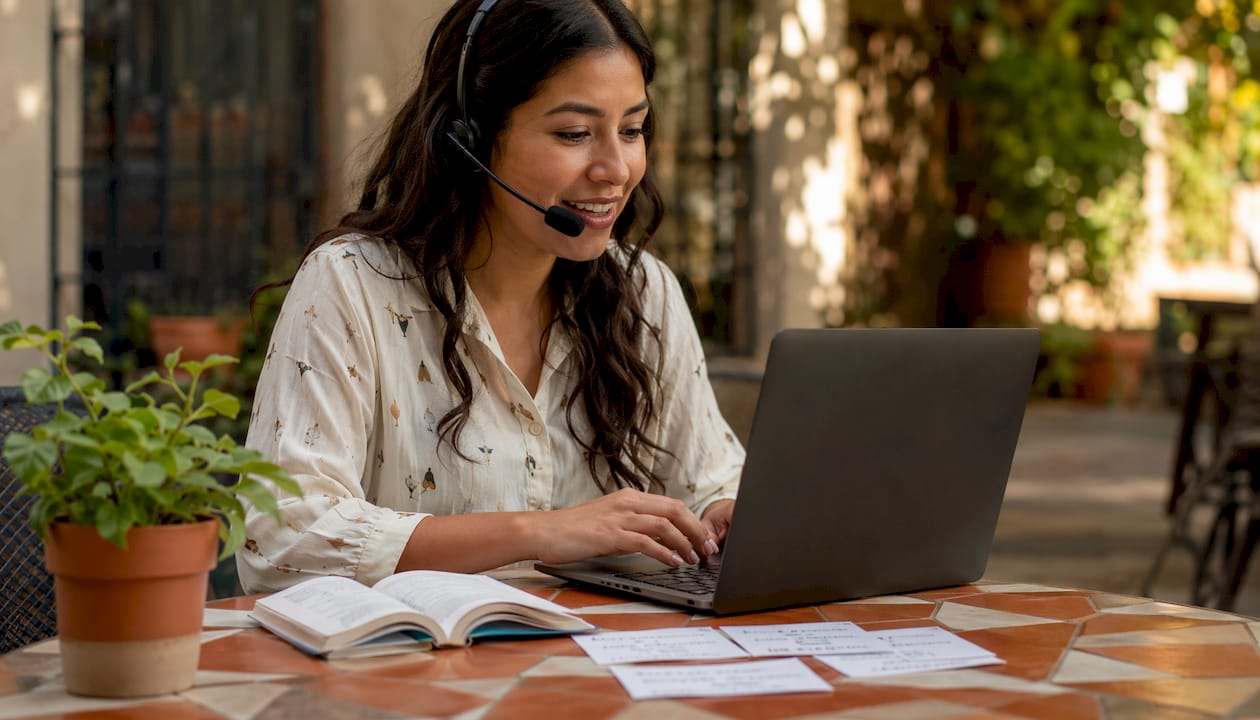
A single bilingual front desk, one that keeps language continuity from the first Spanish-language ad through booking confirmation and follow-up, is the fastest path to retaining and growing your Hispanic patient and client volume. Dental offices, law firms, and healthcare clinics lose appointments every day not because their Spanish ads fail, but because the funnel breaks the moment a Spanish-speaking prospect hits an English-only booking page.
Here is the prioritized action checklist to fix that immediately:
Quick-win sequence by priority:
- Enable Spanish-language paid search and social ads with native Spanish copy
- Build a Spanish landing page with hreflang tags pointing to your English equivalent
- Wire your booking calendar to a Spanish-language experience
- Turn on WhatsApp Business and route Spanish contacts through it
- Set up phone and WhatsApp call tracking into GA4
- Deploy a 24/7 bilingual reception layer (AI or human)
By practice type:
- Dental practices: Start with Spanish Google Ads and a localized booking flow; WhatsApp is your highest-ROI second step
- Law firms: Prioritize a Spanish landing page with localized trust signals; confidentiality messaging in Spanish is non-negotiable
- Healthcare clinics: Lead with HIPAA-aware messaging consent in Spanish before any WhatsApp automation goes live
Table of Contents
- Why does language continuity matter for dental, legal, and healthcare practices?
- What are the core components of a bilingual digital front desk?
- How do you build one coherent bilingual brand voice?
- What does bilingual SEO actually require for your practice site?
- How should you set up WhatsApp, SMS, and AI reception for Spanish-speaking clients?
- What conversion tactics work best for bilingual visitors?
- How do you measure bilingual campaign performance?
- What does implementation actually cost and how long does it take?
- What compliance steps apply to bilingual front-desk deployments?
- How do you choose the right bilingual front-desk vendor?
- How Diazluna’s bilingual front desk performs in practice
- Key Takeaways
- The part most practices get wrong
- Diazluna handles the bilingual front desk so your practice does not have to
- Useful sources and further reading
Why does language continuity matter for dental, legal, and healthcare practices?
Language continuity raises conversion and lowers abandonment for Hispanic clients. When a Spanish-speaking prospect clicks your ad and lands on an English page, they leave. The booking never happens. That is not a traffic problem; it is a funnel architecture problem.
The U.S. Hispanic market is large and growing, and Spanish-language keywords frequently carry lower cost-per-click than their English equivalents while capturing high-intent traffic. For a dental or legal practice, that means cheaper leads from a segment that is actively searching.
The trust dimension matters even more in healthcare and legal contexts. A patient sharing medical history or a client discussing a legal matter needs to feel understood, not just translated at. Bilingual content builds long-term brand authority in Spanish search results that competitors cannot replicate quickly. That compounding effect is why practices that invest early in bilingual content loyalty tend to dominate local Spanish search within approximately a year to a year and a half.
Where practices lose Hispanic clients without language continuity:
- Spanish ad clicks to English landing pages
- English-only booking calendars after a Spanish intake form
- English confirmation emails following a Spanish WhatsApp conversation
- No Spanish option on the phone IVR
What are the core components of a bilingual digital front desk?
The architecture has six layers. Every layer must speak the same language the client started in.

| Funnel Stage | Component | Language Continuity Owner |
|---|---|---|
| Ad | Spanish paid search / social | Ad platform + copywriter |
| Landing | Bilingual site with hreflang | Web developer + SEO |
| Booking | Localized calendar / form | Booking platform config |
| Messaging | WhatsApp Business / SMS | Integration + automation |
| Reception | 24/7 bilingual AI or live agent | Receptionist layer |
| Follow-up | Bilingual email sequences | CRM / email platform |
Component checklist:
- Bilingual website with subdirectory URL structure (
yoursite.com/es/) and hreflang tags - Booking and intake forms available in Spanish with localized field labels
- WhatsApp Business API or Business App configured for Spanish-first routing
- Phone IVR with a Spanish option that routes to a bilingual agent or AI
- 24/7 bilingual AI receptionist with human fallback for complex cases
- Bilingual email sequences for appointment reminders and follow-up
For a small practice (1–3 providers): Start with the Spanish landing page, WhatsApp Business, and a bilingual booking link. That three-piece MVP captures most of the opportunity before you invest in a full AI receptionist layer.
For a mid-size practice (4+ providers or multiple locations): Add the AI receptionist, language-aware IVR, and automated bilingual email sequences. At that scale, manual handling of Spanish inquiries creates bottlenecks that cost real appointments.
How do you build one coherent bilingual brand voice?
The most common mistake in cross-cultural digital strategies is building two separate brands: one English, one Spanish. That fragments your identity and confuses referrals. One brand, expressed natively in both languages, is the goal.
Voice and tone rules by practice type:
- Dental: Warm and reassuring in Spanish (“Estamos aquí para cuidarte”), clinical and efficient in English. Spanish patients often expect more relational warmth before clinical detail.
- Legal: Formal in both languages, but Spanish copy should avoid legalese that does not translate cleanly. Use plain-language Spanish for intake, formal register for contracts.
- Healthcare: Empathetic first, procedural second. In Spanish, lead with care; in English, lead with process.
Pro Tip: Use native transcreators, not post-hoc translators. A transcreator starts from your brand brief and writes in Spanish; a translator starts from your English copy and converts it. The difference shows up in every sentence.
Two quick voice examples:
- Clinical intake (Spanish): “Cuéntenos cómo podemos ayudarle hoy.” (Tell us how we can help you today.) Warm, open, relational.
- Appointment reminder (English): “Your appointment is confirmed for Tuesday at 10 AM. Reply STOP to cancel.” Direct, efficient, no filler.
For deeper guidance on authentic bilingual service in professional contexts, the distinction between translation and transcreation is where most practices underinvest.
What does bilingual SEO actually require for your practice site?
Start with hreflang and a clean URL strategy before you write a single Spanish blog post. Technical foundations first; content second.
“Implementing hreflang tags is non-negotiable for multi-language sites. Without them, search engines may serve the wrong language version to users or flag your pages as duplicate content — both outcomes that suppress rankings.” Multi-Language Digital Marketing Strategy
SEO deployment order:
- Choose subdirectory structure:
yoursite.com/es/for Spanish pages - Add hreflang tags to every page pair:
<link rel="alternate" hreflang="es" href="https://yoursite.com/es/page/" /> - Research Spanish keywords natively using Google Keyword Planner or Ahrefs filtered by language and region
- Transcreate your highest-value pages first: home, services, booking, contact
- Set up Google Search Console with both language versions verified
- Configure GA4 to track language-specific sessions and conversion rates
- Add localized NAP (name, address, phone) to your Google Business Profile in Spanish
| SEO Task | Priority | Tool |
|---|---|---|
| Hreflang implementation | Immediate | Developer / CMS plugin |
| Spanish keyword research | Week 1 | Google Keyword Planner, Ahrefs |
| Money page transcreation | Week 2–4 | Native transcreator |
| Google Business Profile (Spanish) | Week 1 | Google Business Profile dashboard |
| Google Search Console setup | Week 1 | Google Search Console |
| GA4 language dimension | Week 2 | GA4 admin |
A bilingual business website built on this technical foundation compounds in authority over time. Spanish content that ranks today keeps delivering leads without additional ad spend.
How should you set up WhatsApp, SMS, and AI reception for Spanish-speaking clients?
Prioritize WhatsApp Business for Hispanic audiences. WhatsApp is the dominant messaging channel for Spanish-speaking communities in the U.S., and routing Spanish contacts through it from the first touchpoint keeps the conversation in one place.
Integration checklist:
- WhatsApp Business App (for single-location practices) or WhatsApp Business API (for multi-location or high-volume)
- SMS opt-in templates in Spanish with explicit consent language
- Website chat widget with language detection that defaults to Spanish for Spanish-browser users
- AI receptionist configured to handle Spanish-first conversations with English fallback
- Handoff rules: define which inquiry types escalate to a human agent
Spanish ad to booking confirmation flow:
- Spanish Google Ad with Spanish copy and Spanish display URL
- Click lands on Spanish landing page with WhatsApp button prominently placed
- Client sends WhatsApp message in Spanish; AI receptionist responds in Spanish
- Booking link sent via WhatsApp leads to Spanish-language calendar
- Confirmation message sent in Spanish via WhatsApp and email
Pro Tip: Set your AI receptionist’s fallback language to Spanish, not English. If language detection fails, defaulting to Spanish for a Hispanic-serving practice loses fewer leads than defaulting to English.
For bilingual client follow-up sequences that keep the conversation going after the first booking, language-matched email automation is the next layer to build.
What conversion tactics work best for bilingual visitors?
Language-matched CTAs and single-language booking experiences increase completion rates. A Spanish-speaking visitor who sees “Reserva tu cita” converts at a higher rate than one who sees “Book Appointment” after reading Spanish content.
Conversion checklist:
- Short bilingual intake forms (5 fields maximum) with Spanish field labels
- Language detection and auto-redirect for Spanish-browser users
- Local phone number displayed prominently with a Spanish greeting note
- Credentials and trust signals translated into Spanish (board certifications, years in practice)
- Appointment reminders sent in the language the client used to book
Two high-ROI tweaks:
- One-click WhatsApp booking button on the Spanish landing page. Removes the form entirely for clients who prefer messaging.
- Spanish calendar availability display. Month names, day labels, and confirmation copy all in Spanish. An English-only calendar after a Spanish intake form causes immediate abandonment.
How do you measure bilingual campaign performance?
Track Spanish and English KPIs separately from day one. Blended metrics hide which language is performing and which is leaking.
KPI checklist for practices:
- Language-specific sessions (GA4 language dimension)
- Spanish booking conversion rate vs. English booking conversion rate
- WhatsApp leads by language
- Cost per lead by language (from ad platform)
- Booking-to-show rate by language
- Lifetime value by language (CRM)
Setup steps:
- In GA4, create a custom dimension for user language; segment all reports by this dimension
- In Google Search Console, verify both language versions and monitor impressions and clicks separately
- Set up call tracking with a Spanish-specific phone number to attribute Spanish phone leads
- Track WhatsApp conversations as conversion events in GA4 via the WhatsApp Business API webhook
- Review language-specific reports weekly for the first 90 days; monthly after stabilization
What does implementation actually cost and how long does it take?
| Phase | Key Deliverables | Timeline | Cost Range |
|---|---|---|---|
| MVP | Spanish landing page, hreflang, Spanish Google Ads, WhatsApp Business | Weeks 1–4 | a moderate-cost range accessible to DIY or AI-assisted setups |
| Localization | Full site transcreation, bilingual booking flow, SMS opt-in | Weeks 4–8 | a broader cost range for agency or managed services |
| Scale | AI receptionist, bilingual email sequences, GA4 full setup | Weeks 8–10 | a higher-end cost range reflecting multi-location implementations |
Cost notes:
- DIY with AI translation tools cuts upfront costs but requires a native reviewer before anything goes live
- Managed bilingual front-desk services (like Diazluna) bundle site, WhatsApp, and AI reception at a fraction of assembling those pieces separately
- Multi-location practices should budget for per-location Google Business Profile management and separate tracking configurations
For a detailed breakdown of what a bilingual service package includes, the component-by-component view helps practices decide what to build versus buy.
What compliance steps apply to bilingual front-desk deployments?
All messaging and appointment systems that handle patient or client information must meet HIPAA requirements for healthcare practices and confidentiality standards for legal practices.
Risk checklist:
- Secure message storage for any PHI sent via WhatsApp or SMS
- Business Associate Agreements (BAAs) signed with every vendor that touches PHI
- Spanish-language consent capture before any automated messaging begins
- Retention and deletion policies applied equally to Spanish and English communications
Recommended practices:
- Keep initial WhatsApp messages free of PHI; use them only to route the client to a secure booking link
- Send protected communications through HIPAA-compliant booking and intake platforms, not open messaging apps
- Translate privacy notices and consent forms accurately; do not use machine translation alone for legal consent language
- Verify that your AI receptionist vendor will sign a BAA if the tool handles any patient or client data
How do you choose the right bilingual front-desk vendor?
Prioritize vendors with native-language staff, HIPAA experience, and integrated messaging plus booking capability. A vendor that only translates copy is not a bilingual front-desk vendor; it is a translation service.
Questions to ask every vendor:
- Do you have native Spanish-speaking staff on your team, or do you outsource translation?
- Can you provide transcreation for high-value pages, not just word-for-word translation?
- Do you integrate with WhatsApp Business API, GA4, and Google Business Profile?
- Will you sign a BAA for healthcare and legal clients?
- What is your SLA for responding to Spanish-language inquiries during and after business hours?
Red flags:
- No language continuity guarantee across the full funnel
- WhatsApp or phone routing not included in the offering
- Unable to demonstrate HIPAA-compliant workflows
- Relies entirely on machine translation with no native review step
- No reporting on language-specific conversion metrics
For a side-by-side view of bilingual support models (human, hybrid, AI), the service-type comparison helps practices match their volume and budget to the right approach.
How Diazluna’s bilingual front desk performs in practice
Diazluna built a unified bilingual front desk for dental, legal, and healthcare practices combining a fully optimized bilingual website, WhatsApp integration, and a 24/7 AI receptionist fluent in both Spanish and English.
Results from Diazluna’s integrated approach:
- Significant reduction in client loss attributable to language barriers at the booking stage
- Google indexing of new bilingual pages within 24 hours of launch
- Language continuity maintained from Spanish ad through WhatsApp conversation through booking confirmation
The core lesson: bundling the bilingual site, phone routing, WhatsApp, and AI reception into one system eliminates the gaps where Hispanic clients drop off. Practices that assemble these pieces from separate vendors almost always leave at least one gap in the funnel, typically the booking calendar or the follow-up sequence. A single integrated system closes those gaps by design.
Key Takeaways
Bilingual digital marketing strategies for dental, legal, and healthcare practices succeed when language continuity runs unbroken from the first Spanish ad through booking, messaging, and follow-up.
| Point | Details |
|---|---|
| Language continuity first | Every funnel stage must match the language the client started in, or abandonment follows. |
| Start with Spanish ads and landing pages | Spanish keywords often carry lower cost-per-click and capture high-intent traffic. |
| WhatsApp is the priority channel | For Hispanic audiences in the U.S., WhatsApp Business is the highest-ROI messaging integration. |
| Measure language-specific KPIs | Track Spanish and English conversion rates separately in GA4 from day one. |
| Diazluna as a turnkey option | Diazluna bundles bilingual site, WhatsApp, and 24/7 AI reception, reducing client loss and achieving Google indexing within 24 hours. |
The part most practices get wrong
The conventional advice on bilingual marketing focuses on translation: get your website in Spanish, run some Spanish ads, and you are covered. That framing misses the actual problem.
The failure point is almost never the ad. It is the moment after the click. A Spanish-speaking prospect who lands on an English booking calendar does not call to complain. They close the tab. You never know they were there.
What actually works is treating language continuity as a system requirement, not a content task. Every vendor you hire, every tool you integrate, every form you build has to answer one question: does this keep the client in the language they started in? If the answer is no, fix it before you spend another dollar on Spanish ads.
The practices that get this right tend to do one other thing differently: they stop treating their Spanish-speaking clients as a secondary audience and build the Spanish experience first. When the Spanish funnel is airtight, the English funnel usually improves too, because the discipline of removing friction translates across languages.
Diazluna handles the bilingual front desk so your practice does not have to
Assembling a bilingual front desk from separate vendors takes months and leaves gaps. Diazluna delivers the whole system in one place: a fully optimized bilingual website, a 24/7 AI receptionist fluent in Spanish and English, and WhatsApp integration configured for your practice from day one.
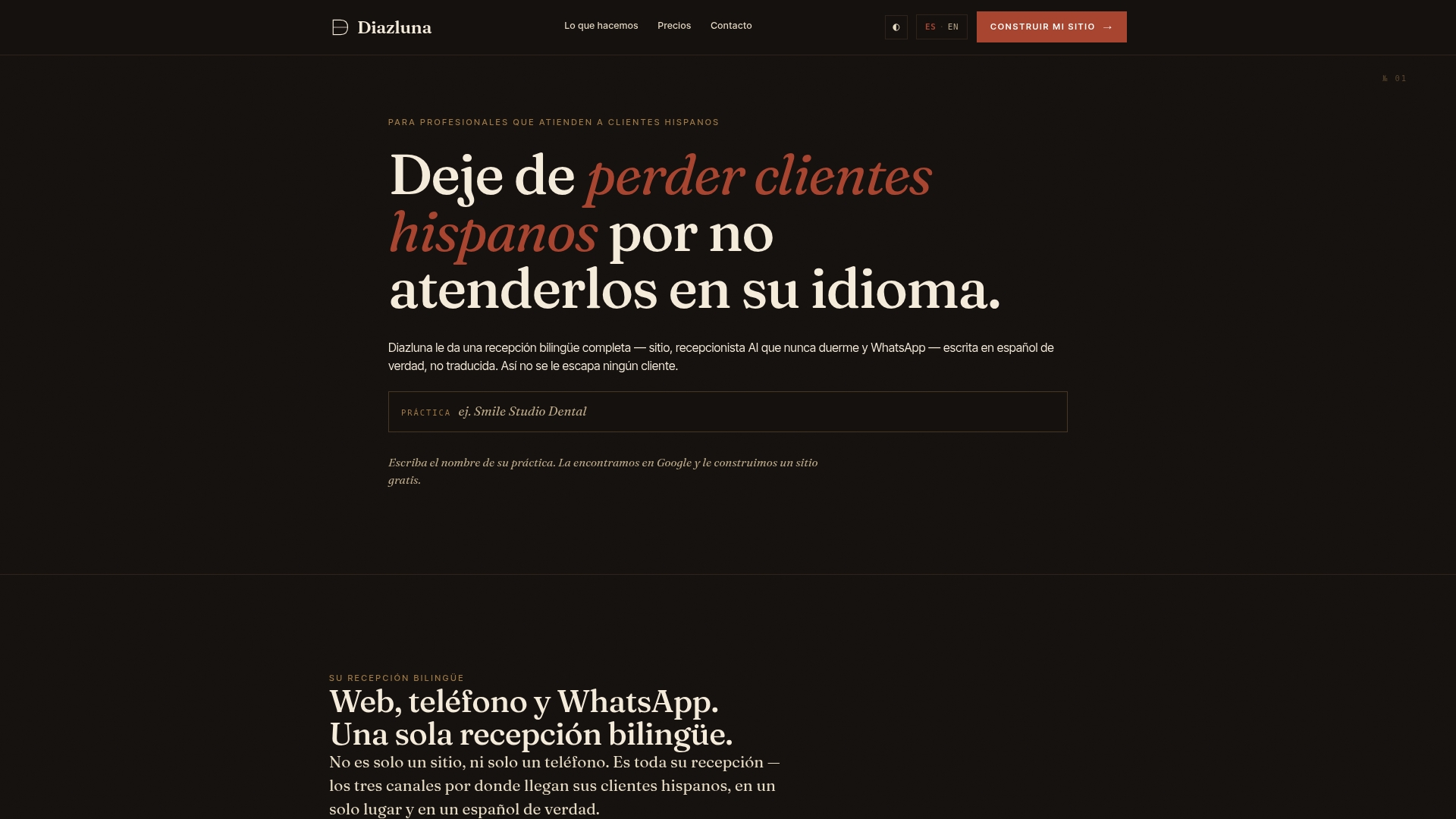
For dental, legal, and healthcare practices, Diazluna’s workflows are built with HIPAA-aware data handling and BAA support, so compliance is not an afterthought. The result: practices report a significant reduction in lost Hispanic clients and Google indexing of new bilingual pages within 24 hours of launch, at a fraction of what a traditional agency charges for the same components separately.
If your practice serves Hispanic clients and your Spanish funnel has any gap in it, that gap is costing you appointments today. See how Diazluna works or go straight to the dentist-specific bilingual front desk page to see what the full setup looks like for a dental practice.
Useful sources and further reading
The sources below support the technical and strategic steps covered in this guide. Consult them for operational detail and vendor evaluation.
- Multilingual Marketing Strategy Guide, Shopify — URL structure, hreflang, and localization strategy fundamentals
- Bilingual Marketing Strategy: Grow Multicultural Reach, Lincoln Digital Group — channel selection, KPI frameworks, and cultural adaptation principles
- The Guide to Bilingual Marketing, Bloom Ads — language continuity across the funnel and common pitfalls
- Multi-Language Digital Marketing Strategy, Telegraph — hreflang implementation, URL strategy, and tiered localization approach
- How Bilingual Digital Marketing Helps Brands Grow, Trusted Writes — Spanish keyword cost advantages and long-term content authority
- Translate Email Campaigns in Multiple Languages, Brevo Help — bilingual email campaign setup and language-attribute delivery
- Translate Content in an Email, Mailchimp — conditional merge tags and Spanish consent capture in email
- Google Business Profile — localized NAP and Spanish-language profile management
- Google Search Console — verifying and monitoring bilingual site versions