November 5, 2026
Law Firm Spanish SEO: A Practical Guide for U.S. Firms
Spanish SEO for a law firm means publishing real Spanish pages for your practice areas, setting them up so Google treats them as the Spanish version of your English site, and making sure the person who finds you can reach someone in Spanish the moment they want to. Most firms do the first part badly (a machine translation) and skip the third (a Spanish page that ends in an English-only phone tree). This guide covers what to build, in what order, and how to tell whether it is working.
TL;DR
- Start small: a complete Spanish path for your two or three best practice areas beats a translated copy of your whole site that nobody maintains.
- Write Spanish pages for how people actually describe their legal problem, not as word-for-word translations of your English pages.
- Use hreflang so each English page and its Spanish counterpart point to each other, and give every page its own canonical URL.
- Local SEO still decides who gets the call: keep your Google Business Profile accurate and tied to a real office.
- Rankings do not retain clients. Intake does: a Spanish phone line, form or WhatsApp reply that works after hours.
Table of Contents
- Why Spanish SEO matters for a law firm
- Decide the scope before you translate anything
- Research Spanish search terms the way clients speak
- Write Spanish legal content that is not a translation
- Perspective: why the site and the phone have to work together
- Technical setup: hreflang, canonicals and clean URLs
- Local SEO for Spanish-speaking clients
- Measure what matters
- Common mistakes to avoid
- A 30-day plan for a small firm
- Put the front desk behind your Spanish pages
- FAQ
- Sources
Why Spanish SEO matters for a law firm
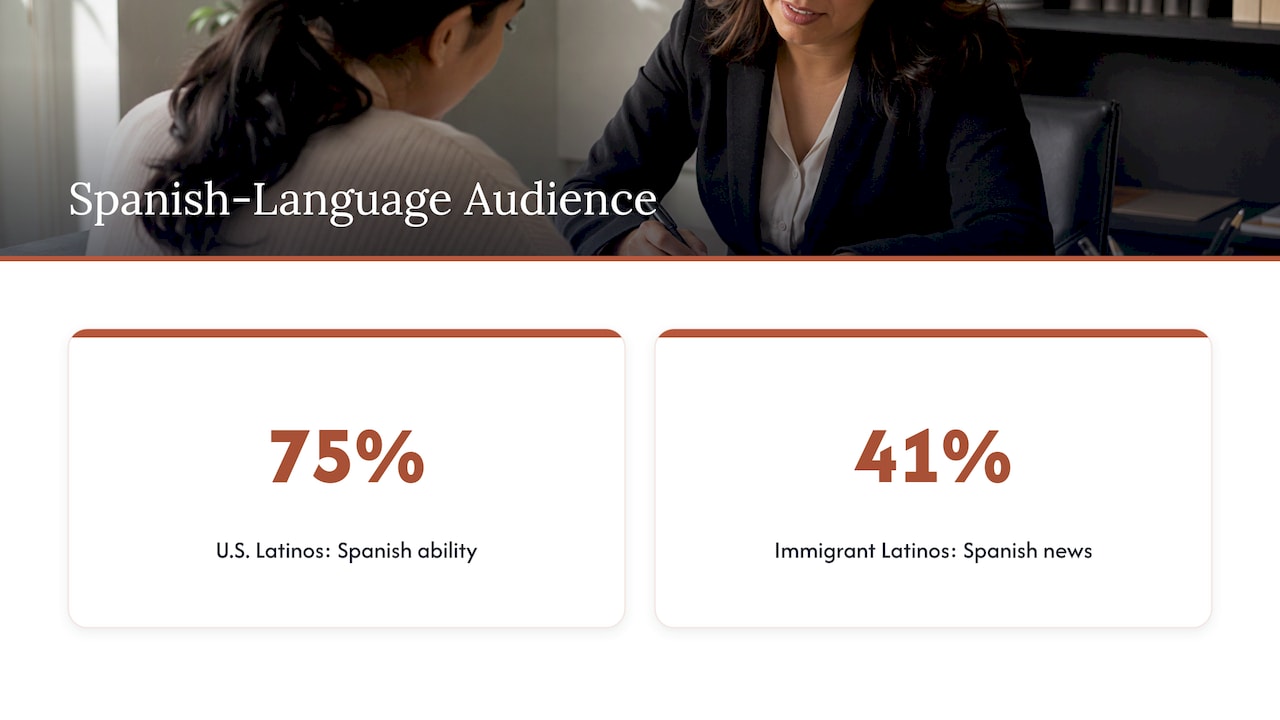
People search in the language they are most comfortable using when the stakes are high. A legal problem is a high-stakes moment: an accident, an immigration question, a custody filing, a workplace dispute. Pew Research found that 75% of U.S. Latinos said they could carry on a conversation in Spanish pretty well or very well. That is a large group of potential clients who may prefer to read about their case in Spanish, even when they also speak English.
The picture is not uniform, and a good plan accounts for that. Pew also reports that U.S.-born Latinos overwhelmingly get their news in English, while 41% of immigrant Latinos get their news mostly in Spanish. The practical reading: your Spanish audience is not a single type. Recent arrivals, bilingual families deciding together, and a younger U.S.-born client searching in English for a Spanish-speaking parent all show up in different searches. Your English pages still matter. Your Spanish pages cover the people who would otherwise never find you.
The competitive side is encouraging too. Many firms put “se habla español” next to the phone number and stop there. A real Spanish page that answers a specific question is rare enough in many local markets that a focused firm can stand out quickly.
Decide the scope before you translate anything
The most common failure is ambition. A firm translates 80 pages, nobody reviews them, the English pages change, and the Spanish site goes stale. A better rule, in line with one multilingual legal SEO guide that favors a smaller, complete and maintainable language path over a large translated archive, is to build only what you can support accurately and keep current.
A sensible first scope for most firms:
- A Spanish home page that says who you help, where your office is, and how to reach you in Spanish.
- Two or three practice-area pages for the work you most want: personal injury, immigration, family law, workers’ compensation, or whatever drives your revenue.
- A Spanish contact and intake path: a form, a phone number answered in Spanish, and ideally WhatsApp.
- A short Spanish page about your attorneys and what languages your team actually speaks.
That is five to eight pages. Each should be finished: reviewed by someone who knows both the law and the language, with its own title, description and call to action.
Be clear about what you can deliver in Spanish
A Spanish page promises a Spanish experience. If your attorney does not speak Spanish and relies on an interpreter, say so plainly. The same guide recommends a clear statement of representation scope and language support on multilingual legal pages. Reader trust drops fast when the page promises one thing and the first call delivers another.
Research Spanish search terms the way clients speak
This is where translation fails. A client does not search for the Spanish equivalent of your English page title. They search the way they talk, and that varies by country of origin, region and age.
Build your keyword list from real conversations
Start with what your intake staff already hear. Write down the exact Spanish phrases callers use to describe their problem: “me chocaron el carro,” “me despidieron sin aviso,” “necesito un abogado de inmigración,” “mi patrón no me paga.” These phrases are a better seed list than any generic tool, and they often differ from the textbook legal term.
Then expand:
- Type the phrases into Google and read the suggestions and the “people also ask” box. Note which words recur.
- Check variations: “abogado de accidentes” and “abogado de choques” can both be used, and one may dominate in your city.
- Add place: “abogado de inmigración en Houston” carries local intent. The city name, in Spanish searches, behaves much like it does in English.
- Use your keyword tool of choice to compare volumes, but treat volume as a tiebreaker. A low-volume phrase that matches a client’s exact situation can convert better than a broad one.
Match one page to one problem
Each page should answer one need. “Abogado de accidentes de auto” deserves its own page, separate from a general “abogado de lesiones personales” page if you handle both and the audience searches both. Cover what happens next, what to bring to a first consultation, how fees work in your practice if you are able to say, and how to reach you now.
Write Spanish legal content that is not a translation
Transliterated English reads as foreign. Legal Spanish is also tricky because the same concept can have different names across countries, and some U.S. legal concepts have no clean equivalent. A bad translation does more than weaken SEO: it can confuse a reader about their rights.
What a strong Spanish legal page does:
- Uses the words people use, then explains the formal term once. For example, introduce the everyday phrase, then the U.S. legal term in parentheses.
- Explains U.S. concepts instead of assuming they are familiar. Many readers have experience only with a different country’s legal system.
- Has an attorney review before publishing, for accuracy as much as for style.
- Names an owner for updates. When the law or your process changes, someone is responsible for changing the Spanish page on the same day as the English one.
- Keeps navigation in Spanish. Menus, buttons, forms and confirmation messages should all be in the same language as the page. A Spanish article that sends the reader to an English-only form loses them at the last step.
If you want a deeper look at the writing approach, our guide on Spanish SEO for lawyers explains why we prefer transcreation (rewriting for meaning and intent) over translation. For site structure and conversion, see our piece on a bilingual law firm website.
Perspective: why the site and the phone have to work together
We built Diazluna because we kept seeing the same pattern in practices serving Hispanic clients: money spent on marketing, then lost at the first contact. A Spanish-speaking person finds a page, calls after 6 p.m., reaches voicemail in English, and calls the next firm.
That is why we do not treat Spanish SEO as a stand-alone project. Our approach is one bilingual front desk: a bilingual website with Spanish content reviewed by a human, a 24/7 AI receptionist fluent in Spanish and English, and WhatsApp in the same flow. The pages bring people in, the receptionist answers, schedules and flags urgent cases, and you get a summary.
Our view is that language authenticity is the whole game. Content that reads like a translation looks like a mistake to the reader, and it is easy to feel when a firm does not really speak your language. We would rather a firm publish five pages that sound right than fifty that do not.
Francisco
Technical setup: hreflang, canonicals and clean URLs
The technical layer is short and worth doing once, correctly.
Hreflang
Google recommends using hreflang for alternate language or locale versions of a page. Per Google’s documentation, each version must list itself and every other version, the alternate URLs must be fully qualified, and the links must be reciprocal: if the English page points to the Spanish one, the Spanish one must point back. A missing return link is the classic error.
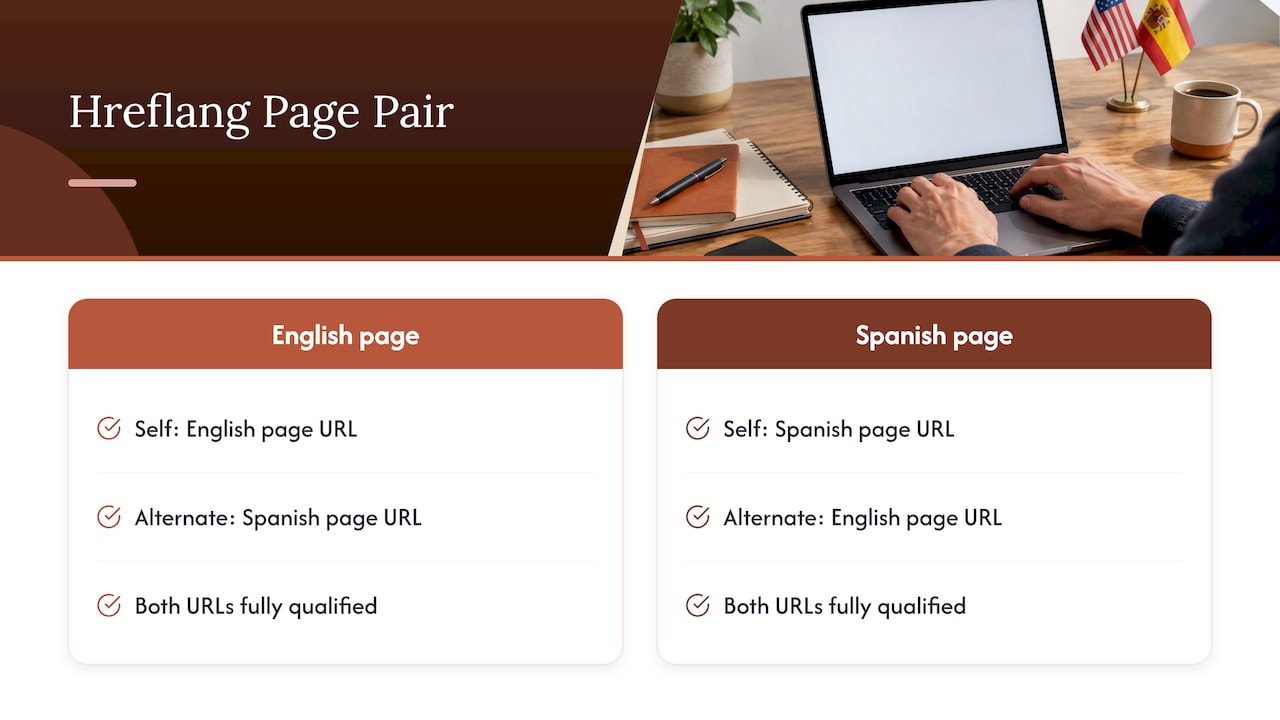
In practice that means a pair like this for each page: the English page declares itself as en and its Spanish counterpart as es, and the Spanish page declares the same two. Our walkthrough on hreflang for English and Spanish shows the three tags and how to test them.
Other structure choices
Beyond hreflang, a multilingual legal SEO guide suggests self-canonical URLs for each language page, accurate language declarations and metadata, and ordinary crawlable links. It also advises against automatic redirects based on a visitor’s IP address or browser language, because they can send people, and search engines, to the wrong version.
A checklist you can hand to your web person:
| Item | What to do |
|---|---|
| URL structure | Give Spanish pages their own URLs, for example a /es/ folder, so each is crawlable and shareable |
| Hreflang | Reciprocal tags on every English and Spanish pair, with full URLs |
| Canonical | Each page points to itself as canonical, not to the English version |
| Language switcher | A visible link between versions, built as a normal link |
| Page language | Set the correct language on each page and write titles and descriptions in Spanish |
| Redirects | No forced redirects by location or browser language |
For broader multilingual site practice, these multilingual website best practices are a useful companion when you plan the build and its upkeep.
Local SEO for Spanish-speaking clients
Legal searches are heavily local. Someone looking for “abogado de inmigración cerca de mí” wants an office they can reach. That makes your Google Business Profile as important as any page.
Practical points:
- Tie your profile to a real location. A multilingual legal SEO guide notes that a profile should represent an eligible real location or public-facing practitioner and should not be created for every city where you merely accept remote matters.
- Avoid thin city pages. The same source warns that unsupported city pages can become doorway pages. One strong page for a city where you have an office is better than twenty near-identical pages for towns where you do not.
- Say “Spanish spoken” where it counts: in your profile description, on your site header, and in Spanish on your contact page.
- Keep name, address and phone consistent wherever your firm is listed.
- Ask for reviews in Spanish from clients who are comfortable giving them. Reviews written in Spanish reinforce the signal that you serve that community.
For a step-by-step routine, this local SEO checklist covers Google Business Profile hygiene and what to avoid with unsupported listings. Our own Spanish local SEO guide walks through the Spanish side of it for U.S. practices.
Measure what matters
SEO reports can look impressive while producing no clients. Pick measures that follow the client’s path, and look at Spanish and English separately.
- Indexing and impressions. In Google Search Console, check that your Spanish pages are indexed and which Spanish queries they appear for. Filter by page folder to separate languages.
- Clicks and queries. Look for the real phrases people used. Add the good ones to your pages and your keyword list.
- Calls and messages. Count Spanish calls, WhatsApp conversations and form submissions. Ask intake to note the language and how the person found you.
- Missed contacts. How many Spanish-language calls went to voicemail or an English-only message? This number is the cheapest improvement you can make.
- Consultations booked. The last step that matters before revenue. Track by language.
Give it a sensible window. New pages need time to be crawled and to build visibility, so judge direction (impressions rising, queries matching your pages) before you judge volume of cases.
Common mistakes to avoid
- Machine translation published unreviewed. It reads wrong to native readers and can state the law inaccurately. Always have a qualified person review.
- Translating everything at once. Scope creep leads to stale pages. Finish a small set first.
- Using one Spanish for everyone. Vocabulary changes by region. Use your intake team’s real phrases.
- A Spanish page with an English form. Every step after the click should be in Spanish.
- No after-hours answer. Clients searching in the evening call once. If nobody answers in Spanish, they move on.
- Over-promising language support. State plainly who speaks Spanish and what services are available in it.
- Hreflang without return tags. The pair must reference each other.
- Doorway pages for cities you do not serve. They add risk without adding clients.
A 30-day plan for a small firm
Week 1: Choose and gather. Pick the practice areas. Pull the top ten Spanish phrases from intake. Confirm who on your team can review Spanish content.
Week 2: Write. Draft the Spanish home page and two practice pages around those phrases. Have an attorney check accuracy, then a native speaker check tone.
Week 3: Build the technical layer. Publish on dedicated Spanish URLs, add reciprocal hreflang tags and self-canonicals, and set up the Spanish contact path, including an answer for after-hours calls.
Week 4: Local and measurement. Update your Google Business Profile for Spanish, request reviews, and set up Search Console filters for your Spanish folder. Write down your starting numbers.
For more on how the pieces fit together, see our overview of Hispanic legal marketing for U.S. law firms and the guide to a law firm Spanish website that converts.
Put the front desk behind your Spanish pages
The pages are half the job. The other half is what happens when a Spanish speaker reaches out. We built Diazluna to give law firms both: a bilingual website, a 24/7 AI receptionist fluent in Spanish and English, and WhatsApp, with summaries of each conversation and transfer of urgent cases to your team.
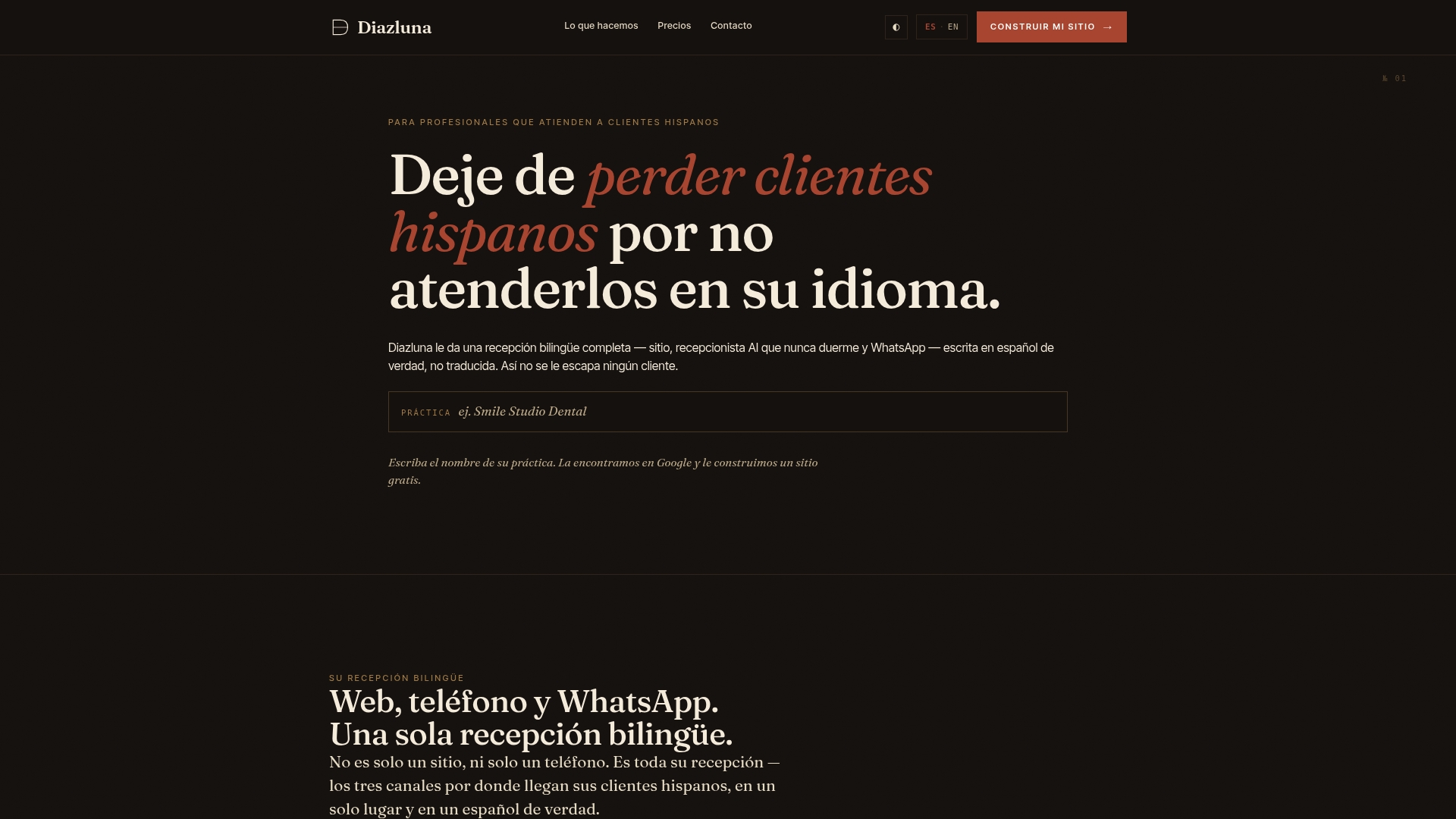
Plans are subscription-based. Solo Sitio, the website only, is $99 per month or $990 per year. Sitio + María, which adds the AI receptionist, is $199 per month or $1990 per year. Sitio + María Pro, the full-service managed package with site updates and expanded call capacity, is $349 per month or $3490 per year. Activation is a one-off $399. You can see the options on our plans page or start building your site.
FAQ
Does my law firm really need Spanish SEO?
If you want Spanish-speaking clients to find you, yes. Many search in Spanish, especially for something as serious as a legal problem, and an English-only site rarely appears for those searches. Pew’s data shows a large share of U.S. Latinos can hold a conversation in Spanish, which is the audience these pages serve.
Can I just use automatic translation for my Spanish pages?
We advise against publishing unreviewed machine output on legal pages. It tends to read unnaturally and can misstate legal ideas. The better path is a short set of pages written in natural Spanish and reviewed by an attorney and a native speaker before they go live.
How many Spanish pages should I start with?
Start with five to eight: a home page, two or three practice-area pages, a contact and intake page, and a short attorney page. Add more only when you can keep them accurate and updated alongside the English versions.
Do I need a separate Spanish website?
Not necessarily. Most firms do well with Spanish pages on the same domain, in their own folder, connected to the English pages with reciprocal hreflang tags. What matters is that each version has its own URL and that the two point to each other.
How do I know if Spanish SEO is working?
Look at Spanish queries and impressions in Google Search Console first, then at Spanish calls, messages and consultations booked. Track them separately from English so you can see which pages and phrases bring real contacts.
Sources
- Pew Research Center: Latinos and the Spanish language
- Pew Research Center: How Hispanic Americans get their news
- Google Search Central: Localized versions of your pages
- SEO for Immigration Lawyers: A Multilingual Guide
- Multilingual website best practices
- Local SEO checklist