October 22, 2026
Spanish Local SEO: A Practical Guide for U.S. Practices
Spanish local SEO means making your practice easy to find, understand and book when a Spanish speaker in your city searches on Google or Maps. It comes down to five things: a Google Business Profile that works in Spanish, Spanish pages on your own site with proper language tags, copy written by a person rather than run through a translator, reviews answered in both languages, and a fast way to book. This guide is for dentists, lawyers, clinics and other small practices in the United States, not for businesses targeting Spain.
That last point matters because much of what ranks for this query is about Spain: Google.es, agencies in Madrid, directories of Spanish companies. If your patients and clients live in Houston, Miami, Phoenix or the Bronx, none of that applies to you.
TL;DR
- Spanish local SEO for a U.S. practice is built on four assets: a Google Business Profile, Spanish service pages, correct hreflang tags and Spanish reviews.
- Write Spanish pages from scratch for your audience. Literal translation reads stiff and loses the visitor before the booking form.
- Never redirect visitors by browser language. Give them a visible language switcher and use separate URLs for each language.
- Search is only the first step. If nobody answers the phone or WhatsApp in Spanish, the ranking does not turn into appointments.
- Health practices need a Business Associate Agreement with any AI or front-desk vendor that touches patient information.
Table of Contents
- Why Spanish local search deserves its own plan
- The four pieces of Spanish local SEO
- Write Spanish, do not translate English
- Search brings the visitor. Someone still has to answer.
- Our perspective: one front desk, not three vendors
- What Spanish local SEO costs
- Privacy and compliance for health and legal practices
- A 30-day plan you can start this week
- How Diazluna fits
- FAQ
- Sources
Why Spanish local search deserves its own plan
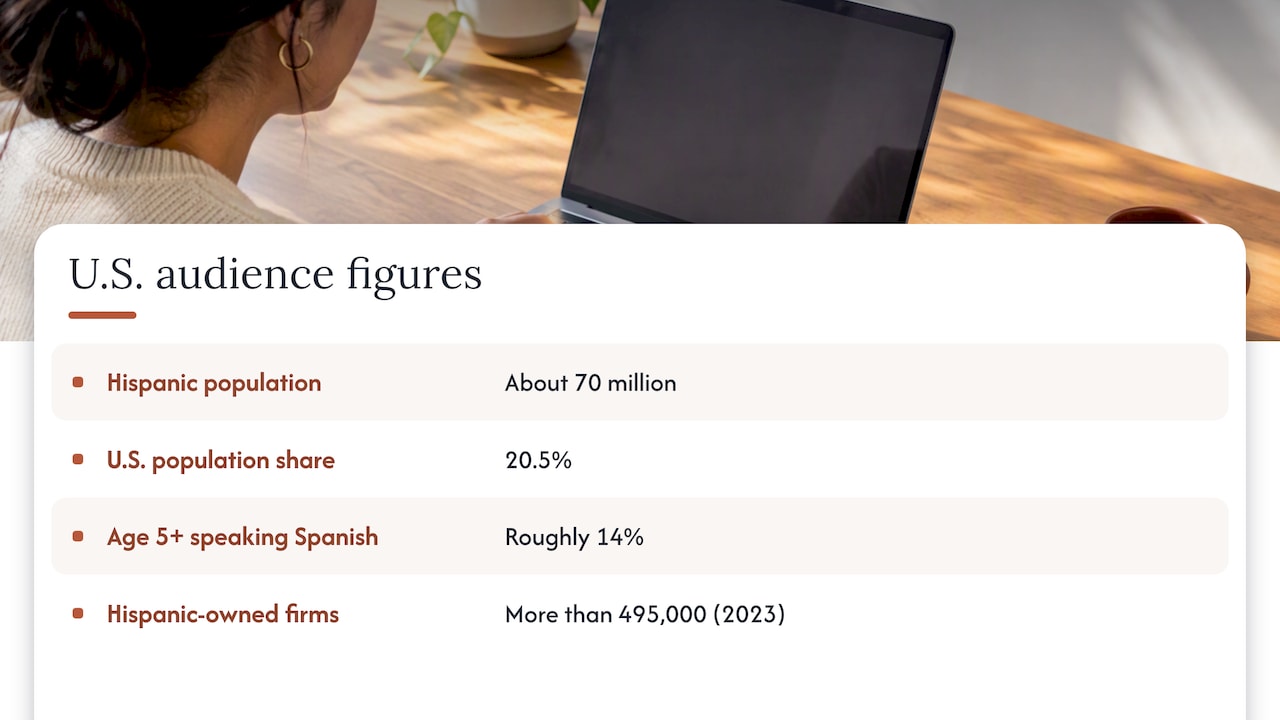
The audience is large and it is already in your service area. The Census Bureau puts the Hispanic population at about 70 million people, or 20.5% of the U.S. population, and Spanish is the most common non-English language spoken in the country. The same agency notes that roughly 14% of people age 5 and over speak Spanish and that more than 495,000 U.S. businesses were Hispanic-owned in 2023.
Most of those households also search in English some of the time. That is the point. Language choice shifts with the task: a person may look up a restaurant in English and a dentist for their mother in Spanish, because the stakes are higher and they want to be understood. If your site only exists in English, you lose that second kind of search, and you lose it before you ever knew the person existed.
There is also a competition angle. In many service areas the Spanish version of a query like “dentista cerca de mí” or “abogado de inmigración” has far fewer well-built pages than the English version. A practice that publishes a few strong Spanish pages can show up quickly where an English-only competitor cannot.
The four pieces of Spanish local SEO
1. A Google Business Profile that speaks Spanish
Your profile is usually the first thing a local searcher sees, so start there. Google’s guidelines for representing your business set the rules: use your real-world name, an accurate address or service area, and honest categories. Do not stuff keywords into the name, even Spanish ones. That is the fastest way to get a profile suspended.
What you can do within the rules:
- Write the description so it includes a clear line in Spanish, such as “Atendemos en español”, along with the services you offer.
- Add Spanish-language posts, photos with Spanish captions where relevant, and Q&A answers in Spanish.
- Answer every review in the language the reviewer used.
- List Spanish among the languages your staff speaks, but only if it is true on the day someone calls.
A caveat: the profile has one name and one description field, and the community discussion on multilingual support shows owners asking whether these can be localized by language. Plan on a single bilingual description rather than counting on separate translated versions. For a deeper walkthrough, see our guide to optimizing your Google Business Profile in Spanish.
2. Spanish pages on your own site
A Spanish home page is not enough. Searchers type specific needs: “limpieza dental para niños”, “consulta de inmigración gratis”, “pediatra que acepta Medicaid”. Each of those deserves a page that answers it in Spanish, with your city, your hours, your phone number and a clear next step.
Start with the three or four services that bring you the most revenue. Write each page for the person who will read it, not for a crawler. Our walkthrough on publishing three Spanish dental pages shows the pattern for dentists, and the same logic holds for lawyers and medical clinics.
3. Technical setup: separate URLs and hreflang
Google’s documentation on multilingual sites gives a few rules worth following exactly:
- Put each language on its own URL, for example
/es/for Spanish, rather than swapping text on one page. - Link the two versions of each page to each other with hreflang annotations so Google serves the right one and does not treat them as duplicates.
- Do not redirect users automatically based on browser language. Googlebot crawls mostly from the U.S. and often sends no language preference, so it may never see the Spanish version. Offer a visible language switcher instead.
This is the part most often broken on do-it-yourself bilingual sites, usually by a translation plugin that rewrites the page in the browser. If Google cannot fetch a Spanish URL, it cannot rank it.
4. Reviews, citations and consistency
Keep your name, address and phone number identical across your site, your profile and directories. Then ask Spanish-speaking patients and clients for reviews in the language they are comfortable with, and reply in kind. A review in Spanish is a signal to the next Spanish speaker that people like them are welcome.
Write Spanish, do not translate English
This is where most bilingual sites fall down. A translated page is technically Spanish, but it often sounds like a form letter, and the reader notices in seconds.
The language itself is varied. Pew Research found that 75% of U.S. Hispanics say they can carry on a conversation in Spanish well, and 63% use Spanglish at least sometimes, a share that rises among bilingual Latinos. Your audience includes recent arrivals, second-generation adults who switch mid-sentence, and grandparents who read only Spanish. A single stiff register fits none of them well.
Practical rules:
- Use the words your patients use. Many say “seguro” and “cita”, not formal alternatives, and may search with regional terms. Ask your front-desk staff what callers actually say.
- Prefer “usted” for medical and legal pages, with a warm tone. Skip slang, but do not write like a statute.
- Rewrite, then have a native speaker review. Do not just translate and proofread.
- Keep the structure of each page parallel to English, so a family can compare, but let the sentences be natural.
- Keep terms like “copay” or “DACA” where your clients use them, and explain them in one line.
For a look at how language choices differ across generations, this bilingual bail-bond guide discusses how families communicate in a high-stakes service, a useful reminder that tone matters most when people are stressed.
Search brings the visitor. Someone still has to answer.
SEO professionals often point out that local SEO is a conversion tool, not just a rankings project: 83% of clients expect their provider to help them reach new customers. For a Spanish-speaking patient, the conversion moment is the first call, the first message or the first booking form. If that is only available in English, the work you did to rank is wasted.
Three habits close the gap:
- Put a click-to-call number and a WhatsApp link above the fold on every Spanish page.
- Make sure someone, or something, can answer in Spanish outside office hours. Many people search at night or on weekends.
- Track Spanish calls and messages separately so you can see what the Spanish pages actually produce.
WhatsApp deserves particular attention. Its use for appointment booking is common in many Latino households, and you can start in about an hour; see how to set up WhatsApp appointment booking.
Our perspective: one front desk, not three vendors
We build Diazluna for practices that serve Hispanic clients, and the pattern we see is consistent. A practice buys a Spanish SEO package from one provider, a website from another, and an answering service from a third. None of them talk to each other. The Spanish page ranks, the visitor calls, and the line goes to English-only voicemail.
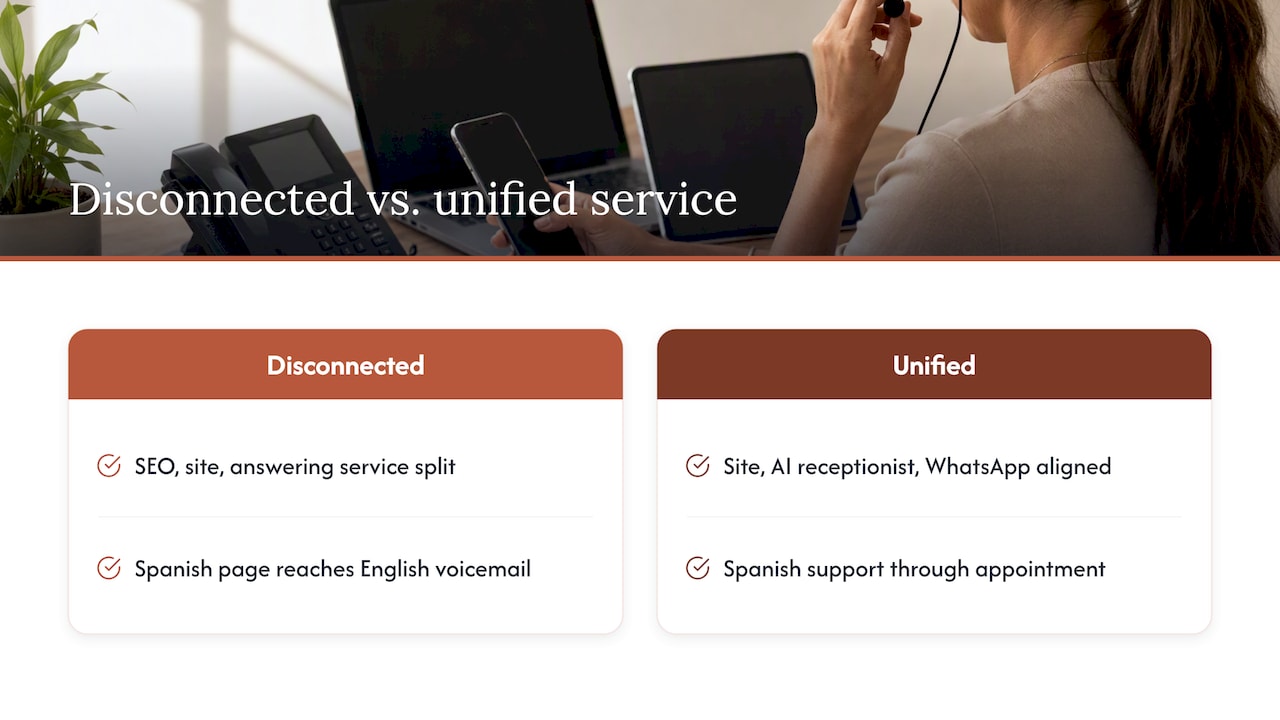
We think the fix is to treat discovery and response as one system. The Spanish site, the AI receptionist and WhatsApp should share the same information, hours and tone, so a person who finds you in Spanish is answered in Spanish all the way to the appointment. That is also why we insist on human-reviewed Spanish rather than machine output: if the first page sounds off, the rest of the experience does not recover.
We also think owners should be able to edit their own site without a developer. Hours change, a new service launches, a holiday closes the office. Waiting on an agency ticket for a change like that costs bookings. For more on this view, read why bilingual support beats traditional agencies and our piece on bilingual content and client loyalty.
— Francisco
What Spanish local SEO costs
Agency pricing for local SEO is not cheap. SE Ranking’s pricing survey reports that local SEO for professional services commonly runs $500 to $2,500 per month, and that agencies tend to charge about 30% more than freelancers. Spanish work is usually an add-on to that, because it needs a native writer.
That is the reason many small practices skip Spanish altogether. The realistic options are:
| Approach | What you get | Watch out for |
|---|---|---|
| Do it yourself | Lowest cash cost | Time, uneven Spanish, hreflang mistakes |
| Freelancer | Writing or audit for specific pages | Nobody answering calls or messages afterward |
| Full-service agency | Strategy, content and reporting | Monthly fees in the range above, several vendors to coordinate |
| Integrated bilingual front desk | Site, receptionist and messaging together | Check the vendor’s privacy and compliance terms |
The right choice depends on your volume and whether you have someone in-house who writes good Spanish. If you do, a freelancer plus careful setup may be enough. If you do not, an integrated option is usually simpler.
Privacy and compliance for health and legal practices
If you handle health information, any AI receptionist or digital front desk is a vendor with access to it. The FTC’s guidance on HIPAA, the FTC Act and health information explains that this typically makes the vendor a business associate, which means you need a Business Associate Agreement in place before patient data flows. Confirm that with your compliance advisor or healthcare attorney, not only with the vendor.
Separately, privacy promises must be clear in the language your patient reads. The FTC has treated misleading data practices as deceptive under Section 5 of the FTC Act, and an FTC filing on a health-data matter illustrates how seriously it takes representations about sensitive data. In practice: publish your privacy notice in Spanish, not just English, and make sure it matches what your systems do.
Law firms face their own rules on advertising and client confidentiality, which vary by state bar. Check your state’s rules before you publish Spanish marketing claims. Our guide to Hispanic legal marketing covers the marketing side.
A 30-day plan you can start this week
- Week 1: Audit your Google Business Profile against Google’s guidelines. Add a Spanish line to the description, check categories, and reply to every open review.
- Week 1: List your five most profitable services and the Spanish phrases patients use for each. Ask your front desk.
- Week 2: Publish a Spanish version of your home page and two service pages on
/es/URLs, with a visible language switcher. - Week 3: Add hreflang tags between each pair of pages and confirm both versions load without redirects.
- Week 3: Add click-to-call and WhatsApp buttons to every Spanish page.
- Week 4: Ask recent Spanish-speaking patients for reviews and reply in Spanish.
- Week 4: Review which Spanish pages get impressions in Google Search Console and expand the best ones.
For a broader plan, see our overview of bilingual digital marketing strategies for practices.
How Diazluna fits
If you would rather not run this as three projects, Diazluna combines a bilingual website, a 24/7 AI receptionist and WhatsApp in one subscription. Plans on our site are:
- Solo Sitio: $99 per month or $990 per year, for the bilingual website.
- Sitio + María: $199 per month or $1990 per year, adding the AI receptionist.
- Sitio + María Pro: $349 per month or $3490 per year, the full-service package.
There is a one-off activation fee of $399. Dentists can see how it works on our page for Hispanic-serving dentists. Whatever you choose, review the privacy and BAA terms first if you are a health practice.
FAQ
What is Spanish local SEO?
It is the work of making your business visible to Spanish-speaking people searching near you. That includes your Google Business Profile, Spanish pages on your site, hreflang tags, Spanish reviews and a way to respond in Spanish. It differs from SEO for Spain, which targets Google.es and Spanish companies.
How much does local SEO cost?
SE Ranking reports that local SEO for professional services often runs $500 to $2,500 per month with an agency, and that agencies charge more than freelancers. Spanish content may add to that. An integrated platform can cost far less, but compare what is included.
Do I need a separate Spanish website?
No. One site with a Spanish section on its own URLs is enough, as long as the pages are linked with hreflang and visitors can switch languages manually. Avoid browser-based automatic redirects.
Is machine translation good enough?
For internal drafts, perhaps. For public pages, we advise against publishing it unreviewed. Pew’s data shows how varied Spanish use is among U.S. Hispanics, and stiff translation is easy to spot. Have a native speaker write or rewrite the page.
Is it worth doing if I only have a few Spanish-speaking clients?
Often yes, because the few you see now may be those who persisted despite the barrier. Start small: a profile update, three Spanish pages and a Spanish answer path, then measure calls and bookings.
Sources
- U.S. Census Bureau: Hispanic Heritage Month and Spanish
- U.S. Census Bureau: Fun Facts, Hispanic Heritage Month
- Google Business Profile Help: Guidelines for representing your business
- Google Business Profile Community: multilingual support
- Google Search Central: Managing multi-regional and multilingual sites
- Pew Research Center: Latinos and Spanish
- Increv: SEO services statistics
- SE Ranking: SEO pricing
- FTC: HIPAA, the FTC Act and health information
- FTC filing on sensitive health data representations