October 1, 2026
30/60/90 Day Medical Spanish SEO for Small U.S. Clinics

Yes, medical Spanish SEO produces measurable new discovery and appointments when implemented correctly. Practices operate in counties where Spanish is widely spoken at home and where a share of residents have limited English proficiency, according to Census language tables, and federal guidance on meaningful access reinforces why clear communication matters. Success looks like tracked increases in Spanish impressions, calls, and completed bookings.
TL;DR:
- Spanish SEO requires localized keyword research based on actual queries from sources like Search Console, call logs, and bilingual staff, not guesswork.
- Proper technical setup including hreflang, alternate URLs, and native Spanish metadata is essential to achieve high search rankings in Spanish.
- Content must remain honest about language access capabilities by clearly stating free interpretation services and avoiding false claims about in-house language capacity.
- Monitoring segmented performance metrics from Search Console, Google Business Profile, and call tracking is crucial to measure Spanish SEO success and identify needed improvements.
- Building a minimal Spanish page set focused on core services and appointment requests can generate search signals within 30 to 90 days.
Table of Contents
- What medical Spanish SEO actually means for your practice
- Core components that make Spanish pages discoverable
- A step-by-step Spanish SEO workflow for your practice
- Language access and safety: what Spanish pages should never do
- Measuring what your Spanish SEO is actually doing
- A 30/60/90 day checklist for your practice
- Lessons from bilingual front-desk deployments
- How Diazluna fits into this workflow
- Sources
- FAQ
What medical Spanish SEO actually means for your practice
Medical Spanish SEO is the technical and content work that helps Spanish-language searchers find your practice online: keyword targeting, page structure, and metadata built around how patients actually search in Spanish. It is not the same as clinician Spanish fluency and it is not medical interpreting. A well-optimized Spanish page can bring a patient to your door, but what happens in the exam room still depends on qualified language support.
The opportunity is sizable at the local level. County and metro-level ACS data show meaningful concentrations of Spanish-at-home households and residents with limited English proficiency, though the pattern varies widely by region, which is why national averages are the wrong planning tool.
That gap between discovery and care delivery is where practices most often get language access wrong.
- Spanish SEO gets a patient to find and choose your practice online.
- Interpreting and bilingual clinical staff carry the conversation from there.
- Confusing the two can create safety risk if a page implies more language capacity than the practice actually has.
Core components that make Spanish pages discoverable
Ranking in Spanish requires more than a translated version of your English site. It requires its own research, structure, and signals.
- Keyword research: Pull real Spanish queries from Search Console filters, Google Business Profile insights, front-desk call logs, and conversations with bilingual staff rather than guessing at translations.
- Information architecture: Decide on alternate URLs per language, implement hreflang correctly, and set a clear canonical strategy before a single sentence gets translated.
- On-page signals: Use proper language attributes, write Spanish metadata natively, and keep headings and body copy in natural Spanish rather than literal English-to-Spanish conversions.
- Technical and local details: Add schema for local business and medical specialty, confirm mobile performance holds up on Spanish pages, and fill out the Spanish-language fields in your Google Business Profile.
Google’s own guidance on multilingual sites is direct about the architecture piece: translation quality alone will not make content discoverable if the underlying URL structure and language signals are missing. A detailed hreflang audit walks through the technical setup step by step.
Pro Tip: Map your URL structure and hreflang plan before you translate a word. Fixing architecture after the fact usually means redoing the content too.
A step-by-step Spanish SEO workflow for your practice
Running this well does not require a large team, but it does require the right people at the right steps.
- Map your catchment area using local ACS language data rather than national statistics.
- Collect real Spanish search queries from Search Console, call logs, and front-desk staff.
- Draft pages with a qualified bilingual clinical reviewer checking every claim before publishing.
- Implement technical flags: hreflang, alternate URLs, and Spanish metadata.
- Submit for indexing and monitor performance in Search Console segmented by language.
- Set a measurement cadence and escalate underperforming pages for revision.
A few roles need to be involved throughout, not just at the end:
- A clinical reviewer signs off on medical accuracy and tone before anything goes live.
- A webmaster or developer handles the hreflang, canonical, and sitemap work.
- The front-desk manager confirms that call scripts and WhatsApp responses match what the site promises.
Prioritize your appointment request page, one or two core service pages, and a short bilingual FAQ first. Those pages carry the most direct path from search to booking, and a bilingual healthcare website built around them tends to convert better than a large batch of thin translated pages.
Language access and safety: what Spanish pages should never do

Spanish SEO content has to stay honest about what it offers. CMS guidance on language access plans explains that meaningful access means qualified interpretation, not reliance on family members standing in for professional interpreters, and it recommends posting taglines that tell patients free language assistance is available.
Copy on your Spanish pages should never suggest that the website itself replaces clinical interpreting or decision-making. It exists to help someone find your practice and book an appointment, not to substitute for a conversation with a qualified interpreter once they arrive.
- Post a visible tagline noting free language assistance is available, matching CMS recommendations.
- Document an escalation path for when a call or message needs a live interpreter.
- Keep front-desk scripts and WhatsApp responses aligned with what the website claims.
Language barriers measurably affect care access and safety. Peer-reviewed research on language barriers in health care found that inadequate language services reduce access and that quality language support improves patient safety and satisfaction. That is the underlying reason Spanish SEO and language access operations need to move together, not separately.
Measuring what your Spanish SEO is actually doing
Segment Spanish performance from English performance from day one, or you will never know whether the work is paying off.
- Track Spanish impressions, clicks, and click-through rate in Search Console using URL or query filters.
- Monitor Google Business Profile views and actions tied to Spanish-language listing fields.
- Set up call tracking so calls originating from Spanish pages are tagged separately.
- Watch appointment requests and qualified-patient conversion rate by language segment.
- Review monthly, and treat high impressions paired with low conversions as a signal that copy or intent matching needs work.
A practical SEO reporting framework can help structure this segmentation so Spanish and English results never get blended into one misleading number.
A 30/60/90 day checklist for your practice
- Days 1 to 30: Audit current Spanish content, pull local ACS data, and list the top ten Spanish search queries relevant to your services.
- Days 31 to 60: Publish three to five clinically reviewed Spanish pages with correct hreflang and alternate URLs in place.
- Days 61 to 90: Monitor segmented performance, fix underperforming pages, and confirm front-desk scripts match site claims.
A minimum viable Spanish page set built around appointment and service pages is usually enough to start seeing signal within this window.
Lessons from bilingual front-desk deployments
Correctly configured alternate URLs and hreflang tend to get indexed fast, sometimes within a day, while literal translation without architecture planning drags for weeks and never really ranks. Clinical review catches risky phrasing before it goes live, which matters more than speed. The most common pitfalls are word-for-word translation, a Google Business Profile missing its Spanish fields entirely, and a phone or WhatsApp handoff that does not match what the website promised. Move fast on structure, slow down on anything a patient will read as a clinical claim.
— Francisco
How Diazluna fits into this workflow
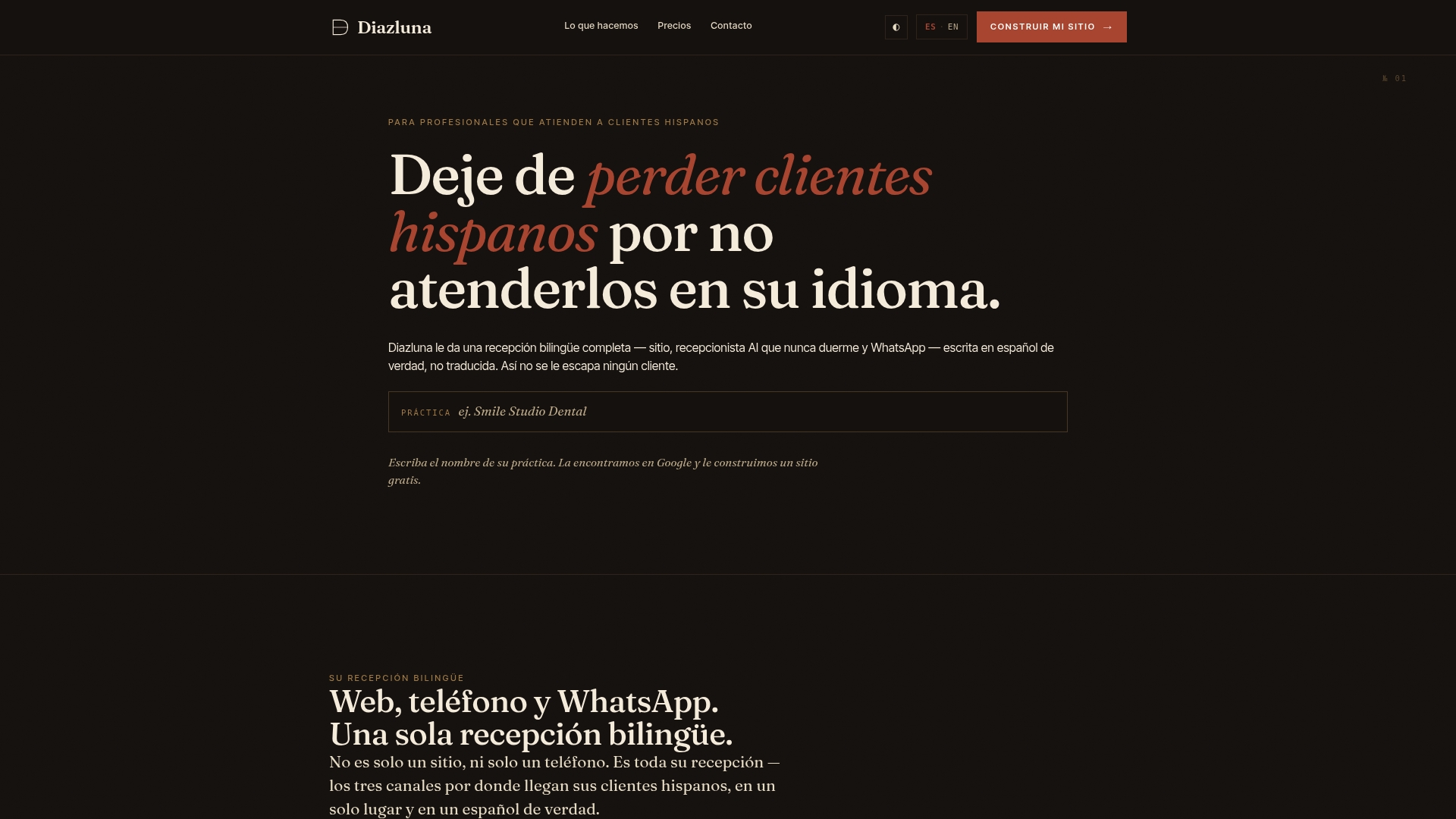
Building and maintaining all of this in-house, a bilingual website, correct technical architecture, a 24/7 answering system, and WhatsApp follow-up, usually means juggling several vendors and a slower timeline. Diazluna combines a bilingual website, a 24/7 AI receptionist, and WhatsApp integration in a single subscription.
A demo typically covers a quick audit of your current site, a look at how the AI receptionist and WhatsApp handoffs would work for your practice, and a realistic timeline for launch.
- Solo Sitio starts the bilingual website on its own, priced at $99 per month or $990 per year.
- Sitio + María adds the AI receptionist for $199 per month or $1,990 per year.
- Sitio + María Pro is the full-service package at $349 per month or $3,490 per year, with a one-time $399 activation fee across plans.
Visit Diazluna to check pricing details or request a demo.
This article is general information, not a substitute for advice from a qualified doctor. Consult a qualified healthcare professional about your own circumstances before acting on anything here.
Sources
- U.S. Census Bureau — American Community Survey language tables (2023)
- CMS — Guide to developing a language access plan
- Google Developers — Managing multi-regional and multilingual sites
FAQ
What does SEO mean in medical terms?
In a medical context, SEO refers to optimizing a practice’s website and listings so patients searching for relevant services and symptoms can find that practice online. It covers keyword targeting, page structure, and local listing accuracy rather than any clinical function.
What does SEO mean in Spanish?
SEO keeps the same English acronym in Spanish and stands for “optimización para motores de búsqueda.” The practice of Spanish SEO applies the same principles, keyword research, metadata, and technical setup, to content written natively for Spanish-speaking searchers.
What is SEO in medical writing?
In medical writing, SEO means shaping page structure, headings, and terminology so search engines and patients can find accurate health content easily. For Spanish medical writing specifically, a qualified bilingual clinical reviewer should check the copy before publishing to keep it both accurate and natural.
What are some common medical terms in Spanish?
Common terms include “cita” for appointment, “receta” for prescription, and “consulta” for consultation or office visit. Using natural, commonly searched Spanish terminology rather than literal translations improves both patient understanding and search visibility.
How is Diazluna different from building a bilingual site with an agency?
Diazluna combines a bilingual website, a 24/7 AI receptionist, and WhatsApp integration in a single subscription instead of separate vendor contracts. Plans start with Solo Sitio at $99 per month, with higher tiers adding the receptionist and full-service management.