August 1, 2026
Best Villafuertesolutions.com Alternatives for US Practices

For most U.S. practice owners serving Hispanic clients, Diazluna is the recommended alternative to Villafuerte Solutions. It replaces the per-minute OPI model with a subscription-based bilingual front desk that includes a bilingual website, 24/7 AI receptionist, and WhatsApp integration in one monthly package. Two other solution categories are worth knowing: Villafuerte-style human OPI services (pay-per-minute certified interpreters like LanguageLine Solutions, CyraCom, Telelanguage, and Stratus Video) and hybrid platforms that route AI-handled intake to live interpreters for complex calls.
When to choose each:
- Subscription bilingual front desk (Diazluna): Ongoing appointment booking, client acquisition, after-hours coverage, and website visibility for dental, legal, or small clinic practices. Predictable monthly cost, HIPAA-aware setup, and WhatsApp included.
- Human OPI pay-per-minute (LanguageLine, CyraCom, Telelanguage, Stratus Video): Emergency medical triage, legal testimony, immigration interviews, or any high-stakes interaction where certified interpreter fidelity is nonnegotiable.
- Hybrid platforms: Practices that need automated intake for routine calls but want a certified interpreter on standby for escalations.
Table of Contents
- How do the main villafuertesolutions.com alternatives compare?
- How the main service models actually differ
- How to choose the right bilingual solution for your practice
- Why Diazluna is the recommended alternative for most U.S. practices
- When human OPI is still the right call
- Key Takeaways
- The real cost of getting this wrong
- Ready to see what Diazluna does for your practice?
- Useful sources and next steps
How do the main villafuertesolutions.com alternatives compare?
| Feature | Human OPI (pay-per-minute) | Hybrid platform | Bilingual digital front desk (Diazluna) |
|---|---|---|---|
| Service model | Human interpreters | AI intake + human escalation | AI receptionist + bilingual website |
| Languages | Spanish + 200+ | Spanish focus + others | Spanish and English |
| Pricing model | Per-minute / per-use | Per-minute + platform fee | Monthly subscription tiers |
| Best for | Healthcare emergencies, legal proceedings | Mid-size clinics, legal firms | Dental, legal, small medical practices |
| HIPAA / compliance | BAA available; verify per vendor | BAA available; verify per vendor | HIPAA-aware; BAA available |
| 24/7 availability | Yes | Yes | Yes |
| WhatsApp + website integration | No | Limited | Yes, bundled |
| Onboarding time | Days (account setup) | 1–4 weeks | Site setup then monthly service |
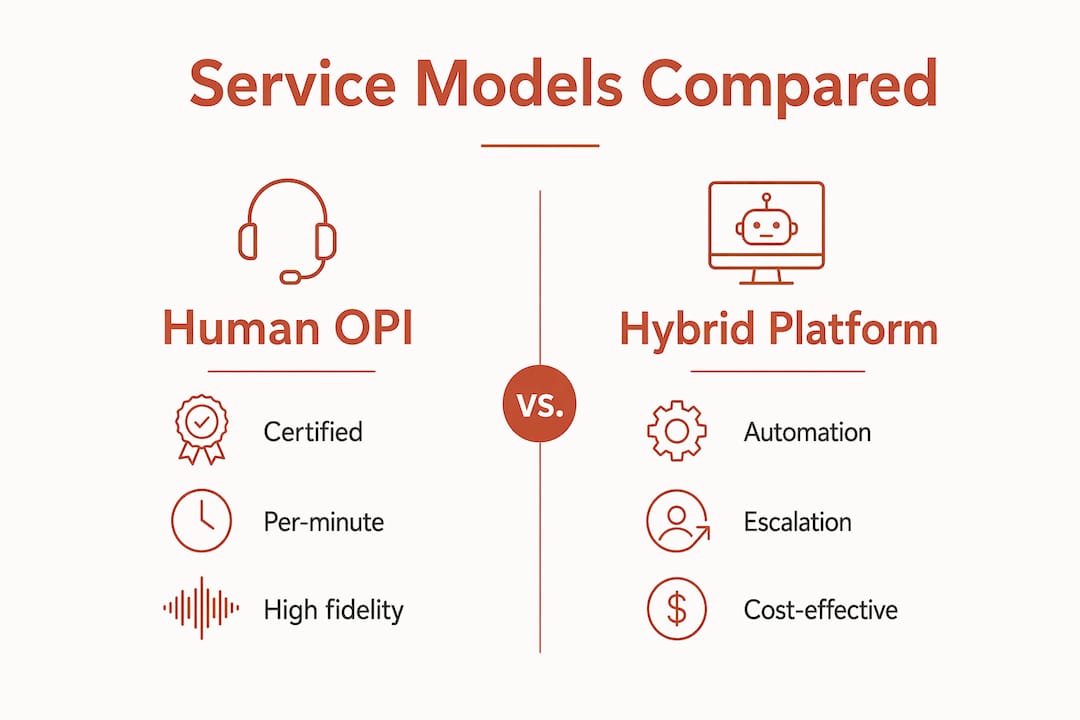
Trust signals to confirm with any vendor: signed Business Associate Agreement (BAA), documented interpreter credentialing or certification, uptime SLA, and encrypted call logs. For human OPI providers like LanguageLine Solutions and CyraCom, ask specifically about medical and legal terminology training hours. Villafuerte Solutions, for reference, requires extensive training per interpreter, which sets a useful benchmark.
How the main service models actually differ
Understanding the operational gap between these models saves you from a costly mismatch.
Human-only OPI delivers the highest language fidelity for sensitive, complex interactions. A certified interpreter joins a call in real time, handles nuance, cultural context, and domain-specific terminology, and carries legal accountability for accuracy. The tradeoff is cost: you pay per minute, every minute, and high-volume practices see bills that swing unpredictably month to month. For a dental office fielding 200 Spanish-language calls a month, that variability adds up fast. Practices managing episodic clinical billing already know how variable per-use costs complicate forecasting.

AI receptionists handle intake, scheduling, and routine questions around the clock without per-minute charges. The limitation is nuance: an AI receptionist is not a certified interpreter and should not be used for clinical consent conversations or legal testimony. What it does well is answer after-hours calls in fluent Spanish, book appointments, send WhatsApp confirmations, and hand off urgent cases with a real-time summary.
Hybrid systems route routine calls through automation and escalate to a live certified interpreter when the conversation requires it. This is operationally efficient for practices that have both high call volume and occasional high-stakes interactions. The setup is more complex, and costs combine a platform fee with per-minute interpreter charges on escalations.
Compliance note: For any model, HIPAA requires a signed BAA before sharing protected health information. Verify encrypted call logs, interpreter credentialing documentation, and your vendor’s breach notification policy before going live. After-hours bilingual support carries the same HIPAA obligations as in-office communication.
Pro Tip: Ask every vendor for their BAA template before the demo ends. A vendor who hesitates or says “we’ll send it later” is a red flag for healthcare and legal practices.
Integration matters too. Human OPI services connect via phone bridge or conference dial-in. AI receptionists like Diazluna’s integrate directly with your website and WhatsApp, so Spanish-speaking clients can reach you through the channel they already use.
How to choose the right bilingual solution for your practice
Prioritize model fit, compliance, price predictability, and integration before comparing vendor names.
Decision checklist:
- Define your core use case: routine intake and scheduling, or emergency and high-stakes interpretation?
- Estimate your monthly Spanish-language interaction volume (calls, messages, appointments).
- Confirm whether you need 24/7 coverage or business-hours-only support.
- Assess clinical or legal sensitivity: does any interaction involve consent, testimony, or diagnosis?
- Choose your budget shape: fixed monthly subscription or variable per-minute spend?
- List required integrations: EHR system, online booking, website, WhatsApp.
Questions to ask on every vendor demo:
- What is your SLA for interpreter connection time?
- Are interpreters certified, and in which domains (medical, legal)?
- Will you sign a BAA before we go live?
- How are calls recorded, stored, and encrypted?
- How does WhatsApp handling work?
- What is the per-minute rate, and is there a monthly cap?
- How long does onboarding take, and is there a pilot option?
- Do you offer training for domain-specific terminology (dental, legal)?
- Can you provide references or case studies from similar practices?
- What happens if an AI interaction needs to escalate to a human?
Pricing and onboarding estimates (ballpark ranges):
- Human OPI services: typically billed per minute; onboarding in days via account setup.
- Hybrid platforms: platform fee plus per-minute escalation charges; onboarding 1–4 weeks.
- Subscription bilingual front desk (Diazluna): monthly subscription tiers after free site setup; onboarding starts with the website build.
Red flags: opaque per-minute pricing with no cap, no BAA offered, no evidence of interpreter credentialing, and onboarding timelines over four weeks with no pilot option.
Why Diazluna is the recommended alternative for most U.S. practices
Diazluna is the recommended subscription alternative for practices that need an always-on bilingual front desk, website, and WhatsApp integration under one predictable monthly cost.
The core offering bundles three things most practices currently pay for separately or go without:
- Bilingual website (Spanish and English), fully optimized and indexed by Google
- 24/7 AI receptionist that handles calls, messages, and appointment scheduling in both languages
- WhatsApp integration with real-time summaries and urgent-case transfer
- Monthly subscription tiers: website-only, website plus AI receptionist, or a full managed package with site updates and expanded call capacity
- Vertical-specific workflows for dental practices and law firms
Diazluna’s marketing claims include reduced client loss and rapid Google indexing within 24 hours of site launch. Spanish-speaking website visitors convert faster when WhatsApp is available, because it removes the friction of calling during business hours. Practices that pair a bilingual website with WhatsApp and a 24/7 receptionist see faster scheduling from Spanish-speaking visitors because the preferred communication channel is already built in.
Pro Tip: If your practice currently loses Spanish-speaking callers after hours, the AI receptionist alone covers that gap. The bilingual website then captures the clients who search in Spanish before they ever call.
Diazluna suits dental offices, law firms, and small medical clinics best. It is not the right fit for emergency room triage or high-stakes legal testimony, where a certified human interpreter is required.
When human OPI is still the right call
Use human-only OPI when language fidelity and live interpretation quality for complex, emergency, or legal proceedings is nonnegotiable.
- Emergency room triage: A misunderstood symptom description can change a clinical decision. Certified medical interpreters carry accountability for accuracy that no AI system currently matches.
- Legal testimony and immigration interviews: Court-admissible interpretation requires a credentialed human interpreter. Providers like LanguageLine Solutions, CyraCom, Telelanguage, and Stratus Video all offer certified legal interpreters for these settings.
- Complex clinical consent: Informed consent conversations involve nuance, patient questions, and emotional context. Human interpreters handle this better than automated systems.
- Hybrid approach: Use an AI receptionist for intake and route complex or sensitive calls to a certified interpreter. This keeps routine costs low while preserving fidelity where it counts.
The cost pattern for human OPI is variable by design. High-volume months produce high bills. Practices with predictable, high Spanish-language call volume will find a subscription model more cost-efficient; practices with occasional high-stakes needs are better served by pay-per-minute access.
Key Takeaways
For most U.S. practices serving Hispanic clients, the choice comes down to whether you need certified human interpretation for high-stakes calls or a subscription bilingual front desk for daily intake, scheduling, and client acquisition.
| Point | Details |
|---|---|
| Match model to use case | Human OPI for emergencies and legal proceedings; AI front desk for daily intake and scheduling. |
| Compliance is non-negotiable | Always get a signed BAA and verify interpreter credentialing before going live with any vendor. |
| Subscription beats per-minute for volume | Fixed monthly costs are easier to forecast than variable per-minute bills for high-volume practices. |
| Hybrid is an option | Route routine calls through AI and escalate sensitive interactions to a certified human interpreter. |
| Diazluna for most practices | Diazluna bundles bilingual website, 24/7 AI receptionist, and WhatsApp under one monthly subscription. |
The real cost of getting this wrong
Most practice owners frame this as a cost decision. It isn’t, not primarily. The real question is what happens to a Spanish-speaking patient or client who calls after hours, hits a voicemail in English, and never calls back.
Human OPI services are excellent at what they do. LanguageLine Solutions and CyraCom have built serious infrastructure for certified interpretation, and for emergency medicine or immigration hearings, there is no substitute. But they were designed for episodic, high-stakes interactions, not for the daily rhythm of a dental office or a small immigration law firm trying to grow its Hispanic client base.
The practices I see struggle most are the ones that sign up for a per-minute service, use it for routine appointment calls, and then wonder why their monthly costs are unpredictable and their website still shows up only in English. A bilingual front desk is a client acquisition tool as much as a communication tool. That reframe changes which solution makes sense for most practices.
Ready to see what Diazluna does for your practice?
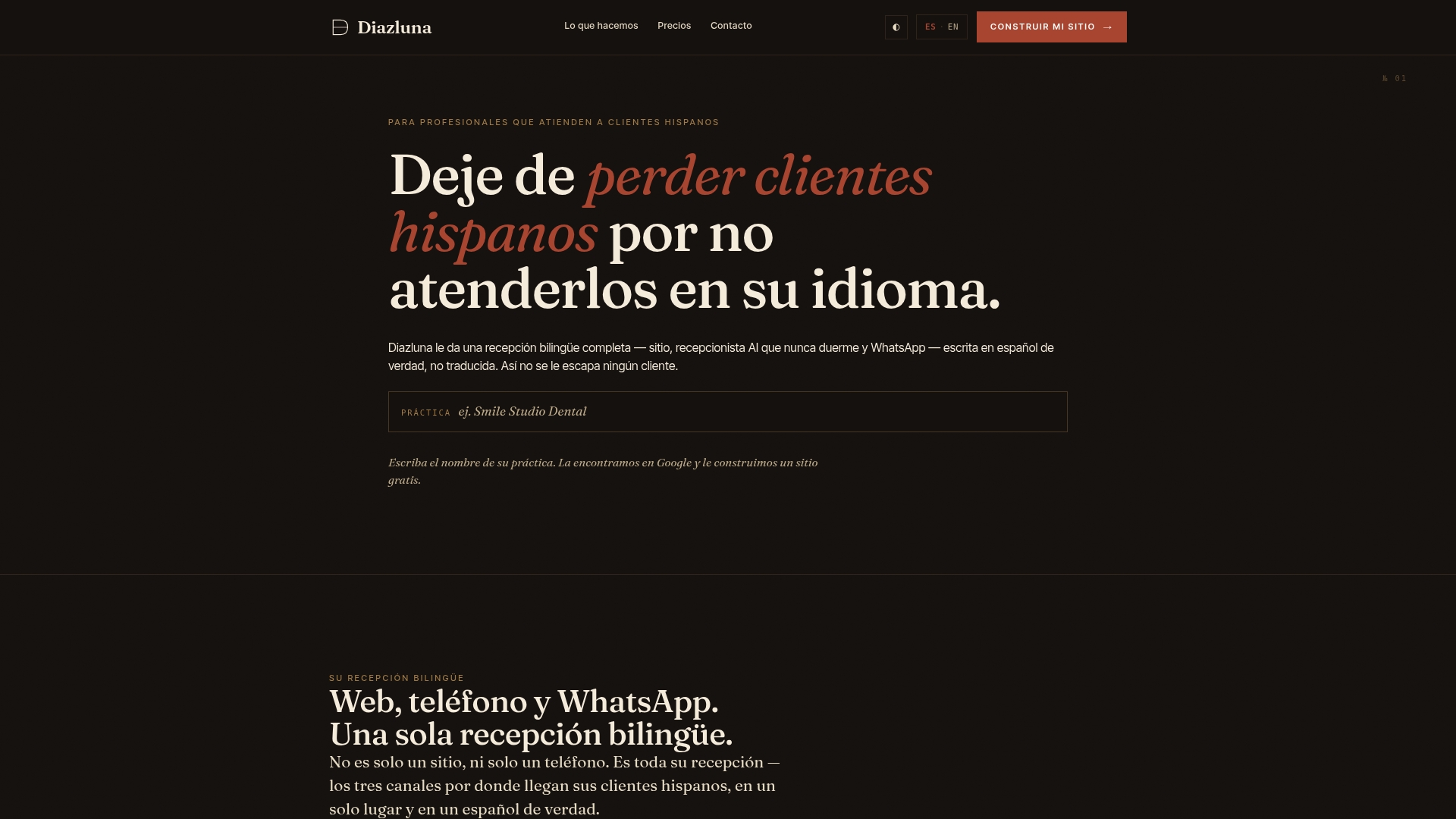
Every practice serving Hispanic clients loses some of those clients to language friction. Diazluna closes that gap with a bilingual website, 24/7 AI receptionist, and WhatsApp integration under one monthly subscription, with no per-minute surprises.
- Predictable monthly cost: subscription tiers replace variable per-minute bills
- Three tools in one: bilingual website, AI receptionist, and WhatsApp, built and managed together
- HIPAA-aware setup with BAA available: built for dental, legal, and medical practices
Schedule a demo or start your free site setup to see how Diazluna fits your practice.
Useful sources and next steps
- Diazluna bilingual front desk platform — product overview, subscription tiers, and demo booking
- Diazluna for dental practices — dental-specific workflows and integration details
- Diazluna for law firms — legal practice setup and compliance notes
- Types of bilingual support services — model-by-model breakdown for professional practices
- Why bilingual support beats traditional agencies — subscription vs. agency cost comparison
- Villafuerte Solutions — human OPI service details and pricing contact
Before contacting any vendor: request their BAA template, ask for interpreter credentialing documentation, and get their SLA in writing. These three documents tell you more about a vendor’s operational maturity than any sales call.
This article is general information for practice owners evaluating bilingual communication options. Confirm HIPAA compliance requirements and BAA terms with a qualified healthcare attorney or compliance officer for your specific situation.