July 18, 2026
What Is a 24/7 AI Business Receptionist?
A 24/7 AI business receptionist is software powered by artificial intelligence that answers, manages, and routes business calls at any hour without human intervention. Unlike a traditional answering machine or a legacy IVR system, it holds a real conversation: it greets callers by name, qualifies their intent, books appointments, and transfers complex calls to the right person. Business owners who miss calls after 5:00 PM lose revenue every single day. A 24/7 virtual receptionist eliminates that loss entirely by keeping the front desk open around the clock, including weekends and holidays.
What is a 24/7 AI business receptionist and how does it differ from older systems?
A 24/7 AI business receptionist is defined as an AI-driven voice agent that replaces or supplements a human front desk operator for inbound call management. The industry term for this technology is “conversational AI receptionist,” and it sits in a different category from the phone trees and press-1 menus most callers dread.
Traditional IVR systems resolve only 10–15% of calls without human help. Modern conversational AI receptionists using large language models resolve 55–70% of calls entirely on their own. That gap represents thousands of dollars in recovered revenue for a busy clinic, law firm, or dental practice.

The core technology stack has three layers. First, speech-to-text converts the caller’s voice into text in real time. Second, natural language understanding reads the intent behind the words. Third, text-to-speech delivers a natural-sounding reply. The entire cycle completes in under one second, which is why callers often cannot tell they are speaking with software.
How does a 24/7 AI business receptionist work to manage calls?
The workflow follows a clear sequence every time a call comes in.
- Instant pickup: The AI answers before the second ring, with no hold music and no busy signal.
- Greeting and identification: It states the business name, confirms the caller’s need, and collects basic information such as name and reason for calling.
- Intent routing: Based on the caller’s response, it books an appointment, answers a FAQ, transfers the call to a staff member, or sends a follow-up text.
- Simultaneous handling: Unlike a human receptionist, the AI manages multiple calls at the same time with no degradation in quality.
- Logging: Every call is transcribed and logged to a CRM or calendar automatically.
The difference from a legacy IVR is conversational depth. A caller can say “I need to reschedule my cleaning for next Thursday afternoon” and the AI understands the full request, checks availability, and confirms the new slot. An old phone tree would require the caller to navigate four menus to reach the same result.
Pro Tip: Record a short list of your ten most common caller questions before onboarding any AI receptionist. That content becomes the foundation of the AI’s knowledge base and directly determines how accurately it handles real calls from day one.
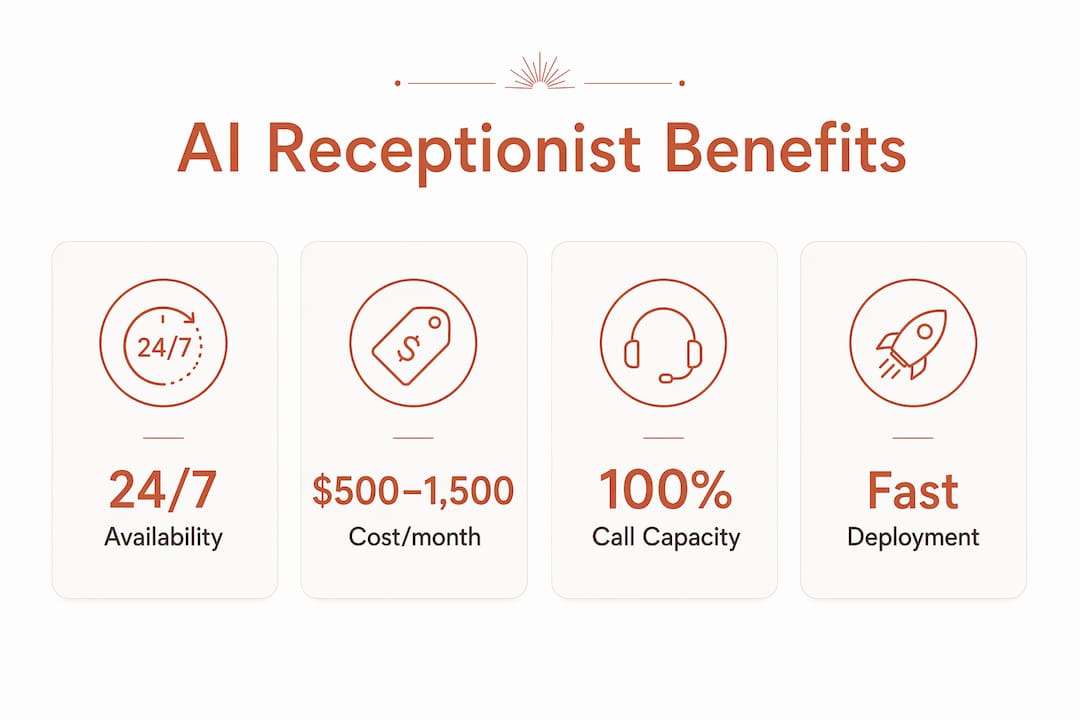
Deployment is faster than most business owners expect. Most AI receptionist services go live within 24–48 hours, and some activate in as little as 10 minutes through a simple website integration. That speed means a practice can be fully covered by the following business day.
What are the key benefits of a 24/7 AI receptionist for business operations?
The practical advantages fall into five clear categories.
1. Round-the-clock availability The AI answers at 2:00 AM on a Sunday the same way it answers at 10:00 AM on a Tuesday. 85% of callers who reach voicemail do not call back. Every unanswered call is a lost client. A 24/7 virtual receptionist captures those leads before they find a competitor.
2. Significant cost reduction A human receptionist costs $3,000–$3,500 per month in salary alone, before benefits and training. AI phone reception services run $500–$1,500 per month, with some platforms starting at $197 per month. The math is straightforward for any small or mid-size practice.
3. Zero busy signals and unlimited call capacity A single human receptionist can handle one call at a time. The AI handles every simultaneous call without putting anyone on hold. A restaurant group using AI receptionists handled 58% of over 9,000 monthly calls through automation alone, including overflow calls while staff were occupied. That volume would require multiple full-time employees to replicate.
4. Consistent, professional caller experience The AI never has a bad day. It delivers the same greeting, the same tone, and the same accuracy on every call. Multi-language support, including Spanish and English, means no caller is turned away because of a language barrier.
5. Predictable costs and easy scaling Flat-rate pricing models make budgeting simple. Human answering services charge per minute during peak hours, which creates unpredictable monthly bills. AI-native systems charge a fixed fee regardless of call volume, which makes scaling a growing practice financially predictable.
For professional service firms, the AI receptionist also integrates with Google Calendar, practice management software, and CRM platforms, so appointment bookings flow directly into existing workflows without manual data entry.
What limitations should businesses keep in mind?
AI receptionists excel at structured, high-volume, routine calls. They have real limits that every business owner should understand before deploying one.
- Emotional complexity: A caller who is distressed, grieving, or angry needs a human voice. The AI can recognize escalation signals and transfer the call, but it cannot replace genuine empathy.
- Regulated advice: AI receptionists should never provide legal, medical, or financial advice. Their role is to route callers to the qualified professional, not to answer clinical or legal questions directly.
- Knowledge quality dependency: The AI is only as accurate as the content it is trained on. Vague or incomplete FAQs produce vague or incomplete answers. The technical setup is simple; the knowledge content is the critical variable.
- Complex multi-turn negotiations: Situations requiring judgment calls, such as a billing dispute or a sensitive patient complaint, belong with a human agent.
Pro Tip: Build an escalation script into your AI setup from the start. Define exactly which call types trigger an immediate transfer to a live team member. This protects your clients and your professional reputation.
Hybrid models that pair AI with live receptionists represent the most effective approach for most professional practices. The AI handles volume and after-hours calls; the human handles nuance. Neither replaces the other entirely.
How to deploy and integrate an AI receptionist in your practice
The setup process is shorter than most business owners expect, but the quality of the outcome depends on preparation.
- Audit your call types first. List every category of call your front desk receives: appointment requests, insurance questions, directions, billing inquiries, and after-hours emergencies. This list becomes your AI’s task map.
- Gather your knowledge content. Write clear answers to your 20 most common caller questions. Include your hours, services, pricing ranges, and booking rules. Quality knowledge content is the single biggest factor in AI accuracy and caller satisfaction.
- Connect your existing systems. Most platforms integrate with Google Calendar, Microsoft 365, and common practice management software through standard APIs. No custom development is required for most setups.
- Customize the voice and tone. Choose a voice that matches your brand. A pediatric dental practice sounds different from a law firm. Most platforms let you set the greeting script, the hold behavior, and the transfer rules.
- Test before going live. Call your own number 20 times with different scenarios. Identify gaps in the AI’s responses and update the knowledge content before opening to real callers.
- Monitor and refine. Review call transcripts weekly for the first month. The AI improves as you add content and correct edge cases.
The full process from signup to live calls typically takes 24–48 hours. For practices with straightforward call flows, the timeline is even shorter.
What types of businesses benefit most from AI receptionist services?
High call-volume businesses with predictable caller needs get the clearest return on investment.
- Dental and medical practices field the same appointment, insurance, and directions questions hundreds of times per week. An AI medical receptionist handles that volume without adding headcount.
- Law firms receive after-hours calls from prospective clients who will not wait until morning. The AI captures the lead, collects contact details, and schedules a consultation automatically.
- Restaurants and hospitality businesses manage reservation calls, hours inquiries, and menu questions at scale. The restaurant group cited earlier automated over 5,300 calls in a single month.
- Bilingual and multicultural practices gain a specific advantage. A caller who speaks Spanish and reaches an English-only receptionist often hangs up and calls elsewhere. An AI fluent in both languages removes that barrier entirely. Diazluna’s approach to bilingual AI receptionist services is built specifically around this problem for Hispanic-serving professionals.
- Service businesses with after-hours demand, including HVAC, plumbing, and home services, capture emergency calls that would otherwise go to a competitor.
The common thread across all these industries is a gap between when clients call and when staff are available. The AI fills that gap without adding payroll.
Key Takeaways
A 24/7 AI business receptionist is the most cost-effective way to eliminate missed calls, reduce front desk costs, and maintain a professional caller experience at any hour.
| Point | Details |
|---|---|
| Core definition | An AI receptionist answers and routes calls around the clock without human staff on duty. |
| Cost advantage | AI reception costs $500–$1,500 per month versus $3,000–$3,500 for a human receptionist. |
| Call resolution rate | Conversational AI resolves 55–70% of calls independently, far above legacy IVR systems. |
| Knowledge content matters | The AI’s accuracy depends on the quality of FAQs and service rules you provide during setup. |
| Hybrid model works best | AI handles volume and after-hours calls; human agents handle emotional or complex situations. |
The part most business owners get wrong about AI receptionists
Business owners worry about the wrong thing when they evaluate AI receptionists. The question I hear most often is “Will it sound robotic?” That concern is understandable, but it is not the real risk. The real risk is deploying an AI with a thin knowledge base and then blaming the technology when it gives incomplete answers.
I have seen practices go live with an AI that knows only their hours and address. Callers ask about insurance, the AI deflects, and the owner concludes that AI receptionists do not work. The technology worked fine. The content did not. The AI is only as good as what you teach it.
The second thing business owners underestimate is the after-hours opportunity. Most practices lose 20–30% of their inbound leads simply because no one answers after 6:00 PM. That is not a staffing problem. It is a systems problem, and AI solves it directly.
The hybrid model is the right long-term answer for most professional practices. Use AI for volume, speed, and after-hours coverage. Keep a human available for the calls that require real judgment. That combination produces better caller satisfaction than either approach alone, and it costs a fraction of a fully staffed front desk.
— Francisco
Diazluna’s bilingual front desk for Hispanic-serving practices
Professional practices that serve Hispanic clients face a specific version of the missed-call problem. A Spanish-speaking caller who reaches an English-only front desk does not wait on hold. They hang up and call the next provider on their list.
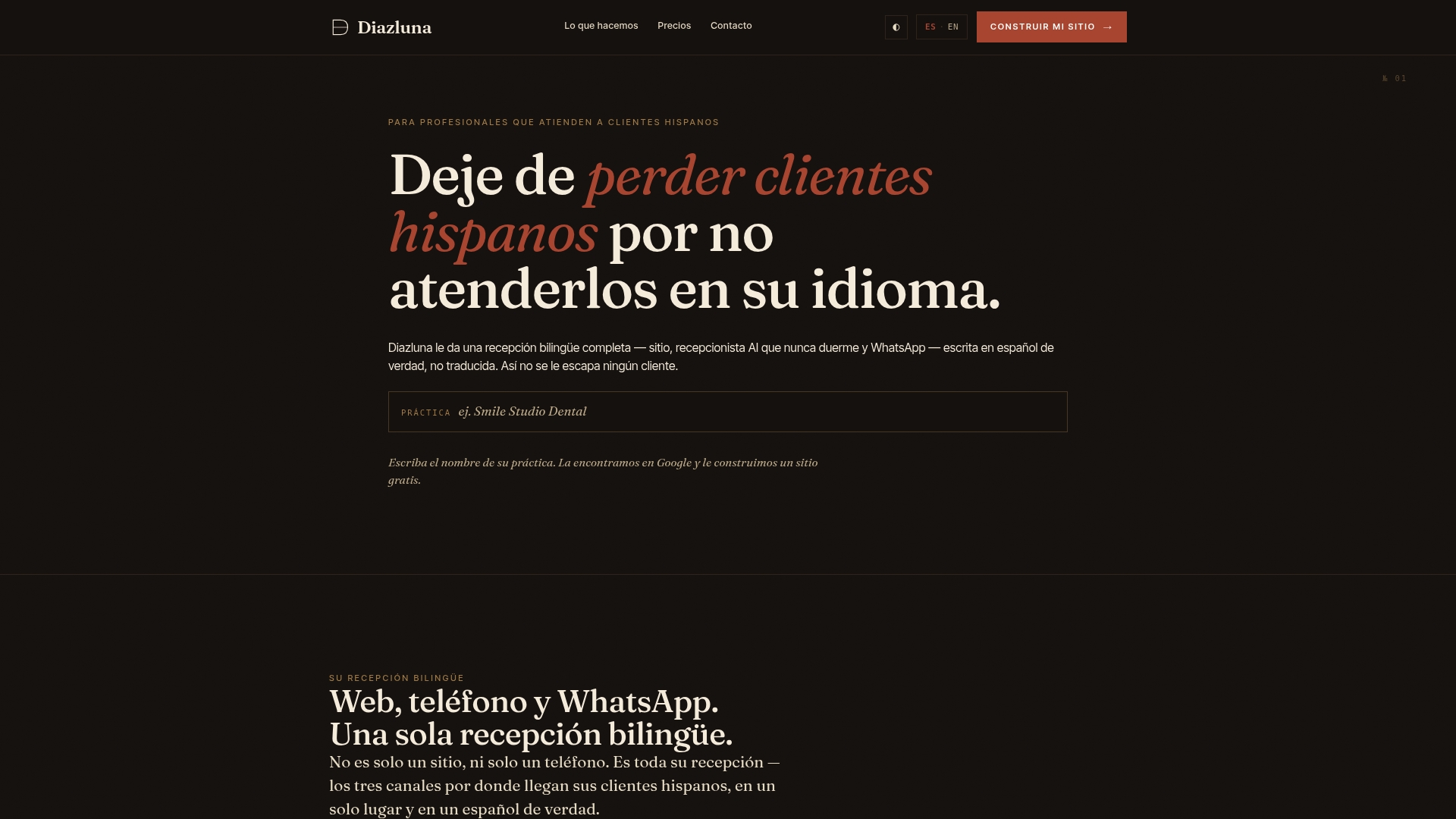
Diazluna solves this with a bilingual AI receptionist fluent in both Spanish and English, combined with a fully optimized bilingual website and WhatsApp integration. The entire system deploys quickly, costs a fraction of traditional agency fees, and captures every caller regardless of language. Dental practices, law firms, and healthcare providers serving Hispanic communities can explore the full offering at Diazluna’s bilingual front desk or see the specialized solution for dental practices.
FAQ
What is a 24/7 AI business receptionist?
A 24/7 AI business receptionist is software that answers business calls at any hour using speech recognition and natural language processing to greet callers, answer questions, and route or book appointments without human staff.
How does an AI receptionist differ from a traditional IVR?
Traditional IVR systems resolve only 10–15% of calls without human help, while conversational AI receptionists resolve 55–70% by understanding natural speech rather than requiring callers to press numbered options.
How much does an AI receptionist cost compared to a human?
AI reception services typically cost $500–$1,500 per month, compared to $3,000–$3,500 per month for a full-time human receptionist, making AI the lower-cost option for most small and mid-size practices.
How long does it take to set up an AI receptionist?
Most AI receptionist services deploy within 24–48 hours, with some platforms activating in as little as 10 minutes through a basic website integration.
Can an AI receptionist handle calls in Spanish and English?
Yes. Bilingual AI receptionists support both Spanish and English in the same call session, which is critical for practices serving Hispanic clients who may switch languages mid-conversation.