October 8, 2026
Launch a Bilingual Dental Website in 4 to 8 Weeks for U.S.
A bilingual dental website bundles a Spanish and English site with a 24/7 bilingual AI front desk and WhatsApp integration, and the right move for most practices is to choose one integrated vendor rather than stitching together a translator, call center, and messaging app. Before signing anything, check three things: who reviews your Spanish content, whether the vendor supports HIPAA-aware messaging workflows, and how the system connects to your practice management software.
TL;DR:
- Using native Spanish content reviewed by a native speaker improves trust and search performance, unlike machine translation that can sound stiff or unnatural.
- A proper bilingual website must mirror your full site in both languages with localized URLs, avoiding auto-translated overlays and ensuring accurate metadata for SEO.
- WhatsApp can be used for non-clinical communication if patients give documented consent, disclose the lack of a HIPAA BAA, and can opt out at any time.
- Full PMS integration requires confirmed BAAs and deep two-way sync, preventing manual workarounds that undermine efficiency and booking accuracy.
- Implementation typically takes four to eight weeks, with early successes seen in faster indexing, fewer missed bookings, and a more seamless patient experience.
Table of Contents
- What to expect from a bilingual dental website product
- Privacy and compliance: HIPAA, BAAs, TCPA, and WhatsApp rules
- Integration: connecting your PMS without creating manual work
- Costs and ROI: budgeting the bilingual website and AI front desk
- Launch checklist and realistic timeline
- Content strategy: keeping Spanish authentic and search-ready
- What actually separates a working bilingual front desk from a broken one
- A turnkey path to a bilingual front desk
- FAQ
- Sources
What to expect from a bilingual dental website product
A real bilingual dental website is not an English site run through a translation plugin. It mirrors your full site in both languages, with Spanish pages carrying their own URLs, titles, and metadata rather than a thin layer over the English version. The AI receptionist layer should handle calls and two-way text messaging in both languages, book and reschedule appointments, generate visit summaries for staff, and hand off urgent cases to a live person when the conversation needs judgment a bot cannot provide.
What to verify before you buy:
- Mirrored Spanish and English pages with a visible language switcher and localized URLs, not auto-translated overlays
- Bilingual AI receptionist covering phone calls, two-way messaging, and appointment booking, with live handoff for urgent cases
- Multiple channels covered: web forms, SMS and email reminders, consented WhatsApp, and Spanish-language intake forms
- Human review of Spanish copy by a native speaker, not machine translation alone
- Indexing and analytics support so you can see how Spanish pages perform in search
If a vendor cannot answer who reviews the Spanish text, treat that as a warning sign. Machine-only translation tends to read stiffly to native speakers and can quietly undercut the trust you are trying to build.
Privacy and compliance: HIPAA, BAAs, TCPA, and WhatsApp rules
WhatsApp is popular with Hispanic patients, but using it for dental communication means working inside real legal limits, not around them. Start with the Business Associate Agreement question: HIPAA requires a BAA whenever a vendor creates, receives, maintains, or transmits protected health information on your behalf, and neither consumer WhatsApp nor the WhatsApp Business Platform currently offers a BAA to US covered entities, according to an analysis of WhatsApp use in US dental practices. That does not rule WhatsApp out. Under the HIPAA Privacy Rule, patients can ask to be reached through a channel of their choice, including an unencrypted one, as long as the practice documents the request and warns the patient of the risk, per HHS guidance on confidential communications. That patient-choice provision is the legal footing that makes WhatsApp reminders workable, provided the content stays minimum-necessary (appointment time and location, never clinical detail).
Build your consent process around four pieces:
- A documented consent record showing the date and source of the patient’s opt-in
- A risk disclosure explaining in plain language that WhatsApp is not covered by a BAA
- An easy, working opt-out the patient can use at any time
- An internal policy that limits WhatsApp content to scheduling and non-clinical messages
Automated texting also triggers the Telephone Consumer Protection Act and, in some states, stricter mini-TCPA rules, which makes documented opt-in for automated messages a separate requirement from HIPAA consent, not a substitute for it. Have your HIPAA compliance officer or outside counsel sign off on the exact consent and disclosure language before it goes live.
Pro Tip: Keep a dated screenshot or log entry for every WhatsApp opt-in; “we assumed consent” will not hold up if a patient disputes it later.
Integration: connecting your PMS without creating manual work
The practical stack most practices land on is a practice management system with a BAA, a patient-engagement platform that also carries a BAA, and WhatsApp as an optional messaging rail layered on top for the patients who prefer it. Common US dental PMS platforms, including Dentrix, Dentrix Ascend, Eaglesoft, Open Dental, and Curve Dental, along with engagement tools like Weave, Solutionreach, and Lighthouse 360, typically offer BAAs and built-in reminder messaging, but WhatsApp usually sits outside that default stack and needs to be connected deliberately, as noted in the same WhatsApp compliance analysis.
Watch for these failure patterns:
- Front-desk staff manually exporting appointment lists because the AI receptionist does not sync back to the PMS
- Sync lag that lets a patient book a slot that was already taken
- Spanish message templates drifting out of sync with the English versions after an update
When evaluating a vendor, prioritize deep two-way scheduling sync, confirmed BAA availability for any channel touching PHI, and a track record of connecting to the PMS you already run, rather than a long feature list that never gets tested against your actual software.
Costs and ROI: budgeting the bilingual website and AI front desk
Pricing for this category usually follows a setup fee plus a recurring monthly charge rather than a single flat cost. Budget for the visible subscription, but also plan for the less obvious line items: time spent capturing and logging consent, ongoing review of Spanish templates as services change, and staff hours during the integration period.
- A one-time activation or setup fee, separate from the monthly subscription
- A recurring monthly or annual fee tied to the plan tier you choose
- Staff time for consent capture, template upkeep, and PMS integration troubleshooting
- Return typically shows up as fewer missed bookings and faster conversion from Spanish-language pages
The ROI case rests less on message volume and more on integration quality: a system that syncs cleanly with your PMS saves staff hours every week, while manual workarounds erase much of the savings a bilingual front desk is supposed to deliver.
Launch checklist and realistic timeline
A phased rollout keeps compliance in order while you move fast on the parts patients actually see.
- Review your PMS and patient-engagement platform for BAA coverage before any patient data flows through them
- Produce Spanish content and send it through native-speaker review, not machine translation alone
- Finalize consent forms and the WhatsApp opt-in flow with sign-off from your compliance officer
- Publish the Spanish pages and test the language switcher, forms, and booking flow end to end
- Run the AI receptionist through a dry run with front-desk staff before it takes live calls
Pro Tip: Check Google indexing of your new Spanish pages around day 10; if they have not appeared, resubmit your sitemap rather than waiting it out.
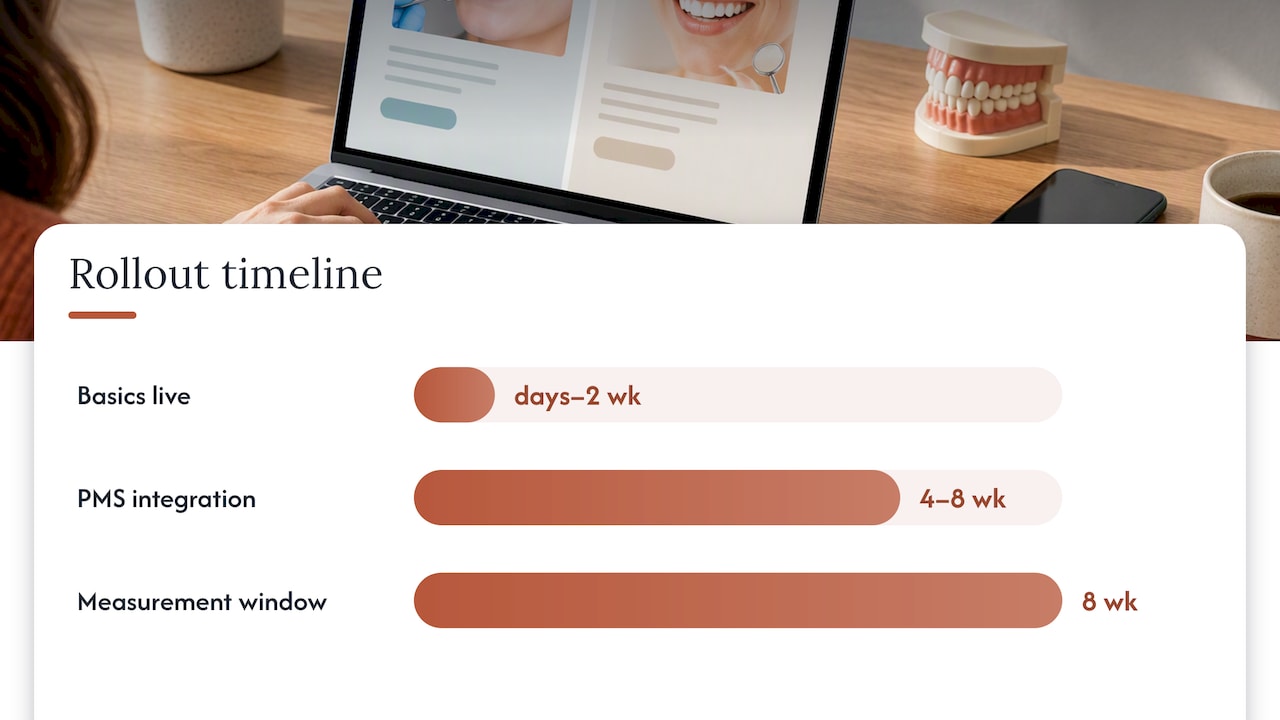
Most practices get the basics live within days to two weeks, with full PMS integration and optimization taking four to eight weeks. Track indexing status, booking lift, missed-call drop, and direct patient feedback across the first eight weeks to know whether the rollout is working.
Content strategy: keeping Spanish authentic and search-ready
Patients notice stiff or literal Spanish fast, and it costs trust at the exact moment you are trying to build it. Human review by a native speaker, not just a machine pass, is what separates a site that converts from one that reads like a translation exercise.
- Route every Spanish page through native-speaker review before publishing, checking for cultural fit as well as grammar
- Keep bilingual metadata and schema markup consistent across both language versions
- Give Spanish pages their own dedicated URLs, and use hreflang tags so search engines serve the right version to the right audience
- Build Spanish landing pages around specific services, not just a translated homepage
- Use CMS templates and assign a clear internal owner for bilingual updates so both versions stay in sync as services or pricing change
Our team at Diazluna’s Spanish dental SEO guide walks through publishing and indexing steps in more detail, and agencies like Babylove Growth focus specifically on multilingual SEO content if you need ongoing production support beyond the initial build.
What actually separates a working bilingual front desk from a broken one
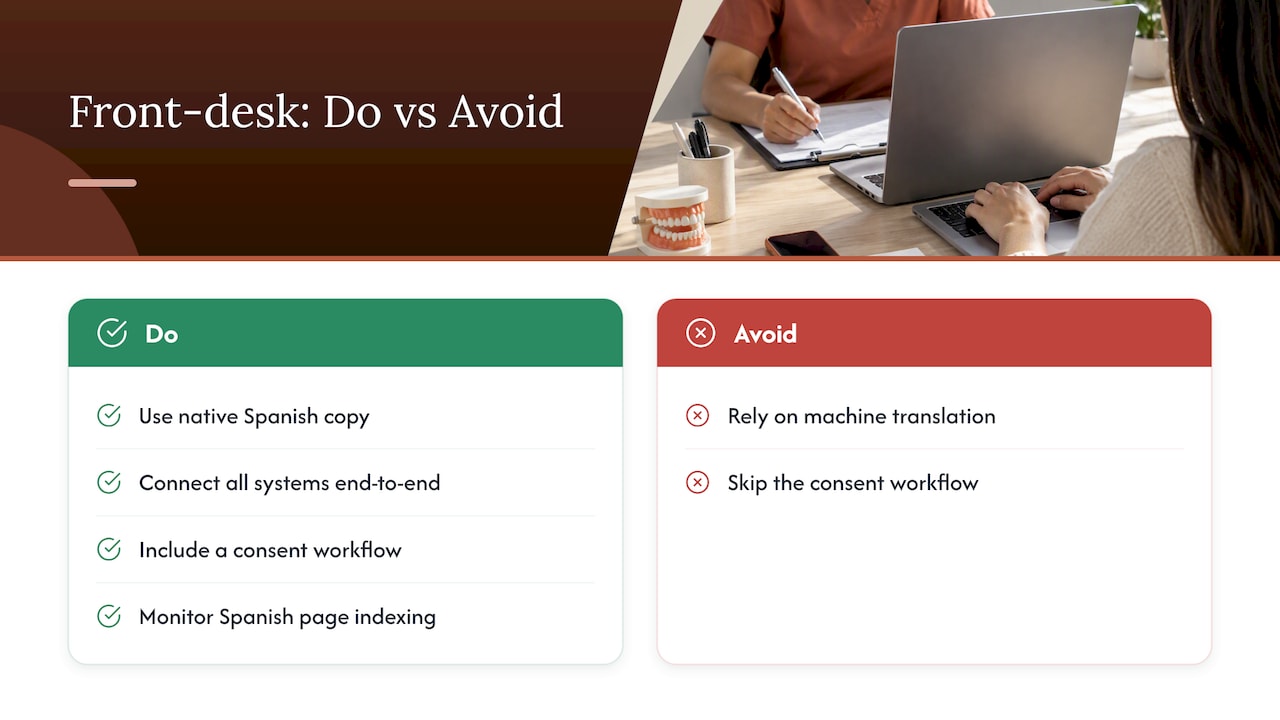
Having reviewed how practices deploy these systems, the feature list matters far less than two things: whether the Spanish feels native to the people reading it, and whether the pieces actually talk to each other. The most common mistake is leaning on machine translation to save a few hundred dollars up front, then wondering why Spanish-speaking callers hang up early. The second most common mistake is skipping the consent workflow because it feels like paperwork, which turns into a real liability the first time a patient disputes how they were contacted.
Early success looks unglamorous: fewer lost bookings, faster indexing of the Spanish pages, and a front desk that stops apologizing for language gaps.
— Francisco
A turnkey path to a bilingual front desk
If building and coordinating all of this piece by piece sounds like a second project on top of running your practice, that is exactly the gap we built our service to close. Our bundle pairs a fully bilingual website with a 24/7 bilingual AI receptionist and WhatsApp integration, all written and reviewed by native Spanish speakers rather than handed to a translation engine.
Clients report a measurable drop in lost Hispanic patients after switching to an integrated setup, along with Spanish pages typically appearing in Google’s index within 24 hours of launch. Before signing with any vendor, including us, ask direct questions: whether a BAA is available for the parts of the system that touch patient data, how the platform connects to your existing PMS, and how WhatsApp consent is captured and stored. We offer plans starting at various tiers including website-only and bundles with an AI receptionist, with additional one-time activation fees; current pricing details are available on the pricing page. Compare the full plan details or see the dentist-specific offering to check availability for your practice.
FAQ
What is a bilingual dental website exactly?
It is a Spanish and English website built for a dental practice, typically paired with a 24/7 bilingual AI receptionist and WhatsApp messaging so the practice can answer calls, book appointments, and send reminders in either language without hiring separate bilingual staff.
Is it legal to text patients on WhatsApp?
Yes, when the practice documents the patient’s consent, discloses that WhatsApp is not covered by a HIPAA Business Associate Agreement, and limits messages to non-clinical content like appointment times, following the patient-choice framework described in HHS guidance. Automated reminders also need documented opt-in to satisfy TCPA rules.
Does my practice management system need a BAA for this to work?
Yes, any system that creates, stores, or transmits protected health information needs a signed BAA, and most major PMS platforms like Dentrix, Eaglesoft, Open Dental, and Curve Dental provide one, per this review of US dental messaging compliance. WhatsApp itself does not currently offer a BAA, which is why it is kept to non-clinical scheduling messages.
How much does a bilingual website and AI receptionist cost?
Pricing varies by vendor and feature set, and our own plans run from $99 per month for a website-only package up to $349 per month for a full AI receptionist bundle, plus a one-time $399 activation fee, as listed on our pricing page. Budget additional time for consent capture and template upkeep beyond the subscription itself.
How long does it take to launch a bilingual dental site?
Basic Spanish pages and a language switcher can go live within days to two weeks, while full integration with your PMS and AI receptionist optimization typically takes four to eight weeks. Check Google indexing of the new Spanish pages around the ten-day mark and resubmit your sitemap if they have not appeared.
Sources
- The HIPAA Line for US Dentists: What WhatsApp Can and Cannot Say (Privacy Rule, Security Rule, Breach Notification) | BossBot Blog
- HIPAA patient request and confidential communications guidance (privacy resources)