August 29, 2026
Practical Bilingual Scheduling for Dental, Legal,

The fastest way to stop losing Hispanic clients to language barriers is an integrated bilingual digital front desk: a Spanish/English website, a 24/7 AI receptionist, and WhatsApp integration working together to handle bilingual appointment scheduling and intake. This is a digital front desk, not a staffing decision. Practices that adopt it typically see faster bookings and fewer abandoned inquiries from Spanish-speaking leads within weeks. Diazluna builds exactly this system for dental, legal, and medical practices.
TL;DR:
- Implementing a bilingual digital front desk can increase appointment bookings by reducing response time and streamlining scheduling through automation.
- A phased rollout allows practices to test each component, such as the website, AI receptionist, and WhatsApp integration, before full deployment.
- Maintaining real-time calendar sync and establishing clear escalation rules are critical for seamless operation and compliance when handling sensitive conversations.
- Tracking metrics like conversion rates, response times, and no-show rates before and after implementation proves the system’s effectiveness and supports expansion decisions.
- Avoid treating bilingual scheduling as merely a translation challenge; investing in operational infrastructure yields better long-term engagement with Hispanic clients.
Table of Contents
- Why bilingual appointment scheduling matters for your practice
- How does a bilingual digital front desk actually work?
- How do you roll out bilingual scheduling step by step?
- Where are the compliance boundaries for messaging?
- How do you measure whether it’s working?
- What practices get wrong about going bilingual
- How Diazluna builds your bilingual front desk
- Sources
Why bilingual appointment scheduling matters for your practice
Practices lose Hispanic clients silently. A caller hears an English-only menu, hangs up, and calls the next name on their list. Nobody logs that as a lost lead, but it happens constantly.
Research on language access backs up why this matters clinically, not just commercially. Reviews of language concordance and interpreter use show that patients who communicate with providers in their preferred language report better understanding of care instructions and stronger trust in the relationship. Yet a substantial portion of U.S. primary care practices always provide professional language services, often because interpreter costs and staffing constraints get in the way. That gap is your opening.
Speed matters just as much as language. A Spanish-speaking caller who reaches an in-language response immediately is far more likely to book than one routed through a translation app or left on hold. WhatsApp closes that gap well, because it lets patients confirm, reschedule, or upload a form without ever picking up the phone.
A quick benefits snapshot:
- Fewer no-shows through automated bilingual confirmations and reminders
- Higher conversion from inquiry to booked appointment
- Lower front-desk labor tied to routine scheduling calls
- A documented, searchable record of every scheduling conversation
Practices that treat language access as infrastructure, not an afterthought, tend to build referral networks inside Hispanic communities that outlast any single ad campaign, according to language-access research.
How does a bilingual digital front desk actually work?
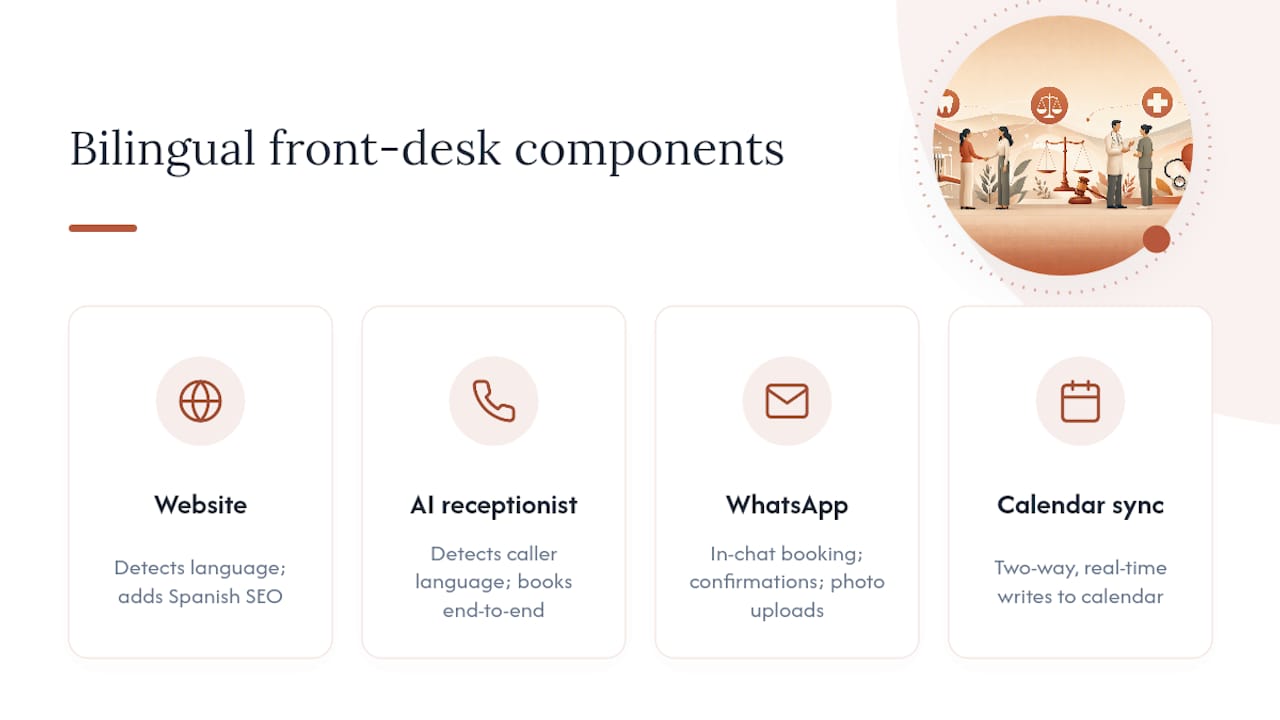
Three components have to talk to each other, not just exist side by side.
The bilingual website does more than translate text. It detects browser or search-language signals, captures a client’s language preference on first visit, and carries proper Spanish SEO markup so your practice actually surfaces when someone searches in Spanish, not just English.
The 24/7 AI receptionist picks up where the website leaves off. It detects the caller’s or texter’s language within the first exchange, follows a scripted booking flow in that language, and knows when to hand off a conversation to a human. A well-built bilingual AI receptionist can manage full appointment booking end to end when it’s tied into your scheduling system, and it logs every interaction for review.
WhatsApp integration handles the parts patients actually want to do on their phone: confirming a time, uploading an insurance card photo, or getting a reminder the morning of the visit. The booking should happen inside the chat itself rather than redirecting to an external form, since keeping the flow in one place removes friction that costs conversions.
None of this works without a fourth piece: two-way EHR or calendar sync. The receptionist and WhatsApp bot both need live access to real open slots, and any booking made through either channel needs to write back to the same calendar instantly to avoid double-booking. A bilingual dental patient intake system that can’t see the calendar in real time just creates a second set of problems.
How do you roll out bilingual scheduling step by step?
Trying to launch everything at once is how practices stall out. A phased rollout keeps risk low and lets staff adjust gradually.
- Set up the fast wins first. Get a dedicated business WhatsApp number, a bilingual landing page, and basic auto-reply and confirmation templates in Spanish and English. This alone can be live in days.
- Build the AI receptionist’s booking logic. Map out how it should greet callers, detect language, and walk through scheduling. Test it against realistic Spanish-language scenarios: a nervous first-time caller, a rescheduling request, a same-day urgent case.
- Connect the integrations. Sync the receptionist and WhatsApp bot to your EHR or calendar so bookings post in real time. Run test bookings from both channels simultaneously to confirm conflict handling works.
- Train staff on escalation. Front-desk staff need clear rules for when to step in personally, how to verify a patient’s identity mid-conversation, and how to move a sensitive issue to a phone call or secure channel.
Pro Tip: Build three specific dialog maps before launch, not one generic script: new-client booking, existing-client reschedule, and same-day urgent request. Each needs its own tone and its own escalation trigger, and skipping this step is the single most common reason pilots feel clunky.
Before going fully live, run a two-week limited-hours pilot rather than flipping on 24/7 coverage immediately. It surfaces scheduling conflicts and script gaps while the stakes are still small. A WhatsApp CRM integration built this way tends to catch its own mistakes early instead of in front of a frustrated patient.
Where are the compliance boundaries for messaging?
Messaging channels are built for logistics, not judgment calls. Keep WhatsApp and your AI receptionist focused on scheduling, confirmations, reminders, and document collection. The moment a conversation turns to clinical advice, a legal opinion, or anything requiring nuance, it needs to move to a recorded, secure channel with a qualified human, and ideally a professional interpreter for complex cases.
Guidance on informal client communication is blunt about the risk: using unofficial or personal channels for substantive advice creates real liability exposure, especially in legal and medical settings where a misunderstood message can carry consequences.
Keep these guardrails in place:
- Use a verified business WhatsApp profile owned by the practice, never a staff member’s personal number
- Route every conversation through one central inbox so records survive staff turnover
- Set explicit triggers that force escalation: any mention of pain, legal deadlines, or medication questions
- Get documented consent for messaging-based communication as part of intake
None of this is legal advice, and HIPAA obligations vary by how your practice handles protected health information over messaging. Confirm your specific setup with counsel before going live.
How do you measure whether it’s working?
Track a baseline before launch, then check it against 30, 60, and 90-day marks. Without a “before” number, you can’t prove the system paid for itself.
Track these on a simple dashboard:
- Booked-conversion rate for Spanish-language inquiries specifically
- Average response time to a new message or call
- No-show rate before versus after automated bilingual reminders
- Number of scheduling interactions the AI receptionist closed without staff involvement
- Escalation rate and reasons for escalation
Pair those numbers with qualitative signals: are Spanish-speaking patients referring friends and family more often? Are staff hearing fewer complaints about being misunderstood on the phone? A bilingual client follow-up process that captures both the hard numbers and the anecdotes gives you a much stronger case when you’re deciding whether to expand the system.
What practices get wrong about going bilingual
The biggest mistake I see practices make isn’t picking the wrong tool. It’s treating bilingual scheduling as a translation problem instead of an operations problem. Slapping Google Translate onto a website or telling a receptionist to “just use the app” when a Spanish-speaking caller phones in doesn’t fix anything, because the failure point is usually speed and consistency, not vocabulary.
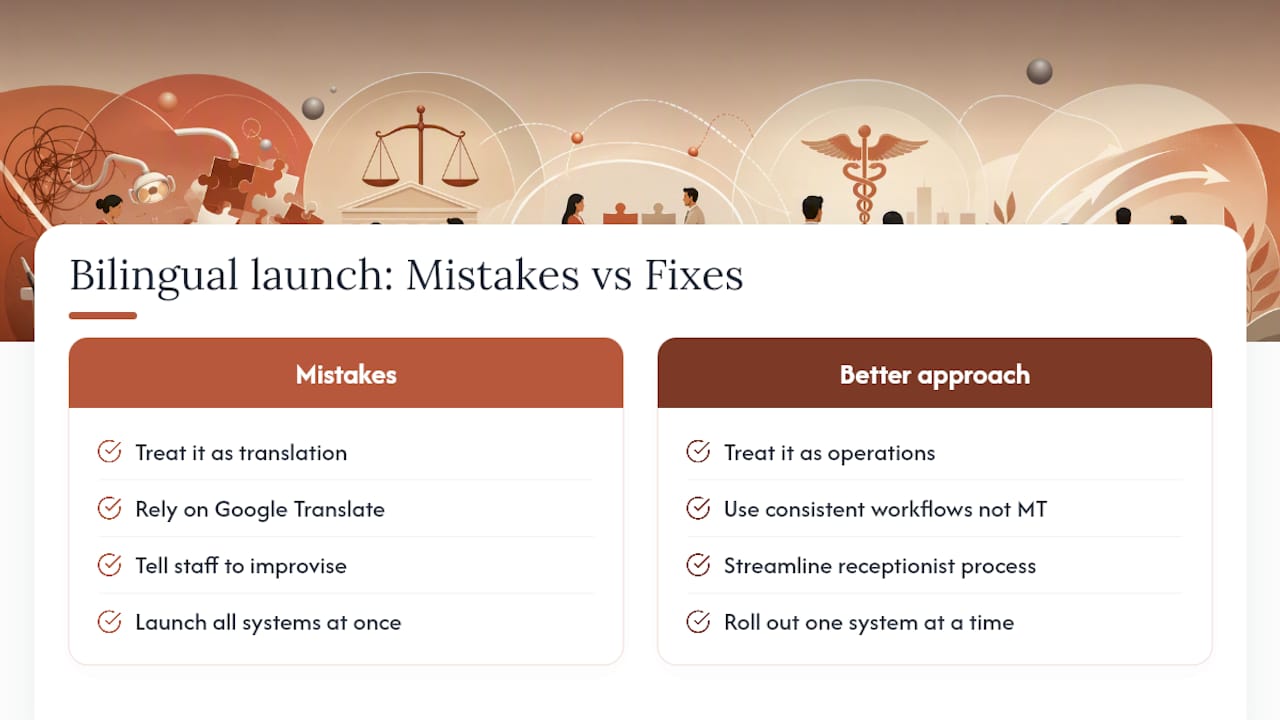
The second mistake is going all-in on day one. Practices that try to launch a full 24/7 AI receptionist, complete WhatsApp automation, and EHR sync simultaneously tend to hit friction they can’t diagnose, because three new systems are failing at once instead of one.
Diazluna exists because most practices serving Hispanic clients can’t justify hiring a bilingual receptionist, a translation agency, and a WhatsApp developer separately, when one integrated system, priced as a single subscription, does the job of all three without losing the authenticity of real Spanish communication.
— Francisco
How Diazluna builds your bilingual front desk
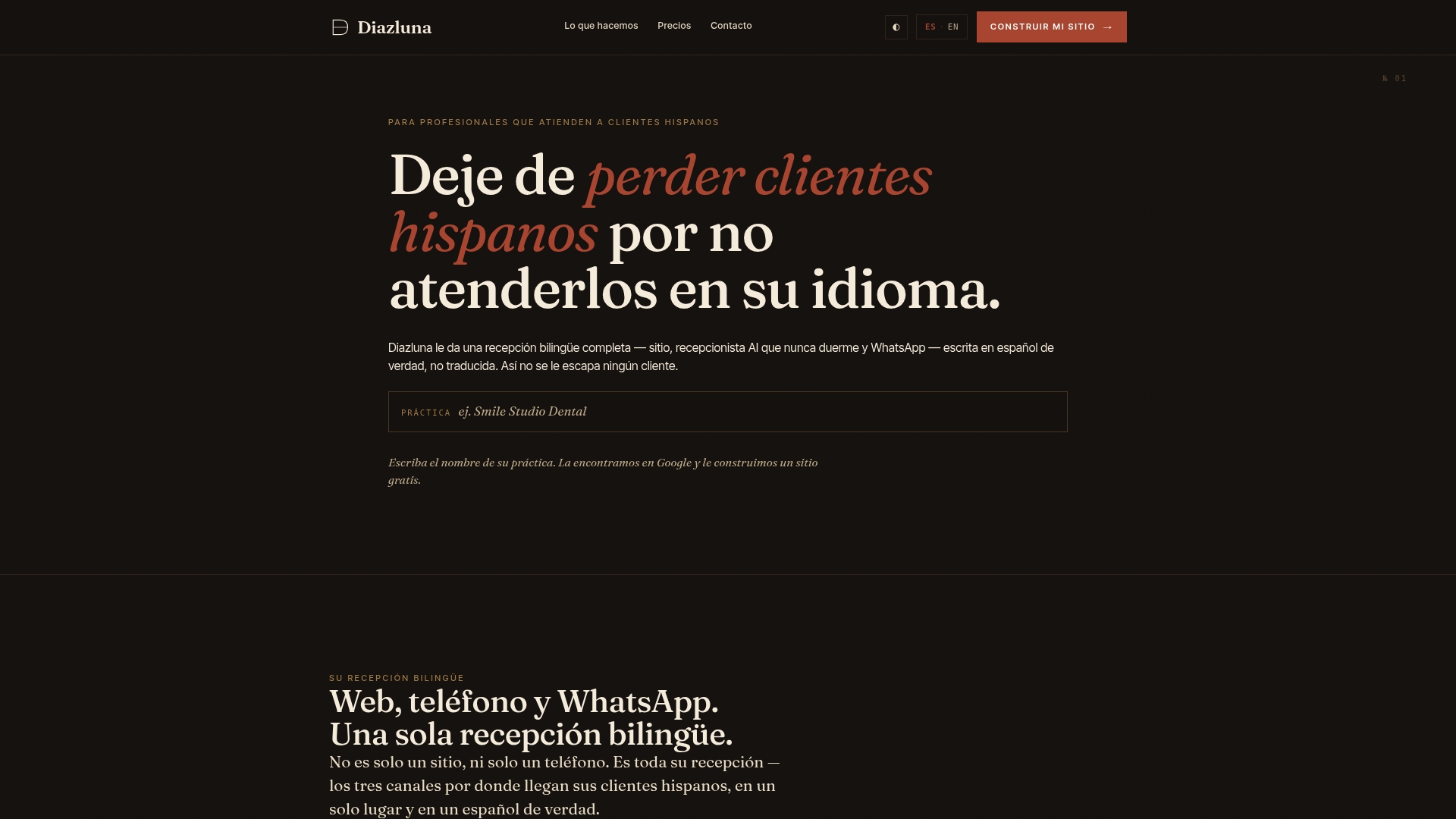
Diazluna is the alternative to piecing together a translation app, a call service, and a separate web developer: one subscription gets you a fully bilingual website, a 24/7 AI receptionist fluent in Spanish and English, and WhatsApp integration, all working from the same calendar and the same client record.
A typical demo walks through your current booking flow, shows how the AI receptionist handles a live Spanish-language call, and maps out what your EHR or calendar integration would look like. Most practices see their bilingual website indexed by Google within 24 hours of launch, with the AI receptionist and WhatsApp layer following shortly after in a phased rollout similar to the one outlined above. If you’re weighing whether to hire a bilingual virtual receptionist or deploy an AI-managed system instead, that comparison is worth reading before your next staffing decision.
Ready to see what a bilingual front desk looks like for your practice? Visit Diazluna to book a demo and get a timeline for going live.
Sources
Claims on language access and outcomes draw from peer-reviewed interpreter and concordance research and primary care language-service data. For deployment specifics, see Diazluna’s guide on AI receptionists for Spanish-speaking patients.
- Language access: review and strategies (SAGE Journals)
- Primary care capabilities for language services (Springer / JGIM DOI)
- Bilingual AI Receptionist for Healthcare: How It Works and Why Your Practice Needs One
- Multilingual AI answering for chiropractors — feature overview
- Navigating the risks of informal client communications (Macbeths)