September 21, 2026
Finish Policies by July 5, 2026

Yes. Under Section 1557 and its implementing rule, 45 CFR Part 92, covered health programs must provide meaningful, free language assistance to individuals with limited English proficiency. HHS’s Office for Civil Rights enforces this. Three things need to happen immediately: post a Notice of Availability of language services, make qualified interpreters accessible rather than relying on staff or family, and finish written policies and staff training before the July 5, 2025 deadline.
TL;DR:
- Health programs receiving HHS funds must post multilingual notices and translate taglines into the top 15 languages in their state, with sample notices provided by HHS.
- Organizations must adopt written policies covering interpreter procedures, grievance processes, auxiliary aids, and reasonable modifications, with staff training documented annually.
- Telehealth should include interpreter access comparable to in-person visits, with multi-state operations aggregating language needs across all served states.
- Automated translation tools are only suitable for routine text, while complex medical documents require review by qualified human translators to ensure accuracy and compliance.
- Enforcement begins with complaints, so organizations should maintain detailed records of policies, training, interpreter requests, and grievances to demonstrate ongoing compliance.
Table of Contents
- Who Has to Comply With Section 1557 Language Access Rules?
- What Does “Meaningful Access” Actually Require?
- How Do You Turn Section 1557 Into Working Policy?
- What About Telehealth, Multiple States, and Machine Translation?
- When Do the Deadlines Hit and What Happens If You Miss Them?
- What Should Be on Your Section 1557 Compliance Checklist?
- What Does Compliant Bilingual Intake Actually Look Like?
- Language Access Is a Civil Rights Duty, Not a Checkbox
- How Diazluna Helps Practices Operationalize Language Access
- Where to Find the Official Section 1557 Rules and Sample Notices
- Sources
- FAQ
Who Has to Comply With Section 1557 Language Access Rules?
Section 1557 applies to any health program or activity that receives federal financial assistance from HHS, any program HHS itself administers, and health insurance marketplaces along with the issuers that sell plans through them. That net is wider than most administrators assume.
A hospital that bills Medicare is covered. A community clinic running on a Medicaid grant is covered. A dental practice that takes no federal money directly but participates in a Marketplace plan network can still fall under the rule through that relationship. Insurance issuers offering qualified health plans on the Exchange are covered outright, regardless of whether they touch a single federal dollar elsewhere in their business.
If you’re unsure where your organization stands, check these three things:
- Funding sources: Medicare Part A, Medicaid, HRSA grants, or other HHS funding streams all trigger coverage.
- Program activities: coverage extends to the entire program, not just the department that received the grant.
- Third-party relationships: contracts with covered entities (billing companies, referral networks, Marketplace participation) can extend obligations downstream.
The HRSA health center locator is a useful starting point for confirming federal funding relationships if your organization operates alongside a federally qualified health center or receives pass-through grants.
What Does “Meaningful Access” Actually Require?
Meaningful access is a flexible, fact-specific standard, not a fixed checklist. HHS evaluates whether an LEP patient can understand and participate in care about as well as an English-speaking patient would, given the nature of the interaction, the frequency of contact, and the resources available to the provider. A single walk-in visit and an ongoing chronic-care relationship don’t demand identical measures, but both demand something concrete.
The regulation is specific about who can deliver that access. Providers must offer qualified interpreters and translators, and 45 CFR Part 92 sets real qualification standards for both roles. Pulling a bilingual receptionist off the front desk or asking a patient’s teenage daughter to interpret a diagnosis does not satisfy the rule, except in narrow emergency circumstances, and even then the reliance has to be documented and temporary.
Notice requirements are equally specific. Covered entities must post a Notice of Availability of Language Assistance Services and Auxiliary Aids and Services, along with taglines in the top 15 languages spoken by LEP individuals in the state or states where they operate—guidelines detailed in Web Accessibility: Boosting Inclusion and SEO Impact. That notice has to appear in physical locations, on the organization’s website, and on significant publications and communications, and it must state plainly that the services are free of charge.
By the numbers: Covered entities must translate taglines into the 15 most common languages spoken by LEP individuals in their state, and HHS provides ready-made sample notices specifically to reduce the drafting burden.
A few practical notes worth flagging:
- The notice and taglines belong on intake forms, appointment letters, and billing statements, not just a lobby poster.
- Auxiliary aids for disability access (large print, screen-reader compatible files) get bundled into the same notice requirement.
- Free-of-charge language matters. Any hint that a patient might be billed for interpretation undermines the notice’s legal purpose.
How Do You Turn Section 1557 Into Working Policy?
Compliance lives or dies in the paperwork nobody wants to write. HHS requires covered entities to adopt written policies and procedures, and those documents need to cover a specific set of ground:
- Language access procedures describing how staff identify an LEP patient, request an interpreter, and document the request.
- A grievance procedure so patients have a defined path to report a denial of language services.
- Auxiliary aids and services policy covering disability-related communication needs alongside language needs.
- Reasonable modification policy explaining how the organization adjusts standard practices when meaningful access requires it.
Intake is where most language gaps actually start. Build a workflow that flags LEP status at scheduling or check-in, routes the flag to an interpreter request automatically, and logs the response. Waiting until a clinician is mid-appointment to discover a language barrier is how organizations end up with undocumented gaps.
Staff training needs to happen at onboarding and at least annually after that, covering how to request an interpreter, what qualifies as an emergency exception, and how to complete the documentation trail OCR will ask for if a complaint ever surfaces. Keep signed training records and vendor contracts on file. If your organization uses video remote interpreting or phone interpreting vendors, reviewing the different modalities available before signing a contract helps match the vendor to your actual patient mix rather than a generic package.
Pro Tip: Build a two-step quality check into any translated material: a first draft from whatever tool or vendor you use, then a sign-off from a qualified human translator who documents which terms they checked and their own credentials. That sign-off record is exactly what an OCR reviewer will ask to see first.

Vendor selection deserves real scrutiny, not just a signed contract. Confirm interpreter credentials, confidentiality protections, and whether the vendor can produce documentation showing who reviewed a translated document and when.
What About Telehealth, Multiple States, and Machine Translation?
Remote care doesn’t get a pass on meaningful access. Telehealth visits need the same interpreter access as in-person visits, whether that means a three-way video call or a phone interpreter bridged into the platform, and the interaction should be logged the same way an in-person interpreter request would be.
Multi-state operations face one wrinkle worth planning for early: the top-15-language calculation isn’t done state by state in isolation. Organizations serving patients across multiple states aggregate the languages spoken across every state they operate in before generating notices and taglines, which usually means a longer, more varied language list than a single-state clinic would need.
Machine translation has a hard boundary. Automated tools can handle routine, non-critical text, but anything tied to rights, benefits, informed consent, or complex medical instructions requires review by a qualified human translator before it reaches a patient.
- Emergency exceptions allow temporary reliance on available staff, but the file needs a note explaining why and confirming a qualified interpreter followed up.
- A patient can decline offered language assistance, but that decline should be documented, not assumed.
- Video remote interpreting needs sufficient bandwidth and audio quality to actually function; a dropped connection mid-consultation is a real access failure, not a technical footnote.
When Do the Deadlines Hit and What Happens If You Miss Them?
The final rule took effect July 5, 2024, with several obligations phased in afterward. The written-policies-and-procedures requirement, including documented staff training, had to be in place by July 5, 2025. If your organization hasn’t finished that work, you’re already past deadline and should treat it as a priority, not a project for next quarter.
OCR enforcement typically starts with a complaint, either from a patient or a third party, filed through its complaint portal. Resolution paths range from voluntary compliance agreements to corrective action plans, and in serious or repeated cases, suspension or termination of federal financial assistance.
- Keep dated records of policy adoption, not just the final policy document itself.
- Run an annual internal audit comparing interpreter request logs against actual LEP patient volume.
- Retain signed training attendance records for every staff member, updated annually.
Good documentation doesn’t just satisfy Section 1557 compliance on paper. It’s the difference between a quick voluntary resolution and a drawn-out investigation.
What Should Be on Your Section 1557 Compliance Checklist?
A working compliance file needs specific items, not a vague intention to “do better with language access.” Here’s the order that matters most:
- Post the Notice of Availability in physical locations, on your website, and on key patient documents.
- Translate taglines into the top 15 languages spoken in your state or states of operation.
- Inventory vital documents (consent forms, discharge instructions, billing notices) and confirm which have qualified translations on file.
- Sign interpreter contracts with vendors who can document credentials and turnaround times.
- Complete and log staff training with signed attendance records.
- Finalize your grievance procedure and post it alongside the language access notice.
Model policy documents typically need headings for language access procedures, grievance procedures, auxiliary aids and services, and reasonable modifications, each with a named responsible staff role and a review date.
For ongoing monitoring, track interpreter requests fulfilled against requests made, run periodic quality checks on translated materials, and log grievances by category. A Spanish-language readability audit is a practical way to check whether translated patient materials are actually landing at the reading level your patients need, not just technically translated.
What Does Compliant Bilingual Intake Actually Look Like?
A workable model looks like this: a bilingual intake step flags LEP status at scheduling, an on-demand interpreter escalation path handles anything beyond routine scheduling questions, and any written material a patient takes home, like discharge instructions, goes through human review before it’s finalized.
- Intake: bilingual scheduling captures language preference before the first visit, not during it.
- Escalation: routine questions get handled at the front desk; clinical or consent-related conversations route to a qualified interpreter.
- Documentation: written instructions get a human-reviewed Spanish translation rather than a raw machine output, especially for medication instructions or follow-up care.
None of this replaces a qualified interpreter for a complex clinical conversation, and no automated workflow should be marketed as a substitute for human review where accuracy affects patient safety or legal rights.
Language Access Is a Civil Rights Duty, Not a Checkbox
Treating Section 1557 as paperwork to survive an audit misses the point. A missed interpreter request isn’t just a compliance gap. It’s a moment where a patient couldn’t describe their symptoms accurately or understand a treatment plan, and that has real clinical consequences.
Front desk workflows that route language needs correctly from the first phone call, the kind Diazluna’s bilingual reception model is built around, tend to catch access failures before they become documentation gaps or, worse, clinical errors. The organizations that do this well don’t treat language access as a one time policy. They measure it, the same way they’d track any other patient safety metric, and they can produce the numbers when someone asks.
— Francisco
How Diazluna Helps Practices Operationalize Language Access
Diazluna is the alternative to juggling separate vendors for your website, phone coverage, and translated patient materials. Instead of piecing together a translation service, a call center, and a web developer, you get one bilingual front desk built specifically for practices serving Hispanic clients.
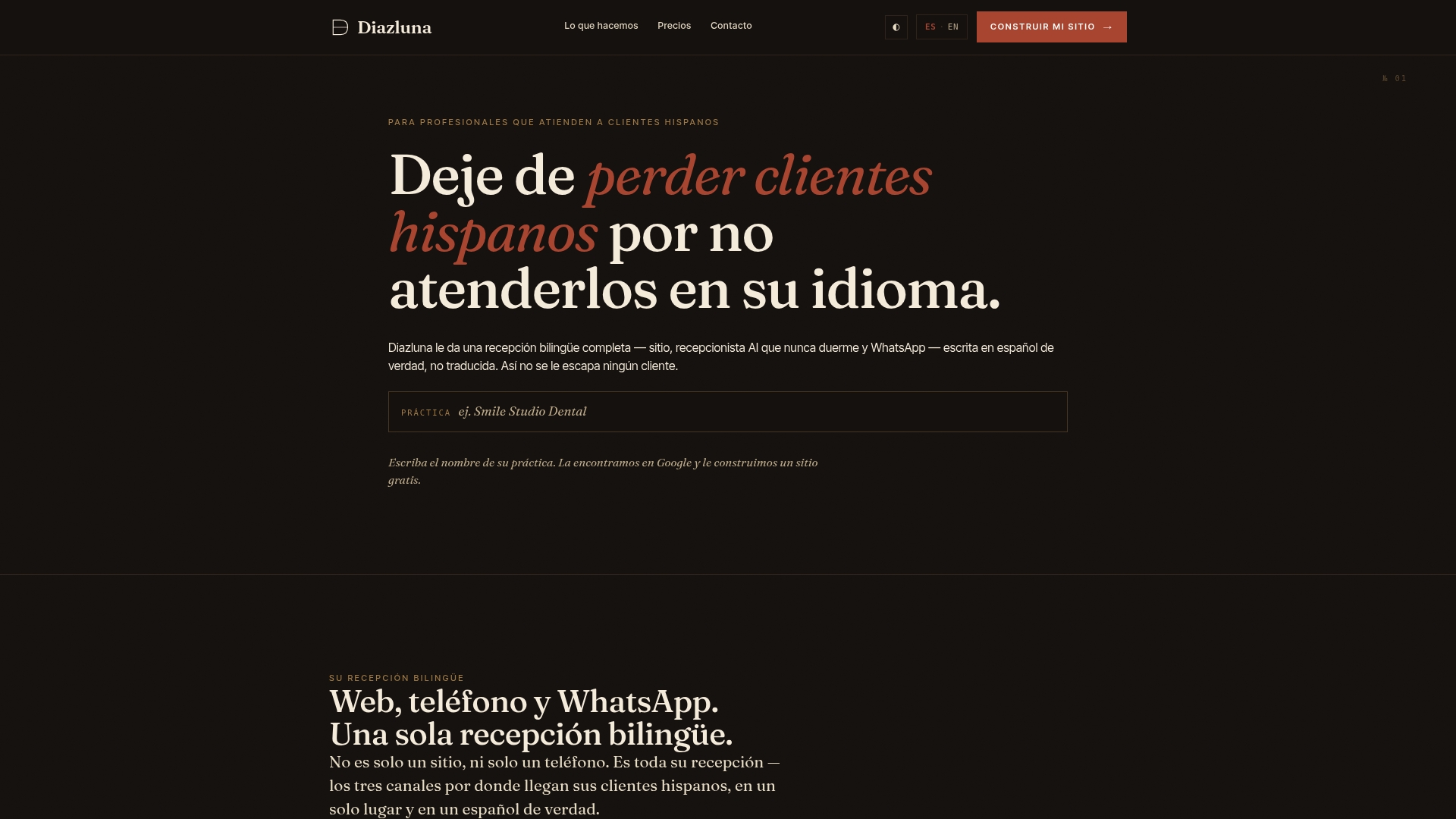
The plans include a bilingual website, options to add a 24/7 bilingual AI receptionist handling calls, messages, and appointment scheduling in Spanish and English, and WhatsApp integration to enable patient communication through popular channels. Higher-tier packages offer expanded call capacity and ongoing site management for practices with heavier patient volume.
These plans help with exactly the operational pieces this article covers: bilingual intake at first contact, a properly displayed language access notice on your site, and a triage path that escalates complex or urgent conversations to a qualified human interpreter rather than leaving them to an automated system. Technology handles volume and consistency. It does not replace the human-qualified review that critical documents, like discharge instructions or consent forms, still require under 45 CFR Part 92.
Check current plan details and get your bilingual front desk running at Diazluna.
Where to Find the Official Section 1557 Rules and Sample Notices
- HHS’s Section 1557 fact sheet covers meaningful access, interpreter standards, and taglines directly from the regulator.
- 45 CFR Part 92 is the binding regulatory text.
- The Section 1557 FAQ page includes downloadable sample notices in multiple languages.
- The Federal Register final rule explains phased deadlines and rulemaking reasoning.
- The OCR Dear Colleague Letter offers a condensed practical summary for administrators.
This article is general information, not a substitute for advice from a qualified lawyer. Consult a qualified legal professional about your own circumstances before acting on anything here.
Sources
- Hhs
- Hhs
- 45 CFR Part 92 — Nondiscrimination in health programs or activities
- Final rule preamble and regulatory impact analysis (Federal Register)
- OCR Dear Colleague Letter: Section 1557 language access (PDF)
FAQ
Does Section 1557 Require Language Assistance for LEP Patients?
Yes. Covered entities must take reasonable steps to provide meaningful access to language assistance services free of charge to individuals with limited English proficiency. This includes qualified interpreters, translated vital documents, and a posted Notice of Availability.
What Is the Main Purpose of a Language Access Policy?
A language access policy exists to guarantee that patients who don’t speak English proficiently can understand their care and participate in decisions about it as fully as English-speaking patients do. It also gives staff a documented, consistent procedure to follow instead of improvising in the moment.
Which Law Requires Language Access for LEP Patients in Healthcare?
Section 1557 of the Affordable Care Act, implemented through 45 CFR Part 92, is the primary federal law requiring healthcare language access for LEP individuals. It builds on longstanding nondiscrimination principles in federal civil rights law.
How Does Title VI Relate to Section 1557 Language Access Requirements?
Title VI prohibits national-origin discrimination by recipients of federal funds, and language barriers have long been treated as a form of national-origin discrimination under that law. Section 1557 extends and modernizes that Title VI framework specifically for health programs, adding concrete requirements like the top-15-language notice and qualified interpreter standards.
Can My Practice Use Diazluna to Meet Some of These Requirements?
Diazluna’s bilingual website and AI receptionist can help display your language access notice, manage bilingual intake, and route urgent conversations to a qualified interpreter. Current plan pricing is listed on Diazluna, and human review still applies to any document where accuracy affects patient rights or safety.