August 7, 2026
Spanish Discharge Instructions Setup for Providers
Start your Spanish discharge instructions setup with three moves: enable automatic Spanish document generation in your EMR for every patient whose language preference is Spanish, require a teach-back in Spanish or through a qualified interpreter and document it in the chart, and attach the AHRQ “Cómo cuidarme” toolkit as the patient-facing summary. Then run a baseline audit in week one and a weekly check for the next 30–90 days. A published quality improvement study moved translated-document delivery from 65.5% to 88% using exactly this combination of EMR automation and staff education, with no increase in length of stay. Here is the operational checklist to get there:
- Enable EMR auto-generation: Set a language-preference flag so Spanish-preference patients automatically receive a translated discharge packet without a manual order.
- Require and document teach-back: Provider or nurse confirms comprehension in Spanish or via a certified interpreter; document the encounter in the chart.
- Attach “Cómo cuidarme”: Include the AHRQ Spanish discharge PDF or a locally adapted one-page summary in every discharge packet.
- Run baseline and weekly audits: Target a high proportion of Spanish-preference discharges with a translated packet delivered and teach-back documented.
- Automate delivery and logging: A bilingual front-desk platform like Diazluna can push the translated summary via WhatsApp or secure messaging and log delivery timestamps, closing the gap between document creation and confirmed receipt.
Table of Contents
- Why language-concordant discharge instructions reduce readmissions
- What every Spanish discharge instruction must include
- What U.S. law requires for language access at discharge
- How to set up the discharge workflow in your clinic or hospital
- How bilingual digital tools support delivery and tracking
- How to measure whether your process is actually working
- Spanish templates and phrases clinicians can use today
- Common pitfalls and how to fix them before they stall your pilot
- Frequently asked questions about Spanish discharge instructions
- Key Takeaways
- The part most QI guides skip
- Diazluna supports your Spanish discharge workflow
- Useful sources and toolkits
Why language-concordant discharge instructions reduce readmissions
Patients who leave the hospital without written instructions in their preferred language are not just inconvenienced. They call back with medication questions, miss follow-up appointments, and return to the ED at higher rates. A peer-reviewed study found that standardized, language-concordant written discharge instructions reduce post-discharge medication-related questions and narrow the disparity gap between English-preferring and Spanish-preferring patients when paired with verbal counseling.
The numbers from a recent quality improvement project make the case concretely. Before the intervention, only 65.5% of Spanish-speaking patients were discharged with a translated document. After implementing EMR workflow changes and staff education, that figure climbed to 88%. Provider-initiated translation orders increased markedly. Critically, length of stay did not increase. That last point matters for every administrator who will ask whether this adds time to the discharge process.
The American Community Survey documents the scale of Spanish-preferring households across the U.S., and in many markets Spanish is the most common non-English language by a wide margin. Volume alone justifies building a reliable, repeatable process rather than relying on ad hoc ordering.
What every Spanish discharge instruction must include
A discharge instruction that leaves out a single critical field can send a patient home confused about which medications to stop, when to call 911, or who to follow up with. The content below is the minimum safe set.
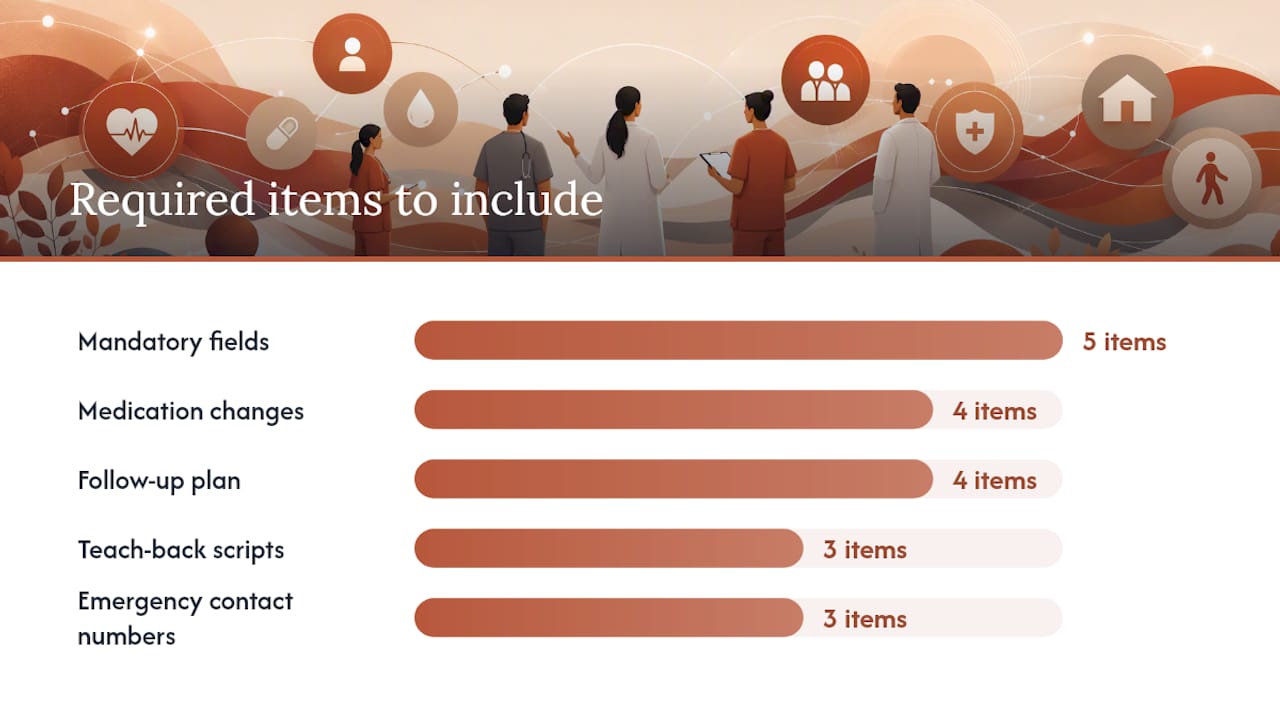
Mandatory fields:
- Admission diagnosis and brief hospital course: One or two plain-language sentences explaining why the patient was admitted and what happened. Avoid clinical jargon; “usted tuvo una infección en el pulmón” lands better than “neumonía bacteriana adquirida en la comunidad.”
- Medication changes: List every medication with an explicit start, stop, or change label. Include dose, frequency, and route. Never leave a patient to infer whether a prior medication continues.
- Follow-up plan: Named provider or specialty, date, clinic address, and phone number. If the appointment is not yet scheduled, state the timeframe and the number to call.
- Return precautions: Clear urgency language with numeric thresholds where relevant. Specialty-specific packets, such as hematology/oncology discharge instructions, include explicit fever thresholds (e.g., temperature above 38°C) and direct call instructions.
- Emergency contact numbers: 911, the hospital’s nurse line, and the follow-up clinic, all on the same page.
Teach-back scripts clinicians can use:
After handing the patient the written summary, ask:
- “¿Me puede decir cuáles son los medicamentos nuevos que va a tomar en casa?” (Can you tell me which new medications you will take at home?)
- “¿Cuándo debe llamar al médico o ir a urgencias?” (When should you call the doctor or go to the emergency room?)
- “¿Puede mostrarme cómo va a tomar esta medicina?” (Can you show me how you will take this medication?)
Document the patient’s response, not just that teach-back was “done.”
Pro Tip: Use a 12–14 pt sans-serif font (Arial or Calibri work well), keep each instruction to one action per bullet, and limit the page to front and back. Patients with low health literacy process shorter, bulleted items faster than dense paragraphs. Avoid word-for-word machine translation for idiomatic phrases; “tome con el estómago vacío” is correct, but a literal translation of “take on an empty stomach” can produce awkward phrasing that confuses rather than clarifies.
For additional guidance on how bilingual patient onboarding shapes the data that flows downstream to discharge, that resource covers staff roles and intake language-preference capture in detail.
What U.S. law requires for language access at discharge
The legal foundation is Title VI of the Civil Rights Act of 1964. Any provider that receives federal financial assistance, which includes Medicare and Medicaid reimbursement, must provide meaningful access to patients with limited English proficiency (LEP). HHS guidance on Title VI is explicit: failure to provide translated materials or qualified interpreter services can constitute discrimination. The obligation covers written communications, including discharge instructions.
The National CLAS Standards (Culturally and Linguistically Appropriate Services) go further, recommending that organizations offer language assistance at no cost to patients at all points of care and that they communicate this availability clearly. AHRQ’s “Cómo cuidarme” toolkit is designed to meet both the CLAS spirit and the Title VI floor.
The HHS language access plan provides sample organizational policies that hospital compliance teams can mirror when building their own language access documentation. OIG audits have flagged documented gaps in language access compliance, making a written audit trail not just good practice but a defensible record if a complaint is filed.
Documents to prioritize for translation:
| Document | Priority | Notes |
|---|---|---|
| Discharge summary | Highest | Required for safe transitions; LEP patients must receive it in their language |
| Medication list (start/stop/change) | Highest | Medication errors are the most common post-discharge harm |
| Follow-up instructions | High | Missed follow-up drives preventable readmissions |
| Return precautions / when to call 911 | High | Safety-critical; must include numeric thresholds |
| Consent-related post-discharge instructions | Medium | Required when post-discharge consent elements apply (e.g., wound care, device use) |
Documentation checklist for compliance audits:
- Language preference recorded in the chart at admission
- Translated document version noted (date, source)
- Interpreter name or service logged if used
- Teach-back encounter documented with patient response
- Delivery method recorded (printed, portal, secure message)
How to set up the discharge workflow in your clinic or hospital
The most reliable setups share one feature: they remove the manual step. When a clinician must remember to order a translation, it does not happen consistently. The QI evidence confirms this: Ishikawa cause-and-effect mapping followed by targeted EMR automations produced the jump from 11% to 75% in provider-initiated translation orders. Build the system so the default is translated, not the exception.
-
Form an interdisciplinary team. Include a hospitalist or attending, a charge nurse, a pharmacist, a case manager, a health IT analyst, and a patient advisor who speaks Spanish. This group owns the pilot.
-
Map the current discharge workflow. Walk through every step from “discharge decision made” to “patient leaves the building.” Mark every point where language preference could affect what the patient receives. Most teams find two or three gaps immediately.
-
Identify EMR trigger points. Work with your health IT analyst to set the language-preference flag as the trigger for auto-attaching the Spanish discharge template. In Epic, this typically involves a SmartSet or discharge navigator configuration. In Cerner, it is a discharge instruction rule set. The exact path varies by version, but the logic is the same: language preference = Spanish → attach translated packet.
-
Pilot on one service. Pick a unit with a high volume of Spanish-preferring patients (hospitalist medicine or general surgery are common choices). Run the pilot for 4–12 weeks. Collect weekly data on translated-document delivery rate, teach-back documentation rate, and length of stay.
-
Collect measures and review. At week four, pull a chart sample of 20–30 discharges. Calculate your translated-document rate and your teach-back documentation rate. Present a run chart at the next team huddle.
-
Iterate and scale. Fix the one or two workflow gaps the pilot reveals, then roll out to additional units. Bring the patient advisor back to review any phrasing that generated confusion.
Staff training checklist:
- One-hour orientation covering Title VI obligations and the new EMR workflow
- Teach-back demonstration with return demonstration by each staff member
- Reference card posted at nursing stations with the three teach-back questions
- Pharmacist-led 15-minute session on medication-change phrasing in Spanish
Timeline: Most teams complete the pilot phase in 6–8 weeks and reach full-unit rollout within 12 weeks. The main variable is health IT queue time for EMR configuration.
How bilingual digital tools support delivery and tracking
Getting the document to the patient’s hands before they leave the building is only half the problem. The other half is confirming they received it, can access it at home, and know who to call. That is where a bilingual front-desk platform adds operational value that the EMR alone does not provide.
A platform like Diazluna can detect the patient’s language preference from the intake record, push the translated discharge summary and the AHRQ “Cómo cuidarme” PDF via WhatsApp or secure messaging at the moment of discharge, and log a delivery timestamp to a dashboard. If the message goes unread within a defined window, the system flags it for a human follow-up call. That loop closes the gap between “we sent it” and “they have it.”
Messaging method comparison:
| Method | Delivery confirmation | HIPAA path | Best for |
|---|---|---|---|
| Secure patient portal (e.g., MyChart) | Yes, read receipt | Fully covered under BAA | Established patients with portal access |
| WhatsApp (via HIPAA-compliant vendor) | Yes, delivery + read | Requires BAA and patient consent | Patients without portal; high open rates |
| SMS (plain text) | Delivery only | Avoid PHI in message body | Appointment reminders, not clinical content |
| Printed handout only | None | N/A | Backup; always include regardless of digital method |
Pro Tip: Before sending any clinical content via WhatsApp, obtain explicit written consent from the patient and document it in the chart. Use a HIPAA-compliant messaging vendor with a signed Business Associate Agreement. Never send medication lists or diagnosis details through a personal WhatsApp account or an unconfigured consumer app.
Integration metadata to capture for each discharge: document version and date, delivery method, delivery timestamp, read confirmation (where available), teach-back documented (yes/no), and interpreter used (name or service). Surface these fields in a weekly dashboard report that feeds directly into your audit protocol.
For practices thinking about after-hours Spanish support for post-discharge questions, routing unanswered messages to a bilingual AI receptionist after hours keeps the follow-up loop closed without adding staff hours.
How to measure whether your process is actually working
A discharge process that looks good on paper but is not audited regularly drifts. Within weeks of a pilot launch, manual steps creep back in, documentation rates slip, and the translated-document rate quietly falls. A simple audit protocol prevents that.
Primary KPIs to track weekly:
- Percent of Spanish-preference discharges with a translated packet delivered (target: ≥ 88%)
- Percent with teach-back documented in the chart (target: 100% of Spanish-preference discharges)
- Percent of translation orders placed by the provider (not just nursing or case management)
- Post-discharge medication question rate (tracked via nurse line call logs)
Audit protocol:
- Sample 20–30 charts per week from Spanish-preference discharges
- Reviewer checks for: language preference flag set, translated document attached, delivery method recorded, teach-back documented with patient response, interpreter logged if used
- Results plotted on a run chart; flag any week below the centerline for immediate review
- Monthly summary to unit leadership; quarterly summary to compliance
Stoplight thresholds:
- Green: ≥ 88% translated packets delivered, ≥ 90% teach-back documented
- Yellow: 75–87% delivered or 75–89% teach-back documented; review workflow gaps
- Red: < 75% delivered or < 75% teach-back documented; escalate to unit leadership within 48 hours
Balancing measures: Track average length of stay for Spanish-preference patients separately during the pilot. The QI evidence shows no increase, but confirming this locally protects against pushback from administrators who assume the process adds time.
For post-discharge outreach tracking, bilingual client follow-up strategies offer practical frameworks for measuring whether patients actually engaged with the materials they received.
Spanish templates and phrases clinicians can use today
The AHRQ “Cómo cuidarme” template, adapted from Project RED (Re-Engineered Discharge), gives teams a ready-made structure. The fields below mirror that structure and can be dropped directly into an EMR discharge navigator or printed as a standalone handout.
One-page template structure:
- Diagnóstico / Por qué estuvo en el hospital: (Diagnosis / Why you were in the hospital)
- Lo que pasó durante su estadía: (What happened during your stay)
- Sus medicamentos:
- Medicamentos nuevos: (New medications)
- Medicamentos que debe dejar de tomar: (Medications to stop)
- Medicamentos que siguen igual: (Medications that continue unchanged)
- Citas de seguimiento: Nombre del médico, fecha, dirección, teléfono (Follow-up appointments: provider name, date, address, phone)
- Cuándo llamar al médico o ir a urgencias: (When to call the doctor or go to the emergency room)
- Preguntas que tiene: (Questions you have)
- Número de teléfono del hospital / enfermera: (Hospital / nurse line phone number)
Common medication phrases for clinicians and pharmacists:
- Tome [nombre del medicamento], [dosis], [frecuencia]. (Take [medication name], [dose], [frequency].)
- Empiece a tomar este medicamento hoy. (Start taking this medication today.)
- Deje de tomar [nombre del medicamento] a partir de hoy. (Stop taking [medication name] starting today.)
- Tome este medicamento con comida para evitar malestar estomacal. (Take this medication with food to avoid stomach upset.)
- No tome más de [número] pastillas en 24 horas. (Do not take more than [number] pills in 24 hours.)
Teach-back phrase bank for interpreters and bilingual staff:
- “Le expliqué sus instrucciones. ¿Me puede decir con sus propias palabras qué va a hacer cuando llegue a casa?” (I explained your instructions. Can you tell me in your own words what you will do when you get home?)
- “¿Cuál es la señal más importante para llamar al médico?” (What is the most important sign to call the doctor?)
- “¿Tiene alguna pregunta sobre sus medicamentos?” (Do you have any questions about your medications?)
For patients with low health literacy, simplify further: use short sentences, one instruction per line, and avoid subjunctive constructions. A patient advisory board review of any locally adapted template catches phrasing that reads correctly in clinical Spanish but sounds unnatural to patients from specific regions.
Pro Tip: Cultural tone matters as much as accuracy. “Usted debe” (you must) can feel authoritative and off-putting to some patients; “Le recomendamos que” (we recommend that you) often lands better. For guidance on how Spanish tone affects patient trust and retention, the article on why Spanish tone matters covers this in depth.
Common pitfalls and how to fix them before they stall your pilot
Most discharge language-access pilots fail for the same four reasons. Each one has a fix that takes less time than the problem it prevents.
Pitfall 1: The discharge rush. The patient is ready to leave, the room is needed, and no one has ordered the translated document. Fix: remove the order step entirely. Auto-attach the Spanish packet to every discharge navigator for Spanish-preference patients. The document is there before anyone remembers to ask.
Pitfall 2: Responsibility gaps. When everyone is responsible for ordering translations, no one is. Fix: assign a single role, typically the discharging nurse or case manager, as the accountable party for confirming the translated packet is in the chart. Add a hard stop or a checklist item in the discharge navigator that requires confirmation before the patient can be marked as discharged.
Pitfall 3: Inaccurate machine translations. Generic machine translation tools produce errors in medical phrasing that can cause real harm. A medication instruction that reads correctly in English can become ambiguous or wrong in Spanish when translated word-for-word. Fix: use professionally translated, pre-approved templates (AHRQ “Cómo cuidarme” is already vetted) for the standard fields. Reserve machine translation only for free-text additions, and require a bilingual staff review before those additions go to the patient.
Pitfall 4: Documentation drift. Teach-back gets done but not charted. Translated documents get printed but delivery method is not recorded. Fix: build documentation into the EMR workflow, not as a separate task. A single checkbox in the discharge navigator (“Teach-back completed in Spanish / via interpreter: Y/N”) takes three seconds and creates the audit trail.
On length of stay: The concern that translated discharge instructions will slow the process is common and understandable. The QI evidence is clear: EMR automation and staff education did not increase length of stay. The time cost is in setup, not in execution.
Pro Tip: Recruit one or two Spanish-speaking patient advisors from your community to review your templates before launch. They will catch phrasing that a bilingual clinician might miss because it sounds clinical-correct but reads awkwardly to a patient from Oaxaca or Puerto Rico. A 30-minute review session with a patient advisor is worth more than three rounds of internal editing.
Pro Tip: Set a quarterly calendar reminder for your audit team. The single biggest predictor of process drift is an audit cadence that starts weekly and quietly becomes “whenever someone has time.” Lock the date.
Frequently asked questions about Spanish discharge instructions
What must be included in Spanish discharge instructions? Every instruction set must cover the admission diagnosis in plain language, all medication changes (start, stop, change with dose and frequency), follow-up appointments with dates and contact numbers, and return precautions with clear urgency language. The AHRQ “Cómo cuidarme” template covers all of these fields and is free to download and adapt.
Who is responsible for ordering translated discharge documents? Under Title VI, the responsibility falls on the institution, not the individual clinician. In practice, the discharging nurse or case manager is typically the accountable role, but the most reliable systems remove the manual order entirely by auto-attaching translated documents via the EMR when language preference is set to Spanish.
How do you document teach-back for a Spanish-speaking patient? Document the specific question asked, the patient’s response in summary form, and whether comprehension was confirmed. Note whether the encounter was conducted in Spanish directly or through a qualified interpreter, and record the interpreter’s name or service. A checkbox alone (“teach-back done”) does not meet the documentation standard most compliance auditors expect.
Is machine translation acceptable for discharge instructions? Machine translation is not acceptable as the sole method for clinical instructions. Pre-approved, professionally translated templates like AHRQ “Cómo cuidarme” are the standard. Machine translation may supplement free-text additions only when reviewed by a bilingual clinical staff member before delivery to the patient.
How long does it take to set up a Spanish discharge instruction process? Most teams complete a pilot on one unit in 6–8 weeks. Full-unit rollout typically takes 10–12 weeks. The main variable is health IT queue time for EMR configuration changes.
Key Takeaways
A reliable Spanish discharge instructions setup requires EMR automation, documented teach-back, and a short audit loop to sustain delivery rates above 88%.
| Point | Details |
|---|---|
| EMR automation is the foundation | Auto-attach translated packets via language-preference flag; manual ordering produces inconsistent results. |
| QI evidence supports the investment | Translated-document delivery rose from 65.5% to 88% with EMR changes and staff education, with no LOS increase. |
| Title VI compliance requires documentation | Record language preference, translated document version, interpreter used, and teach-back encounter for every Spanish-preference discharge. |
| Audit weekly, not quarterly | Track translated-packet delivery rate and teach-back documentation rate weekly; target ≥ 88% and ≥ 90% respectively. |
| Diazluna closes the delivery gap | Diazluna’s bilingual front-desk platform can push translated discharge packets via WhatsApp, log delivery timestamps, and route unread messages to human follow-up. |
The part most QI guides skip
The hardest part of a Spanish discharge instructions setup is not the EMR configuration or the template design. It is the three weeks after go-live when the novelty wears off and the old habits return.
Every team I have seen run this kind of pilot hits the same wall around week four. The translated-document rate climbs quickly in the first two weeks because everyone is paying attention. Then a busy weekend happens, a float nurse covers the unit, and the rate drops five points. Leadership looks at the run chart and concludes the intervention “didn’t hold.” That conclusion is wrong, and it is preventable.
The fix is not more training. It is removing the decision point entirely. When the EMR auto-attaches the Spanish packet before the clinician even opens the discharge navigator, there is nothing to forget. The teach-back step is harder to automate, but a single hard stop in the navigator, a checkbox that must be checked before the patient can be marked as discharged, changes the behavior faster than any in-service.
The second thing most guides skip is the patient advisor step. Clinicians who are fluent in Spanish often translate with a clinical register that is accurate but alienating. “Administre el medicamento por vía oral cada ocho horas” is correct. “Tome la pastilla por la boca cada 8 horas” is what the patient will actually follow. A patient advisor from your community, ideally someone who has been a patient in your system, will catch that gap in one read-through.
Small pilots also do something that large rollouts cannot: they build the social proof that moves skeptical attendings. When a hospitalist sees the run chart showing 88% delivery and no LOS increase on one unit, the conversation about scaling changes completely. Lead with the data from your own house, not from a published study. Both matter, but one is about your patients.
Diazluna supports your Spanish discharge workflow
Most clinics that build a strong Spanish discharge process hit a gap at the same point: the document is created, but confirmed delivery and post-discharge follow-up still depend on a staff member making a phone call. Diazluna fills that gap directly.
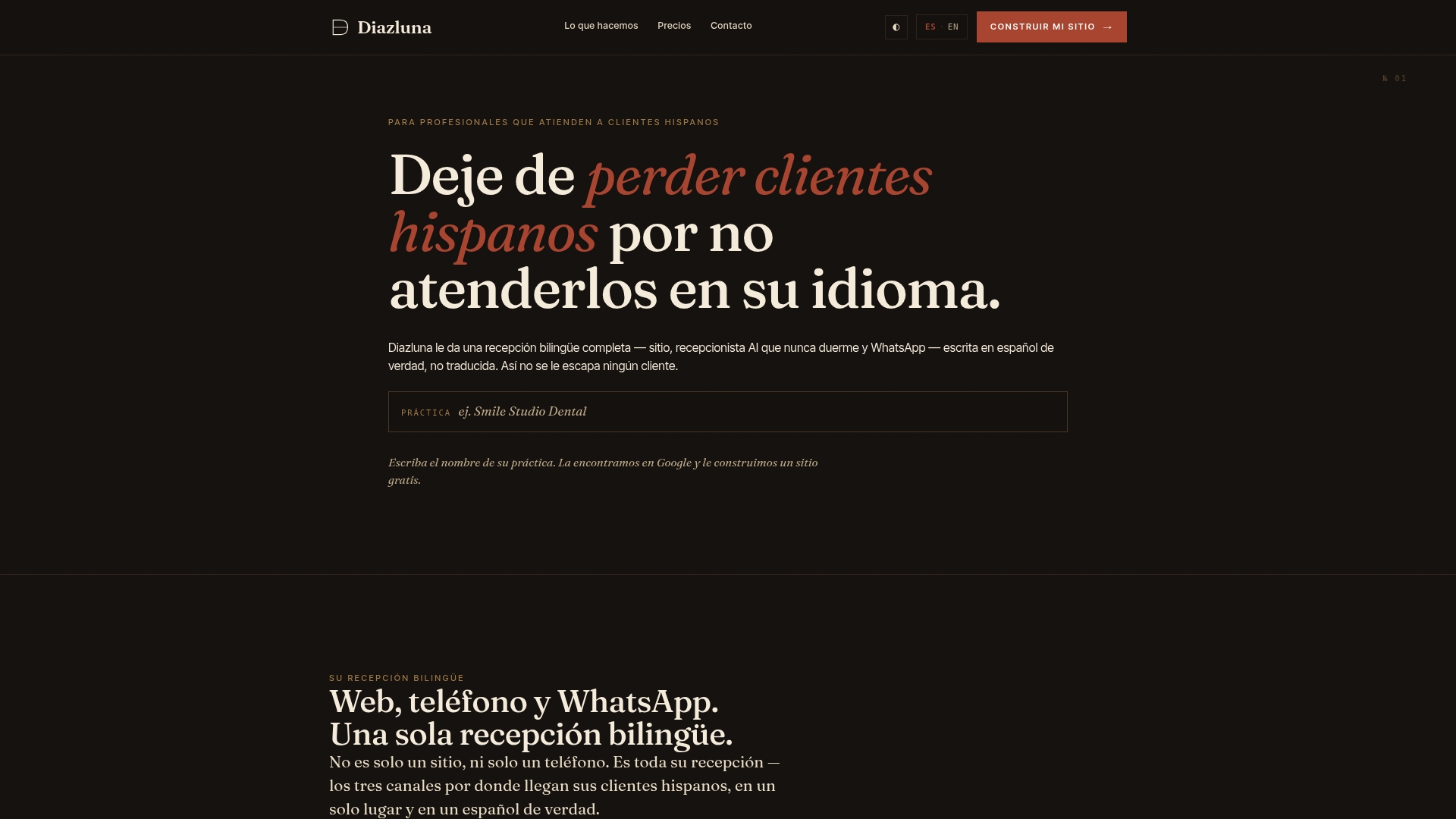
Diazluna’s bilingual front-desk platform automatically delivers translated discharge packets via WhatsApp or secure messaging the moment a patient is discharged, logs a delivery timestamp to a dashboard your team can pull into weekly audits, and routes any unread message to a human follow-up queue within a defined window. No extra staff hours, no manual tracking spreadsheet. The platform handles Spanish and English natively, so the patient receives the message in the language they actually read.
For practices ready to connect their discharge workflow to a bilingual automation layer, Diazluna’s bilingual front desk is built for exactly this use case. Request a demo or ask for the technical integration checklist to see how it maps to your EMR’s discharge navigator.
Useful sources and toolkits
These are the primary downloads and references to store in your policy library and link from your EHR intranet page:
- A Quality Improvement Initiative to Improve the Discharge Process for Spanish-Speaking Patients — Abstract - Europe PMC
- Impact of standardized, language-concordant hospital discharge instructions on post-discharge medication questions — PMC
- Cómo cuidarme: Guía para cuando salga del hospital (AHRQ)
- Guidance for federal financial assistance recipients: Title VI (HHS)
- HHS language access plan 2023 (PDF)
- American Community Survey (ACS) language-use data (2022) — Census
- OIG language access findings (OEI-05-10-00051)
This article provides general operational and informational guidance. It is not legal or clinical advice. Confirm current Title VI obligations, CLAS standards, and EMR-specific configurations with your compliance officer, legal counsel, and health IT team.