October 5, 2026
8–12 Week Urgent Call Routing for U.S. Clinics With Spanish
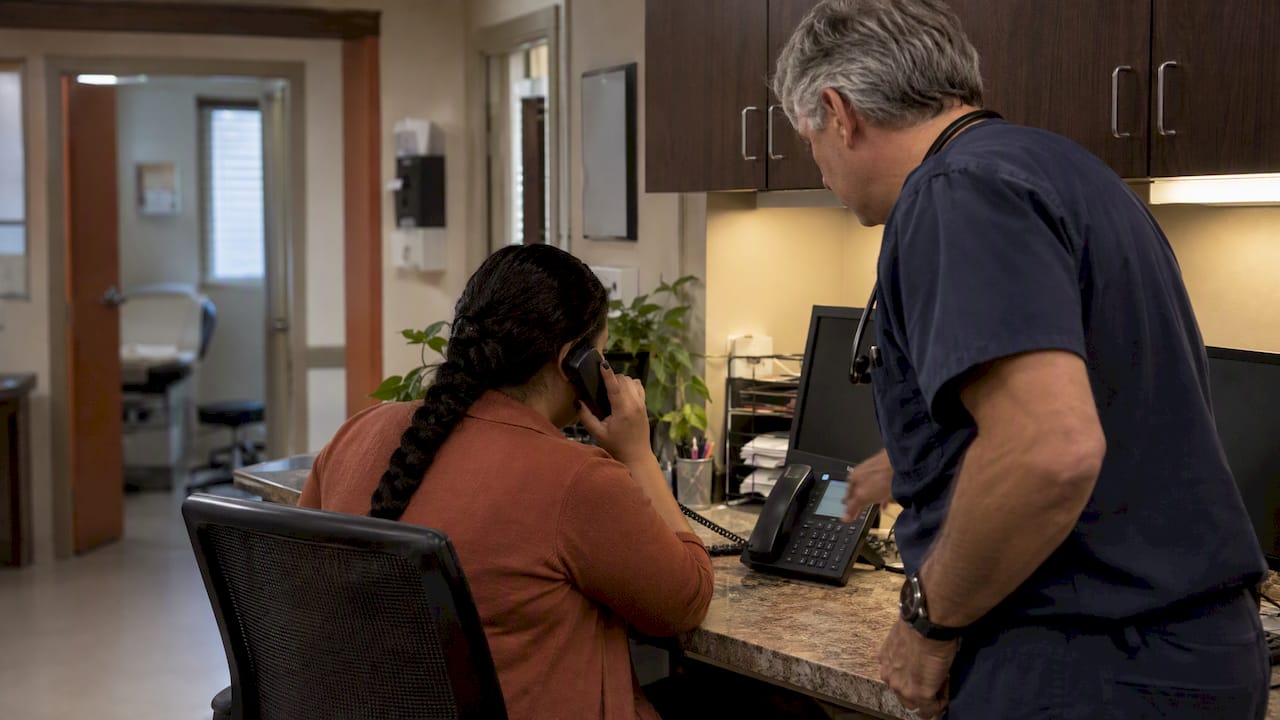
For safe urgent call routing, deploy automated multilingual intake that captures context and immediately escalates red-flag calls to RN or physician oversight under a physician-approved protocol and a signed BAA. That combination, not automation alone, is what keeps patients safe. Clinics serving Spanish-speaking patients should add bilingual intake and WhatsApp support so no urgent case is lost to a language gap.
TL;DR:
- Automated multilingual intake with strict clinical oversight and physician-approved protocols is essential to safely escalate urgent calls and prevent missed emergency cases.
- Clinics must track metrics like call escalation response times and missed urgent events to ensure the call routing system functions effectively, especially during initial rollout.
- A formal governance structure, including a physician director, RN-trained staff, and documented protocol updates, is mandatory for legal compliance and patient safety.
- Vendors handling protected health information require a signed Business Associate Agreement, encryption, clear data retention policies, and audit trails; ask vendors about data deletion after departure.
- Implementing a reliable urgent call routing system typically takes eight to twelve weeks, including governance setup, vendor contracting, technical integration, and a monitored pilot phase with clinician reviews.
Table of Contents
- What urgent call routing and after-hours answering must do for clinics
- Clinical governance and safety: AMA guidance and safe triage protocols
- Legal and privacy must-haves: HIPAA, BAAs, and secure call transcripts
- Triage and escalation design: symptom screening, red flags, and escalation paths
- Technology and integrations that matter
- How to choose and implement an urgent call routing setup
- Publisher perspective: how Diazluna approaches bilingual urgent routing
- Estimated timelines for setting up an urgent call routing system in a clinical setting
- Comprehensive cost breakdown for urgent call routing services
- Practitioner perspective: prioritize safety you can measure
- How Diazluna solves bilingual urgent call routing
- FAQ
- Sources
What urgent call routing and after-hours answering must do for clinics
A clinic’s phone line handles two very different jobs, and confusing them is where risk creeps in. Routine calls, prescription refills, appointment changes, billing questions, can be resolved by a script or a well-trained virtual assistant without clinical judgment. Clinical calls, chest pain, a worsening wound, a child with a high fever, require triage: someone (or something, under strict protocol) has to assess risk and decide what happens next.
The workflow difference matters. Message-taking just records information for callback later. Active triage makes a real-time decision: book an appointment, schedule a nurse callback, page the on-call clinician, or tell the caller to call 911 immediately. A system that only takes messages for every call type will eventually sit on an urgent case.
Typical routing outcomes look like this:
- Routine resolution: appointment booked, refill request logged, billing question answered.
- RN callback: symptoms need clinical judgment but are not immediately dangerous.
- On-call clinician escalation: symptoms meet a red-flag threshold defined in the protocol.
- Direct 911 instruction: life-threatening presentation, no callback delay.
Clinics should track a short set of operational metrics: time from call to escalation, percentage of callbacks completed within the promised window, and any missed urgent event caught retroactively in chart review. These numbers tell you whether the system is actually working, not just whether it sounds good on paper.
Clinical governance and safety: AMA guidance and safe triage protocols
Automated routing without clinical governance is a liability, not a convenience. AMA policy H-285.944 requires that telephone triage protocols be developed and regularly updated by knowledgeable physicians, and that the people delivering triage advice, including any AI system acting on a protocol, have training at least equivalent to a registered nurse. Non-clinical staff and algorithms must operate strictly under physician-approved rules, not independent judgment.
That means a clinic adopting automated intake needs a named physician director accountable for the protocol, RN-level review of any triage logic before it goes live, and a documented process for updating red-flag rules as conditions or staffing change. Automation increases efficiency, but efficiency without a named clinical owner is how urgent calls slip through.
Governance checklist:
- A physician director signs off on every triage algorithm and reviews it on a set schedule.
- Anyone giving clinical advice, human or AI-assisted, operates under protocols equivalent to RN training.
- Red-flag thresholds are written conservatively: when in doubt, escalate rather than reassure.
- Protocol updates are logged, dated, and tied to a specific clinical reviewer.
AMA policy states that telephone triage should be performed by health professionals with training at least equivalent to a registered nurse, with physician-maintained protocols governing medical advice. That standard applies whether the first voice on the line is a nurse or a well-governed AI system.
Separately, AHRQ evidence on nurse advice lines shows that structured triage algorithms, applied consistently, can direct patients to appropriate care faster and cut unnecessary emergency department visits. The algorithm is only as safe as its conservative design and its clinical oversight.
Legal and privacy must-haves: HIPAA, BAAs, and secure call transcripts
Any vendor that creates, receives, maintains, or transmits protected health information on a clinic’s behalf is a business associate under HIPAA, not a neutral conduit. HHS OCR guidance on cloud computing is explicit: a service that stores or processes ePHI, even encrypted, needs a signed Business Associate Agreement and must apply reasonable administrative, physical, and technical safeguards. A call transcript with a patient’s name and symptoms is ePHI the moment it is recorded or stored.
Before signing with any routing or answering vendor, clinics should confirm:
- The vendor will sign a BAA covering call recordings, transcripts, and any stored intake data.
- Data in transit and at rest is encrypted, and the vendor can describe its breach notification timeline.
- Retention and deletion terms are specified: how long transcripts are kept, and what happens to them if the contract ends.
- The vendor can produce an audit trail showing who accessed a given call record and when.
- Subcontractors (cloud hosting, speech-to-text providers) are also bound by BAA terms, not left out of the chain.
Pro Tip: Ask every vendor one blunt question: “If we leave, do you delete our data, and will you put that in writing?” A vendor that hesitates is telling you something.
An HHS FAQ on cloud storage confirms that a provider storing even encrypted ePHI without a decryption key is still a business associate, so encryption alone does not remove the need for a signed BAA. Treat every transcript as PHI until a contract says otherwise.
Triage and escalation design: symptom screening, red flags, and escalation paths
Good triage design starts with a short, conservative list of red flags that trigger immediate escalation regardless of how calm the caller sounds. Common examples include chest pain or pressure, signs of a severe allergic reaction, uncontrolled bleeding, sudden confusion or slurred speech, and difficulty breathing. Each of these should route to an immediate instruction to call 911, not a callback queue.
Below red-flag severity, most clinics use a tiered escalation path:
- Tier 1, immediate danger: instruct caller to call 911 or go to the nearest emergency department without delay.
- Tier 2, urgent but not immediately life-threatening: page the on-call clinician, with a target response time written into the protocol, typically within a clinically appropriate timeframe.
- Tier 3, needs clinical judgment, not urgent: RN callback within a defined window, commonly same business day or within a few hours overnight.
- Tier 4, routine: handled by scheduling or administrative staff with no clinical escalation needed.
Whatever system handles the handoff should pass along a tight set of fields so the receiving clinician does not have to re-ask everything: time of the call, the chief complaint in the patient’s own words, which red flags (if any) were present, current medications and allergies, last known vitals if the caller reported any, and preferred language for effective digital implant planning. A receiving physician who gets a clean, structured handoff can act in seconds instead of minutes.
AHRQ’s review of advice-line outcomes found that a study of more than 20,000 advice-line calls screened for potential appendicitis showed improved time-to-care when structured triage was used consistently, a reminder that the structure of the questions matters as much as who asks them.
Technology and integrations that matter
The routing system is only as useful as what it connects to. A tool that takes a great call but drops the information into an inbox nobody checks is not solving the problem.
- EHR integration: the system should write a note directly into the patient’s chart, create a task for the right team member, and attach the call transcript rather than requiring manual re-entry.
- On-call scheduling sync: escalation should route to whoever is actually on call that day, with paging or secure clinician messaging built in rather than a generic office number.
- Multichannel intake: phone remains essential, but SMS and WhatsApp capture patients who would rather text a symptom than call, particularly useful for clinics serving Spanish-speaking populations where a quick WhatsApp message feels more natural than a phone tree.
- Human review for Spanish-language calls: automated transcription and translation can miss nuance, so a native Spanish-speaking reviewer should periodically sample calls to confirm comprehension, not just literal word-for-word accuracy.
- Reporting and analytics: dashboards tracking escalation volume, time-to-callback, and any flagged mis-triage events let the physician director spot drift before it becomes a safety incident.
A bilingual AI receptionist built for clinics can handle the intake and summary-writing load, but the EHR note, the page to the on-call clinician, and the human quality check around Spanish-language accuracy still need to be designed into the workflow, not assumed.
How to choose and implement an urgent call routing setup
Picking a routing solution is a clinical procurement decision, not just a software purchase. Evaluate vendors against five criteria: documented clinical governance, HIPAA/BAA readiness, depth of EHR and scheduling integration, clearly stated escalation service-level agreements, and genuine bilingual support rather than machine translation alone.
- Ask whether a physician director reviews and signs off on the triage protocol, and how often it is updated.
- Confirm RN-level training or equivalent oversight for anyone or anything giving clinical advice.
- Request a sample transcript and summary format to see what the receiving clinician actually gets.
- Get the BAA in writing before any PHI touches the system, not after go-live.
- Ask for published uptime and escalation response-time commitments, not vague assurances.
Run a pilot before full rollout: pick one clinic location or one shift window, define success metrics in advance (missed-escalation rate, callback completion time, patient complaints), and have a clinician review every escalation daily for the first few weeks. Use that review to tune red-flag thresholds and catch any gap in handoff quality, especially for bilingual calls.
Pro Tip: Treat the pilot’s go/no-go decision as a clinical safety review, not a vendor satisfaction survey. If escalations are slow or transcripts are incomplete, fix it before scaling, not after.
A practical after-hours call handling setup guide walks through staffing and escalation sequencing in more detail for clinics building this out for the first time.
Publisher perspective: how Diazluna approaches bilingual urgent routing
We built our bilingual digital front desk around the same governance logic this guide describes: automated intake paired with a clear path to human clinical judgment. Our platform combines a bilingual website, a 24/7 AI receptionist fluent in Spanish and English, and WhatsApp integration, so urgent calls or messages are captured accurately regardless of language.
- We route urgent cases with real-time summaries so the information reaches staff quickly rather than sitting in a voicemail queue.
- We preserve authentic Spanish communication rather than relying on literal machine translation, which reduces the risk of a mistranslated symptom.
- Our platform connects into a clinic’s existing workflow, including EHR documentation and clinician handoff, without requiring clinics to rebuild their governance structure around it.
For clinics already operating under a physician-approved protocol, our platform becomes the bilingual intake layer that feeds that protocol, not a replacement for clinical oversight.
Estimated timelines for setting up an urgent call routing system in a clinical setting
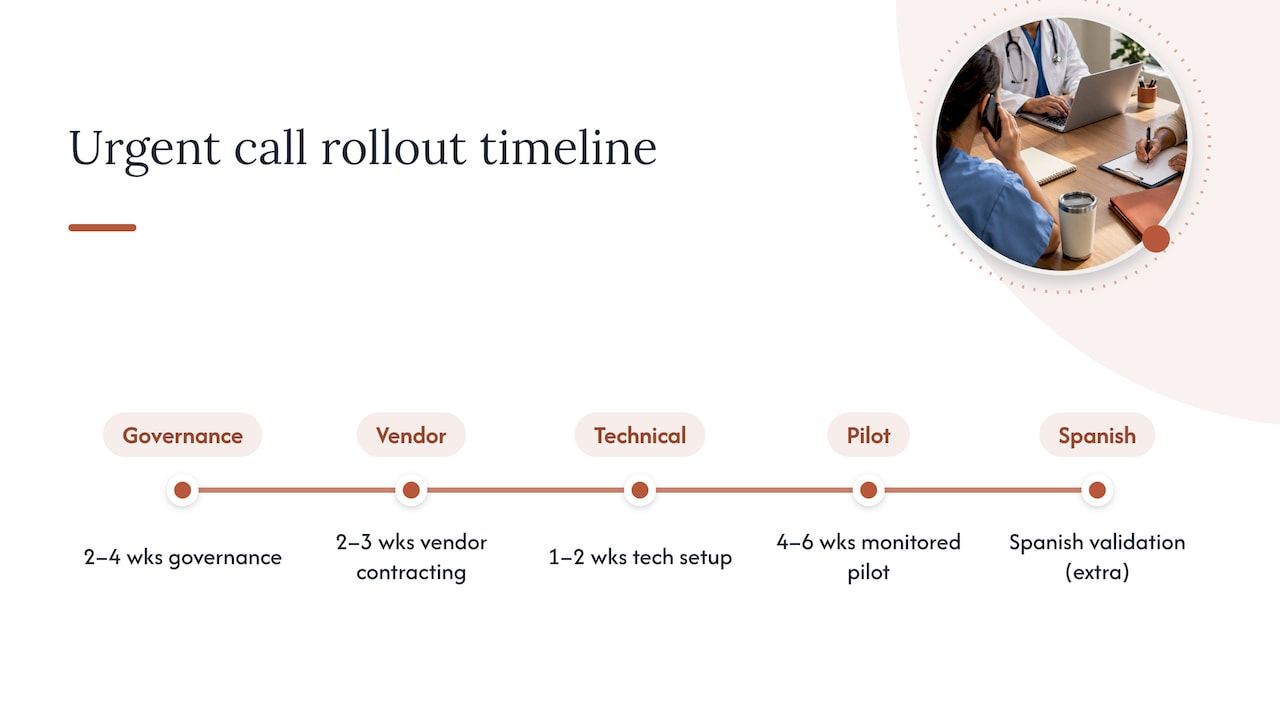
Most clinics can expect a staged rollout rather than a single launch date. The first two to four weeks typically go toward governance work: naming a physician director, drafting or adapting red-flag protocols, and confirming RN-level training requirements for whoever handles triage calls.
Vendor selection and contracting, including BAA negotiation, usually adds another two to three weeks, longer if legal review is slow or the vendor needs custom integration work for the clinic’s EHR. Technical setup, connecting phone lines, configuring EHR note-writing, and setting up on-call paging, generally runs in parallel and takes one to two weeks for a straightforward integration.
The pilot phase itself should run four to six weeks at minimum, with a clinician reviewing every escalation daily to catch mis-triage early and tune thresholds. Clinics that skip or shorten this safety-monitoring window tend to discover protocol gaps the hard way, after a missed escalation rather than before one.
All told, a clinic moving with reasonable urgency can expect somewhere between eight and twelve weeks from the decision to adopt automated routing to a fully monitored, scaled rollout. Clinics adding bilingual intake on top of this timeline should budget extra time for validating Spanish-language accuracy with native-speaking clinical reviewers before trusting the system with live urgent calls.
Comprehensive cost breakdown for urgent call routing services
Costs break into three categories: setup, ongoing service fees, and the hidden costs clinics often underestimate.
Setup costs cover initial configuration: integrating with the EHR, building or adapting triage protocols with physician sign-off, and training staff on the new escalation workflow. This is largely a time investment from clinical leadership rather than a pure cash outlay, though vendor-side setup or activation fees are common.
Ongoing service fees are typically billed monthly or annually and scale with call volume, number of lines, and whether bilingual support is included. Clinics should ask vendors directly for current pricing rather than assuming a flat industry rate, since models vary widely by vendor and by how much clinical oversight is bundled in.
Hidden costs are where budgets get surprised. Clinician time reviewing escalations during a pilot is a real cost even if no invoice reflects it. Transcript storage and retention, if priced per gigabyte or per record, can add up for high-volume clinics. Retraining staff when a vendor updates its platform, and the cost of a second human-review pass for bilingual accuracy, are easy to leave out of an initial budget.
Clinics evaluating a bilingual front desk platform should ask for pricing on a per-plan basis, including any one-time activation fee, rather than comparing vague monthly estimates across vendors with very different scopes of service.
Practitioner perspective: prioritize safety you can measure
My honest read after looking at how clinics actually deploy this technology: the biggest risk isn’t the automation itself, it’s skipping the pilot’s safety-monitoring phase because the system seems to be working. Clinician oversight during those first weeks is what catches a mis-triaged call before it becomes a harm event, not after. If a clinic can only do one thing well, it should be measuring escalation accuracy daily during rollout, not polishing the bilingual script. Build governance first, then scale the convenience features.
— Francisco
How Diazluna solves bilingual urgent call routing
We offer clinics a bilingual digital front desk designed to address this problem: a Spanish and English website, a 24/7 AI receptionist, and WhatsApp integration working together in one platform instead of three separate vendors.
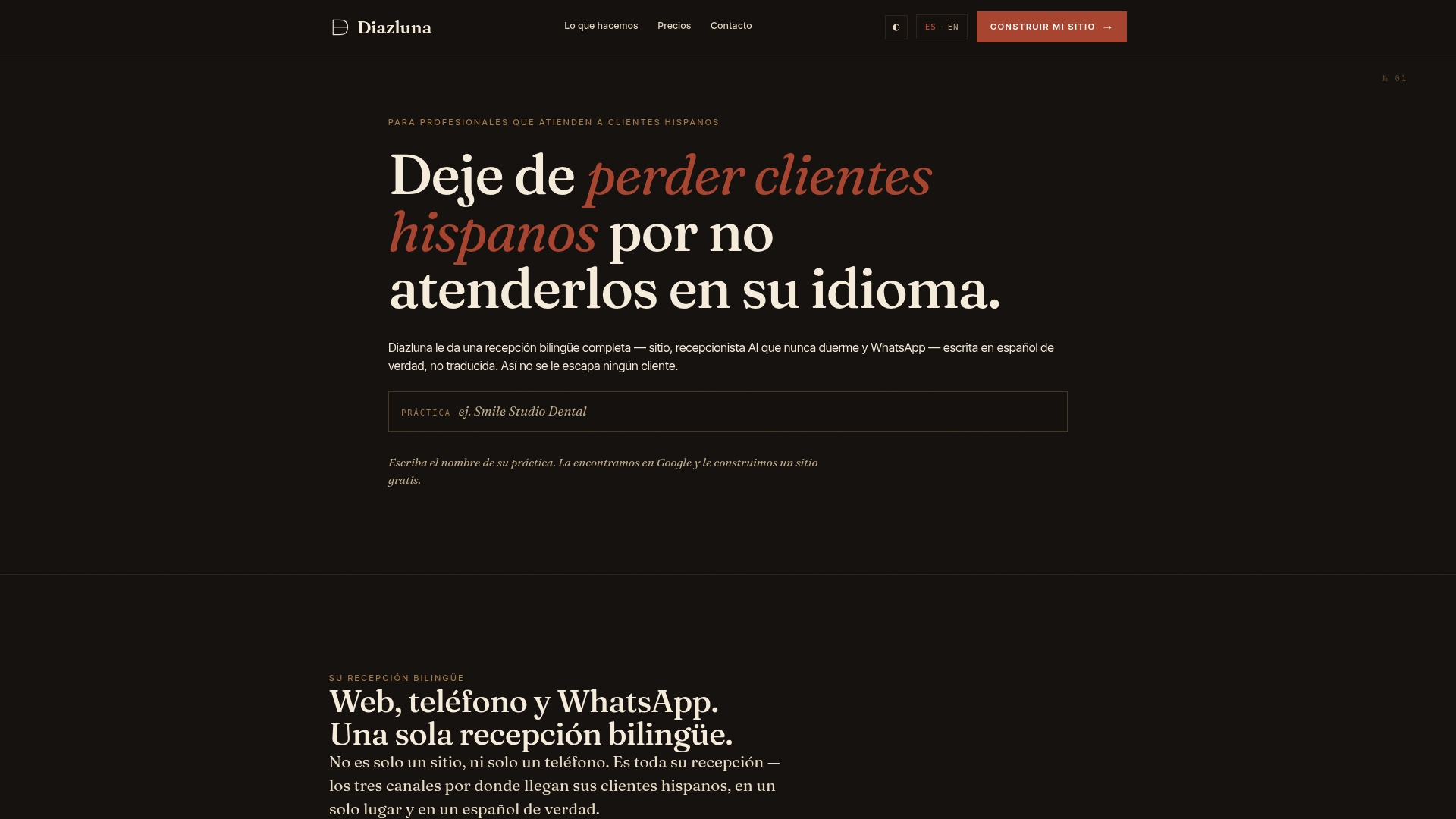
- We capture intake in whichever language the patient speaks and route urgent cases with a real-time summary, so nothing waits in a generic voicemail box.
- We address two common failure points clinics worry about most: missed urgent calls overnight and language barriers that cause patients to hang up and call another provider.
- We provide a documented summary for on-call staff, so the clinician picking up the escalation has context instead of a blank slate.
See current plans and pricing on our site and find the package that fits your clinic’s call volume.
FAQ
What is urgent call routing for a medical clinic?
Urgent call routing is the process of sorting incoming patient calls so routine requests go to scheduling or billing while clinically urgent symptoms get escalated to an RN callback, an on-call clinician page, or a direct instruction to call 911. The goal is a protocol-driven decision made consistently, not case-by-case guesswork.
Does a clinic need a BAA for its call routing vendor?
Yes, if the vendor creates, receives, maintains, or transmits any protected health information, including call recordings or transcripts, it is a business associate under HHS OCR guidance and needs a signed BAA. Encryption does not remove this requirement if the vendor stores the data.
Who is allowed to give telephone triage advice?
Under AMA policy H-285.944, telephone triage should be performed by staff with training at least equivalent to a registered nurse, operating under protocols a physician director maintains and updates. Non-clinical staff or AI systems must act strictly within those physician-approved rules.
How long does it take to set up a safe urgent routing system?
Most clinics need roughly eight to twelve weeks from decision to scaled rollout, covering governance setup, vendor contracting with a BAA, technical integration, and a four to six week pilot with daily clinician review of escalations. Clinics adding bilingual intake should budget extra time to validate Spanish-language accuracy before full launch.
What does Diazluna charge for bilingual call routing?
Diazluna’s plans start at $99 per month for the Sitio-only package, with the Sitio + María plan including the 24/7 bilingual AI receptionist at $199 per month, and a Pro tier at $349 per month; a one-time $399 activation fee applies, with full details on our pricing page.
Sources
- AMA policy H-285.944: Health plans’ medical advice (telephone triage) requirements
- Strategies for improving patient experience with ambulatory care: on-demand advice and triage (AHRQ)
- HHS OCR guidance: Cloud computing and HIPAA obligations