August 17, 2026
What Is Medical Hispanic Outreach for Your Practice?
Medical Hispanic outreach, in the sense that matters to a practice owner, is a bilingual digital front desk: a Spanish and English website, a 24/7 AI receptionist, and WhatsApp integration working together to answer calls, book appointments, and route urgent cases without dropping a caller because of language. If you serve any meaningful share of Spanish-speaking patients or clients, this setup pays for itself fast. It closes the gap between “we tried to call” and “we got seen.”
The verdict up front: adopting this kind of system improves reach, cuts administrative friction, and protects revenue you’re currently losing to missed calls and abandoned bookings. It’s not a marketing nice-to-have. It’s front-desk infrastructure.
- A bilingual website with Spanish landing pages and clear microcopy
- An AI receptionist that answers, schedules, and triages in both languages, all day and night
- WhatsApp integration for the channel patients already trust
Pro Tip: Pull your last 90 days of missed calls and no-shows. If more than a fifth of those patients have Spanish surnames or Spanish-preference notes in your chart, you’re already losing revenue to a language gap you can close in weeks, not months.
You should prioritize this now if your patient mix is shifting, your no-show rate has crept upward, or your front desk staff routinely says “we don’t have anyone who speaks Spanish right now” when the phone rings after 5 p.m.
Key Takeaways
A bilingual front desk combining a Spanish/English website, a 24/7 AI receptionist, and WhatsApp integration closes language gaps that otherwise cost practices patients and revenue.
| Point | Details |
|---|---|
| Definition | Medical Hispanic outreach here means a bilingual website, AI receptionist, and WhatsApp working together as one front desk. |
| Patient demand is high | 72% of patients believed a bilingual portal would strengthen their relationship with providers, per surveyed data. |
| Provider buy-in lags | Only 39% of providers planned to recommend portal use, so pilot data matters more than persuasion. |
| WhatsApp is not PHI-safe by default | Use it for scheduling and reminders; route clinical details through secure, expiring links instead. |
| Diazluna as the practical option | Diazluna bundles the bilingual website, AI receptionist, and WhatsApp into one subscription built for practices serving Hispanic clients. |
Table of Contents
- What Are the Core Components of a Bilingual Front Desk?
- Does Bilingual Outreach Actually Improve Patient Engagement?
- How Do You Design a Bilingual Front Desk for Accessibility?
- Is WhatsApp Safe to Use for Patient Communication?
- How Long Does It Take to Roll Out a Bilingual Front Desk?
- What Objections Do Practice Owners Usually Raise?
- What Should You Ask Before Choosing a Vendor?
- Why Bilingual Front Desks Work Better Than Practices Expect
- Why Diazluna Fits Practices Serving Hispanic Clients
- Sources
What Are the Core Components of a Bilingual Front Desk?
A working system has five parts, and each one solves a specific failure point in the patient journey. Skip one, and patients fall through the gap it was supposed to cover.
The website needs actual bilingual SEO, not a Google Translate widget bolted onto an English site. That means dedicated Spanish landing pages, Spanish-language metadata, and microcopy on the actions that matter most: “Agende su cita” instead of a button that only makes sense in English. Bilingual digital marketing done right is what makes a Spanish-speaking searcher actually land on a page they can use.
The 24/7 AI receptionist answers calls and messages, routes them by language, books and confirms appointments, and escalates anything urgent to a human. This is where most practices see the fastest return, because it eliminates the “call back during business hours” bottleneck that drives Spanish-speaking callers to a competitor with bilingual staff. A well-built AI receptionist handles triage logic, not just scheduling.
WhatsApp integration matters because it’s where a large share of your Hispanic patients already are. WhatsApp Business supports verified profiles, click-to-chat links, QR codes at check-in, automated greetings, and labeled conversations that make handoff to a human simple, according to guidance on WhatsApp outreach features.
Messaging orchestration ties SMS, email, and secure portal links together with your EHR or practice-management system, so a WhatsApp confirmation and a portal reminder don’t contradict each other.
Reporting closes the loop: missed-appointment analytics, language-preference tagging per patient, and contact-resolution tracking tell you whether the system is actually working or just running.
| Component | Primary function |
|---|---|
| Bilingual website | Spanish/English SEO, landing pages, clear call-to-action copy |
| AI receptionist | Call and message handling, booking, triage, escalation |
| WhatsApp integration | Business profile, click-to-chat, automated replies, human handoff |
| Messaging orchestration | SMS, email, portal links, EHR handoff |
| Reporting | No-show tracking, language capture, resolution rates |
Does Bilingual Outreach Actually Improve Patient Engagement?
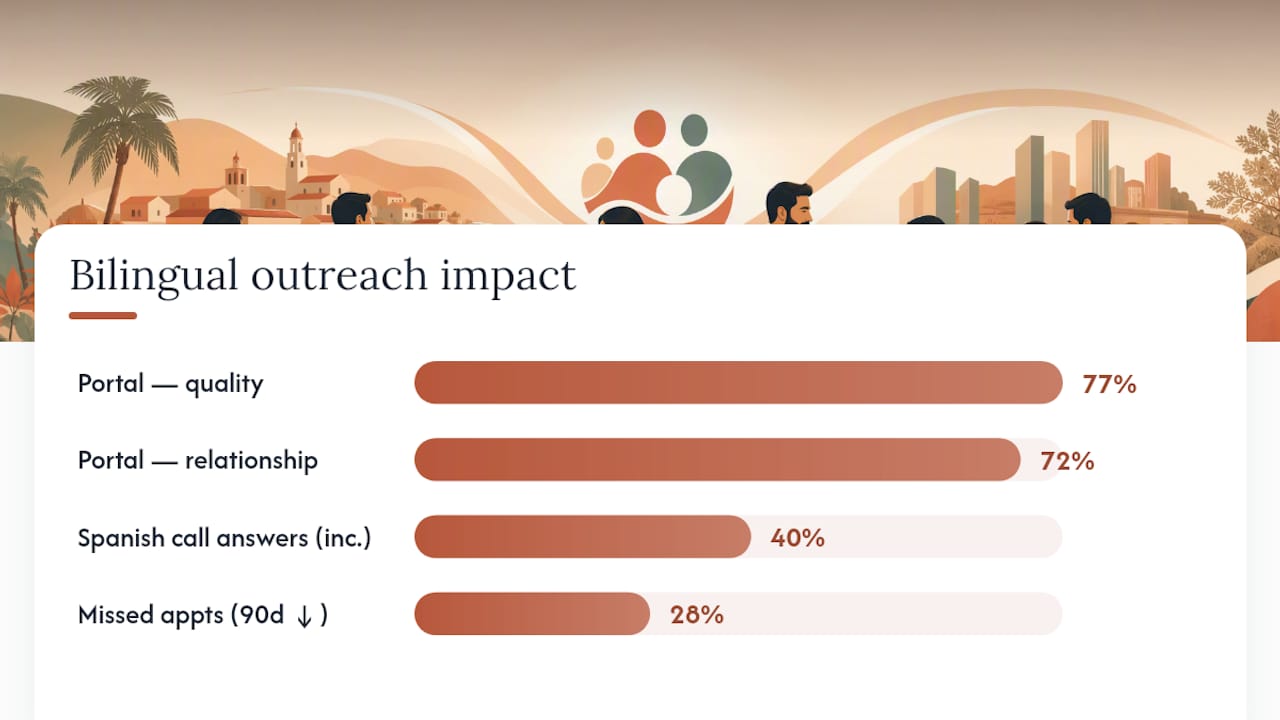
Patients want this more than providers expect. In a survey of a safety-net health system, 72% of patients believed a bilingual patient portal would strengthen the patient-provider relationship, and 77% believed it would improve quality of care.
That gap between patient enthusiasm and provider hesitation is the real story here. Patients are ready. Staff often assume they aren’t, usually because nobody’s tested it.
On the operational side, one field case reported a 40% increase in answer rates for Spanish-speaking callers after integrating bilingual answering and routing, along with a 28% drop in missed appointments over 90 days. Fewer missed appointments means fewer empty chair-hours and less staff time spent chasing reschedules.
WhatsApp adds reach most practices underuse. It reached a large share of U.S. Latinx adults currently use WhatsApp, according to state Medicaid outreach research, and organizations used it successfully during the pandemic for rapid Spanish-language health messaging. If it worked for vaccine campaigns at scale, it works for appointment reminders at your practice.
How Do You Design a Bilingual Front Desk for Accessibility?
Mobile-first isn’t optional here. Smartphone and internet access vary sharply by age, income, and education, and older or lower-income Spanish-speaking patients report meaningfully lower access than younger, higher-income patients. If your booking flow assumes a desktop and a fast connection, you’ve already excluded a chunk of the patients you’re trying to reach.
Language handling has to go beyond a translate button. Detect device language automatically, use explicit Spanish calls to action, and drop English jargon words like “portal” that don’t translate cleanly into everyday Spanish.
- Default to device language, don’t force a manual toggle
- Use plain Spanish verbs on buttons (“Escríbanos” instead of “Contact Us” translated literally)
- Offer WhatsApp voice notes for patients who read less comfortably than they speak
- Share short video or YouTube explainers through messaging instead of long text instructions
- Build a quick “this translation was confusing” feedback link into every patient-facing message
Equity-centered telehealth research backs this directly: using platforms patients already have on their phones, like SMS, WhatsApp, and YouTube, and designing for low bandwidth, measurably increases access for Latino patients.
Pro Tip: Test your Spanish booking flow on a five-year-old Android phone with a throttled connection. If it lags or breaks, that’s the exact experience a chunk of your patients are having right now.
The digital divide is frequently a design failure, not a patient preference. When a tool skips Spanish-language support or a mobile-friendly layout, adoption drops. Fix the design, and usage follows.
Is WhatsApp Safe to Use for Patient Communication?
Short answer: WhatsApp works well for outreach and general communication, but it is not a substitute for a secure patient portal when protected health information is involved. Standard consumer WhatsApp does not come with a signed business associate agreement, so PHI has no business sitting in a plain WhatsApp message thread.
Use WhatsApp for what it’s good at: appointment reminders, general questions, and directing patients to a secure link. Use a portal or encrypted messaging system for anything involving diagnoses, test results, or billing detail.
- Confirm appointments and answer general questions over WhatsApp
- Send secure, expiring links rather than PHI directly in a chat message
- Require human verification of identity before any record gets shared
- Document staff protocols for what can and can’t go in a WhatsApp thread
- Train front-desk staff to recognize when a conversation needs to move to a secure channel
Pro Tip: Write a one-page “what goes where” rule for staff: general scheduling and reminders in WhatsApp, anything clinical behind a secure link. Post it at every workstation, not just in a training manual nobody reopens.
This is general guidance, not legal advice. Confirm your specific safeguards with your compliance officer or legal counsel before rolling out any messaging channel that touches patient data.
How Long Does It Take to Roll Out a Bilingual Front Desk?
Most practices can go from audit to full launch in 60 to 90 days if they don’t try to fix everything simultaneously.
- Audit (weeks 1 to 2): Pull your patient language mix, current no-show rate, phone routing setup, and EHR integration points.
- Pilot design (weeks 2 to 3): Pick a sample cohort, a limited pilot schedule, and three KPIs: enrollment rate, booking completion, and no-show change.
- Staff training (weeks 3 to 5): Build scripts, escalation flows, and basic cultural-competency notes for the front desk.
- Pilot run (weeks 5 to 9): Measure against baseline, adjust routing and scripts weekly.
- Full launch (weeks 9 to 13): Expand to the whole patient base once pilot KPIs hold steady.
| Phase | Timeframe | Key milestone |
|---|---|---|
| Audit | Weeks 1–2 | Language mix and no-show baseline documented |
| Pilot | Weeks 2–9 | Enrollment and booking-completion KPIs tracked |
| Training | Weeks 3–5 | Staff scripts and escalation flow finalized |
| Full launch | Weeks 9–13 | System live across full patient base |
What Objections Do Practice Owners Usually Raise?
“This will add work for my front desk.” Usually the opposite happens. Bilingual intake typically reduces manual follow-up calls, because patients get clear answers the first time instead of calling back three times to clarify something they didn’t fully understand in English.
The fix is showing providers pilot numbers, not asking for a leap of faith.
- Cost concerns usually resolve once you calculate lost revenue from no-shows and missed new-patient calls against a monthly subscription fee
- Integration worries shrink with a minimal-viable setup: start with the AI receptionist and WhatsApp, layer in full EHR sync later
- Staff resistance drops once front-desk teams see fewer angry callback conversations, not more
Pro Tip: Run the pilot for 30 days before asking providers for a full rollout decision. Real numbers beat every argument you can make in a meeting.
What Should You Ask Before Choosing a Vendor?
Technical fit matters as much as price. Ask whether the platform syncs appointments directly with your EHR or practice-management system, whether it exports reporting data you can actually use, and how it handles language routing accuracy, not just translation.
- Does it integrate with your specific EHR or require manual double-entry?
- What’s the actual coverage window, and what happens during a true 24/7 gap?
- Who handles escalation when the AI can’t resolve a call, and how fast?
- Is there a signed business associate agreement and encrypted storage?
- What’s the onboarding timeline, and is training included or billed separately?
- What’s the pricing structure: flat subscription, tiered by call volume, or add-on based?
- Is there a pilot or trial period before a full commitment?
- Confirm EHR and scheduling integration during a live demo, not a slide deck.
- Ask for a sample escalation transcript showing a real urgent-case handoff.
- Request the uptime SLA in writing before signing anything.
Compare answering-service models against AI receptionist alternatives before committing, since the right fit depends heavily on your call volume and staffing already on hand.
Why Bilingual Front Desks Work Better Than Practices Expect
The gap between what patients want and what providers assume never stops surprising me. Patients consistently say they’d trust a bilingual system more, and providers consistently underestimate that. That mismatch is where most practices leave money on the table.
What actually moves the needle isn’t a fancier website. It’s whether a Spanish-speaking caller at 7 p.m. gets an answer in their own language instead of a voicemail. Diazluna’s clients have seen measurable drops in lost client volume after switching on a bilingual AI receptionist and WhatsApp line, and new sites typically get indexed by Google within 24 hours, which matters because a page that doesn’t rank doesn’t get found.
If you do one thing this month, turn on Spanish-language call routing before you touch anything else. It’s the single change that stops the bleeding fastest, and everything else in this guide builds on top of it.
Why Diazluna Fits Practices Serving Hispanic Clients
Diazluna is the alternative to hiring separate vendors for your website, phone coverage, and messaging: one subscription covers a bilingual website, a 24/7 AI receptionist fluent in Spanish and English, and full WhatsApp integration, at a fraction of what three separate agencies would charge.
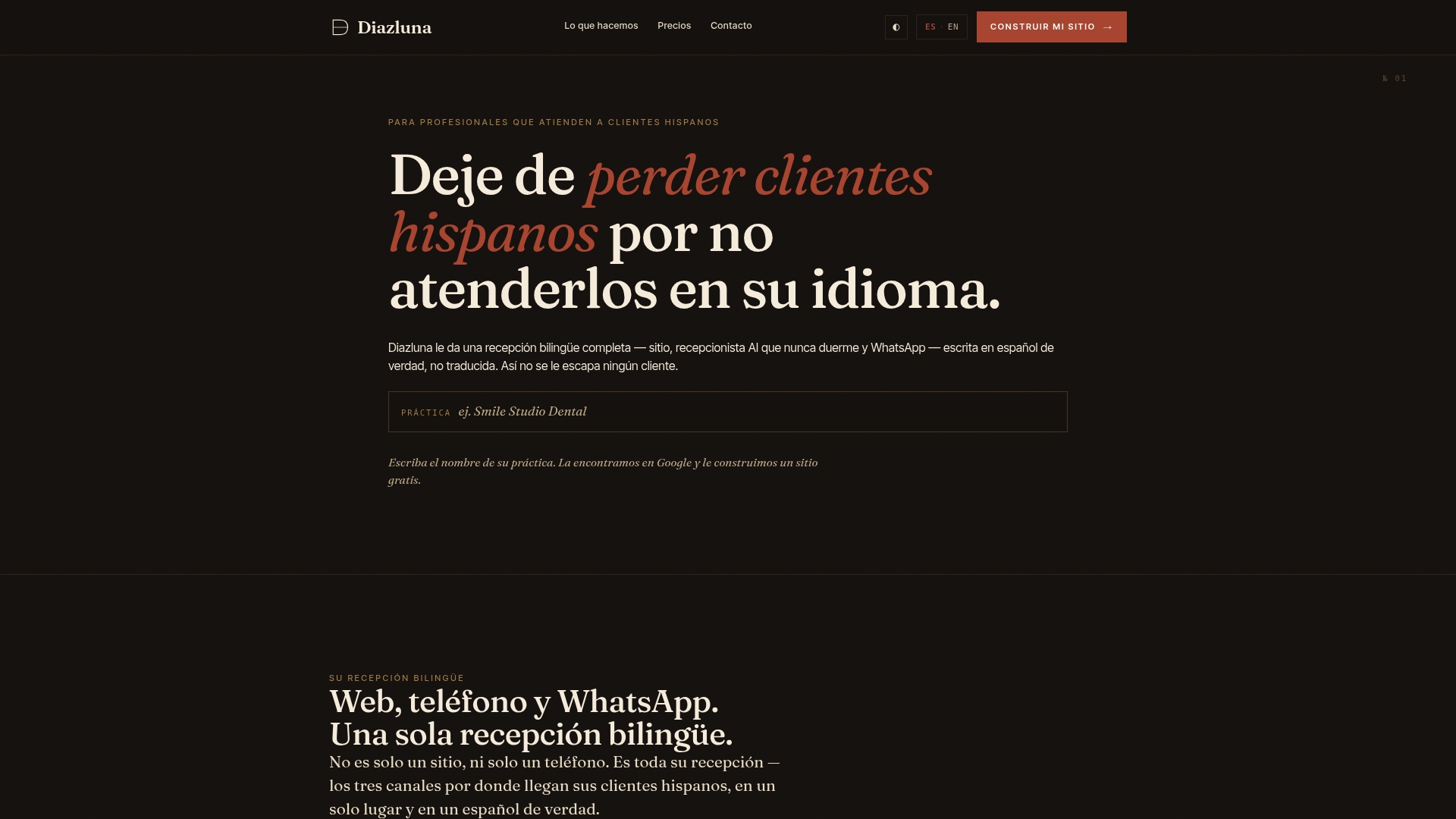
It fits best for small to mid-size dental, medical, and legal practices where Spanish-speaking clients make up a real share of demand but staffing a full-time bilingual receptionist isn’t realistic around the clock. New sites typically get indexed by Google within 24 hours, and clients have reported a real drop in lost client volume once the AI receptionist and WhatsApp line go live. Practices considering a bilingual answering setup can also compare 24/7 Spanish answering options before deciding on scope.
If your front desk is missing calls after hours or losing Spanish-speaking callers to language gaps, start with a look at the full bilingual front desk platform or the dentist-focused package to see pricing tiers and book a demo.
Sources
- Patient and provider perspectives on the potential value and use of a bilingual online patient portal in a Spanish-speaking safety-net population
- Utilizing WhatsApp in state Medicaid and Marketplace outreach efforts
- Bridging the Digital Divide: Empowering Latinos/x in Healthcare - California Health Care Foundation