August 14, 2026
The Most Common Small Business Language Barrier Mistakes

The biggest language barrier errors small businesses make come down to a short, predictable list: over-relying on raw machine translation, translating only the homepage while leaving intake forms and contracts in English only, using bilingual friends as stand-in interpreters, ignoring cultural and regional language differences, and never testing whether a Spanish-speaking client can actually complete a booking or checkout. The single fastest fix? Add a language preference question to your intake process today. That one step stops the most common source of silent client loss.
Start here — do these in the next 24–72 hours:
- Audit every client-facing touchpoint (website, intake forms, phone greeting, email templates, appointment confirmations) and flag which ones exist only in English.
- Add “What language do you prefer?” to your intake form or phone script.
- Run your most-visited page through a native speaker review, not just a machine translation check.
Pro Tip: Don’t wait for a complaint to discover a language gap. Most clients who can’t navigate your intake process simply leave — they don’t call back to explain why.
Key Takeaways
The most damaging language barrier errors in small businesses are preventable with a structured audit, a short glossary, and a clear escalation path from machine translation to human review.
| Point | Details |
|---|---|
| Audit first | Map every client-facing touchpoint and flag which ones exist only in English before making any other change. |
| Capture language preference | Add a language preference question to intake forms and phone scripts — this single step stops the most common source of silent client loss. |
| Human review for high-risk content | Any document a client signs, any consent form, and any billing statement needs human-reviewed or certified translation, not raw machine output. |
| Localize, don’t just translate | Adapting tone, register, and regional idiom for your specific client community drives higher conversion and trust than word-for-word translation. |
| Diazluna for bilingual front desk | Diazluna’s bilingual website, 24/7 AI receptionist, and WhatsApp integration address intake and scheduling gaps for practices serving Hispanic clients. |
Table of Contents
- How language barriers actually cost small businesses money and reputation
- What are the most common small business language barrier mistakes?
- How these mistakes play out in specific small-business settings
- What solution actually fits your situation?
- How to audit and improve your language access in 30 and 90 days
- Which tools and trends should small businesses pay attention to?
- What US legal and compliance risks come from language barriers?
- What does the research actually say about localization vs. translation?
- Your 30/90-day action plan for fixing language gaps
- What practitioners see in bilingual front-desk workflows
- Diazluna handles the bilingual front desk so you don’t have to
- Sources
How language barriers actually cost small businesses money and reputation
Lost revenue from language gaps rarely shows up as a line item. It shows up as a no-show, a one-star review in Spanish, or a contract dispute six months after signing. DeepL’s May 2025 research found that nearly 70% of U.S. enterprises face daily unexpected operational challenges due to language barriers. Those are enterprise numbers, but the underlying dynamic hits small businesses harder because there’s no communications department to absorb the fallout.
The concrete impacts stack up fast:
- Lost sales: A client who can’t read your service description or complete a checkout in their language leaves without converting. CSA Research figures cited by Talented Ladies Club show a large majority of consumers prefer buying in their own language, and a substantial share avoid purchasing from a site in another language.
- Negative reviews: A misunderstood billing statement or a confusing appointment reminder generates a one-star review that stays public for years.
- Operational delays: Miscommunication during intake or scheduling creates rework, missed appointments, and staff time spent on callbacks.
- Legal and compliance exposure: A contract signed without genuine comprehension, or a consent form that was never translated, can become a dispute or a regulatory problem. Translation errors can trigger costly legal disputes, and the liability falls on the business that issued the document.
Consider a small dental practice in a predominantly Spanish-speaking neighborhood. The front desk sends appointment reminders in English only. Patients miss appointments at a higher rate than average, the practice attributes it to “no-shows,” and no one connects it to the language of the reminder. That’s a direct, measurable revenue leak with a straightforward fix.
What are the most common small business language barrier mistakes?
These ten mistakes appear across industries, and each one has a low-cost fix. The seven common business translation mistakes documented by Green Sun Japan — literal translation, missing QA, inconsistent terminology, cultural insensitivity, and over-reliance on AI — form the backbone of this list, expanded for the small-business context.
-
Over-relying on raw machine translation. Google Translate and similar tools produce fluent-sounding output that can be factually wrong, tonally off, or legally dangerous. A medical consent form translated by an AI tool may read smoothly while conveying the wrong procedure. Fix: Use MT as a first draft only. Route any client-facing or high-stakes content through a native speaker review before publishing.
-
Translating only the homepage. Many small businesses translate their main page and stop there, leaving service pages, pricing, intake forms, and checkout flows in English. A Spanish-speaking visitor lands on a welcoming homepage and hits a wall at the booking step. Fix: Map the full client journey and identify every drop-off point. Prioritize the pages between “first visit” and “booked appointment.”
-
Using bilingual friends or staff as translators for formal documents. A bilingual employee who handles casual conversation is not equipped to translate a lease, a consent form, or a service agreement. Errors in those documents create real legal exposure. Fix: Reserve professional or certified translation for any document a client signs or that carries legal weight.
-
Assuming simplified English is enough. Slowing down speech or using shorter sentences does not make English comprehensible to someone who speaks Spanish as a primary language. This assumption is particularly common in phone-based intake. Fix: Offer a Spanish-language option at the start of every phone interaction, not just when a caller struggles.
-
Inconsistent terminology across materials. One document calls a service “consulta,” another calls it “cita,” and a third uses “reunión.” Clients lose confidence when the same concept appears under different names. Fix: Build a short glossary of 5–10 key terms and apply it across all translated materials. This single step raises consistency across every future translation.
-
Literal translation that ignores tone and register. Word-for-word translation often produces phrasing that sounds cold, awkward, or even offensive in the target language. A warm English welcome can become a stiff, bureaucratic sentence in Spanish if translated literally. Fix: Brief your translator or reviewer on the tone you want, not just the words.
-
Ignoring regional and cultural variation. Spanish spoken in Mexico, Puerto Rico, and Cuba differs in vocabulary, idiom, and formality. A practice in Miami serving Cuban clients that uses Mexican slang in its materials signals disconnection. Fix: Know your client community’s primary origin and adapt accordingly. Localization, not just translation, is what builds trust.
-
Missing translated support channels. A Spanish-language website that routes all support to an English-only phone line or email address breaks the experience at the moment of highest need. Fix: Offer at least one support channel — WhatsApp, a bilingual phone option, or a contact form — that operates in Spanish.
-
Failing to test the client journey end-to-end. Most businesses never ask a native Spanish speaker to walk through the full booking or checkout process and report where it breaks. Fix: Run a quarterly native-speaker walkthrough of your top client journey. Treat it like a mystery shopper exercise.
-
Not training staff on language-preference protocols. Even with translated materials, a front desk that defaults to English the moment a call comes in undoes the investment. Fix: Write a one-page language protocol for staff: how to greet callers, how to ask for language preference, and what to do when a bilingual team member isn’t available.
How these mistakes play out in specific small-business settings
The same errors look different depending on the industry, and the damage shows up in different places.
Dental and medical practices carry the highest risk because the stakes of miscommunication are both clinical and legal. An intake form that asks about allergies or current medications, completed by a patient who guessed at the English, creates a patient safety issue before the appointment even starts. Consent documents for procedures are among the business documents that require specialist or certified translation — not because of bureaucratic preference, but because a misunderstood consent is legally unenforceable. The simplest corrective action here is a bilingual intake form and a Spanish-language option on the appointment reminder.
Retail and e-commerce businesses lose clients at checkout. A product description translated by machine may be accurate, but a return policy or shipping notice that reads awkwardly in Spanish creates hesitation at the moment of purchase.
Local service businesses (plumbers, electricians, HVAC contractors) often rely on phone-based intake and in-person estimates. A misunderstood scope of work during an estimate, communicated through a mix of gestures and simplified English, becomes a billing dispute when the invoice arrives. Small wording differences during a negotiation or technical exchange can derail deals and erode trust before the work even begins. The fix is a bilingual estimate template and a clear protocol for confirming scope in writing.

Law offices and real estate agents handle documents where a single mistranslated clause can void an agreement or expose a client to terms they never understood. Arbitration clauses, liability waivers, and purchase agreements are not candidates for machine translation or a bilingual paralegal working from memory.
Pro Tip: Flag your five highest-risk documents right now: the ones a client signs, the ones that involve money, and the ones that touch health or legal status. Those five get human-reviewed translation. Everything else can use a tiered approach.
What solution actually fits your situation?
There’s no single answer here. The right approach depends on your risk level, your client volume, and your budget. Here’s how to think through the options:
Human translation is the right call for any document a client signs, any content with legal or clinical implications, and any marketing copy that represents your brand’s voice. The main limitation is cost and turnaround time. For a small practice, budget human translation for your top five to ten documents and refresh them annually.
On-demand interpreters (phone or video) solve the real-time conversation problem without requiring a bilingual staff member on every shift. Services like phone interpretation lines are available by the minute and work well for medical appointments, legal consultations, and complex service estimates. The limitation is that they add friction to the interaction and require staff to know when and how to use them.
Bilingual staff provide the most natural client experience and the highest trust. The tradeoff is hiring cost and the risk of over-relying on one person. A bilingual front desk employee who calls in sick should not bring your Spanish-language intake to a halt. Build redundancy into the system. For a deeper look at bilingual support models that work for professional practices, the options range from in-house staff to fully managed bilingual front-desk services.
Machine translation with human review is the practical middle ground for high-volume, lower-stakes content: blog posts, FAQ pages, email newsletters, social media. Use MT to produce a draft, then have a native speaker spot-check for tone, terminology, and cultural fit. This approach scales without the cost of full human translation on every asset.
Localization goes further than translation. It adapts tone, register, idiom, and cultural references for a specific community. A bilingual business website built with localization in mind performs differently from one that is simply translated. Localization is what makes a Spanish-speaking client feel the practice was built for them, not just made accessible to them.
Glossaries and termbases are underrated. A focused list of 5–10 brand and technical terms, consistently applied across all translations, raises quality across every asset without recurring cost. This is the highest-leverage investment for a small team.
Decision rule: If the content involves a signature, a health decision, or a legal obligation, use human-reviewed or certified translation. If it’s high-volume and low-stakes, use MT with a spot-check. If it’s your brand voice or your client’s first impression, localize.
How to audit and improve your language access in 30 and 90 days
A realistic roadmap beats a perfect plan that never gets started.
30-day audit and quick wins:
- List every client-facing touchpoint: website pages, intake forms, appointment reminders, phone greetings, email templates, signage, social media bios.
- Mark each one as “English only,” “translated,” or “bilingual.” That inventory is your gap map.
- Add a language preference field to your intake form and phone script.
- Identify your top three highest-risk documents (consent forms, service agreements, billing statements) and schedule a professional review.
- Run a native-speaker walkthrough of your most common client journey (booking an appointment, completing intake, receiving a confirmation).
90-day goals:
- Complete human-reviewed translation of your top five client-facing documents.
- Train all front-desk staff on the language protocol: how to ask for preference, how to route Spanish-speaking callers, and what to do when a bilingual team member isn’t available. Consistent internal communication channels — whether a weekly team recap or a shared protocol document — keep multilingual staff aligned.
- Launch at least one Spanish-language support channel (WhatsApp, bilingual phone option, or Spanish contact form).
- Build your brand glossary: 5–10 key terms, reviewed by a native speaker, distributed to anyone who produces client-facing content.
- Set up measurement: track conversion rate by language, CSAT scores by language, complaint rate, and appointment no-show rate. Review monthly.
KPIs worth tracking:
- Conversion rate by language (booking completions, form submissions)
- CSAT score segmented by language preference
- Complaint or dispute rate tied to billing or service misunderstandings
- Appointment no-show rate (often a proxy for communication clarity)
- Response time on Spanish-language inquiries
Which tools and trends should small businesses pay attention to?
Machine translation has improved dramatically, but the gap between “fluent” and “correct” is still wide enough to cause real problems. The practical issue for small businesses is that a bad MT output reads confidently — there’s no red flag, no obvious error, just a sentence that means something slightly different from what you intended.
The recommended practice for smaller teams is multi-model verification: run the same content through two different MT engines and compare outputs. Where they diverge, flag for human review. Where they agree, the risk is lower. This approach catches the invisible blind spots that a single-model workflow misses.
Tools worth knowing:
- WhatsApp Business with bilingual message templates is practical for appointment reminders, follow-ups, and quick client communication. It meets Spanish-speaking clients on the platform they already use.
- AI receptionists configured for multilingual replies can handle after-hours calls, appointment scheduling, and FAQ responses in Spanish and English. AI assistants paired with human oversight improve response times and client satisfaction without requiring a bilingual staff member on every shift.
- Multilingual chatbots on your website can handle initial intake questions and route complex inquiries to a human. The key is building a clear escalation path: the chatbot handles routine questions, and anything involving a health decision, a legal question, or a billing dispute goes to a person.
Pro Tip: For any AI-generated translation that will be sent to a client, build a one-step human review into the workflow for messages involving appointments, billing, or clinical instructions. The cost is minutes; the risk of skipping it is a misunderstood diagnosis or a disputed charge.
What US legal and compliance risks come from language barriers?
Language mistakes in the United States create legal exposure that most small business owners don’t think about until a dispute arrives. The risk concentrates in a few specific areas.
Consumer contracts and service agreements signed by a client who did not understand the terms are vulnerable to challenge. Courts have found that a contract is not enforceable when one party lacked genuine comprehension of its terms, particularly when the business knew the client’s primary language was not English.
Healthcare consent is the highest-stakes category. Informed consent requires that a patient understand what they are agreeing to. An English-only consent form given to a Spanish-speaking patient does not satisfy that standard. HIPAA-sensitive communications — billing statements, explanation of benefits, treatment summaries — carry their own compliance requirements when language access is at issue.
ADA and accessibility considerations extend to language access in some contexts, particularly for businesses receiving federal funding or operating in regulated sectors. The specifics vary by entity type and funding source; consult legal counsel for your situation.
Arbitration clauses and liability waivers are the documents most likely to be challenged when a dispute arises. If a client signed an arbitration clause in a language they don’t read, that clause may not hold. Legal terminology requires specialist translation — not because of preference, but because a single mistranslated term can change the legal meaning of a clause.
Red flags that require human-reviewed translation:
- Any document a client signs
- Consent forms (medical, dental, legal)
- Arbitration clauses and liability waivers
- Billing statements and explanation of charges
- HIPAA-related communications
- Employment agreements for bilingual staff
This article provides general information, not legal advice. Consult a qualified attorney for guidance specific to your business and jurisdiction.
What does the research actually say about localization vs. translation?
enterprises face daily operational challenges from language barriers](https://www.prnewswire.com/news-releases/new-deepl-research-finds-that-nearly-70-of-us-enterprises-face-daily-unexpected-operational-challenges-due-to-language-barriers-302449137.html) — that is an enterprise number, but the underlying dynamic is more acute for small businesses. A large company absorbs a missed appointment or a confused client. A small practice with 20 appointments a day cannot.
The consumer-preference data makes the business case for localization concrete. CSA Research figures, as reported by Talented Ladies Club, show a large majority of consumers prefer buying in their own language, and a substantial share avoid purchasing from a site in another language. Those figures apply directly to a dental practice’s booking page, a law firm’s contact form, or a clinic’s patient portal.
Localization is distinct from translation. Translation converts words. Localization adapts tone, register, idiom, and cultural reference for a specific community. A practice serving Mexican-American clients in Los Angeles and a practice serving Cuban-American clients in Miami may use the same Spanish words but need different registers, different idioms, and different levels of formality. Ignoring that distinction makes a business appear disconnected from the community it claims to serve.
A short playbook for prioritizing localization investment:
- Identify your three highest-traffic pages and your three highest-risk documents. Those six assets get localized first, not just translated.
- Route all six through a native speaker who matches your client community’s regional background.
- Adapt tone and terms, not just words. Brief the reviewer on the register you want: warm and informal, or professional and precise.
- Monitor results for 60 days: track conversion rate and CSAT on those pages and documents specifically.
Bilingual content built with localization in mind influences client loyalty and lifetime value in ways that a translated-only approach rarely achieves.
Your 30/90-day action plan for fixing language gaps
Fix the highest-risk channels first and use a mixed approach — human review where the stakes are high, technology where the volume is high and the risk is low.
30-day actions:
- Complete the touchpoint audit and produce your gap map.
- Add language preference capture to intake and phone scripts.
- Send your top five high-risk documents to a professional translator or certified reviewer.
- Set up one Spanish-language support channel.
- Run a native-speaker walkthrough of your primary client journey.
90-day goals:
- Train all front-desk staff on the language protocol.
- Launch a reviewed, localized version of your top three website pages.
- Build and distribute your brand glossary.
- Establish monthly KPI review: conversion by language, CSAT by language, no-show rate, complaint rate.
- Evaluate whether a bilingual front-desk solution — managed or in-house — makes sense for your client volume and risk profile.
The businesses that close the most language-related revenue gaps are not the ones that translate everything at once. They’re the ones that identify the two or three highest-impact fixes and execute them cleanly before moving to the next layer.
What practitioners see in bilingual front-desk workflows
The pattern that shows up most often in practices serving Hispanic clients is not a translation problem — it’s a capture problem. Language preference is never asked, so it’s never known. A Spanish-speaking patient calls, gets an English greeting, struggles through the scheduling question, and books an appointment with the wrong time or the wrong provider. The front desk logs it as a completed booking. The patient shows up at the wrong time or doesn’t show up at all.
The operational fix is simpler than most practice owners expect. A language preference field in the intake form, a bilingual greeting on the phone line, and a WhatsApp channel for follow-up messages cover the majority of the gap. Bilingual message templates for appointment confirmations and reminders eliminate the most common source of no-shows. When those three elements are in place and working consistently, the complaint rate drops and the booking completion rate rises.
Diazluna’s bilingual front-desk platform was built specifically for this workflow: a bilingual website that captures language preference from the first visit, a 24/7 AI receptionist that handles calls and scheduling in both Spanish and English, and WhatsApp integration for follow-up and urgent case escalation. For practices in dentistry, law, and healthcare serving Hispanic clients, that combination addresses the intake and scheduling gaps without requiring a bilingual staff member on every shift.

Diazluna handles the bilingual front desk so you don’t have to
Practices that serve Hispanic clients lose clients at the intake stage more than at any other point — not because of price or quality, but because the first interaction happens in the wrong language. Diazluna solves that specific problem with a bilingual digital front desk that combines a fully optimized Spanish and English website, a 24/7 AI receptionist that manages calls, messages, and appointment scheduling in both languages, and WhatsApp integration for real-time client communication.
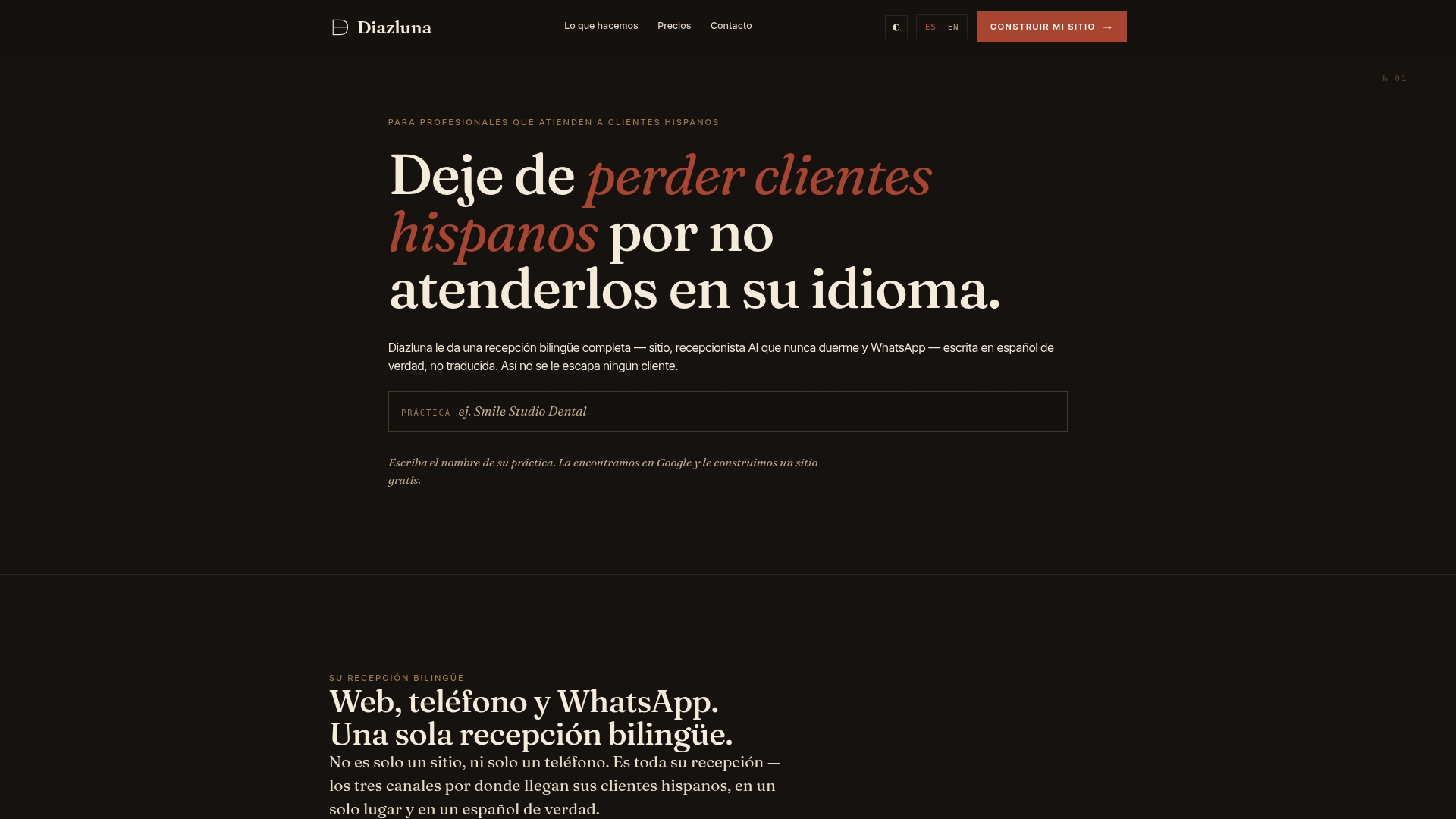
For dental practices, law offices, and medical clinics, Diazluna delivers all three capabilities at a fraction of what a traditional agency charges for each separately. The AI receptionist captures language preference on the first call, routes urgent cases to a human, and sends bilingual appointment confirmations automatically. No missed bookings because a Spanish-speaking client couldn’t navigate an English-only phone tree.
This is a publisher-owned solution. If your practice serves Hispanic clients and you’re losing appointments to language gaps, see how Diazluna works for dental practices or visit Diazluna to review pricing and next steps.
Sources
- New DeepL research finds that nearly 70% of US enterprises face daily unexpected operational challenges due to language barriers
- The Cost of Translation Errors in Global Business | Boostlingo
- Seven Common Business Translation Mistakes That Cost Companies Millions | 多言語翻訳のGreen Sun Japan 株式会社
- Small-business communication guide | Salesforce APAC blog