October 31, 2026
Healthcare Spanish SEO: A Practical Guide for U.S. Practices

Healthcare Spanish SEO is the work of making your practice show up on Google when patients search in Spanish: real Spanish pages, found through the terms your patients actually type, set up so Google can connect them to your English site. It is not a translated copy of your homepage. It is a 30/60/90 day project that a small clinic can start with three or four good pages, and it matters more in healthcare than in most fields because Google treats medical content as high-stakes.
This guide covers what the term means, why the opportunity is real, how to research Spanish keywords, the technical setup, the compliance lines you should not cross, and how to tell whether any of it is bringing in patients.
TL;DR
- Healthcare Spanish SEO means optimizing medical pages to rank for Spanish-language searches, with expertise and trust signals that Google expects from health content.
- Use separate Spanish URLs (for example /es/), reciprocal hreflang tags, and human-written Spanish rather than machine translation.
- Research terms by region and audience: patients may say “dentista” or “odontólogo” depending on where they are from.
- Measure Spanish pages separately: impressions, clicks, calls, forms and qualified inquiries, without sending patient data to tracking tools carelessly.
- Spanish pages only convert if someone can answer in Spanish when the patient calls, texts or writes.
Table of Contents
- What healthcare Spanish SEO actually means
- Why the opportunity is worth a small clinic’s time
- Start with Spanish keyword research, not translation
- Build pages that deserve to rank
- The technical setup Google needs
- Accuracy, safety and language access
- Measuring whether Spanish SEO is working
- Our perspective: the page is only half of the front desk
- Where Diazluna fits
- Frequently asked questions
- Sources
What healthcare Spanish SEO actually means
SEO is the set of techniques that improve a website’s visibility in search results. Healthcare SEO applies them to medical sites: content, site structure and local listings. The Spanish version does the same job for Spanish-language queries. One provider describes it as optimizing medical and health-related websites to rank for Spanish-language queries, and notes that because healthcare is a “your money or your life” topic, it demands strong expertise, authority and trustworthiness.
For a U.S. clinic, bilingual SEO means optimizing your online presence for both languages, not swapping one for the other. Your English site keeps doing its job. The Spanish layer reaches people who either search only in Spanish or switch to Spanish when the topic is their health.
Three things separate it from ordinary translation:
- Spanish queries differ from English ones. People do not search the Spanish version of your English keyword. They search what they say out loud.
- Spanish pages need their own URLs. Google must be able to crawl, index and match them to the right audience.
- Trust is part of the ranking. A page about symptoms, treatment or insurance has to read as written by a professional who knows the subject.
Why the opportunity is worth a small clinic’s time
The demand is visible in search data. Using October 2026 Google Ads estimates, one Spanish SEO provider reports that “clínica cerca de mi” draws about 49,500 U.S. searches a month, roughly one for every five searches of “clinic near me”. Estimates like these are directional, not a promise of traffic, but they show that a large group of people looks for care in Spanish and many practices still publish nothing for them.
That gap is the second argument. Spanish-language healthcare SEO can be a less competitive opportunity than its English counterpart. A dental, primary care or family law practice that publishes careful Spanish pages about its core services and its city is often competing against far fewer well-built pages than it would in English.
The third argument is practical. The patient who finds you in Spanish will usually want to contact you in Spanish too. Ranking without a way to answer is a leak, and we come back to it below.
Start with Spanish keyword research, not translation
The most common failure is taking English page titles and running them through a translator. Professional translators, ideally with healthcare experience, should be used instead of automatic translation, and the keyword work comes before the writing.

The reason is vocabulary. Spanish-speaking patients may say “dentista” or “odontólogo” depending on country of origin, age and education. The same variation shows up for procedures, specialists and insurance terms. A page built on one word can miss the audience that uses the other.
A workable research routine for a small practice:
- List your ten revenue services (for example emergency dental visit, implants, well-woman exam, diabetes care, immigration-related medical letters).
- Write how a patient would say each one in everyday Spanish, then in the more formal form.
- Check how your local patient base speaks. If your patients are largely from one country, ask your front desk staff which words they hear most.
- Run each phrase through a keyword tool and a Google search, and read what ranks. If the results are all English or all clinics in another country, note it.
- Pair each service with your city or neighborhood, since much of the intent is local.
We go deeper on this in our guides on Spanish keyword research for clinics and, for dentists, chairside Spanish dental keywords.
Build pages that deserve to rank
Google’s long-standing position is that multilingual sites should offer useful content in the searcher’s language on accessible, language-specific URLs, not machine-translated or hidden variants. For a clinic, that translates into a short list of pages worth writing first:
- A Spanish page for each core service, with what happens at the visit, who it is for and what to bring.
- A Spanish page for insurance, payment options and first-visit expectations.
- A Spanish contact and location page with your address, hours and a way to reach you by phone or WhatsApp.
- A Spanish page for your most common patient question per service.
Write each page as you would for an English-speaking patient: a direct answer first, then detail. Name the clinician who reviewed it, state credentials and keep the claims modest. On expertise and trust for medical content, this overview of E-E-A-T for health topics is a helpful companion. Credible, evidence-based patient education is, as one healthcare SEO explainer puts it, the foundation of the work, since the content has to inform as well as be visible.
If you need a content outline, our piece on Spanish clinic website content lists the pages and the order we would publish them.
The technical setup Google needs
The technical layer is small but unforgiving. Four pieces matter.
Separate URLs, ideally in a subdirectory
Use a distinct URL for every language version. For most local U.S. practices, a subdirectory such as yourpractice.com/es/ is the usual recommendation, because the Spanish section sits under the existing domain and signals one unified site. Another guide makes the same point about distinct URLs per language and adds that server IP-based geotargeting is not a meaningful ranking factor, so do not rely on serving different content by visitor location.
Reciprocal hreflang tags
Hreflang tells Google that two pages are the same content in different languages. Google says it identifies language codes for alternate URLs and can help show users the version that matches their language preference. The tags must be bidirectional: the English page points to the Spanish one and the Spanish page points back. Missing return links are the most common reason the annotation is ignored.
Use valid codes. Google does not support codes outside the ISO standards, such as es-419, while es-US is a supported language-and-region code. For a U.S. practice, es-US on the Spanish page and en-US on the English page is the clean choice.
If your site changes often, a developer can generate the tags automatically on every publish. Automating reciprocal hreflang in a build pipeline keeps the pairs from drifting out of sync as pages are added or removed.
Translated metadata and schema
Titles, meta descriptions, image alt text and structured data should all be in Spanish on the Spanish pages. A Spanish page with an English title tag sends mixed signals to both Google and the patient reading the search result.
Local signals
Spanish content does not replace local SEO. Your Google Business Profile, consistent name, address and phone details, and reviews still carry the “near me” searches. Our Spanish local SEO guide shows how to connect the two.
A quick comparison of the common site structures:
| Approach | Example | Fit for a local practice |
|---|---|---|
| Subdirectory | yourpractice.com/es/ | Usual recommendation: one domain, one authority pool |
| Separate domain | tupractica.com | More to maintain, authority is split |
| Same URL, language toggled by script | one URL, two languages | Google cannot index the Spanish version reliably |
Accuracy, safety and language access
Health content can hurt people when it is wrong, so Spanish pages need the same clinical review as English pages, and a few extra checks.
For practices that take federal funding, language access is a legal topic, not just a marketing one. Under Section 1557 of the Affordable Care Act, covered entities must provide meaningful access, including accurate, timely and free language assistance to people with limited English proficiency. The same HHS guidance says machine translations must be reviewed by a qualified human translator when accuracy is essential, the material is complex or technical, or the text is critical to rights, benefits or meaningful access. It also covers notices of availability, which must appear in English and in the most commonly spoken languages in the relevant states.
Whether your practice is a covered entity, and what you must publish, is a question for your compliance officer or a healthcare attorney. Our own summary of the rule and the deadlines practices were working to is in our Section 1557 language access post.
Three habits keep Spanish pages safe:
- Never publish raw machine output for symptoms, medication, consent or billing text.
- Have a Spanish-speaking clinician or qualified translator review anything that describes treatment.
- Do not promise outcomes or urgent triage on a web page. Tell readers to call you or 911 in an emergency, and make that instruction visible in Spanish.
Measuring whether Spanish SEO is working
Set up measurement before you publish, so you have a baseline. The numbers worth watching are Spanish-page impressions, clicks, landing-page engagement, form submissions and qualified inquiries. One caution from a bilingual SEO guide: Search Console’s country filter shows where the search took place, not the searcher’s language, so it will not isolate Spanish speakers by itself.
The simple fix is to segment by URL path. Filter Search Console to pages containing /es/ and track rankings, traffic and conversions separately for each language. Then compare to calls and messages that arrive in Spanish.
Privacy matters here. HHS OCR says HIPAA obligations apply when tracking technologies used by covered entities or business associates collect or disclose protected health information, and that disclosures to tracking vendors need a permitted HIPAA basis and, where applicable, a business associate agreement. Before you add analytics or ad pixels to appointment or patient-portal pages, ask your privacy officer or counsel what is allowed.
A realistic first quarter, in outline:
| Period | Focus | What to check |
|---|---|---|
| Days 1 to 30 | Keyword research, /es/ structure, hreflang, three core pages | Pages indexed, no hreflang errors |
| Days 31 to 60 | More service pages, Business Profile Spanish details, reviews | Impressions on Spanish queries |
| Days 61 to 90 | Improve pages with impressions but few clicks | Clicks, calls, forms, Spanish inquiries |
Our 30/60/90 day Spanish SEO checklist goes through the same sequence in more detail.
Our perspective: the page is only half of the front desk
We build for practices that serve Hispanic patients and clients, and the pattern we see is consistent: the SEO work gets a patient to the door, then the door is closed. A Spanish speaker finds a clean Spanish page, calls after hours, reaches an English-only voicemail and tries the next clinic.
That is why we do not treat Spanish SEO as a separate project from the front desk. The website, the phone line and WhatsApp have to speak the same Spanish, with the same tone, the same hours and the same answers. Spanish that reads like a translation on the site and sounds different on the phone breaks trust faster than having no Spanish at all. We insist on human-reviewed, non-translated Spanish for that reason, and on pages the practice owner can edit without a developer.
Our advice to a small practice is to start narrow. Publish three excellent Spanish pages, set up hreflang correctly, and make sure every Spanish inquiry gets an answer the same day. Expanding to twenty pages later is easy. Rebuilding trust after a bad first impression is not.
— Francisco
Where Diazluna fits
If you would rather not coordinate a Spanish website, an after-hours phone solution and a WhatsApp setup from three different vendors, that is the gap we built Diazluna to close. It is a bilingual front desk for practices: a fully optimized Spanish and English website, an AI receptionist named María that handles calls, messages and scheduling in both languages, and WhatsApp communication, with summaries and urgent-case transfer to your team.
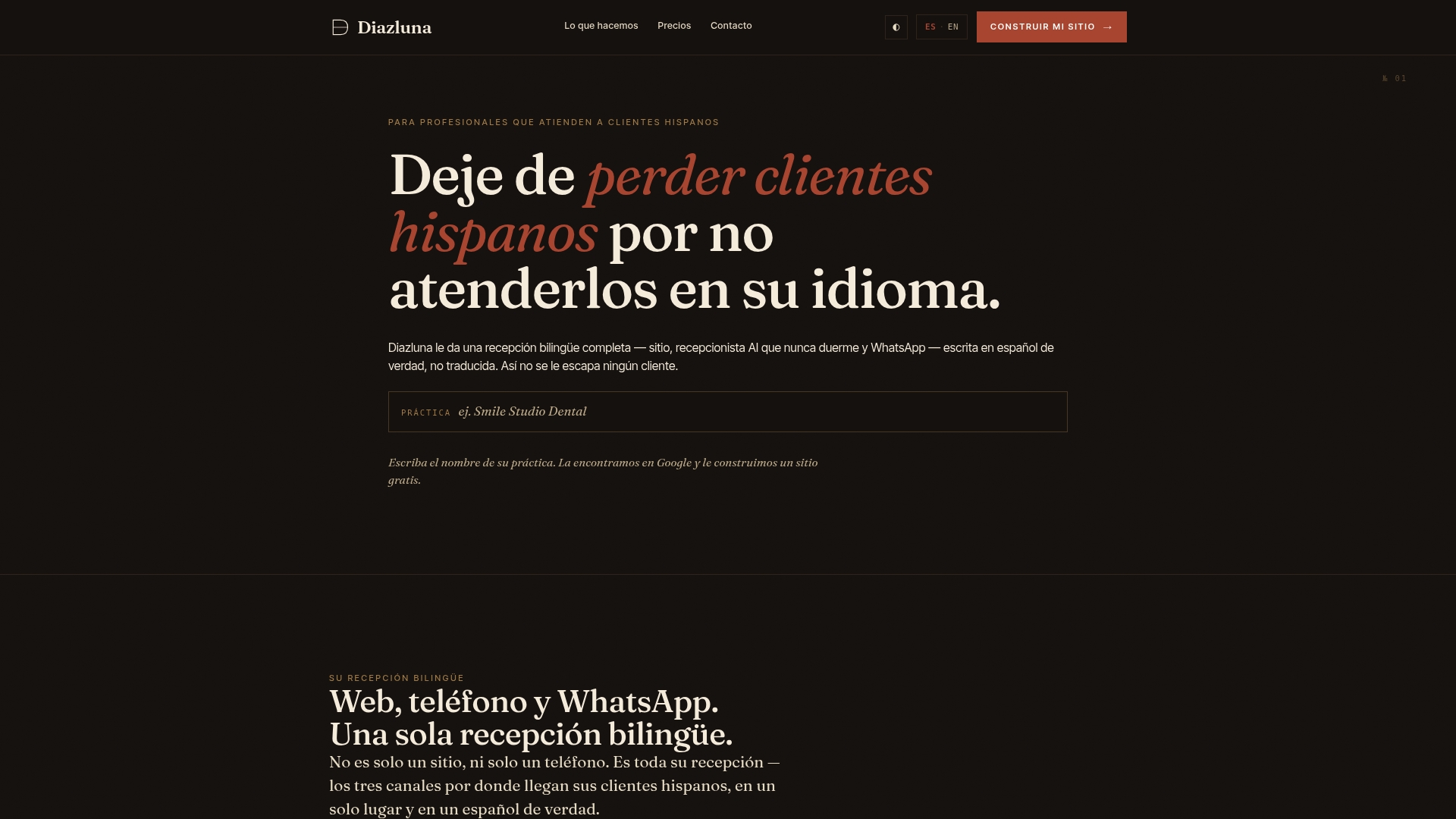
Plans, as published on our pricing page:
| Plan | Monthly | Yearly |
|---|---|---|
| Solo Sitio (website only) | $99 per month | $990 per year |
| Sitio + María (website plus AI receptionist) | $199 per month | $1,990 per year |
| Sitio + María Pro (managed, with site updates and expanded call capacity) | $349 per month | $3,490 per year |
There is a one-off activation fee of $399. Pick Solo Sitio if you only need the Spanish site and have your own phone coverage, and one of the María plans if missed Spanish calls are where you lose patients.
Frequently asked questions
What does SEO stand for in healthcare?
SEO stands for search engine optimization. In healthcare it means improving a medical website’s content, structure and local listings so it appears when patients search for conditions, treatments or providers nearby. The goal is qualified patient inquiries, not traffic for its own sake.
Do I need a separate Spanish website?
No. Most local practices do well with Spanish pages in a subdirectory such as /es/ on the same domain, linked to the English pages with reciprocal hreflang tags. This keeps your existing domain authority and gives Google a clear, unified structure.
Can I use machine translation for my Spanish pages?
Not as the final text. Google favors useful content in the searcher’s language over machine-translated pages, and HHS guidance says machine translations should be reviewed by a qualified human translator when accuracy is essential or the material is technical. A Spanish-speaking clinician or healthcare translator should review every page.
How long does Spanish SEO take to show results?
It depends on your competition, your domain and how many useful pages you publish, so no one can promise a date. A practical approach is to use a 90-day plan: set up, publish, then improve the pages that already get impressions but few clicks. Judge progress by qualified Spanish inquiries, not rankings alone.
Sources
- Spanish Healthcare SEO, GEO and AI search
- Spanish SEO for Clinicians: How to Attract U.S. Spanish-Speaking Patients
- Boost Healthcare SEO and Attract More Patients
- Spanish SEO for Medical Clinics in the US
- Multilingual SEO for Healthcare: Reach More Local Patients
- Working with multilingual websites, Google Search Central
- Unifying content under multilingual templates, Google Search Central
- Localized versions of your pages, Google Search Central
- International SEO and Hreflang guide
- Language Access Provisions of the Final Rule, HHS OCR
- Use of Online Tracking Technologies by HIPAA Covered Entities, HHS
- SEO in Spanish: How to Rank for Bilingual Audiences
- Spanish SEO Guide for Bilingual Search Strategy
- Medical SEO and E-E-A-T overview
- Automating hreflang in CI/CD