October 23, 2026
Spanish Dental Keywords: Chairside Terms and Website
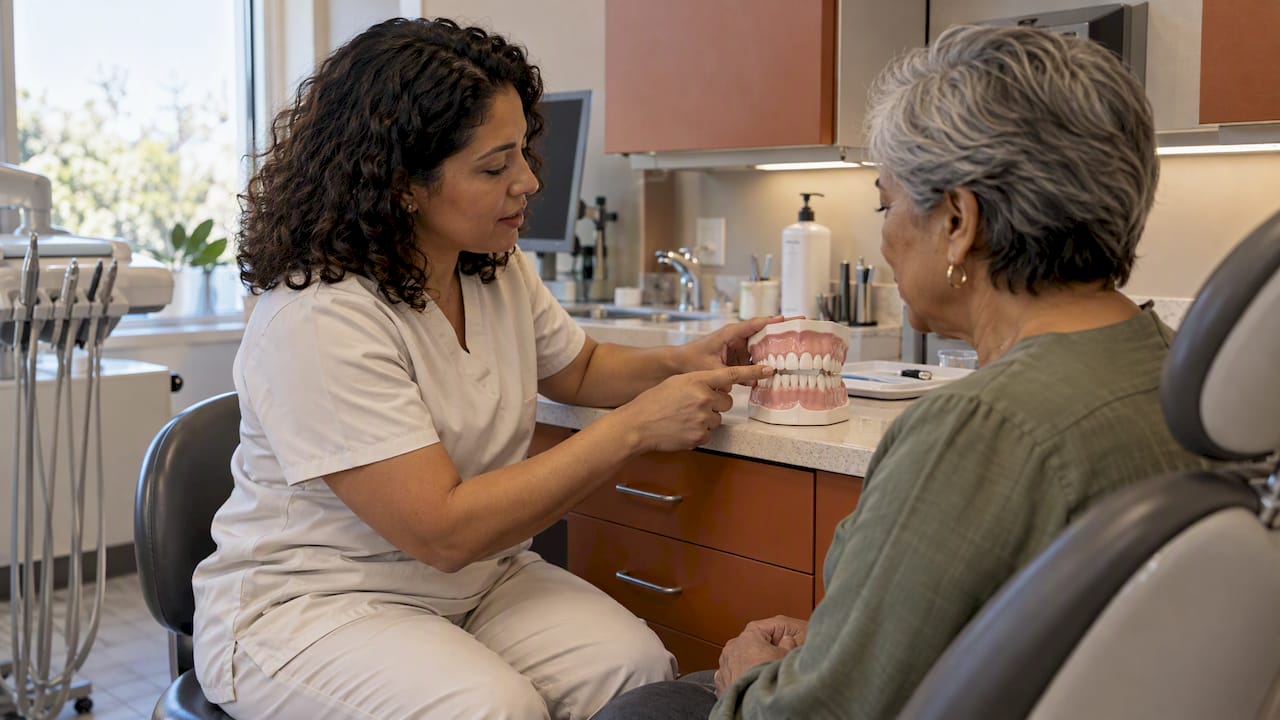
“Spanish dental keywords” means two things in a dental office, and a practice that serves Hispanic patients needs both. The first is the vocabulary your team says at the chair and on the phone: limpieza, caries, corona. The second is the words patients type into Google and WhatsApp before they ever call you. This guide gives you a working list of each, explains where plain Spanish beats clinical Spanish, and shows what the law expects when a patient does not speak English well.
TL;DR
- Learn a short core list first. Cleaning (limpieza), cavity (caries), crown (corona), filling and numbness cover most visits.
- Use the everyday word with patients and keep the clinical word for charts. Limpieza at the chair, profilaxis in the record.
- Fluent Spanish is not the same as dental literacy. Written Spanish instructions help even bilingual patients.
- If your practice is covered by Section 1557, language help must be free, accurate and timely. Relying on a few memorized phrases does not meet that.
- Your website and phone line need the same Spanish. Patients search in Spanish, and a page that reads like a machine translation loses them.
Table of Contents
- Why the words matter more than most practices think
- Core Spanish dental terms for the front desk and the chair
- Phrases for the operatory
- Everyday words or clinical words?
- The other Spanish dental keywords: what patients search
- What the law expects when a patient has limited English
- Our perspective on Spanish at the front desk
- Using these keywords on the phone and in intake
- When the website and the phone need to speak Spanish too
- A realistic first month
- FAQ
- Sources
Why the words matter more than most practices think
The stakes are not abstract. A study of Hispanic oral health in the United States reports that Hispanic youth aged 2 to 19 have the highest prevalence of dental caries, at 52%, compared with 39% for non-Hispanic White youth. It also reports that households where Spanish is the primary language show a 70% likelihood of tooth decay, against 47% in English-speaking households. Those are the families who most need clear explanations of prevention, and the ones most likely to get an English-only one.
There is also a supply problem. A Virginia Dental Journal piece quotes a member of the Hispanic Student Dental Association on the shortage of Hispanic dentists, who made up only 5.6% of the workforce as of 2018. In practice, most Spanish-speaking patients will be treated by someone who did not grow up speaking their language. That is why vocabulary training and good written materials carry so much weight.
Core Spanish dental terms for the front desk and the chair
Start with the words you use in nearly every visit. The list below mixes terms from public dental glossaries and the everyday words patients actually use. Have a Spanish-speaking clinician or interpreter confirm pronunciation and regional preferences before you print anything for your team.
| English | Spanish | Note |
|---|---|---|
| Dentist | dentista | Same word for men and women |
| Tooth / teeth | diente / dientes | |
| Gums | encías | |
| Cleaning | limpieza | Clinical term: profilaxis |
| Cavity | caries | Also cavidad in some lists |
| Filling | empaste or obturación | Regional variation, confirm with your patients |
| Crown | corona | |
| Toothache | dolor de dientes | |
| X-ray | radiografía | |
| Plaque | placa | |
| Permanent tooth | diente permanente | Patients may say diente adulto |
The limpieza versus profilaxis split, along with caries and corona, comes from the Merck Manual’s table of how patients and dentists name things. The same table is a good reminder that your patient and your chart often use different words for one thing.
If you want a longer list, Spear Education’s guide to 25 dental terms in Spanish is organized for clinical teams. We also keep our own list of 20 to 25 dental Spanish terms for clinic staff.
Phrases for the operatory
Single words get you through the greeting. Phrases get you through the procedure. The Colgate Oral Health dental translator for Spanish pairs English lines with Spanish and a pronunciation guide, covering greetings, exam instructions and radiograph positioning. Typical examples from that kind of sheet:
- Abra la boca and cierre la boca: open and close your mouth.
- Escupa, por favor: spit out, please.
- Necesito sacar una radiografía de su diente: I need to take an X-ray of your tooth.
Post-extraction instructions deserve extra care. The same Colgate sheet includes the advice not to drink through a straw, phrased with popotes (the Mexican word), and not to spit, both of which matter for avoiding dry socket. A Caribbean or Central American patient may say sorbete, pajilla or pitillo for a straw, so ask which word your patient uses. Written instructions on paper or in a text message fix this far better than a phrase you said once while the anesthetic was wearing off.
Everyday words or clinical words?
Use the word your patient would use. Caries and limpieza explain themselves, while profilaxis may sound like a procedure that costs extra. Save the clinical vocabulary for the record and for treatment plans that a patient will read at home, where you can define it in a sentence.
There is a second trap: assuming a patient who speaks Spanish well understands dentistry in Spanish. A MedlinePlus article on adult dental care shows what plain-language Spanish dental education looks like: short sentences, causes first, steps second. Researchers also note that acculturation and oral health literacy can move independently. A patient can be fluent in English and still unsure what a root canal involves, and the reverse is just as true.
The goal of your keyword list is therefore comprehension, not translation. A patient who nods politely and leaves confused will not follow the post-op plan and may not return.
The other Spanish dental keywords: what patients search
Now the second meaning. A patient looking for a dentist rarely types the term your team uses at the chair. A few patterns to build your pages around, which you should check against your own search console data and a native speaker’s ear:
- Service plus location: dentista en [your city], limpieza dental cerca de mí, dentista de emergencia.
- Language of service: dentista que habla español, dentista bilingüe.
- Problem-first searches: dolor de muela, muela del juicio, encías sangrando.
- Payment and access: dentista sin seguro, planes de pago dentista.
Note that muela (molar) is the everyday word for the tooth that hurts, while diente is the general word. A page written only with textbook terms will miss the people with a toothache at 11 p.m.
Two practical rules follow. First, write the Spanish page as a Spanish page, not as a translation of the English one: its headings, calls to action and keywords should come from how Spanish speakers search. Second, make the Spanish version a complete page, with hours, services, insurance information and a booking path. Half-translated sites send patients back to the phone, where the language gap reappears.
If you also work on rankings yourself, a general guide to SEO for dental practices covers the keyword research and technical basics that apply to both language versions of a site.
What the law expects when a patient has limited English
This is the part many practices get wrong, because memorized phrases feel like a solution. Under Section 1557 of the Affordable Care Act, covered dental practices must take reasonable steps to give meaningful access to patients with limited English proficiency. When language assistance is required, the ADA explains it must be free of charge, accurate, timely, and protective of the patient’s privacy. Whether your office is covered, and how far your obligations go, depends on an individualized assessment, so ask your attorney or your state dental association rather than guessing. We cover the practical side in our piece on Section 1557 language access.
In practice, this means:
- Do not rely on family members or untrained staff for anything clinical. Researchers who reviewed barriers for Latinx patients with limited English proficiency found that qualified, culturally competent communication improves trust and outcomes compared with ad hoc interpreting.
- Speak directly to the patient. The ADA’s guidance on using an interpreter in your dental office says to keep eye contact with the patient and use the first person: “I am going to check your teeth,” not “tell her I am going to.”
- Add time to the schedule. The same guidance points out that interpretation takes longer than staff expect, so build in a buffer for these appointments.
- Put it in writing. Consent, post-op instructions and treatment plans should exist in Spanish that a patient with ordinary reading skills can follow. Our Spanish readability audit checklist walks through how to test this.
A vocabulary list helps with rapport. It does not replace a qualified interpreter for informed consent or a diagnosis. Our article on what a dental Spanish translation actually covers lays out where the line sits.
Our perspective on Spanish at the front desk
We build for practices serving Hispanic patients, and the pattern we see is consistent: the clinical team often does its best, and the loss happens earlier. A patient finds a website in English only, calls after hours, reaches a voicemail, and tries the next practice. By the time the chair and its vocabulary matter, you have already won or lost the patient.
That is why we treat Spanish as a system, not a glossary. The website, the phone and WhatsApp should say the same things in the same natural Spanish, and a human should review the Spanish rather than letting a translation tool decide how your practice sounds. Patients notice when the words feel borrowed. They also notice when a practice answers a message at 9 p.m. in their own language.
Our advice is to start small. Train the team on twelve words this month, fix your Spanish booking page next, and measure how many Spanish-speaking callers become appointments. Then decide what to automate.
— Francisco
Using these keywords on the phone and in intake
The first contact is usually a phone call or a message, and it is where a few well-chosen phrases earn their keep. A greeting, a request to hold, a question about the reason for the visit, and a confirmation of date and time cover most of the call. We wrote out Spanish phone scripts for dental offices that you can adapt, and a companion piece on HIPAA-safe Spanish phone etiquette for what staff should and should not say aloud.
Intake is the next place to use them. A bilingual form with a clear medical history section lets a patient answer accurately instead of guessing at a translated term. See what bilingual dental patient intake does for a practice, and if you want a starting point, four Spanish new-patient dental forms are available to download.
A simple routine for the week:
- Pick ten terms from the table and post them at the front desk.
- Ask a Spanish-speaking patient or colleague which regional words they use for the same things.
- Rewrite your most-used post-op sheet in plain Spanish and have a qualified reviewer check it.
- Add buffer time to scheduled visits with patients who need an interpreter.
- Check your Spanish web page on a phone, as a patient would see it.
When the website and the phone need to speak Spanish too
A vocabulary list reaches only the patients who already got through the door. For the ones who are still searching, the practice needs a Spanish website, someone to answer when the office is closed, and a channel many Hispanic patients already use daily, which is WhatsApp.
That is the problem Diazluna is built to solve: a bilingual digital front desk that combines a Spanish and English website, an AI receptionist named María who answers calls and messages 24/7 and schedules appointments, and WhatsApp integration, with urgent cases transferred to your team. Our plans are:
| Plan | Monthly | Annual |
|---|---|---|
| Solo Sitio (website only) | $99 | $990 |
| Sitio + María (website and AI receptionist) | $199 | $1,990 |
| Sitio + María Pro (fuller managed package) | $349 | $3,490 |
There is a one-time activation fee of $399. You can see what each plan includes on the Diazluna plans page. If you are comparing options, our review of patient communication tools for Spanish-speaking patients explains the main types of tools and what to ask of each, and what medical Hispanic outreach involves covers the wider picture.
A realistic first month
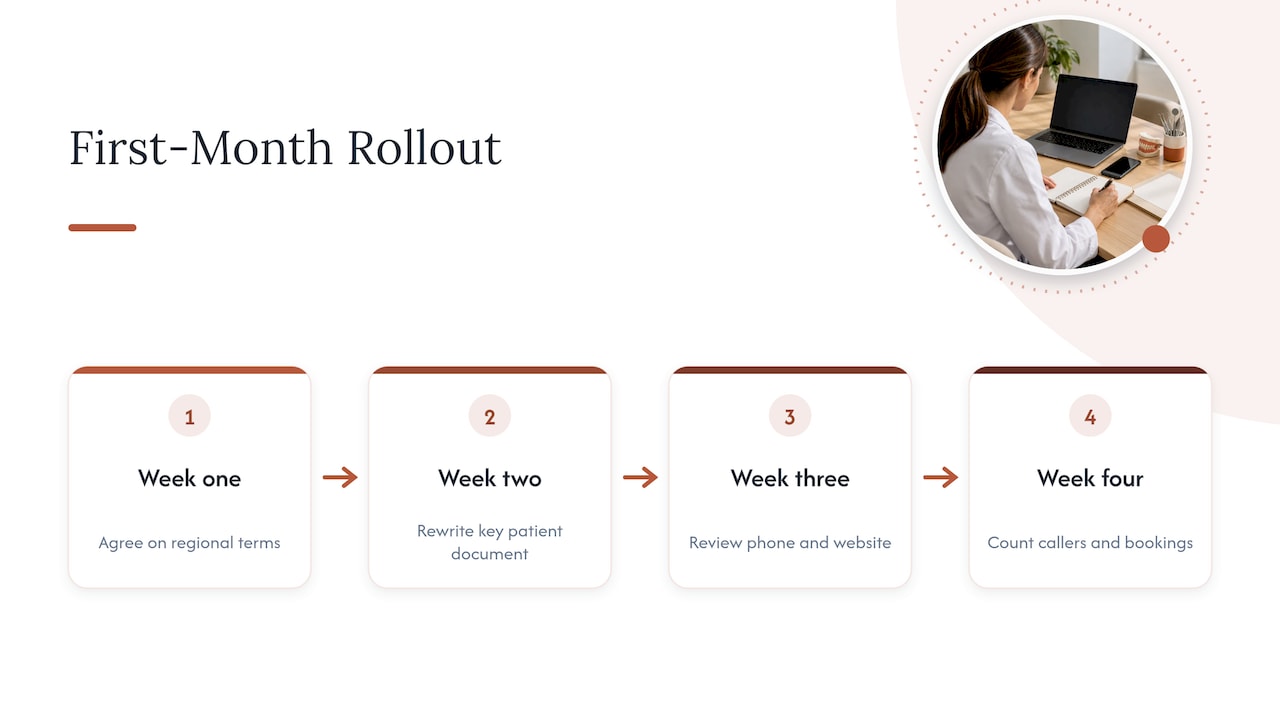
If you do nothing else, do this. In week one, teach the table above and agree on one regional Spanish word for each term your patients use. In week two, rewrite the single most important patient document, usually post-extraction care or the new-patient form. In week three, review how your phone is answered after hours and what a Spanish speaker experiences on your website. In week four, count: how many Spanish-speaking callers did you have, and how many booked?
Numbers keep the project honest. A practice that tracks this can see whether training, documents or a front-desk system is the weakest link, and spend accordingly.
FAQ
What is a dental cleaning called in Spanish?
The everyday word is limpieza, and patients will recognize it immediately. Dentists use profilaxis for the clinical procedure. At the chair and on the phone, use limpieza, and keep profilaxis for charts and billing.
How many Spanish dental words does my team really need?
A core of 20 to 25 terms covers most routine visits, which is the scale of the public glossaries from dental education providers. Fluency is not required for rapport, but it does not replace a qualified interpreter for consent, diagnosis or treatment decisions. Add terms as your patient mix shows you what you need.
Is it enough to put my website through a translation tool?
No. Machine output often misses the words Spanish speakers actually search for, and it can read stiffly or choose the wrong regional term. Have a human who knows dental Spanish review every page, then test it on a phone. Patients judge your practice by how natural the Spanish feels.
Do I have to provide an interpreter for Spanish-speaking patients?
If your practice is covered by Section 1557, you must take reasonable steps to give patients with limited English proficiency meaningful access, and language assistance must be free, accurate and timely when it is required. Whether and how this applies to you depends on your situation, so check with your attorney or state dental association.
What Spanish keywords should my dental website use?
Combine service, location and language: dentista bilingüe, limpieza dental, dolor de muela, and your city. Also write about the problems patients describe in their own words. Check your results in search console and revise as you learn.
Sources
- Addressing social determinants of oral health among immigrant and non-English speaking Hispanics in the United States (PMC)
- Virginia Dental Journal: cultural competency and Hispanic patients (ADA Commons)
- El lenguaje de los dentistas (Merck Manual)
- Dental Terms in Spanish (Spear Education)
- COHA Dental Translator, Spanish (Colgate Professional)
- Cuidado dental en adultos (MedlinePlus)
- Acculturation and oral health literacy (PMC)
- Section 1557: Individuals with LEP (American Dental Association)
- Barriers in Healthcare for Latinx Patients with Limited English Proficiency (PMC)
- Using an Interpreter in Your Dental Office (American Dental Association)