October 11, 2026
Spanish Clinic Website Content
Clinic-grade Spanish website content means two things working together: human-reviewed, plain-language Spanish pages and bilingual front-desk communications, not a glossary of medical terms for staff training. The single most effective step you can take is to publish human-reviewed plain Spanish pages and make sure the entire patient journey, from the search result to the booking confirmation to the portal message, stays in Spanish from start to finish.
TL;DR:
- Publish Spanish service pages, appointment forms, portal prompts, and confirmation messages; an English only login can interrupt the booking process.
- Write patient pages in plain Spanish with short sentences and familiar words, then use local human reviewers to catch cultural mismatches missed by machine translation.
- A rollout across 30, 60, and 90 days puts priority pages and contact options first, forms and portal prompts next, then staff training and tracking.
- Post Spanish and English language assistance notices prominently, name an owner for updates, and offer free assistance with a direct contact point.
- Judge performance by completed Spanish bookings and intake forms, plus recovered Spanish missed calls; page views alone cannot show whether patients complete the journey.
Table of Contents
- What to publish on your clinic site and where
- How to write Spanish content patients actually understand
- A 30/60/90-day rollout plan for bilingual pages and front-desk scripts
- Front-desk and AI receptionist scripts that actually work
- SEO and funnel testing that turns Spanish pages into bookings
- Meeting language-assistance expectations without legal guesswork
- Measuring whether your Spanish content is working
- What integrated bilingual deployments have taught us
- A managed bilingual front desk for clinics that want it done for them
- FAQ
- Sources
What to publish on your clinic site and where
A complete Spanish experience needs specific pages and interface elements, not a single translated landing page bolted onto an English site. Patients should be able to reach a Spanish homepage, read service pages in their own language, and confirm an appointment without ever switching back to English.
- Build a full Spanish homepage, not a one-paragraph summary, along with Spanish versions of your core service pages.
- Translate the contact and appointment page completely, including form labels, confirmation text, and any calendar widgets.
- Add Spanish prompts and help text inside the patient portal login, not just on the marketing pages.
- Place a visible language toggle in both the top navigation and the mobile menu, plus a one-tap Spanish phone or WhatsApp button.
- Post nondiscrimination and language-assistance notices in prominent, easy-to-find locations, consistent with HHS Section 1557 guidance.
Research on hand surgery practice websites found that language-concordant portal prompts matter as much as the public pages, since patients who find a Spanish homepage but hit an English-only login often abandon the process entirely, according to research on Spanish-language resources.
How to write Spanish content patients actually understand
Plain language comes first. Short sentences, common vocabulary, and a reading level closer to lower-secondary school make the difference between a page patients skim and one they actually use. Peer-reviewed research on Hispanic patients’ online health information seeking found that many readers struggle with dense medical writing, and recommends optimizing for readability and direct contact paths rather than clinical tone, according to research published in the Journal of Medical Internet Research.
- Write for plain Spanish first: short sentences, familiar words, minimal jargon.
- Use human reviewers who know the local community’s dialect and expressions, not a one-pass machine translation.
- Localize examples and provider bios so names, neighborhoods, and references feel familiar rather than generic.
- Avoid literal, word-for-word translation of English copy, since idioms and medical phrasing rarely carry over cleanly.
The CDC’s health literacy guidance recommends composing Spanish content for the audience from the start, then applying human review for cultural nuance, instead of translating finished English copy. Our Spanish Readability Healthcare Clinic Audit Checklist walks through the practical checks: sentence length, vocabulary level, and cultural fit, page by page.
Pro Tip: Read your Spanish pages out loud. If a sentence sounds stiff or overly formal when spoken, it will read that way to patients too.
A 30/60/90-day rollout plan for bilingual pages and front-desk scripts
Spreading the work across three phases keeps the project manageable and gives you measurable checkpoints along the way.
- Days 1 to 30: Add a visible Spanish language toggle, publish one Spanish landing page for each top service line, post a language-assistance notice, and prepare short WhatsApp and phone scripts for the front desk.
- Days 31 to 60: Publish the remaining service pages, translate portal prompts and appointment forms, and add Spanish metadata and page-level keywords for search visibility.
- Days 61 to 90: Finish patient education pages, train staff on bilingual scripts, and start tracking the key metrics that show whether the rollout is working.
Each phase builds on the last instead of trying to launch everything at once.
- 30-day focus: visibility and first contact, so a Spanish-speaking patient can find you and reach someone who understands them.
- 60-day focus: completeness, closing the gaps between marketing pages and the actual booking or portal experience.
- 90-day focus: measurement and staff readiness, so the bilingual journey holds up under real patient volume.
Our 30/60/90 Day Medical Spanish SEO program follows this same structure for small clinics that want a ready-made timeline instead of building one from scratch.
Front-desk and AI receptionist scripts that actually work
Scripts need structure, not just translated vocabulary. A good call or chat flow greets the patient, confirms the preferred language, moves quickly to the reason for the call, and closes with a clear appointment offer and confirmation.
- Open with a greeting and a quick language confirmation so the patient knows they will be served in Spanish throughout.
- Keep the reason-for-call section short: one or two questions before moving toward scheduling.
- Confirm the appointment date, time, and location clearly, then repeat it back before ending the call.
- For WhatsApp, use short prompts, quick-reply buttons, and get consent for messaging before sending any clinical information, matching the approach described in digital health literacy research among Spanish-preferred patients.
- For an AI receptionist, require human review of any canned reply, set clear escalation triggers for clinical questions, and generate a short handoff summary for staff.
Our guide on HIPAA-safe Spanish phone etiquette covers the specific phrasing front-desk staff can use when a call needs to move from scheduling to a clinical escalation.
SEO and funnel testing that turns Spanish pages into bookings
Spanish pages only matter if they get found and if they lead somewhere useful. On-page work includes Spanish metadata, a clear language toggle or hreflang setup, readable URL patterns, and keywords written the way patients actually search, not literal translations of English terms.
- Write metadata, titles, and headers in natural Spanish, not machine-translated English copy.
- Use structured data and a current sitemap to help search engines index Spanish pages quickly.
- Test the full mobile journey yourself: search result, landing page, booking form, confirmation message.
- Track Spanish calls-to-action separately from English ones, using distinct phone numbers or links where possible.
Our Spanish dental SEO checklist walks through publishing three priority pages and fixing the most common indexing issues, a pattern that applies to most small practices regardless of specialty. For clinics that want a broader technical SEO partner, healthcare SEO services can complement the Spanish-specific work with site-wide audits and backlink strategy.
Meeting language-assistance expectations without legal guesswork
You do not need a law degree to meet the expectations behind Section 1557. You need visible notices, a clear owner, and a documented process.
- Post nondiscrimination and language-assistance notices where patients will actually see them, in Spanish as well as English, following the placement guidance in HHS’s Section 1557 resources.
- Name one person or team responsible for keeping Spanish materials current and for managing interpreter or escalation requests.
- Train front-desk staff on when and how to offer language assistance.
- Offer language assistance free of charge and list a direct contact point on the site itself.
Our Section 1557 language-access guide breaks these steps into a short implementation checklist for clinics working toward a policy deadline.
Measuring whether your Spanish content is working
Page views alone will not tell you much. Track outcomes that connect directly to patient access and revenue.
- Monitor Spanish page sessions alongside appointment requests that originate from those pages.
- Track completed intake forms submitted in Spanish, not just form starts.
- Measure missed-call recovery rates for Spanish-language calls specifically.
- Use dedicated URLs, phone numbers, or WhatsApp numbers with UTM parameters so each channel’s performance is clear.
- Run small A/B tests on call-to-action wording to see which phrasing drives more bookings.
One study on Spanish-language online resources found that operational outcomes, like completed bookings and recovered missed calls, are a more reliable signal of success than page views alone, according to research on Spanish-language online resources and outcomes.
What integrated bilingual deployments have taught us
Across the clinics we have worked with, the pattern repeats: a Spanish page alone rarely moves the needle, but a Spanish page paired with a bilingual front desk does. When the website, the AI receptionist, and WhatsApp all speak the same plain Spanish, patients complete the booking instead of abandoning it partway through. We built our 30/60/90 Medical Spanish SEO program around that observation, and clinics that run our readability audit tend to catch the small gaps, an English-only form field, a missing notice, that quietly undo good content elsewhere on the site.
— Francisco
A managed bilingual front desk for clinics that want it done for them
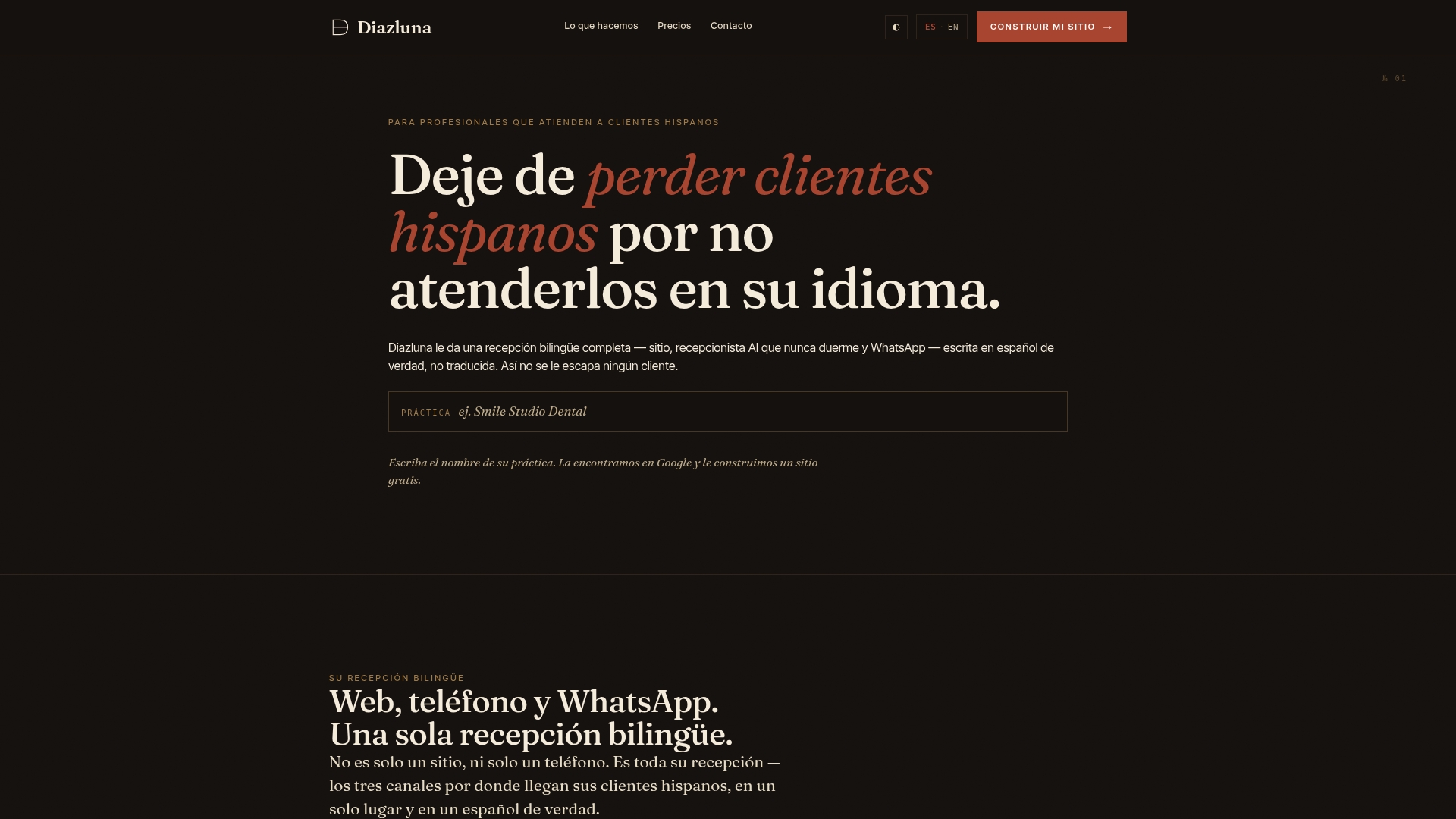
If building and maintaining all of this yourself feels like more than your team has time for, our bilingual front desk platform at Diazluna covers it end to end: a fully bilingual website, a 24/7 AI receptionist that handles calls and WhatsApp messages in Spanish and English, and the same 30/60/90 Medical Spanish SEO approach described above.
- Small clinics and practices that need fast activation without hiring a separate agency for web, SEO, and reception.
- Plans range from Solo Sitio at $99 per month up to Sitio + María Pro at $349 per month, with annual options and a one-time $399 activation fee.
Visit our Diazluna landing page to see the plans in full or to request our Spanish Readability Clinic Audit Checklist before you commit to a rollout.
FAQ
What counts as Spanish medical website content?
It means Spanish-language website pages (home, services, contact, appointment booking) plus bilingual front-desk communications like phone scripts, WhatsApp messages, and portal prompts. It does not refer to Spanish-language courses for medical staff.
What reading level should Spanish patient pages target?
Aim for plain, lower-secondary level Spanish with short sentences and common vocabulary, since research on Hispanic patients’ health information seeking found many readers struggle with dense medical writing. Human review after drafting catches terms that still read as overly clinical.
Is machine translation enough for a clinic website?
Machine translation alone is not enough; CDC guidance recommends composing content for the Spanish-speaking audience first, then using human review for cultural accuracy. Literal translations often miss local terminology and tone.
What does Diazluna cost for a small clinic?
Plans start with Solo Sitio at $99 per month or $990 per year, with Sitio + María and Sitio + María Pro tiers available up to $349 per month, plus a $399 one-time activation fee, all listed on our Diazluna plans page.
Where should language-assistance notices appear on a clinic site?
Post them in prominent, easy-to-find locations such as the homepage footer and the contact page, in line with HHS Section 1557 placement guidance. Include a direct contact point for patients who need language assistance.
Sources
- Culture and language | Health Literacy | CDC
- The Association Between Online Health Information–Seeking Behaviors and Health Behaviors Among Hispanics
- Availability of Online Spanish Language Resources in Academic Hand Surgery - PMC